

Agree the preparation and condition of packaging samples before comparing them. Record the environment, time history and material version, with proposed conditions separate from actual observations. A buyer should not invent temperature, humidity or duration targets simply to make two samples look comparable.
This log helps the responsible reviewer define the comparison. It is not a conditioning standard or proof that a test procedure has been followed.
Ask which condition controls the review
ISTA’s procedure overview includes conditioning in some defined test scopes. Use the relevant responsible procedure or reviewer for actual requirements. The public overview does not supply one set of conditions for every packaging comparison.
State the job being compared: dimensions, closure, print appearance or another defined interface. Ask the responsible source what sample preparation and state should apply to that job.
Keep material and sample IDs linked with the revision record. If one sample uses another board, wrap or finish, record that as a configuration difference rather than an environmental effect.
Keep proposed and actual histories separate
Record when the sample arrived, how it was stored and any preparation performed. Preserve known facts and label missing history as unknown. A later assumption should not replace an undocumented period.
If agreed conditions are measured or recorded by another party, retain its source and date. Keep ordinary room descriptions distinct from controlled or instrument-based evidence.
| Condition-log field | Proposed requirement | Actual sample history |
|---|---|---|
| Review job | Named interface or measurement | What was actually reviewed |
| Sample identity | Material/configuration revision | Received component IDs |
| Environment | Responsible agreed conditions | Recorded condition or unknown |
| Time | Preparation and review interval | Known timestamps/history |
| Handling | Storage and preparation method | Actions and deviations |
| Evidence scope | Required record or procedure | What documentation is available |
Use the dimension method if measurements are involved. A condition log and a measurement reading are different records that should share the sample identity.
Follow a hypothetical lid-fit comparison
Suppose a brand compares two wrapped lid samples. One was just received, while the other has a different storage history. The buyer records those histories and asks the responsible source how the comparison should be prepared.
The log keeps the proposed condition unanswered until the response arrives. It doesn’t select convenient room values and call them standard conditioning. The material revisions are also checked so the comparison is not falsely attributed to storage alone.
After preparation under the agreed scope, the reviewer records the actual history and lid action. Any deviation remains visible beside the observation.
Ask for a comparison method, not a guessed target
A useful question is: ‘Please define preparation and review state for comparing interface LF1 on these sample revisions.’ It gives the source the job and components. A generic statement that samples should acclimatize may leave time and evidence unclear.
If a formal evaluation is required, record its exact scope and responsible provider separately. A local buyer log cannot certify that a published procedure was followed.
The log can make a comparison more traceable without promising equivalent sample behavior or a cause for any observed difference. Keep those conclusions tied to the actual evidence.
Send the known and unknown history
Bring the review job, sample identities and condition log through Packrivo’s enquiry. The next response should define the appropriate comparison state and documentation, then retain the actual review history beside the result.
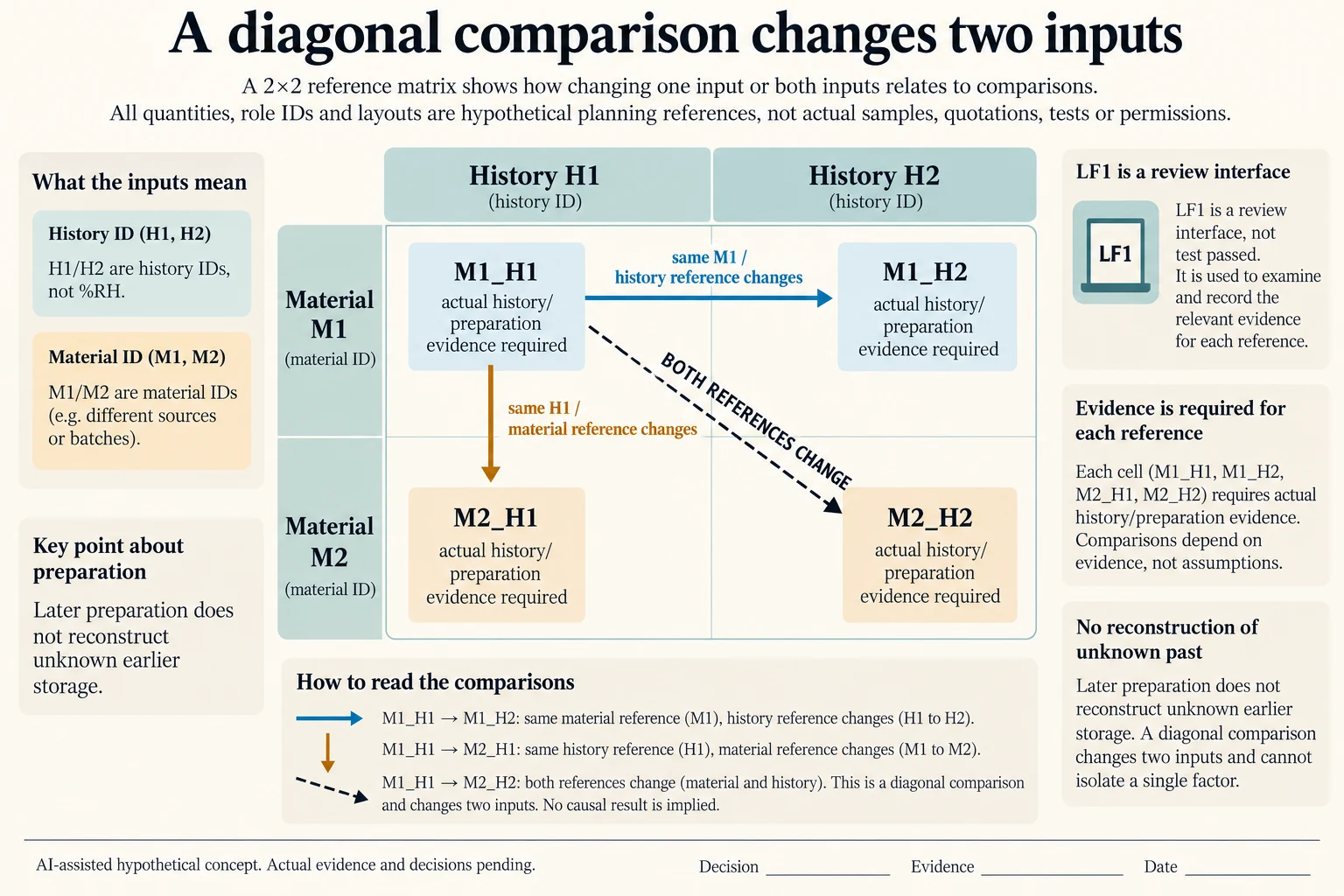
Changing material and history together prevents a simple attribution
Use four invented reference combinations: M1_H1, M1_H2, M2_H1 and M2_H2. M1/M2 identify material proposals; H1/H2 identify histories, not humidity values or standard conditioning settings. None of the four represents a performed trial. The CSV requests actual history, agreed preparation and LF1 review state separately, with temperature, relative humidity, duration and preparation-method fields left unknown.
Scroll horizontally if columns extend beyond the view.
| Hypothetical configuration | Named object | Relationship | Input or next scope |
|---|---|---|---|
| M1_H1 | M1_H1 | uses material | M1 |
| M1_H1 | M1_H1 | uses history reference | H1 |
| M1_H2 | M1_H2 | uses material | M1 |
| M1_H2 | M1_H2 | uses history reference | H2 |
| M2_H1 | M2_H1 | uses material | M2 |
| M2_H1 | M2_H1 | uses history reference | H1 |
| M2_H2 | M2_H2 | uses material | M2 |
| M2_H2 | M2_H2 | uses history reference | H2 |
| COMPARISON25 | HISTORY_PAIR | has limit | MATERIAL_REFERENCE_HELD |
| COMPARISON25 | MATERIAL_PAIR | has limit | HISTORY_REFERENCE_HELD |
| COMPARISON25 | DIAGONAL_PAIR | has limit | BOTH_MATERIAL_AND_HISTORY_DIFFER |
| COMPARISON25 | LATER_MATCHED_PREPARATION | does not reconstruct | UNKNOWN_EARLIER_STORAGE |
A comparison from M1_H1 to M1_H2 holds the material reference while changing the history reference. M1_H1 to M2_H1 instead holds the history reference while changing material. The diagonal M1_H1 to M2_H2 changes both. This map identifies what a comparison would need to document; it does not prove that any real samples had matched conditions or that one variable caused a difference.
A later common preparation step cannot reconstruct an undocumented earlier storage interval. Keep the missing period visible even after prospective preparation is agreed. Record the actual source of any condition data, its timing and whether it is an instrument record, a controlled process report or an ordinary room description. Do not turn H1/H2 into convenient temperature or humidity numbers to complete the matrix.
ISTA’s public procedure overview places conditioning within specific evaluation scopes. It does not supply a single preparation schedule for every lid-fit or appearance comparison, and this matrix is not a test standard. The responsible reviewer must define the applicable method and actual evidence. Keep changes in board, wrap and finish with the sample identity before interpreting an observed difference.
Download the packaging conditioning comparison factors record (.csv). It includes the original table fields and scenarios alongside the added relationships. HYPOTHETICAL rows are editorial examples or required review scopes, not actual records. Actual quantity, configuration, component and file identities, materials, process, specification, copy, method, condition, observation, owner, decision, evidence and dates are blank. ACTUAL_BLANK is a separate empty starting row; enter permitted project evidence before using an actual record. A blank means unknown.
Use the Humidity Can Change a Carton’s Compression Response Before Any Stack Load Changes for its separate question. Use the Agree Packaging Dimensions and Acceptance Methods for its separate question. Use the Packaging Sample Revisions: Compare Versions Before Approval for its separate question.
Source scope checked 16 October 2026. References cover only the named materials, processes or guidance. Added configurations and geometry are hypothetical, not supplier specifications, tests or production approval; they set no universal tolerances or machine limits. Confirm the actual material, process, drawing and formed sample for the project.
Discuss this packaging specification with Packrivo. We coordinate independent suppliers. MOQ: 500 pieces per product/design; illustrative quantities are not production offers. Confirm materials, samples, price and timing for your project.