
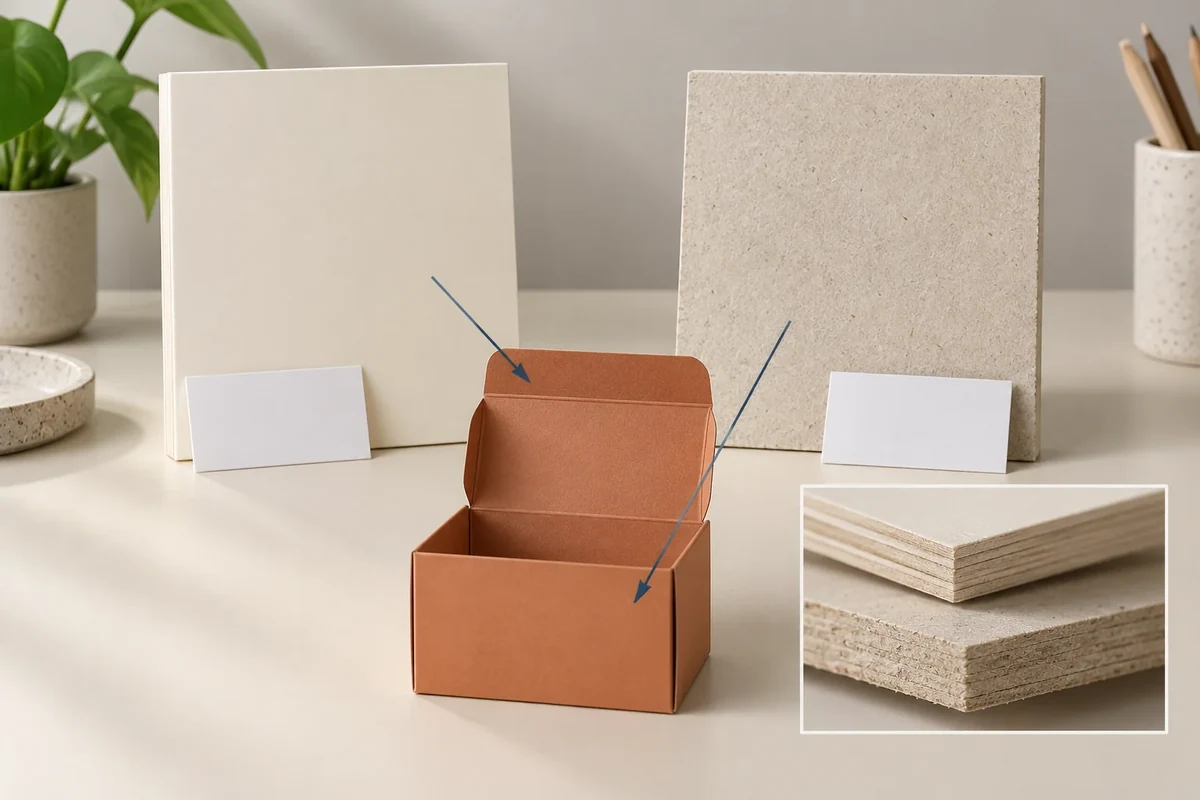
Review a proposed material substitution against the same required component job, with the requested and proposed materials recorded separately. Identify changed properties, construction and evidence. A similar name or one matching value does not establish that a substitute answers the original fit, print or use requirement.
The output is a difference log for one proposed change. It gives the decision owner a record to review rather than treating a supplier reply as automatic approval.
Write the required job before comparing names
Name the component and the job its material must support. Examples can include a formed fold, a printed surface or a product-contact interface. Keep the actual requirement and its owner identified.
Holmen’s technical information records distinct properties within named board specifications. Use that context to ask for traceable material data. It doesn’t approve a substitute or establish equivalence between unrelated grades.
Keep material claims within their evidence scope. A requested sustainability, compatibility or performance claim should remain an identified evidence question, not a nickname carried into the substitute row.
Record the proposed difference explicitly
Ask the source to name the substitute and identify what differs from the requested material. Preserve the original request, proposed grade and date together. Do not overwrite the requested row with the new name.
Show any construction or process change that accompanies the substitute. If the source changes both material and fold design, those are two changes and the sample scope should show both.
| Substitution field | Requested | Proposed | Review action |
|---|---|---|---|
| Identity | Original grade/construction | Named substitute | Source data needed |
| Required job | Component and use | Same intended job | Owner confirms comparison |
| Changed properties | Known original evidence | Source-stated differences | Relevant review scope |
| Accompanying changes | Current drawing/process | Revised drawing/process | Separate change IDs |
| Sample evidence | Existing reference | Proposed sample | Matched configuration |
| Decision | Current accepted scope | Open or accepted change | Responsible signoff |
Use the clarification matrix for the wider supplier conversation. This log retains the actual requested/proposed difference even after the source answers.
Follow a hypothetical board change
Suppose a gift carton’s requested board is unavailable for a proposed run. The source offers another named grade and a revised caliper. The buyer keeps the original material row and lists the changed property explicitly.
The component job includes the formed lid fold and printed front. The decision owner asks for evidence on those specific interfaces rather than calling the substitute acceptable because one grammage value matches.
If the source also proposes another crease layout, it receives a separate change record. A sample using both changes is identified as that combined proposal, not a material-only comparison.
Use a job-specific question
Ask: ‘Please identify the differences and evidence for substitute M2 at fold C1 and print face PF1.’ It names the required jobs. A generic claim that M2 is equivalent can leave the basis unresolved.
Keep source facts, buyer observations and approval in different fields. An attractive sample is appearance evidence under its stated scope, not confirmation of every requirement in the original brief.
After acceptance, retain the substitution decision with the component revision. Later reorders should know which material was actually accepted rather than rediscover the change from an old email.
Send the requested and proposed rows
Bring the difference log, required jobs and open evidence through Packrivo’s enquiry. The next response should clarify the actual change and review scope, leaving unsupported equivalence or performance claims out of the decision.
A combined sample does not isolate the material change
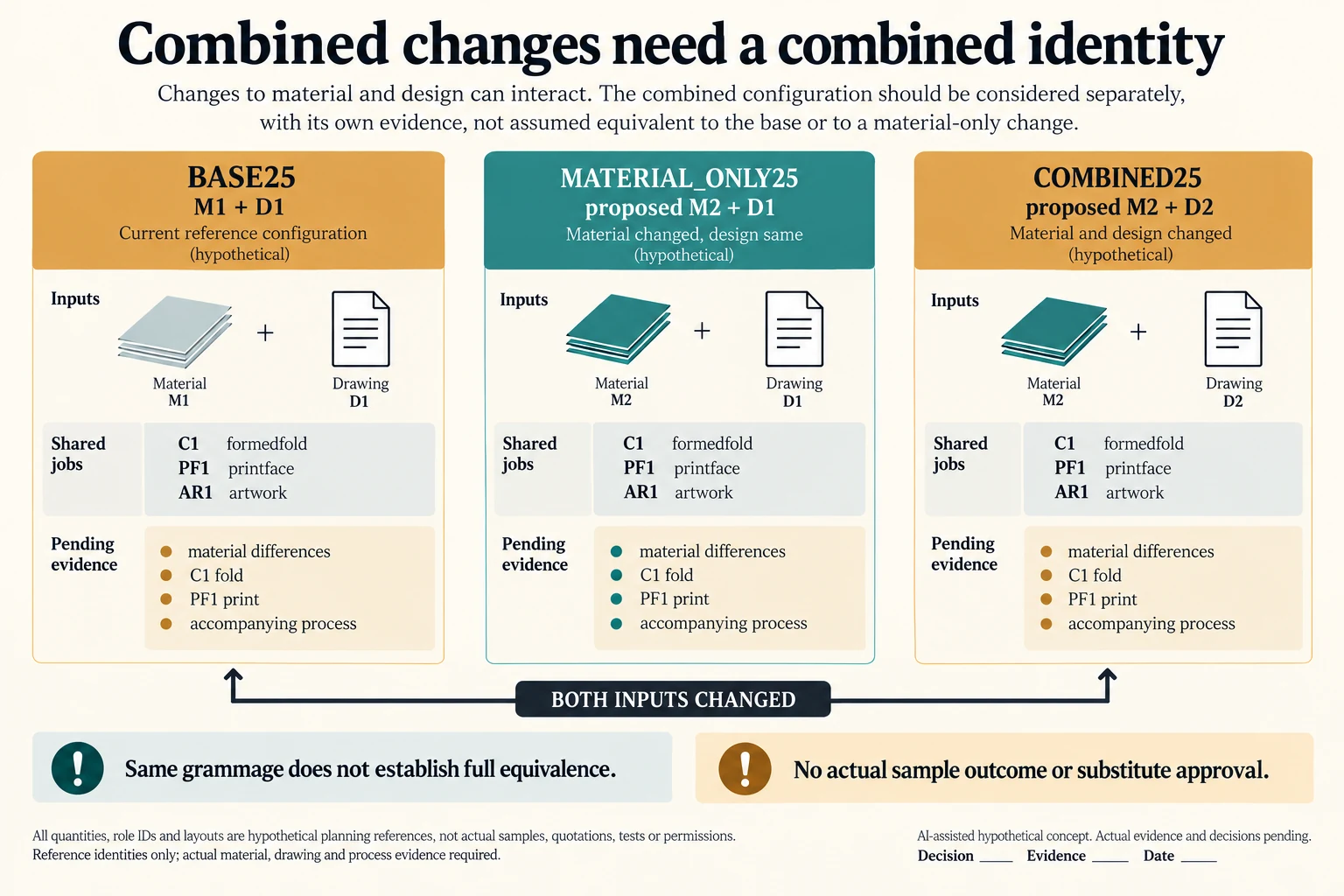
Name three invented configurations while retaining the required jobs at fold interface C1 and print face PF1. BASE25 uses material reference M1 with drawing D1. MATERIAL_ONLY25 proposes M2 with D1 retained. COMBINED25 proposes M2 with drawing D2. AR1 remains the artwork reference in this example; actual process changes still need a source response.
Scroll horizontally if columns extend beyond the view.
| Hypothetical configuration | Named object | Relationship | Input or next scope |
|---|---|---|---|
| BASE25 | BASE25 | uses material | M1 |
| BASE25 | BASE25 | uses drawing | D1 |
| BASE25 | BASE25 | uses fold interface | C1 |
| BASE25 | BASE25 | uses print face | PF1 |
| MATERIAL_ONLY25 | MATERIAL_ONLY25 | uses material | M2 |
| MATERIAL_ONLY25 | MATERIAL_ONLY25 | uses drawing | D1 |
| MATERIAL_ONLY25 | MATERIAL_ONLY25 | uses fold interface | C1 |
| MATERIAL_ONLY25 | MATERIAL_ONLY25 | uses print face | PF1 |
| COMBINED25 | COMBINED25 | uses material | M2 |
| COMBINED25 | COMBINED25 | uses drawing | D2 |
| COMBINED25 | COMBINED25 | uses fold interface | C1 |
| COMBINED25 | COMBINED25 | uses print face | PF1 |
| COMBINED25 | M2_D2_SAMPLE | does not isolate | MATERIAL_ONLY_EFFECT |
The CSV records material, drawing, C1, PF1 and AR1 independently for each candidate, then requests material-data differences, the formed fold, the printed face and any accompanying process. A sample made with M2 and D2 represents that combination. It cannot isolate a material-only effect by silently comparing it with M1/D1. Request evidence against the actual changed inputs rather than calling the whole difference a board substitution.
A matching grammage value does not answer the original caliper, fold or print questions. Holmen’s named technical information separates grammage and thickness/caliper as different properties; it does not establish equivalence between these invented material labels or unrelated commercial grades. No numeric grade properties, tolerance, crease recipe or expected fold performance are assigned here.
Keep the original requested row and proposed substitute instead of overwriting the request. If a revised crease layout accompanies M2, retain its change reference and review the combined construction explicitly. Appearance evidence has its stated scope and is not every required-job decision. Once a responsible decision exists, retain the accepted material and component revision for later reorders; this worksheet leaves that decision and evidence blank.
Download the material substitution combined changes record (.csv). It includes the original table fields and scenarios alongside the added relationships. HYPOTHETICAL rows are editorial examples or required review scopes, not actual records. Actual quantity, configuration, component and file identities, materials, process, specification, copy, method, condition, observation, owner, decision, evidence and dates are blank. ACTUAL_BLANK is a separate empty starting row; enter permitted project evidence before using an actual record. A blank means unknown.
Use the Packaging Material Claims Need a Defined Evidence Scope for its separate question. Use the Turn Supplier Replies Into a Clarification Matrix for its separate question. Use the Packaging Sample Revisions: Compare Versions Before Approval for its separate question.
Source scope checked 16 October 2026. References cover only the named materials, processes or guidance. Added configurations and geometry are hypothetical, not supplier specifications, tests or production approval; they set no universal tolerances or machine limits. Confirm the actual material, process, drawing and formed sample for the project.
Discuss this packaging specification with Packrivo. We coordinate independent suppliers. MOQ: 500 pieces per product/design; illustrative quantities are not production offers. Confirm materials, samples, price and timing for your project.