

Record the proposed contracting seller, offer issuer and payment recipient as separate roles before relying on commercial terms. Keep each identity’s source and unresolved differences visible. A website brand or familiar contact name does not by itself confirm who is named in the actual offer.
This sheet organizes evidence for the buyer’s responsible verification process. It does not certify a company, interpret a contract or authorize a payment.
Separate the three roles in the record
Use the actual proposed offer to identify the seller and issuing entity. Record the source through the authorized project process. Preserve original business details privately; public concept material needs no real account or customer information.
Identify the proposed recipient through the buyer’s existing verified process. If it differs from the named seller, keep the difference as an unresolved field rather than explaining it from a sales message alone.
The FTC small-business guide recommends independent checks for unfamiliar businesses and cautions about misleading identity signals. Use it as general context, not proof that any particular packaging seller is genuine.
Keep the role questions in the clarification matrix until the responsible verification process resolves them. A supplier reply is evidence to examine, not an automatic approval.
Record source and discrepancy, not a trust score
Keep the business name as supplied and the document or independent source used to review it. Record dates and the exact role the evidence addresses. One verified website fact may not answer another role.
If information changes, retain the previous value in the authorized record and identify the change request. Use the buyer’s established verification channel before relying on a changed payment instruction.
| Identity role | Source to record | Open question/status |
|---|---|---|
| Proposed seller | Named offer or responsible document | Which entity is proposed to contract? |
| Offer issuer | Actual issuing entity/reference | Same entity or identified difference? |
| Payment recipient | Authorized verified process | Same role or discrepancy to resolve? |
| Contact channel | Known independent business reference | Where is confirmation obtained? |
| Change request | Original and revised details privately | Who verified the change? |
| Decision | Responsible reviewer and evidence scope | No payment authorization implied |
Avoid a general good-supplier label. Each role needs its own evidence and any material discrepancy should remain visible.
Follow a hypothetical trading-name difference
Suppose a packaging offer uses a trading brand, while another name appears in the proposed seller field. The buyer records both and asks the responsible source to identify their relationship through appropriate evidence.
A proposed recipient has another identity. That difference gets a separate review row. The worksheet does not assume fraud or invent a harmless explanation; it identifies the facts still needed.
After responsible verification, the record states exactly which role and source were checked. It doesn’t expand that conclusion into a guarantee of capability, delivery or financial performance.
Use a role-specific next question
Ask: ‘Please identify the proposed seller entity for offer Q1 and the source explaining its relationship to the issuing name.’ It gives the source a document and role. A factory photograph does not answer that identity field.
Use qualified professional review when the actual transaction requires it through the buyer’s process. Keep that work separate from packaging coordination and technical sample review.
This original field sheet helps retain identity evidence. It does not replace due diligence, create legal certainty or make an unknown recipient safe to pay.
Send the non-sensitive gaps
Bring the role labels, offer reference and unresolved differences through Packrivo’s enquiry. Keep credentials and payment details within the appropriate private process. The next action is a responsible verification response before commercial reliance, not a payment generated by this page.
Evidence for one identity role cannot authorize another
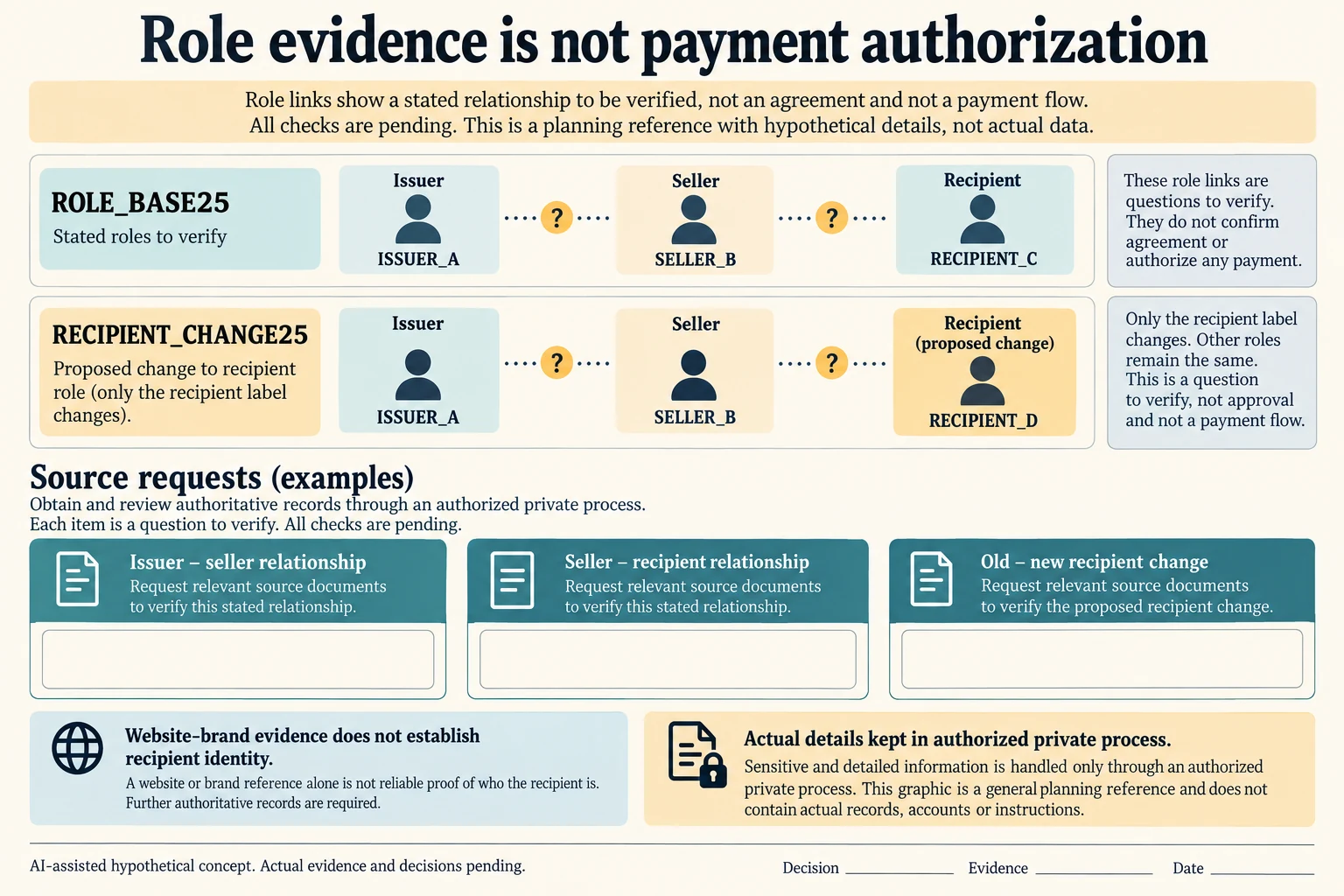
Use fictional labels rather than real company or account details. ROLE_BASE25 names ISSUER_A, SELLER_B and RECIPIENT_C. RECIPIENT_CHANGE25 keeps the same issuer and seller references but proposes RECIPIENT_D. These are three different roles, not a statement that different entities are either acceptable or fraudulent. The labels represent an unresolved verification task.
Scroll horizontally if columns extend beyond the view.
| Hypothetical configuration | Named object | Relationship | Input or next scope |
|---|---|---|---|
| ROLE_BASE25 | ROLE_BASE25 | has proposed role | ISSUER_A |
| ROLE_BASE25 | ROLE_BASE25 | has proposed role | SELLER_B |
| ROLE_BASE25 | ROLE_BASE25 | has proposed role | RECIPIENT_C |
| ROLE_BASE25 | ISSUER_SELLER | requires | ROLE_SPECIFIC_SOURCE_AND_RESPONSIBLE_CHECK |
| ROLE_BASE25 | SELLER_RECIPIENT | requires | ROLE_SPECIFIC_SOURCE_AND_RESPONSIBLE_CHECK |
| ROLE_BASE25 | OLD_NEW_RECIPIENT | requires | ROLE_SPECIFIC_SOURCE_AND_RESPONSIBLE_CHECK |
| RECIPIENT_CHANGE25 | RECIPIENT_CHANGE25 | has proposed role | ISSUER_A |
| RECIPIENT_CHANGE25 | RECIPIENT_CHANGE25 | has proposed role | SELLER_B |
| RECIPIENT_CHANGE25 | RECIPIENT_CHANGE25 | has proposed role | RECIPIENT_D |
| RECIPIENT_CHANGE25 | ISSUER_SELLER | requires | ROLE_SPECIFIC_SOURCE_AND_RESPONSIBLE_CHECK |
| RECIPIENT_CHANGE25 | SELLER_RECIPIENT | requires | ROLE_SPECIFIC_SOURCE_AND_RESPONSIBLE_CHECK |
| RECIPIENT_CHANGE25 | OLD_NEW_RECIPIENT | requires | ROLE_SPECIFIC_SOURCE_AND_RESPONSIBLE_CHECK |
| ROLE_BASE25 | WEBSITE_BRAND_FACT | does not establish | RECIPIENT_IDENTITY_OR_CHANGED_INSTRUCTIONS |
The CSV gives issuer-to-seller, seller-to-recipient and old-to-new-recipient questions separate source and responsible-check scopes. A confirmed fact about a website brand would not, by itself, identify a recipient or verify changed instructions. Keep the prior value and the actual change request in the buyer’s authorized private records. Use the established verification process for the changed role rather than treating a familiar message thread as automatic authority.
The FTC’s July 2023 small-business guide offers general context on checking unfamiliar businesses, reviewing invoices and deceptive identity signals. The role map is an original coordination aid; that guide does not certify a seller, establish a legal contracting identity for Q1 or supply a complete due-diligence procedure. No business has been investigated for this hypothetical example.
Ask which role each source actually addresses, who is responsible for reviewing it and what remains unresolved. A factory photograph or one website fact cannot establish delivery capability, financial standing or permission to pay. Keep actual legal names, payment credentials and sensitive documents inside the appropriate process. Packrivo’s packaging coordination and this public worksheet do not authorize a transaction or replace any required professional review.
Download the seller issuer recipient evidence scope record (.csv). It includes the original table fields and scenarios alongside the added relationships. HYPOTHETICAL rows are editorial examples or required review scopes, not actual records. Actual quantity, configuration, component and file identities, materials, process, specification, copy, method, condition, observation, owner, decision, evidence and dates are blank. ACTUAL_BLANK is a separate empty starting row; enter permitted project evidence before using an actual record. A blank means unknown.
Use the Turn Supplier Replies Into a Clarification Matrix for its separate question. Use the Custom Packaging Quote Comparison Checklist for its separate question.
Additional official reference: FTC small-business scam guide (July 2023). General small-business identity context only; it does not verify the example roles or authorize a payment.
Source scope checked 16 October 2026. References cover only the named materials, processes or guidance. Added configurations and geometry are hypothetical, not supplier specifications, tests or production approval; they set no universal tolerances or machine limits. Confirm the actual material, process, drawing and formed sample for the project.
Discuss this packaging specification with Packrivo. We coordinate independent suppliers. MOQ: 500 pieces per product/design; illustrative quantities are not production offers. Confirm materials, samples, price and timing for your project.