
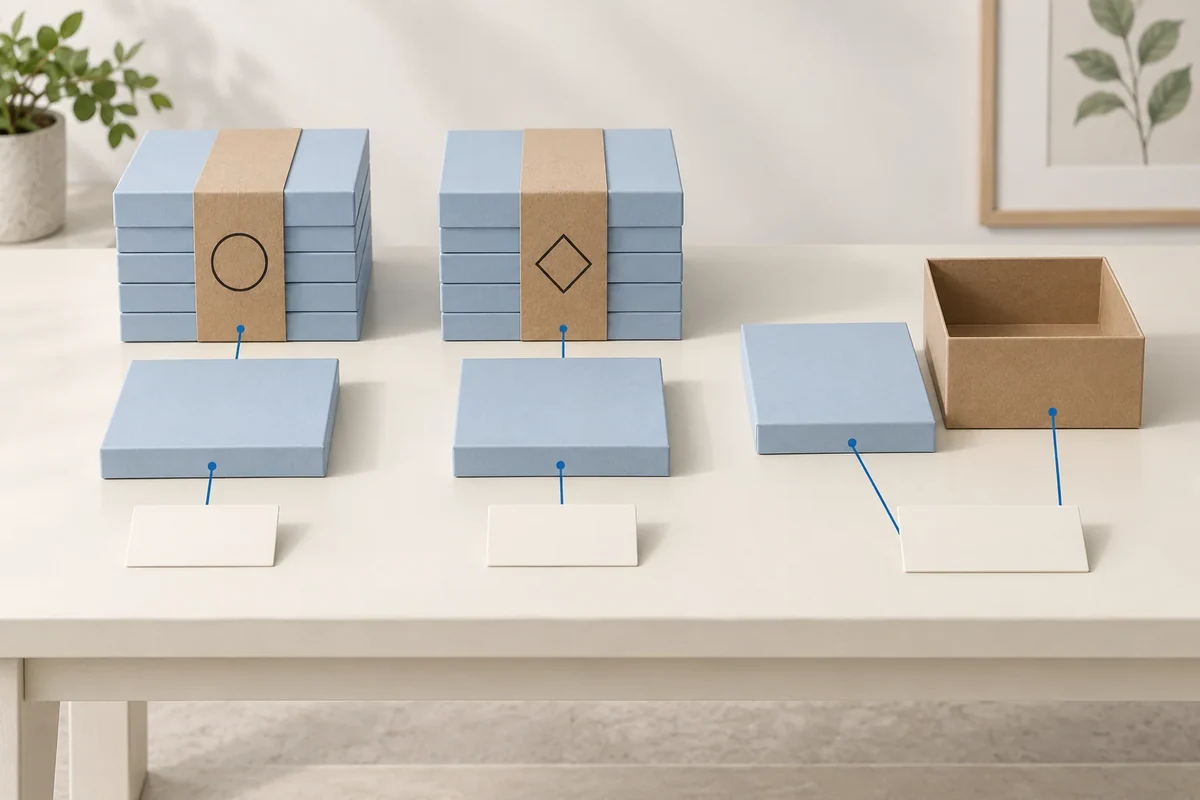
Keep incoming delivery and lot references connected to the exact items reviewed. Record where each item came from, how it was selected and which evidence belongs to it. A receipt label on an outer carton is not enough to identify a loose item after it has been moved to a review bench.
The delivery/lot/reviewed-item cross-reference is a Packrivo original traceability aid that preserves identity. It does not prescribe a sampling plan, sample size, AQL threshold or a conclusion about an entire lot.
Record delivery identity before unpacking
Use the authorized project process to retain delivery and lot labels, component descriptions and known quantities. Keep private shipping data out of public concept material. Mark absent or unreadable references as gaps.
Assign reviewed items their own temporary record IDs linked to the source location. Identify the carton, bundle or grouping they came from if known. A label copied from another grouping can create a false identity chain.
Keep selection and item evidence separate
Record how the item was selected and by whom. Preserve whether the selection was planned under an agreed method or a local observation. Do not call a convenient picked item a representative sample without a basis.
Link photos and measurements to that item ID. If parts are paired during review, name the combination. A loose lid and base from different groupings should not appear as one identified received set without a record.
| Cross-reference field | Entry | Limit/status |
|---|---|---|
| Delivery | Authorized receipt reference | Known or missing |
| Lot/grouping | Actual label and source location | Not inferred from appearance |
| Reviewed item | Stable review ID | Linked to its grouping |
| Selection | Actual method and role | Agreed plan or local observation |
| Evidence | Photos/readings and item state | Only identified items covered |
| Decision link | Responsible acceptance record | No whole-lot conclusion invented |
Use the acceptance record for the later conclusion. Item identification and acceptance are distinct jobs even when they share the same evidence.
Follow a hypothetical mixed delivery
Suppose a brand receives two groupings of printed gift lids. The review bench holds one item from each. The buyer gives them separate item IDs and records their actual source labels before comparing them.
One lid is later paired with a base for a fit observation. The record names that base as well, so the observation cannot be mistaken for proof about an unidentified complete set.
If a lot label is missing, the gap remains visible. A familiar artwork or colour does not establish that the item belongs to the same production grouping as another one.
Use an identity-specific next question
Ask: ‘Please confirm the source grouping for reviewed item RI2 and the related component reference.’ It identifies the missing link. A generic statement that the delivery is correct leaves RI2 unresolved.
If an agreed sampling or acceptance programme applies, retain its reference separately and follow its responsible process. This worksheet does not choose the number of items or establish a statistical claim from the recorded observations.
Keep the original source images and item map available through the project record. Later movement or re-pairing should be recorded rather than overwriting the earlier identity chain.
Send the missing reference
Bring non-sensitive delivery references, reviewed-item IDs and source gaps through Packrivo’s enquiry. The next response should clarify the actual identity link before an observation is expanded beyond the item it covers.
A bench pairing does not rewrite where its components came from
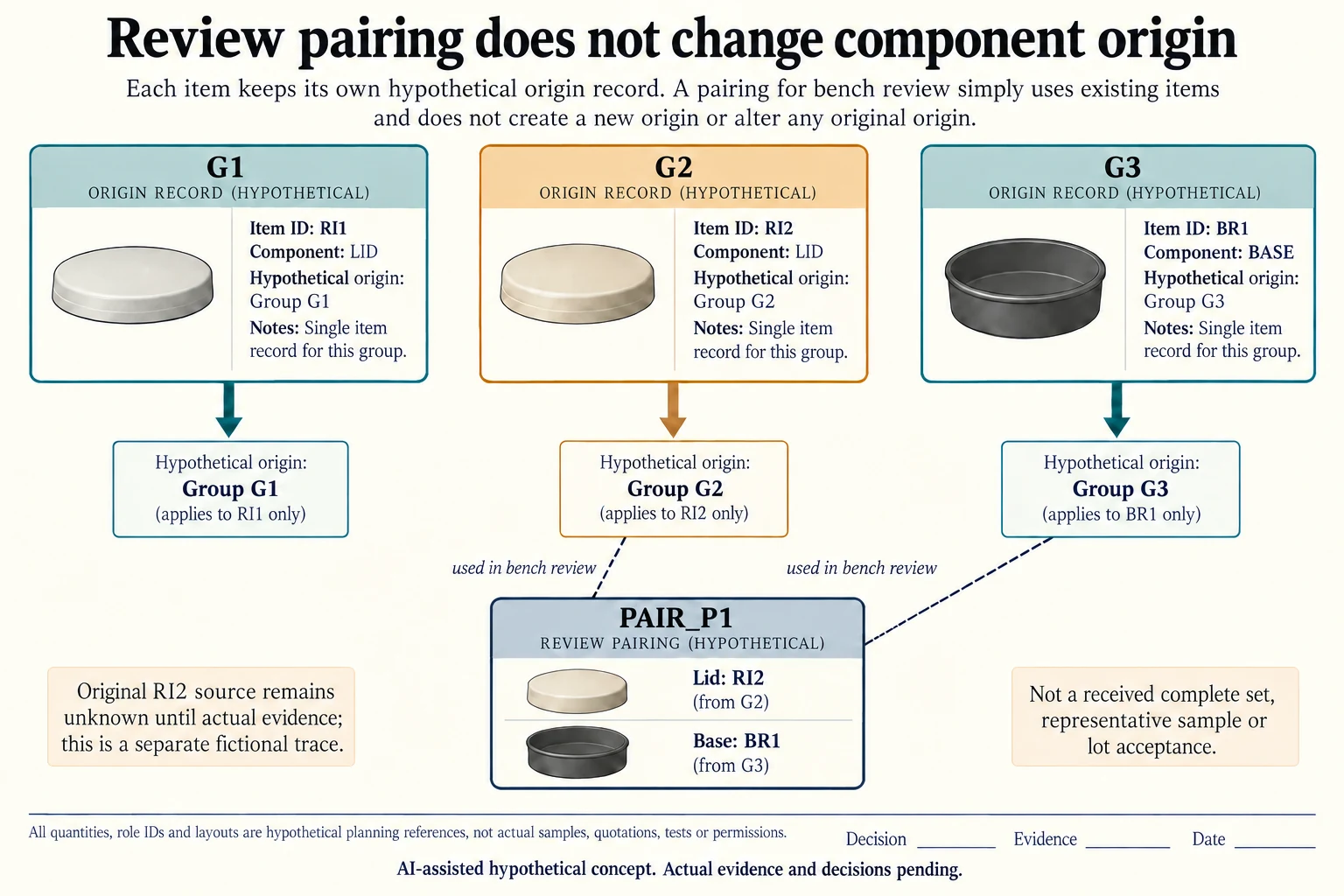
Separate a source-group association from a later review pairing. The original example has two printed-lid groupings and one reviewed lid from each, while RI2’s actual source needs confirmation. In a separate invented trace model, assign RI1 to G1, RI2 to G2 and base BR1 to G3. These are hypothetical associations; actual lot labels, revisions and origin evidence remain blank. They do not resolve the original missing source.
Scroll horizontally if columns extend beyond the view.
| Hypothetical configuration | Named object | Relationship | Input or next scope |
|---|---|---|---|
| ORIGINAL_RECEIPT | PRINTED_LID_GROUPINGS | assumed quantity | SEPARATE_GROUPINGS; 2 groupings |
| ORIGINAL_RECEIPT | G1 | assumed reviewed quantity | ONE_ITEM; 1 lid |
| ORIGINAL_RECEIPT | G2 | assumed reviewed quantity | ONE_ITEM; 1 lid |
| TRACE26 | RI1 | assumed origin group | G1 |
| TRACE26 | RI2 | assumed origin group | G2 |
| TRACE26 | BR1 | assumed origin group | G3 |
| PAIR26 | PAIR_P1 | uses lid | RI2 |
| PAIR26 | PAIR_P1 | uses base | BR1 |
| PAIR26 | PAIR_P1 | does not rewrite | RI2_G2_OR_BR1_G3_ORIGIN |
| TRACE26 | RI1_RI2 | does not establish | LOT_QUALITY_OR_ACCEPTANCE |
PAIR_P1 then links lid RI2 to base BR1 for a bench review. It does not rewrite RI2’s G2 origin or BR1’s G3 origin and does not establish that they arrived as a complete set. The CSV stores the lid role, base role and each source relationship independently. Moving an item between review locations can create a location record while leaving its origin unchanged.
A known origin is not the same as a representative selection or accepted lot. One reviewed item from each of two groups provides those item-level observations only unless the actual agreed method supports a broader decision. Artwork or colour similarity cannot fill an absent label or prove a common lot. Keep an unknown origin explicit instead of assigning it to the nearest pile.
Use the carton-version manifest to trace what was packed and the acceptance record for the eventual disposition. This item record preserves the chain into a named review configuration. The actual component match, observation scope, method, owner and decision must be obtained separately; a pair photographed on a bench is not a shipment, fit result or lot release.
Download the incoming item origin and bench pairing record (.csv). It includes the original table fields and scenarios alongside the added relationships. HYPOTHETICAL rows are editorial examples or required review scopes, not actual records. Actual quantity, configuration, component and file identities, materials, process, specification, copy, method, condition, observation, owner, decision, evidence and dates are blank. ACTUAL_BLANK is a separate empty starting row; enter permitted project evidence before using an actual record. A blank means unknown.
Use the Incoming Packaging Inspection: Check the Batch Before Packing for its separate question. Use the Shipping-Carton IDs Need the Packaging Versions Inside Them for its separate question. Use the Describe Transit Damage by Location and Pack Version for its separate question.
Source scope checked 16 October 2026. References cover only the named materials, processes or guidance. Added configurations and geometry are hypothetical, not supplier specifications, tests or production approval; they set no universal tolerances or machine limits. Confirm the actual material, process, drawing and formed sample for the project.
Discuss this packaging specification with Packrivo. We coordinate independent suppliers. MOQ: 500 pieces per product/design; illustrative quantities are not production offers. Confirm materials, samples, price and timing for your project.