

Link each shipping-carton ID to the actual packaging component versions packed inside it. Record the carton type, contents unit basis, component revisions and relevant lot or order references. This manifest makes a version question traceable without turning a carton’s dimensions or total count into proof that its contents are current.
Keep outer-carton identity separate from component identity
The official GS1 logistic-label guideline distinguishes logistic-unit identification and applicable contents/count information. Use that context only where the real identifiers and fields apply. This project manifest uses supplied carton and component references; it does not create GS1 identifiers or require a fabricated SSCC.
Name each shipping-carton type and the individual carton identity used in the project. List which packaging components or complete sets it contains. Keep the quantity basis clear: a box, lid, insert and card may be counted as separate components rather than one finished retail set.
For every contents row, record the actual drawing/artwork/component revision and available lot. A title such as jewelry box does not distinguish the earlier configuration from a changed insert or care card. Keep missing references explicitly open until the packing or supplier owner confirms them.
Match the manifest at the time of packing
Ask the packing owner to retain the versions actually placed in each carton. If components from different revisions are intentionally grouped, identify them separately and keep the decision approving that grouping. Do not replace the earlier reference with the newest file merely because it arrived later.
Attach the carton label or packing-record reference to the manifest. The physical label, internal project ID and any genuine carrier/logistics identifiers have different roles. Keep those roles visible without assuming a barcode contains the project’s component revision information.
When a version question appears, locate the carton row and its contents references. The next response should identify the affected cartons or explain which evidence is missing. A total shipment quantity alone cannot answer where a particular version was packed.
Use a carton-to-component-version manifest
The hypothetical example below is an original Packrivo record, not an actual shipment.
| Carton reference | Contents unit | Version/lot record | Next check |
|---|---|---|---|
| CT1, type A | Gift bases | Base BX1_r02, actual lot field | Packing owner confirms the used revision |
| CT1, type A | Separate lids | Lid L1_r02, quantity basis named | Match to the approved base/closure |
| CT2, type B | Insert components | Insert I1_r03, actual lot field | Keep its revision distinct from the base |
| CT3, type C | Care cards | Card C1_r01, artwork reference | Identify final supplied card version |
| Label reference | Project carton label or packing record | Linked to CT1/CT2/CT3 | Retain actual label/manifest match |
| Exception | Missing or mixed version field | Keep known contents and uncertainty | Named owner confirms affected carton scope |
Resolve an illustrative mixed-version question
Imagine a revised holder is delivered alongside unchanged gift-box bases. A carton can contain the new holder while another carton contains bases from the existing configuration. Keep both rows and the accepted relationship visible before assembly.
If the supplier replies that the latest version was shipped, request the actual component and carton references. The packing owner can then identify the rows needing confirmation. This avoids treating a broad delivery message as proof that every component in every carton has the same revision.
Keep this manifest distinct from freight and bench records
The carton freight-data method records measurements and shipment-comparison inputs. The drawing-change record explains affected component dependencies. This manifest adds the physical carton-to-version link; packing-bench variant matching is a separate step.
The supplier provides component/lot facts, the packing owner records actual contents by carton, and the buyer resolves their accepted relationship. Retain the evidence and decision date so a later reorder can use the correct baseline.
Share the manifest, actual version references and unresolved carton scope through the packaging brief. MOQ is 500 pieces per design; component grouping, sampling and commercial details are confirmed for the project.
A mixed insert carton is not one current revision
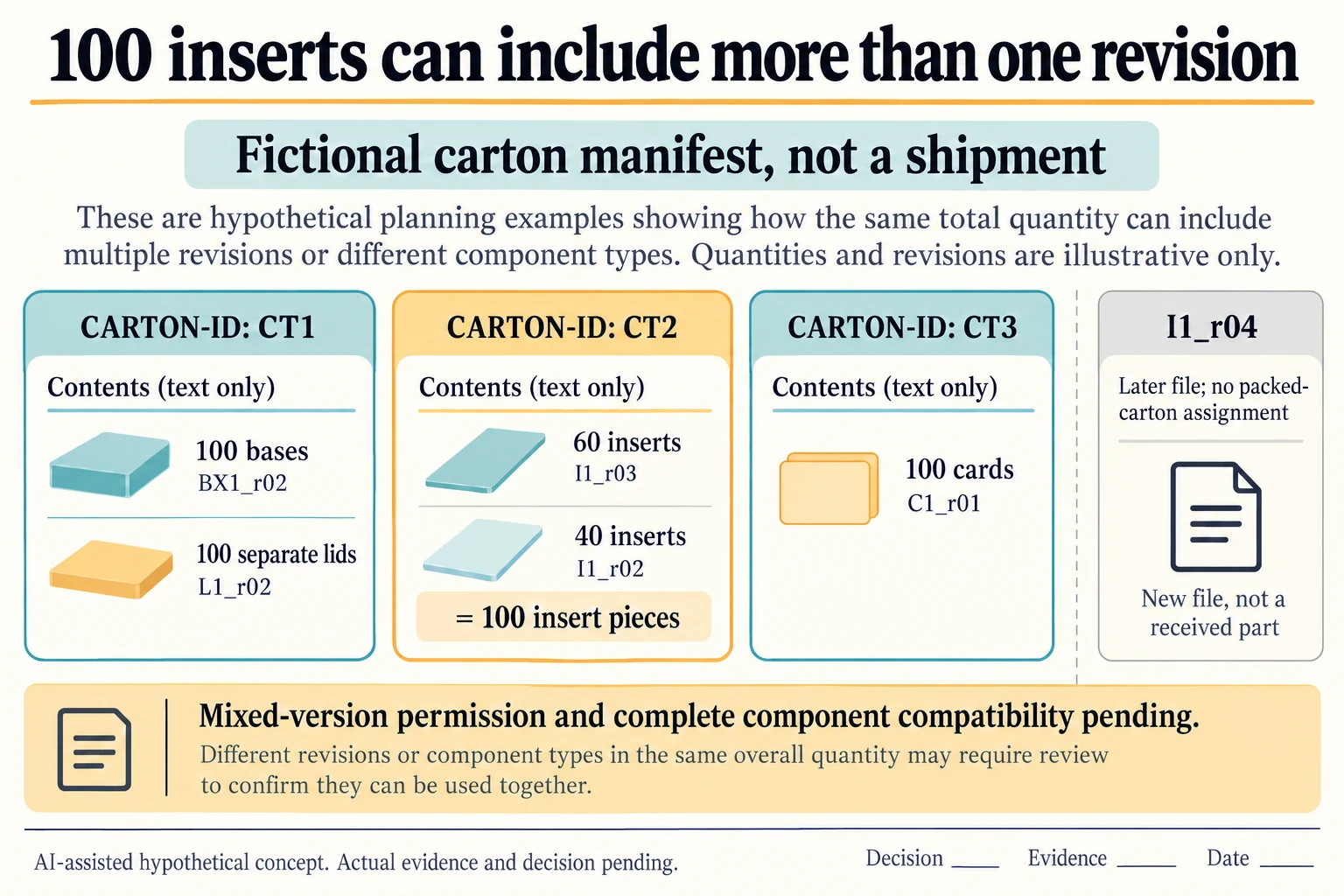
Extend the original manifest with fictional quantities, keeping every component row explicit. CT1 contains 100 BX1_r02 bases and 100 separate L1_r02 lids. CT2 contains 60 I1_r03 inserts and 40 I1_r02 inserts. CT3 contains 100 C1_r01 cards. These are invented packed references, not an actual shipment or instruction approving mixed revisions. The CSV keeps carton identity, component role, version and quantity on each association.
Scroll horizontally if columns extend beyond the view.
| Hypothetical configuration | Named object | Relationship | Input or next scope |
|---|---|---|---|
| PACKED24 | CT1 | assumed contains | BX1_r02; 100 component pieces |
| PACKED24 | CT1 | assumed contains | L1_r02; 100 component pieces |
| PACKED24 | CT2 | assumed contains | I1_r03; 60 component pieces |
| PACKED24 | CT2 | assumed contains | I1_r02; 40 component pieces |
| PACKED24 | CT3 | assumed contains | C1_r01; 100 component pieces |
| PACKED24 | CT2 | calculated from | INSERT_NEW+INSERT_OLD; 100 insert pieces |
| LATE_FILE24 | I1_r04 | is | NEW_FILE_NOT_RECORDED_PACKED |
CT2 therefore contains 100 insert pieces, but not 100 pieces of I1_r03. Its 60 newer and 40 earlier references remain separate. A later file I1_r04 has no packed-carton association in this example; receiving that file does not rewrite CT2’s history. If a question concerns I1_r03, locate its CT2 row before asking which cartons or units are affected. The CT1 bases and lids do not silently acquire an insert revision because they belong to the same project.
Do not convert these component counts into approved complete sets. The accepted base/lid/insert/card relationship and permission for CT2’s mixed contents remain separate requirements. An actual lot or packing-label reference can strengthen the trace, but unknown values stay blank. Likewise, a complete manifest entry is not a release to assemble or ship the goods.
The GS1 logistic-label material separates genuine logistic identity from applicable contents information; this worksheet uses internal example IDs, not allocated SSCCs or GTINs. Its carton-to-version function is separate from freight measurements and bench selection. The next useful reply names the actual carton, component version and supporting packing record instead of saying only that the latest version was shipped.
Download the carton component version quantity map record (.csv). It includes the original table fields and scenarios alongside the added relationships. HYPOTHETICAL rows are editorial examples or required review scopes, not actual records. Actual quantity, configuration, component and file identities, materials, process, specification, copy, method, condition, observation, owner, decision, evidence and dates are blank. ACTUAL_BLANK is a separate empty starting row; enter permitted project evidence before using an actual record. A blank means unknown.
Use the Packaging Carton Data Makes Freight Inquiries Easier to Compare for its separate question. Use the Packaging Dieline Changes Need an Impact Record for its separate question. Use the Keep Box Insert and Sleeve Variants Matched During Packing for its separate question.
Source scope checked 16 October 2026. References cover only the named materials, processes or guidance. Added configurations and geometry are hypothetical, not supplier specifications, tests or production approval; they set no universal tolerances or machine limits. Confirm the actual material, process, drawing and formed sample for the project.
Discuss this packaging specification with Packrivo. We coordinate independent suppliers. MOQ: 500 pieces per product/design; illustrative quantities are not production offers. Confirm materials, samples, price and timing for your project.