
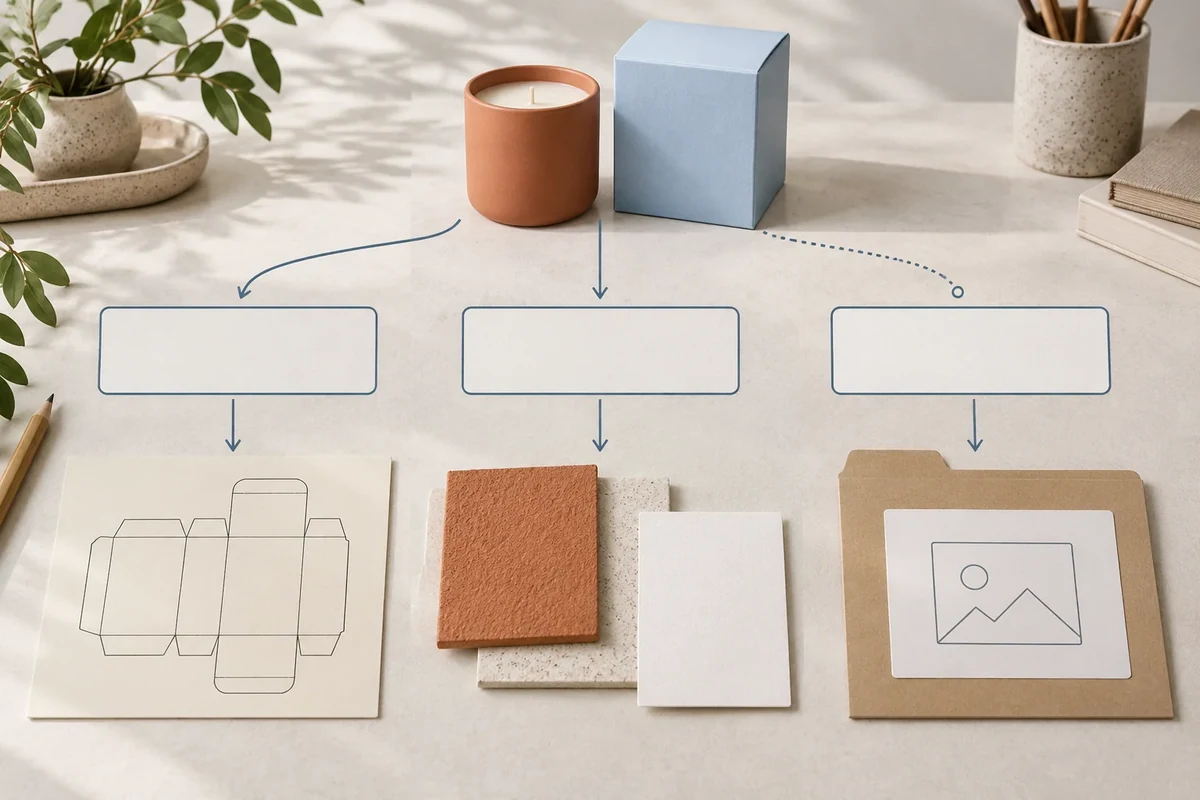
Turn an unknown brief field into an answerable supplier question by naming the component, known context and evidence you need. Keep a request for a proposal separate from a request to confirm an existing fact. A row marked unknown is useful when it leads to a specific next response rather than a broad request for advice.
The output is a Packrivo original communication aid: a question sheet that sits beside the first brief. It should make uncertainty easier to answer without pretending the missing information already exists.
Classify the kind of gap
Identify whether the field lacks a fact, a proposed construction, an evidence record or a buyer decision. Those gaps need different questions. A supplier can propose a closure while the buyer still has to choose the intended opening use.
Record what is already known and its source. Keep the actual product and component reference beside the gap. A screenshot or concept can provide context without being proof of a material or joint.
Use the first brief guide for the wider inputs. This sheet transforms the unfinished fields into located requests.
Write context and an expected answer form
Name the component and the relationship to review. Ask for the appropriate answer form, such as a marked drawing, material identity, supplied-state photo or explanation of a proposed method. Avoid requesting a certificate when the real gap is a construction sketch.
Keep the next owner and decision visible. A returned fact can still require a buyer choice, and a buyer preference can still need supplier feasibility evidence.
| Transformation field | Entry | Resulting question |
|---|---|---|
| Unknown | Specific missing field | What needs an answer? |
| Known context | Product/component and source facts | Which configuration applies? |
| Gap type | Fact, proposal, evidence or decision | Confirm, propose, show or choose? |
| Answer form | Appropriate drawing/data/view | What evidence is requested? |
| Owner | Source and decision roles | Who answers and who decides? |
| Returned status | Actual response and remaining gap | Next action not invented |
Use the clarification matrix to track returned answers. The transformation sheet preserves why each question was asked.
Follow a hypothetical unknown closure
Suppose a gift-box brief has closure method marked unknown. The buyer knows the full contents and wants the box to reopen. The question asks the supplier to propose a closure for that named use and show its opening action on the drawing.
That differs from asking the source to confirm a closure already proposed. The sheet marks the gap as proposal, with a drawing and use explanation expected. A generic catalogue link may leave the actual configuration unanswered.
Another field lacks an artwork asset. That becomes a file-evidence question to the responsible artwork owner rather than a structural question to the box supplier. The same word unknown should not send every task to one role.
Keep returned uncertainty honest
A useful request is: ‘Please propose the closing action for contents C1 and show the customer opening route.’ It supplies context and answer form. A reply naming a material leaves the closure proposal open.
If a response introduces another unknown, add it with its type and owner. Do not infer a complete answer from a partial or contradictory reply. Keep the original request connected to the returned evidence.
This method is an original communication aid. It does not establish supplier capability, guarantee an answer or approve the resulting proposal.
Send the answerable questions
Bring the known facts, gap types and located requests through Packrivo’s enquiry. The next useful response should answer the named field in the requested form, leaving the buyer’s remaining decision visible.
A material reply cannot close a closure-proposal question
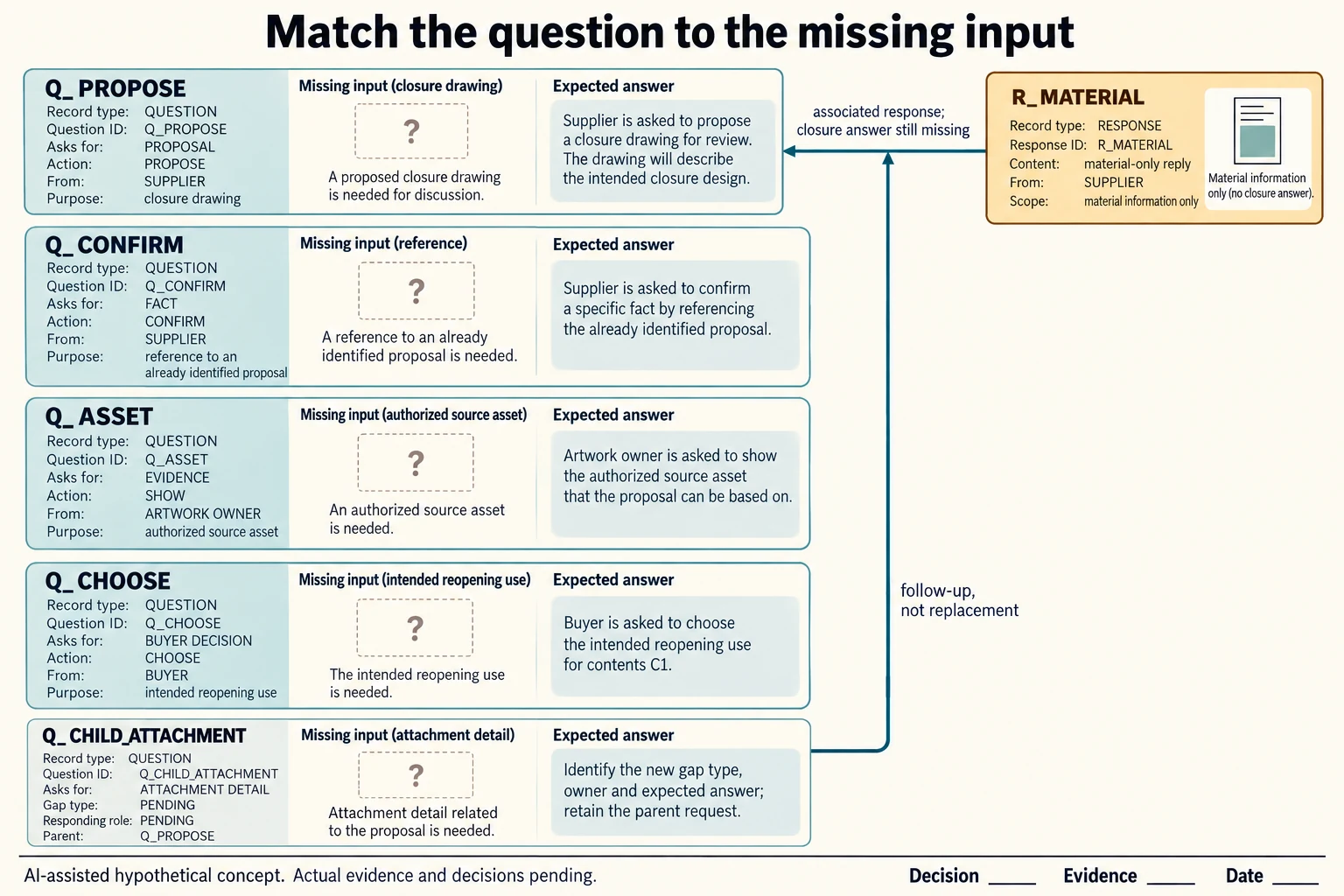
Give a missing field an expected answer before assigning its returned status. In the invented QUESTION27 record, Q_PROPOSE asks the supplier for a closure drawing and opening explanation for contents C1. Q_CONFIRM instead asks for the reference to an already identified proposal. These are different questions: an unknown construction cannot be confirmed merely by using the word confirm in a message.
Scroll horizontally if columns extend beyond the view.
| Hypothetical configuration | Named object | Relationship | Input or next scope |
|---|---|---|---|
| QUESTION27 | Q_PROPOSE | has gap | PROPOSAL |
| QUESTION27 | Q_PROPOSE | has verb | PROPOSE |
| QUESTION27 | Q_PROPOSE | has responding role | SUPPLIER |
| QUESTION27 | Q_PROPOSE | has expected form | CLOSURE_DRAWING_AND_OPENING_EXPLANATION |
| QUESTION27 | Q_CONFIRM | has gap | FACT |
| QUESTION27 | Q_CONFIRM | has verb | CONFIRM |
| QUESTION27 | Q_CONFIRM | has responding role | SUPPLIER |
| QUESTION27 | Q_CONFIRM | has expected form | IDENTIFIED_EXISTING_PROPOSAL_REFERENCE |
| QUESTION27 | Q_ASSET | has gap | EVIDENCE |
| QUESTION27 | Q_ASSET | has verb | SHOW |
| QUESTION27 | Q_ASSET | has responding role | ARTWORK_OWNER |
| QUESTION27 | Q_ASSET | has expected form | AUTHORIZED_SOURCE_ASSET |
| QUESTION27 | Q_CHOOSE | has gap | BUYER_DECISION |
| QUESTION27 | Q_CHOOSE | has verb | CHOOSE |
| QUESTION27 | Q_CHOOSE | has responding role | BUYER |
| QUESTION27 | Q_CHOOSE | has expected form | INTENDED_REOPEN_USE |
| QUESTION27 | R_MATERIAL | does not satisfy | Q_PROPOSE |
| QUESTION27 | Q_CONFIRM | requires | ALREADY_IDENTIFIED_PROPOSAL |
| QUESTION27 | Q_CHILD_ATTACHMENT | followup of | Q_PROPOSE |
Q_ASSET asks the artwork owner to show the authorized source asset, while Q_CHOOSE asks the buyer to choose the intended reopening use. The CSV records gap type, action verb, responding role and expected form separately for each question. It supplies no actual owner, source file, reply or buyer preference. A role such as artwork owner is a responsibility to identify, not a person whose authority has been verified.
Now suppose a fictional R_MATERIAL response supplies only a material description. Keep it associated with Q_PROPOSE but leave the closure drawing and opening explanation unresolved. The material response may be useful context without answering that question. If it exposes a missing attachment detail, create Q_CHILD_ATTACHMENT linked to Q_PROPOSE rather than replace the parent request and lose its original purpose.
Use the clarification matrix after replies arrive to record their actual scope and the action they enable. This transformation sheet works earlier: it prevents an evidence request being sent as a construction proposal or a buyer choice being delegated as a supplier fact. A complete-looking response in the wrong form remains an open input until the responsible source resolves the named gap.
Download the unknown packaging brief answer form record (.csv). It includes the original table fields and scenarios alongside the added relationships. HYPOTHETICAL rows are editorial examples or required review scopes, not actual records. Actual quantity, configuration, component and file identities, materials, process, specification, copy, method, condition, observation, owner, decision, evidence and dates are blank. ACTUAL_BLANK is a separate empty starting row; enter permitted project evidence before using an actual record. A blank means unknown.
Use the Packaging Supplier Brief: The First Details to Send for its separate question. Use the Turn Supplier Replies Into a Clarification Matrix for its separate question.
Editorial scope reviewed 17 October 2026: the question worksheet and related Packrivo method links help distinguish an unknown construction, an existing proposal, a requested source asset and a buyer choice. The added records are invented examples of those communication tasks, not manufacturer test data or geometric calculations. A returned material reference does not establish that a closure proposal or its evidence has been supplied. Actual project identities, replies and decisions remain unknown.
Discuss this packaging specification with Packrivo. We coordinate independent suppliers. MOQ: 500 pieces per product/design; illustrative quantities are not production offers. Confirm materials, samples, price and timing for your project.