
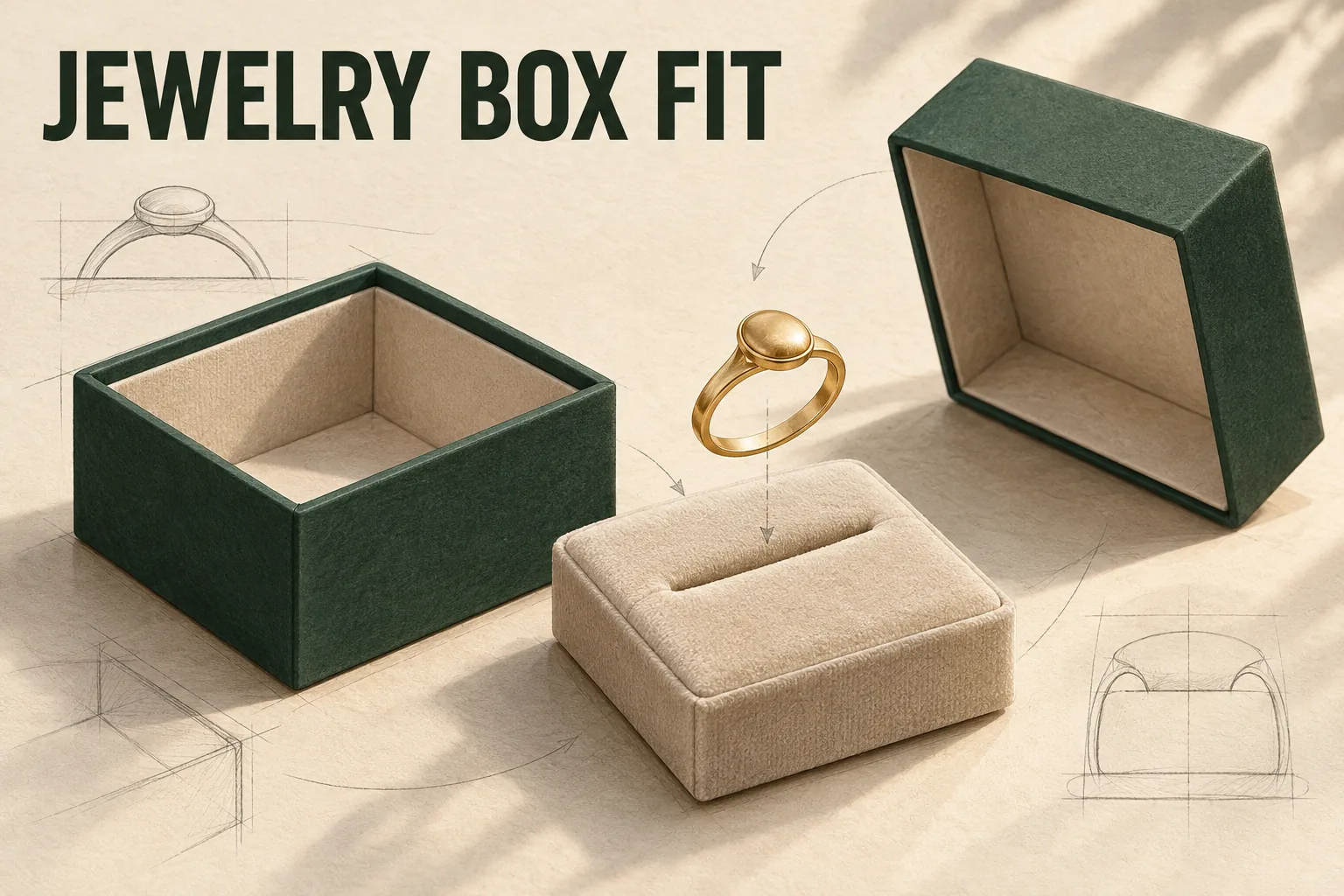
Choose jewelry box dimensions from the complete piece in its intended position, the finished interior and the space above the installed insert. Give each measurement a named reference. Then check loading, closing and removal on a sample. Outside box dimensions alone leave those relationships unresolved.
View the full-size planning illustration
A ring standing in a slot occupies a different envelope from the same ring lying on a card. Start with the arrangement you want the customer to see. The result should be a measurement record a supplier can use, rather than a photograph with one unexplained size.
Measure the complete presentation before choosing an insert
Place the jewelry in its intended display orientation. Include the clasp, chain, earring backs, backing card and any protective layer that remains in the box. Take a top view and a side view, marking which item each measurement describes.
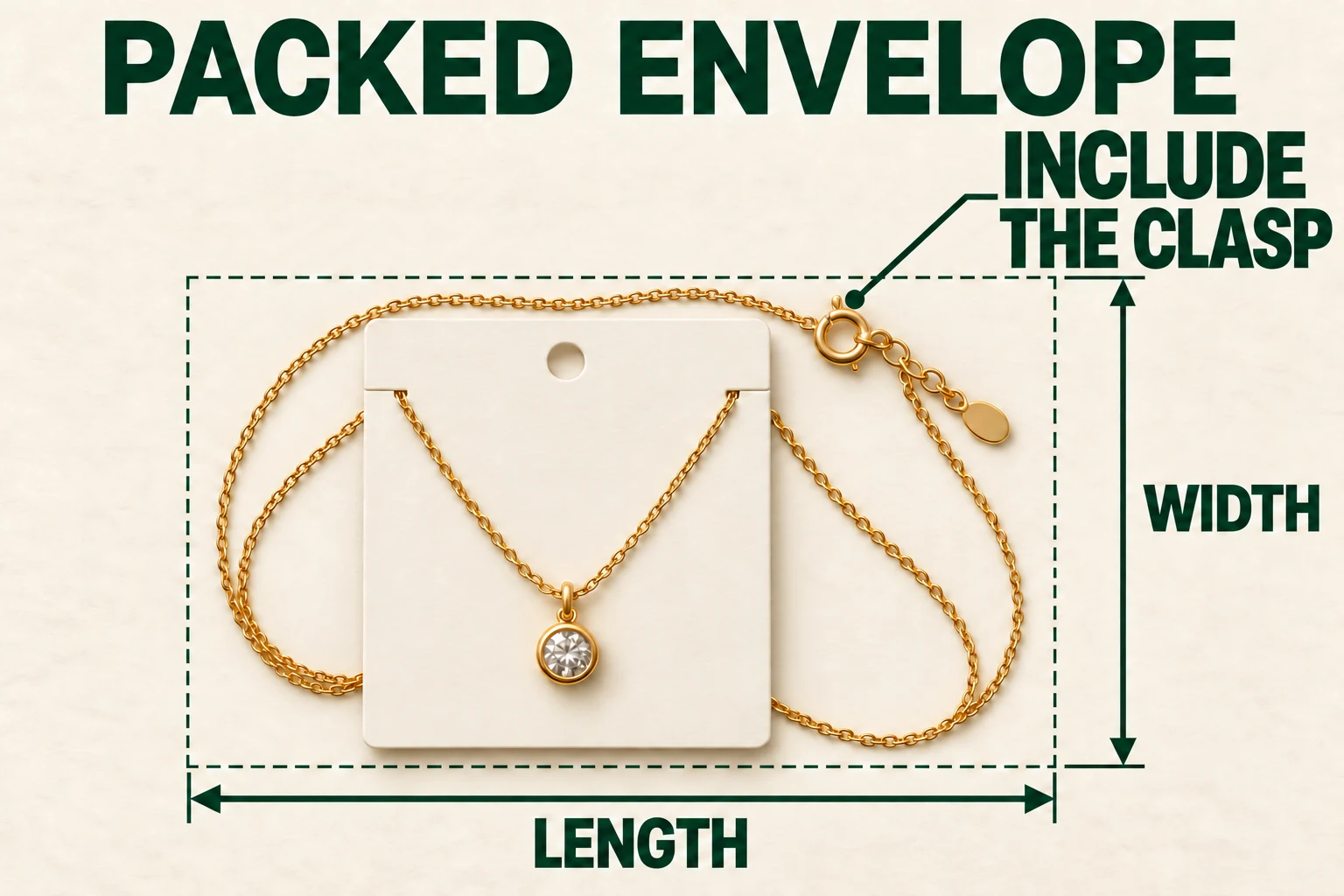
Record the furthest occupied points in that position. For a pendant, the visible stone width might exclude a projecting bail. For earrings, the front view can hide the posts and backs. Identify those features separately so the proposed holder doesn't begin from an incomplete outline.
Use one unit throughout the record. Note the measuring tool and whether the number came from the actual piece, a drawing or an estimate. NIST's measurement guidance explains why a result needs a defined property and reference. It supplies no ready-made jewelry clearance.
Describe surfaces that may touch the holder and areas you want kept clear. Treat that information as a product requirement to resolve, particularly around fragile settings or decorated surfaces. A fabric name or a soft-looking render doesn't settle compatibility with your actual piece.
Keep free height and installed projection separate
Free height is the bottom-to-top size of the unsupported piece in its recorded position. Installed projection is how far the seated piece rises above its supporting insert surface. Both are useful, but they answer different questions.
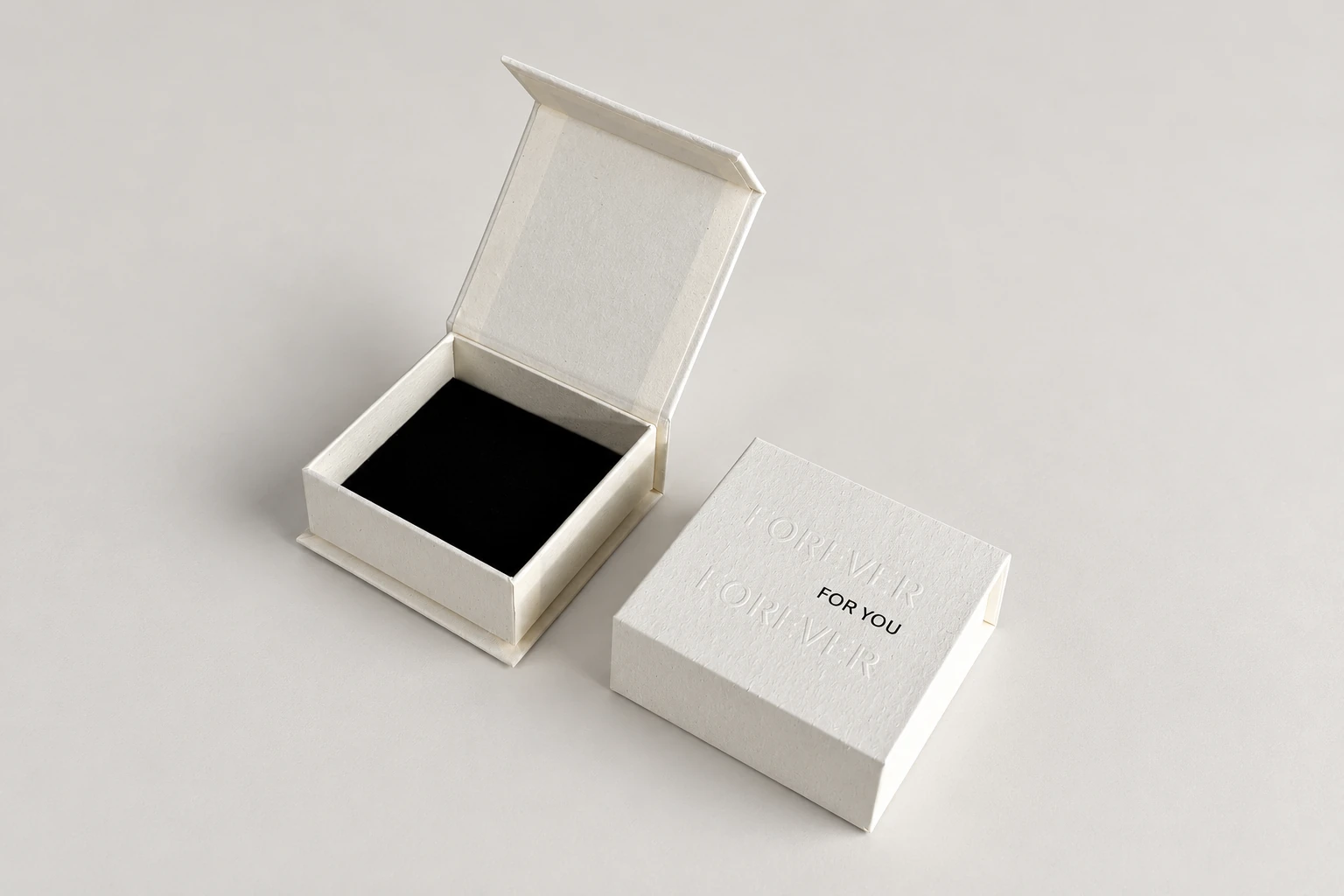
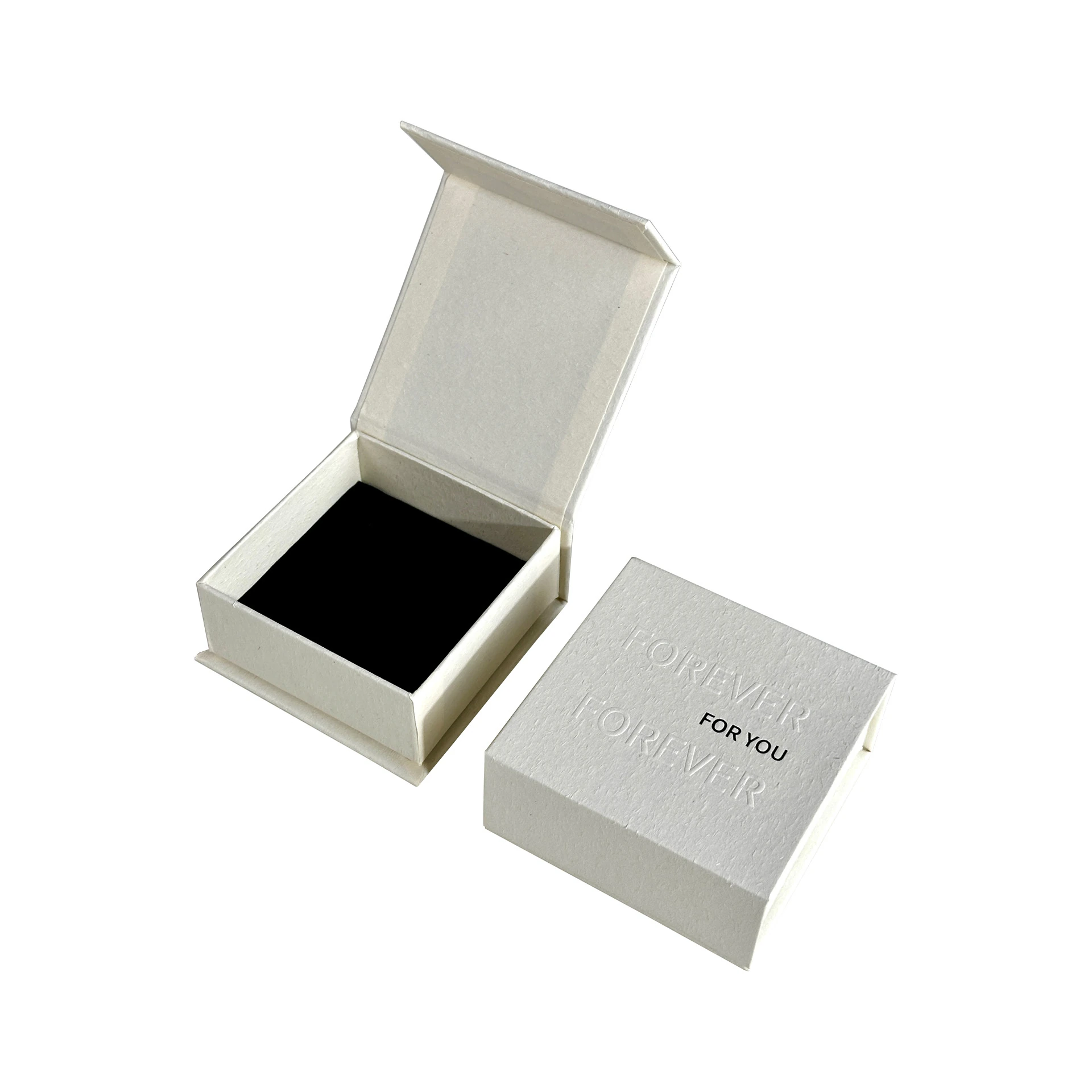
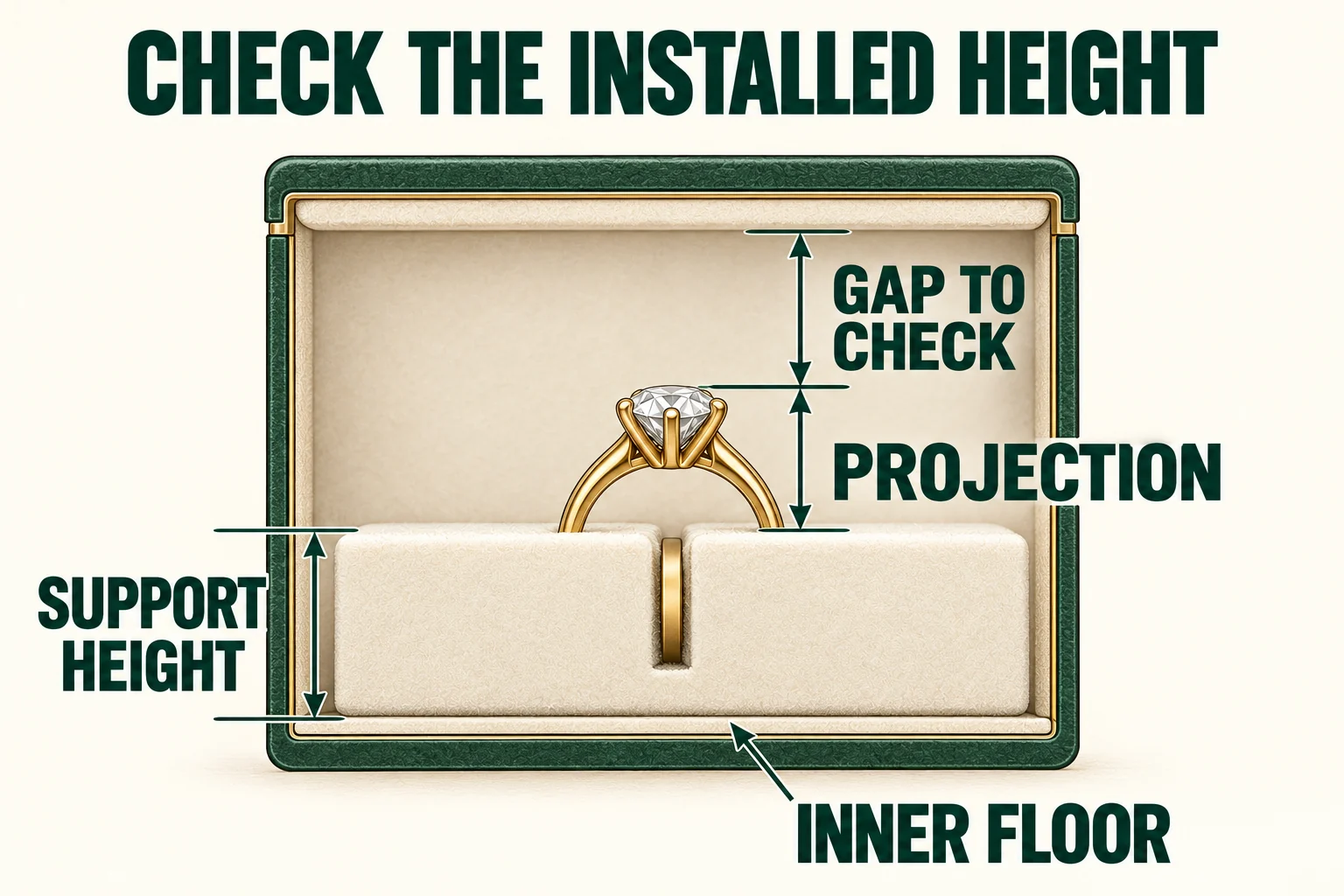
The insert may place part of a ring below its top face. A card can raise earrings above the box floor. Record the support surface and the highest installed point rather than subtracting overall product height from outside box depth.
For lid clearance, identify the lowest relevant inner lid or lining surface above the piece when the box is closed. Wrapping, turned edges and other local features can change that interface. Keep the usable finished interior distinct from an unfinished board cavity or a supplier's nominal outside size.
A proposed gap is a design input. Its suitability still depends on the complete construction and the agreed review. Avoid adding a standard allowance simply because a size field is empty; ask for a named proposal that can be checked on the formed sample.
Build a fit record with seven usable fields
These fields keep the product, holder and enclosure connected. Add item and drawing references beside the table so another reviewer can reproduce the arrangement.
Scroll horizontally if columns extend beyond the view.
| Field | Record | Check on the loaded sample |
|---|---|---|
| Displayed footprint | Occupied length and width in the chosen orientation | Walls, folds and nearby accessories |
| Free height | Unsupported bottom-to-top measurement | Whether the recorded position matches the piece |
| Installed projection | Highest point above the named support | Remaining space beneath the closed lid |
| Projections | Posts, prongs, clasp and bail locations | Pressure, snagging and access |
| Chain route | Displayed section and stored remainder | Loading, release and repacking |
| Finished interior | Usable dimensions after intended lining | Holder seating and local obstructions |
| Insert position | Support elevation, construction and seating | Closure, support and removal together |
Request an insert drawing against this record. A fitted jewelry-box configuration should identify both the outer structure and the holder, while a drawer jewelry box also needs a clear sliding and retrieval route.
Use common-reference arithmetic without calling it approval
Planning example: assume a closed lid surface is 30 mm above the inner floor at the relevant location. The proposed supporting surface is 18 mm above that same floor, and the seated piece projects 9 mm above it. These are chosen planning inputs, not measurements of an actual sample.
The support-to-lid distance is 30 minus 18, or 12 mm. Subtracting the 9 mm installed projection leaves a modeled 3 mm gap. The calculation helps identify which references the supplier must confirm. It doesn't establish a production tolerance or show that the piece stays clear during handling.
Changing the supporting elevation to 20 mm would reduce that modeled gap to 1 mm, with the other assumptions unchanged. Making the insert thicker can therefore affect closure even while the box's outside dimensions remain unchanged.
Ask for the actual section and loaded review before accepting either arrangement. If the lid has a lower local feature, the calculation must use that surface. If the piece tilts in the holder, its highest installed point must be measured in that state.
Review contact and retrieval as separate actions
Load the jewelry in the proposed order, close the lid, reopen it and follow the intended removal route. Record where the piece touches, where fingers or a card can be reached, and whether the holder shifts. Keep each observation tied to the same product and sample versions.
Retrieval deserves its own check. A holder can position a pendant attractively while leaving the chain trapped behind a card. Microsoft's packaging guidance considers opening and access across the user's interaction. Its examples inform the questions; they don't certify a jewelry box or supply a universal grip size.
Give the recipient an intended support and grip, then review that arrangement with appropriate users. Don't turn pulling a delicate chain into the default way to lift the whole presentation. If a substitute piece is used, identify it and keep unsupported product-specific decisions open.
When several jewelry styles might share a box, keep one row set per packed configuration. A smaller pendant can still have a longer chain or a thicker clasp. Shared outside dimensions don't make the occupied envelopes interchangeable. Compare the individual records before asking for a common holder, then identify which combinations the eventual sample review actually covers.
Send measurements with a defined next decision
Choose the opening family with the jewelry box structure comparison before finalizing a holder around it. Send the measured record, labeled views, proposed display and removal directions, quantity by design and destination together.
Ask the supplier to return the finished interior, insert construction and sample scope against those references. If it changes a support point or box size, update the record before comparing the next proposal. The useful output is an identified configuration with answerable fit questions, rather than an unlabeled dimension advertised as finished.
Bring that record to a jewelry packaging inquiry when you're ready to discuss the next drawing or sample.