
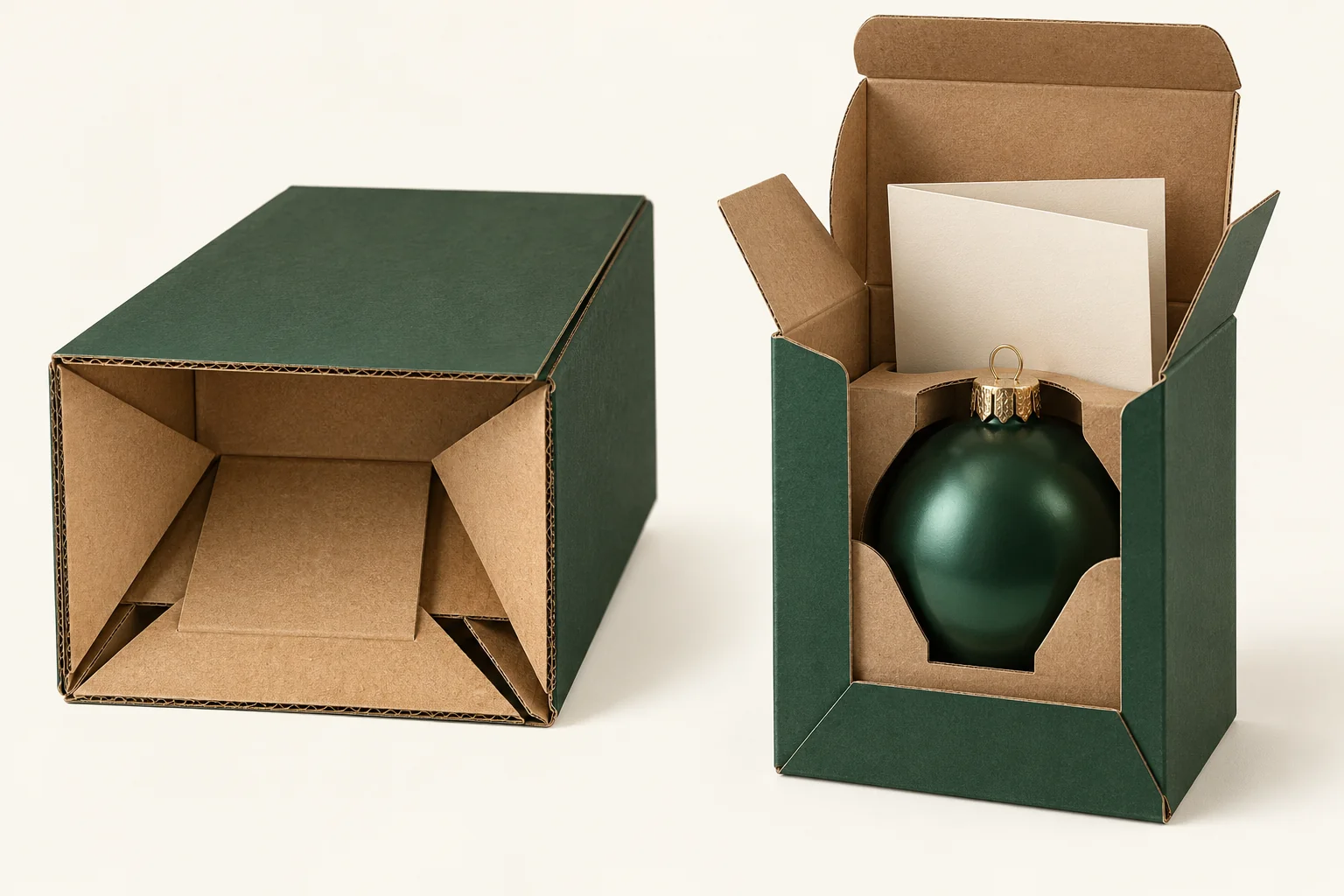
This concept needs confirmation of its actual material, joints and delivered form. Keep those details connected to the sample rather than importing them from a style name.
Show the base before the product enters
The tuck top auto bottom catalogue identifies the combined format. Request the supplied and formed views for the proposed base. Ask what the operator completes during setup and which joints arrive prepared.
Photograph the empty final base state from a useful inspection angle. If an extra alignment action is needed, record it before loading. Avoid treating eventual closure as evidence that the written setup instruction was complete.
Compare the manual snap-bottom version when the packing process could use a different base. Keep the comparison on operator actions and actual supply preparation, without making a universal speed claim.
Close the top around every included component
Record the highest packed point, holder position and any folded card above the product. Show how the top flap enters its intended position. The proposal should identify the surface it meets and any neighbouring flaps.
For a hypothetical ornament gift, the holder may seat the ornament below a folded instruction card. Review the card’s final position before lowering the tuck top. If contact appears, photograph it before moving the card to obtain a successful closure.
Repeat customer opening and removal with the contents still in the approved arrangement. A top that can be closed by staff may need a different grip or instruction for the customer’s first opening.
Use a condition-pair record
Keep the same carton and material revision in each row. The base and top observations should remain separate even if they appear on one review page.
| Condition | Part to inspect | Decision or evidence |
|---|---|---|
| Supplied empty | Prepared base joints | Supplier's delivered-state view |
| Formed empty | Final base position | Setup instruction and inspection photo |
| Loaded open | Holder and highest contents | Full contents image |
| Loaded closing | Top entry and contact | Located interface observation |
| Opened loaded | Grip and removal | Customer action sequence |
If a second product configuration shares the carton, create another loaded pair. The same base preparation can sit beneath a different top-envelope question.
Keep the packing and evaluation scopes clear
Confirm the corrugated proposal, side-seam preparation and whether any closing material is supplied separately. Name who sets up, loads and closes the carton. If the supplier proposes another top feature, update the top rows rather than carrying over approval.
Inspect the base after loading and the top after opening. Record visible movement by part and stage. Those observations can locate a revision question, while capacity or distribution requirements need their own agreed evaluation.
For the hypothetical sample, call the base view B1 and the loaded top view T1. A supplier reply about B1 does not close T1. This simple separation helps prevent a familiar carton name from hiding two unresolved interfaces.
Send the two states together
Submit the supplied-base view, loaded envelope, top observations, quantity and destination through Get a Quote. Packrivo’s minimum is 500 pieces per design. Materials, samples and commercial terms are confirmed for the actual project.