
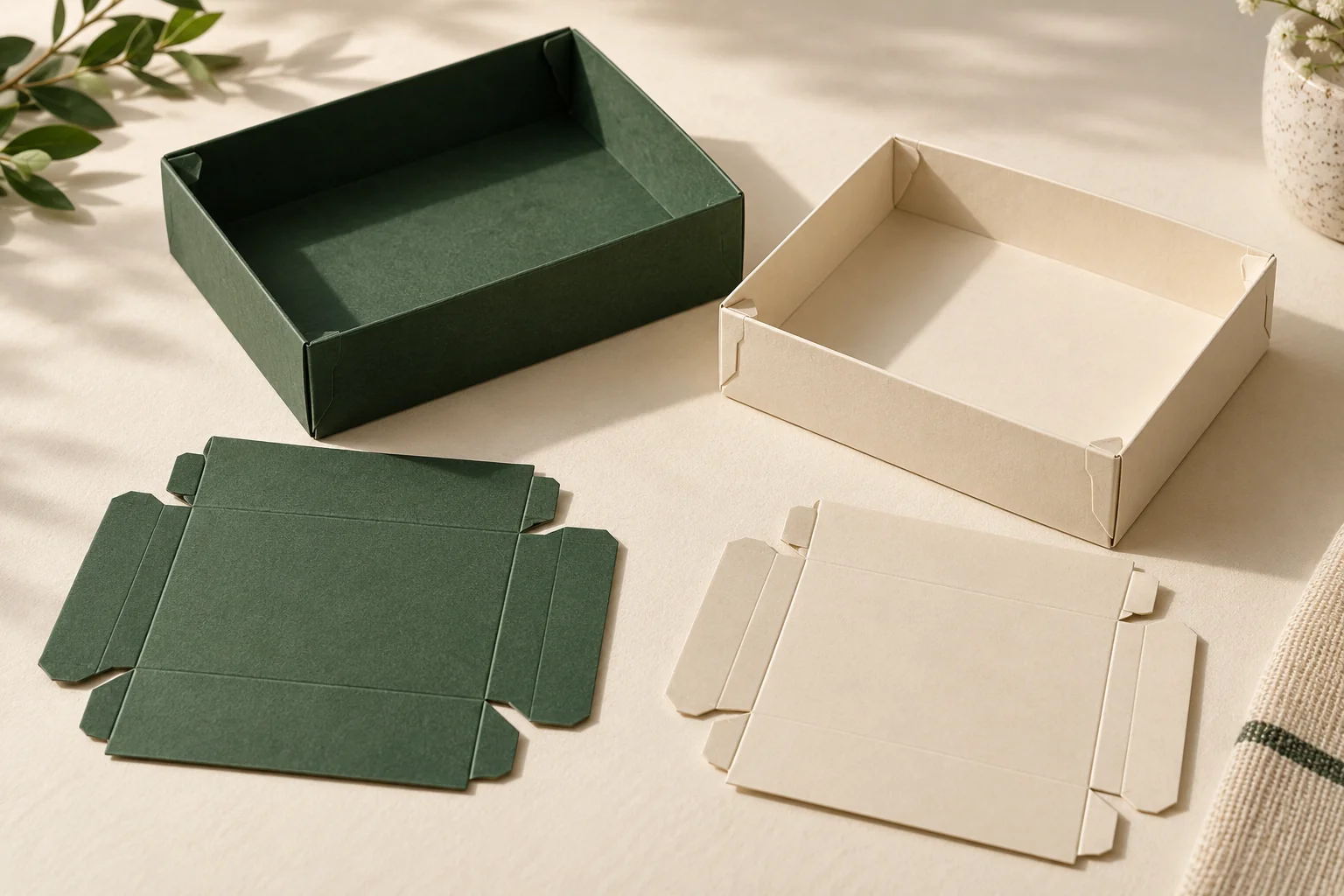
Concept / packaging option. AI-assisted visuals explain the structure; final materials, production details and sample scope are agreed for the project.
Treat the base and lid as separate constructions
A two-piece appearance does not tell you which panels fold, lock or arrive pre-glued. Ask for the proposed base drawing and lid drawing, with the remaining local work marked on each. Identify any doubled walls, corner tabs, adhesive areas or additional parts before assigning packing responsibilities.
Measure the formed base for its usable product space, then discuss the lid overlap against the actual assembled construction. The outside dimensions of a flat blank answer a different question. Added wrapping, a holder or a card that rises above the walls can change the finished lid decision.
Decide where the formed components are stored before loading. A packing team might form both pieces in advance or assemble one complete gift at a time. Those are different workflows, with different staging questions. Record the preferred process and ask whether the supplied packing arrangement supports it.
Choose the lift-off format with its local work
Compare this option with the rigid lid-and-base format when deciding whether local forming work belongs in the project. Both have a separate cover, but their component construction and delivery state need individual confirmation. Compare a one-piece folding carton when an attached closing flap better suits the loading process.
For an illustrative gift kit, a pouch and a care card may need a shared holder inside the base. A lid that fits an empty box may respond differently to that complete layout. Specify the removal sequence and the part the customer should grasp after the cover is lifted.
Describe the two-piece packing job
| Field | Record for review |
|---|---|
| Base | Usable formed space, wall build, locks and support for the product. |
| Lid | Formed interior, overlap depth and the intended lift-off action. |
| Components | Holder, tissue, cards and their loaded height. |
| Assembly | Folds, consumables, instructions and the person completing each step. |
| Delivery | State of both pieces, bundles and proposed carton packing. |
| Artwork | Named base and lid files, print faces and finish areas. |
Keep the top artwork orientation related to how the base is loaded. If a logo should face the customer at a particular opening angle, show that view in the brief. The flat and assembled scope worksheet lets the proposals identify what arrives and what remains to do.
Review one complete gift
- Form the base and lid using the supplied instructions.
- Inspect corners, locks, seams and the intended wall positions.
- Load all items and extras into their proposed places.
- Fit the lid, then lift it using the intended customer grip.
- Remove the contents and inspect contact with the walls and holder.
- Check artwork orientation and fold appearance on the formed pieces.
Record a base or lid correction against the appropriate drawing. If a change affects overlap or loaded height, identify the paired component that must be checked again. Approving one blank should not silently approve a different assembled pair.
Agree quantities for the complete configuration
Packrivo’s order planning policy is 500 pieces per product / design. List the base, lid, holder and printed extras with their quantity and sample scope. Final materials, pricing, production conditions and delivery timing are reviewed for the agreed project.
The original foldable lid-and-base reference shows the separate folding components. Use it to understand the format, without transferring its material or commercial claims.
Get a Quote with your contents and preferred assembly state. Packrivo helps organize the two-piece questions before you compare supplier responses and plan the sample review.