
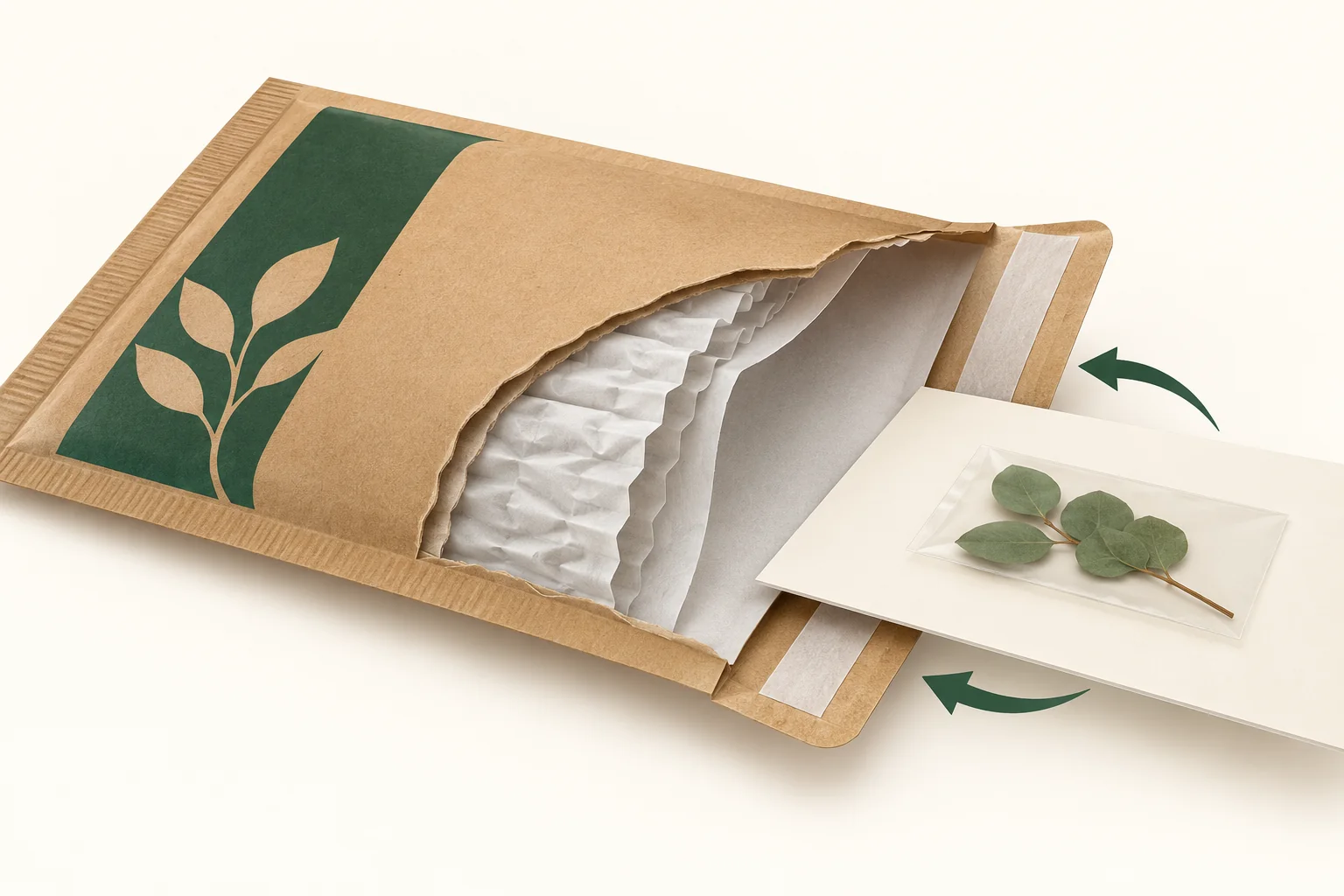
This is an inquiry concept. The exact paper and padding construction need supplier confirmation; environmental and protective outcomes require their own evidence.
Name each proposed layer
The paper padded envelope reference identifies a paper envelope with integrated padding. Request the actual outer layer, padding and inner contact layer for your proposal. Do not infer a particular honeycomb, loose-fill or other structure from the category name.
Keep seam and joining areas on a side section. Ask whether the padding stops before the mouth or extends into the closing region. Those details affect the loaded geometry to review.
Compare an unpadded paper mailer when the inner product pack already defines another contact and support system. The choice should be based on the complete proposed configuration.
Load through the actual usable opening
Provide the maximum product envelope, including cards, inner wrap and any projecting part. Mark the intended entry orientation. Ask the supplier for usable opening dimensions on the actual proposal, with their reference condition labeled.
For a hypothetical accessory on a backing card, the card’s corners can be the leading contact points. Insert the full pack through the mouth and record contact with the inner layer or seam rather than forcing it past an obstruction for a photograph.
Review the final filled thickness before closing. Ask the supplier to identify the closing area and method. An empty envelope’s neat flap position doesn’t show the filled reach.
Use a layer and contact record
Attach the section drawing and loaded sample identity. Keep material facts and buyer observations in different columns.
| Part | Layer specification requested from the supplier | Loaded observation |
|---|---|---|
| Outer layer | Material and print surface | Final outside shape |
| Padding | Actual construction and extent | Relationship around contents |
| Inner contact | Material touching product | Named contact points |
| Seams/mouth | Usable boundaries | Entry route and first contact |
| Closure | Method and receiving area | Filled closing reach |
The packed-system guide keeps any protective requirement broader than one layer name. A padded category does not substitute for the agreed evaluation of actual contents.
Keep the layer scope current
In the hypothetical record, call the leading card corner LC1 and inner seam IS1. A contact at LC1/IS1 gives the supplier a specific opening question. It need not be labeled a padding failure without further evidence.
If the source proposes another padding stack, identify the changed layers and repeat the relevant loading and closing actions. An outside size that stays unchanged can still contain a different internal interface.
Confirm the delivered preparation, who packs the contents and where the shipping label will be applied. Any distribution or cushioning requirement needs a named method and responsible evidence, separate from the local fit record.
Bring the section and loaded envelope
Send the layer questions, complete contents, usable-mouth request, quantity and destination through Get a Quote. The minimum is 500 pieces per design. Final construction, samples, price and timing are confirmed for the project.