
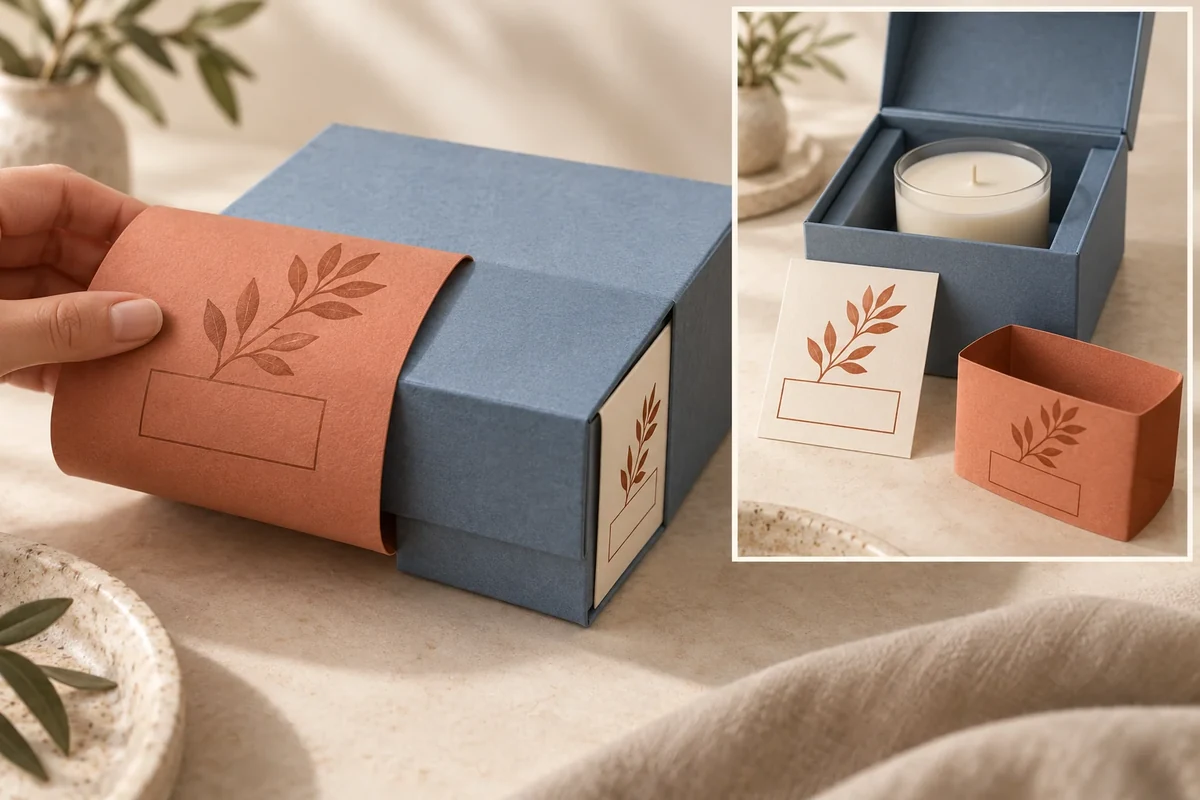
Map which product identity, care and reference information remains when a belly band is removed. Assign each required supplied field to a retained product, card or box surface and review that removal state. A removable band can introduce the gift, while the customer still needs an identifiable item after the band is discarded.
List the information that needs to survive removal
This is an original Packrivo handoff tool. The product owner supplies the actual identity and approved information; the worksheet does not create a barcode standard or decide regulatory copy.
Identify the band fields and the point at which the band is removed. List which supplied name, variant, care instruction or project reference the customer needs afterward. Keep required and optional information separate instead of duplicating everything by default.
Give each retained field a physical carrier: the actual product/primary pack, a kept card or a permanent box area. Record its position and the supplied wording or reference. A filename or information visible only on the discarded band does not identify the retained item.
Review the band-off state with the complete pack
The paper belly band defines the removable construction. This tool adds the information handoff after that removal. Load the complete gift, remove the band through its intended route and retain the customer-facing state for review.
Check whether the remaining product/card/box identity still corresponds to the actual contents. If a gift has multiple variants, use the real supplied matching reference and keep its owner visible. Do not create a fake identifier merely to make an illustration resemble a retail label.
Record information that becomes inaccessible after another component is removed. The buyer should decide whether the card stays with the gift, the box remains useful or the primary product needs a different approved information position.
Use a retained-identity map
These hypothetical gift references illustrate the decision; they are not real product SKUs or an actual order.
| Supplied information | On removable band | Retained carrier after removal |
|---|---|---|
| Product name | Band field N1 | Approved name on actual primary pack |
| Variant reference | Supplied project field V1 | Matching approved field on retained card/pack |
| Care information | Short pointer if supplied | Approved text on a card intended to be kept |
| Project/reference field | Only if supplied for this purpose | Named retained box/card location |
| Removal point | Customer slides band off gift box | Band-off photo with retained fields visible |
| Missing identity | Field exists only on discarded band | Product owner/design owner resolves location |
Resolve an illustrative band-only identity
Imagine two gift variants share a similar outer box and their supplied variant names appear only on different belly bands. When the customer removes a band, the remaining pack may no longer show the intended reference. Record that specific field rather than asking for generally more branding.
The product owner can decide which approved field should remain on a card or primary pack. The designer then returns the actual placement and file, and the buyer reviews the band-off arrangement with the correct contents. This gives the handoff a retained identity without turning the article into barcode-placement guidance.
Handoff retained fields to the artwork owner
Use the artwork handoff checklist to keep the approved wording and file revisions with the placement. The next route is band construction, retained information map, artwork handoff and the packaging brief.
The product owner supplies the real identity and approved copy. The designer places it on the agreed retained carrier. The packing observer returns the removal state, and the buyer decides which fields remain open. Keep those responsibilities explicit before accepting the complete presentation.
MOQ is 500 pieces per design. Packrivo helps prepare the brief and coordinate the remaining information/packaging questions; the actual artwork, sample scope and commercial details are confirmed for the project.
Check whether the retained carrier survives the next removal state
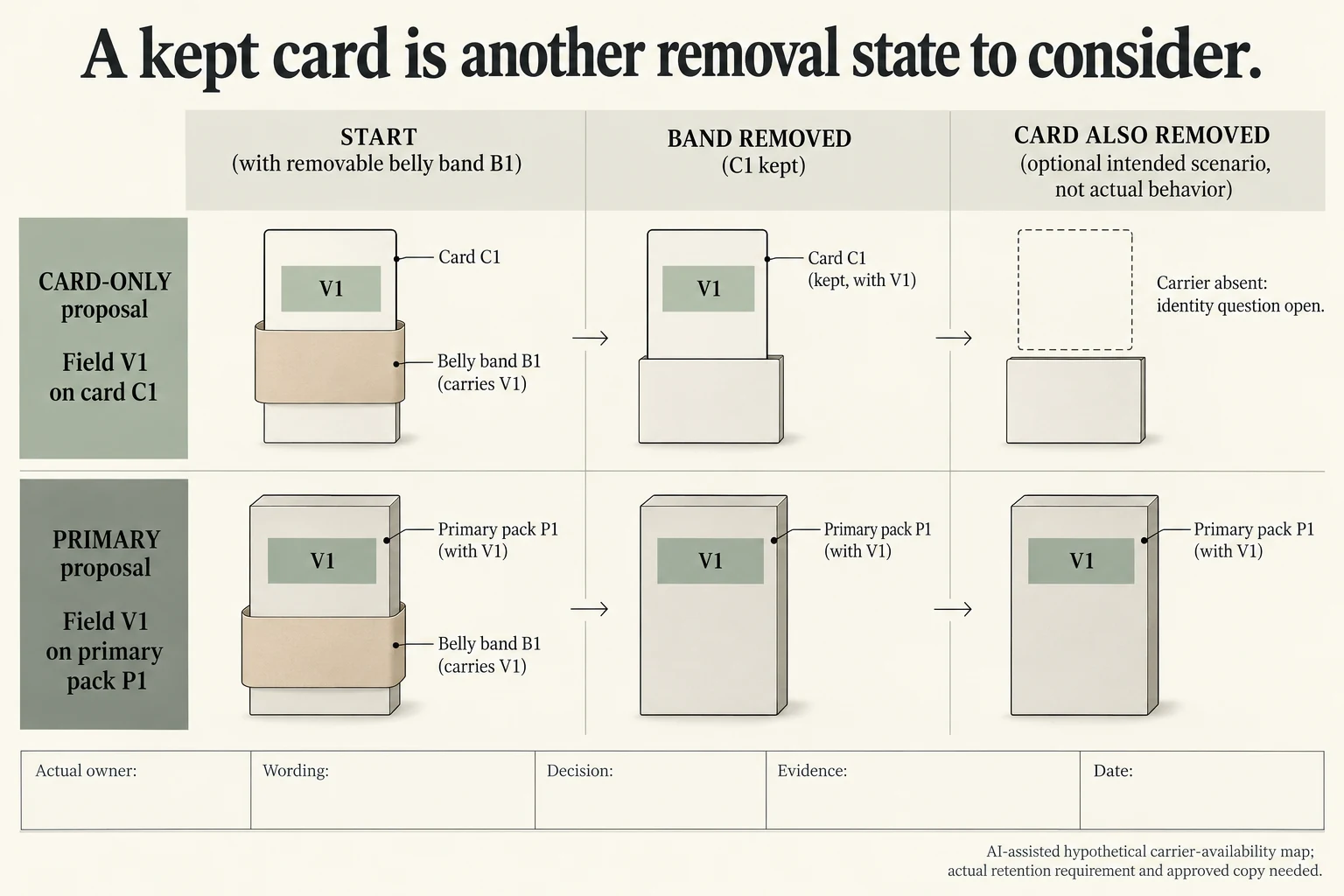
A field can survive band removal yet disappear when the customer later separates a card. Compare two hypothetical placements for the supplied V1 variant field: CARD_ONLY22 assigns it to C1, while PRIMARY22 assigns it to primary pack P1. The fields are location references, not actual variant names, retail identifiers or proposed care wording.
Scroll horizontally if columns extend beyond the view.
| Hypothetical configuration | Named object | Relationship | Input or next scope |
|---|---|---|---|
| CARD_ONLY22 | V1_FIELD | assigned to | C1_CARD |
| CARD_ONLY22 | V1_FIELD | carrier available at | BAND_OFF_CARD_KEPT; AVAILABLE_BY_ASSUMED_CARRIER_STATE |
| CARD_ONLY22 | V1_FIELD | carrier absent at | BAND_OFF_CARD_REMOVED; CARRIER_ABSENT_IDENTITY_QUESTION_OPEN |
| PRIMARY22 | V1_FIELD | assigned to | P1_PRIMARY_PACK |
| PRIMARY22 | V1_FIELD | carrier available at | BAND_OFF_CARD_KEPT; AVAILABLE_BY_ASSUMED_CARRIER_STATE |
| PRIMARY22 | V1_FIELD | carrier available at | BAND_OFF_CARD_REMOVED; AVAILABLE_BY_ASSUMED_CARRIER_STATE |
Review two explicit states: BAND_OFF_CARD_KEPT and the optional BAND_OFF_CARD_REMOVED. Under the first assumption, the C1 field still has its carrier. Under the second, a field located only on C1 has lost that carrier. The P1 placement remains available in these particular assumed states because P1 is retained. Those are planning relationships, not evidence of customer behavior or a claim that all information must be duplicated.
Ask the product owner which removal states actually need the identity. If the card is intended to stay with the gift and that meets the requirement, a primary-pack duplication may be unnecessary. If the customer needs the variant after separating the card, request an approved retained position. Keep the name, care and project-reference fields independent; the product owner determines their required or optional scope and supplies the actual copy.
The CSV retains the original two-variant band-only gap and all original field-to-carrier prompts, then adds candidate-specific availability, copy-match, contents-match and actual-state-view requests. A carrier existing in a diagram does not show that its words identify the correct contents or can be found in the complete band-off presentation. Keep those decisions separate before handing the selected placement and artwork revision onward.
Download the belly band retained product identity map record (.csv). It includes the original table fields and scenarios alongside the added relationships. HYPOTHETICAL rows are editorial examples or required review scopes, not actual records. Actual quantity, configuration, component and file identities, materials, process, specification, copy, method, condition, observation, owner, decision, evidence and dates are blank. ACTUAL_BLANK is a separate empty starting row; enter permitted project evidence before using an actual record. A blank means unknown.
Use the Packaging Artwork Handoff Checklist for Print Approval for its separate question. Use the Gift-Set Barcode Identity Follows the Sold Assortment for its separate question.
Source scope checked 16 October 2026. References cover only the named materials, processes or guidance. Added configurations and geometry are hypothetical, not supplier specifications, tests or production approval; they set no universal tolerances or machine limits. Confirm the actual material, process, drawing and formed sample for the project.
Discuss this packaging specification with Packrivo. We coordinate independent suppliers. MOQ: 500 pieces per product/design; illustrative quantities are not production offers. Confirm materials, samples, price and timing for your project.