
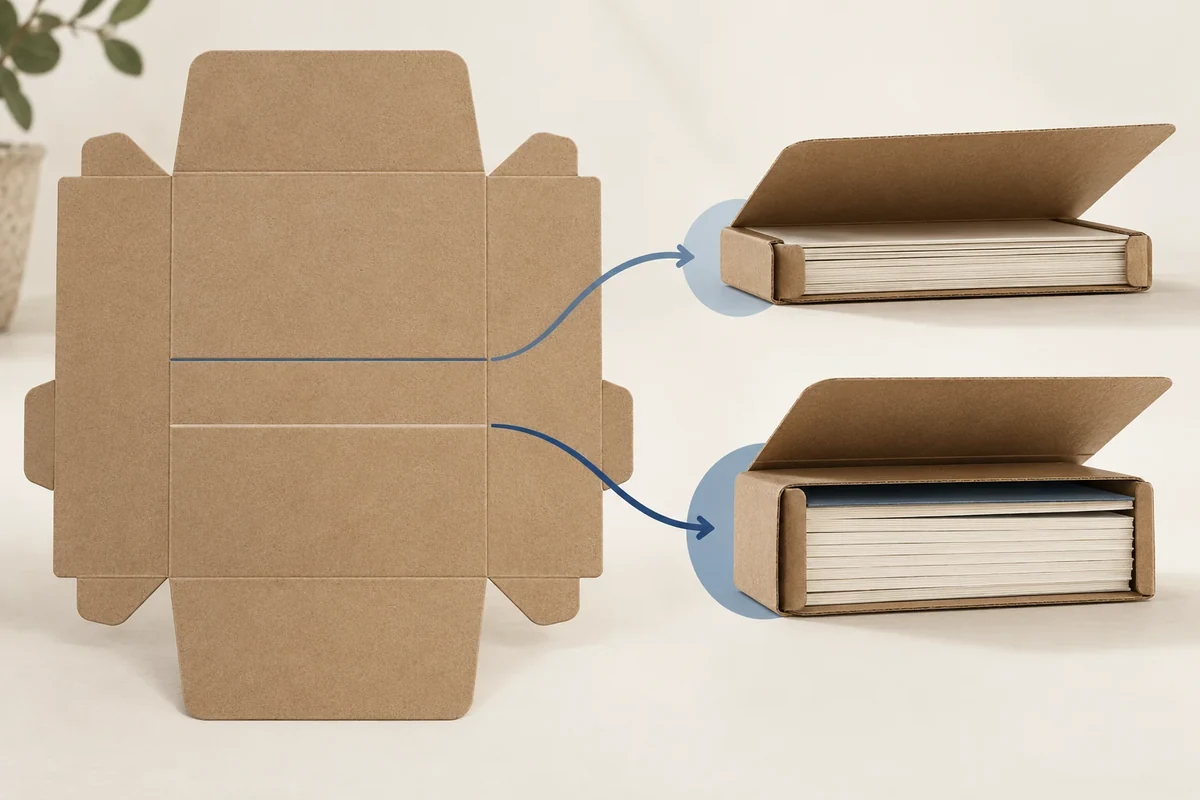
Assign proposed book-wrap fold positions to named complete fills before writing the packing instruction. Record the contents, filled thickness and closing route for each configuration. A wrap described as adjustable still needs confirmation of the actual settings available on the proposed blank.
This chart connects one fill to one confirmed setup. It should not create a universal thickness range or allow staff to choose any fold by appearance alone.
Ask which settings the proposal actually has
The book-wrap mailer reference establishes the form. Request the actual blank and supplier-marked fold settings. If only one setting is proposed, record it rather than inventing multiple positions.
Name each fill with its complete contents and orientation. Include backing, cards and wraps that change thickness. Mark local high points separately from the main stack.
Use the supplied-state guide to keep delivered folds or prepared joins separate from staff setup. A chart should describe work the actual packing location performs.
Link each fill to its closing route
Place the named contents on the proposed starting panel. Follow the confirmed folds and show the final closing surfaces. Keep the available joining area visible before it is completed.
If two fills use different settings, review them as separate states. A thick fill closed by an extra unrecorded fold is not evidence for the original setting.
| Setup-chart field | Named fill A | Named fill B | Source/status |
|---|---|---|---|
| Contents | Complete list and orientation | Complete list and orientation | Buyer confirmed |
| Thickness | Recorded packed state | Recorded packed state | Method and high point |
| Fold setting | Supplier-named position | Supplier-named position | Confirmed or open |
| Closing route | Method and receiving area | Method and receiving area | Proposal revision |
| Operator action | Actual setup sequence | Actual setup sequence | Instruction identity |
| Evidence | Loaded view and opening | Loaded view and opening | Matched sample |
Leave a missing setting open. An empty field is more useful than a guessed position copied from another book-wrap design.
Follow a hypothetical print bundle
Suppose a gift brand packs a card collection and a thicker booklet collection. The supplier proposal includes two stated fold settings. The buyer names the fills A and B, then links each to its proposed setting and closing view.
During a trial, fill B requires another movement before the flap reaches its joining area. The record preserves that action and asks whether the setting or instruction needs revision. It does not describe B as approved simply because the wrap finally closes.
If the supplier revises the blank, the chart updates the setting IDs and keeps the earlier instruction superseded. Both fills remain named so the new proposal is not reviewed only with the easier one.
Make the next question fill-specific
Ask: ‘Please confirm setting FS-B and the closing route for fill B on this blank revision.’ It names the configuration and action. A generic size or material reply can leave FS-B unresolved.
Review the customer’s opening with the same fill after the confirmed closure. Packing and removal can need different movements. Keep both in the chart instead of assuming the customer reverses all setup steps.
The chart is an original setup tool. It does not establish bend protection, capacity or transport performance; required evaluations need the actual system and a separately agreed method.
Send the named fills and settings
Bring the contents lists, actual blank references and loaded closing observations through Packrivo’s enquiry. The next response should confirm which setup applies to each fill and what evidence is still required.
A new blank needs a complete fill-to-setting map
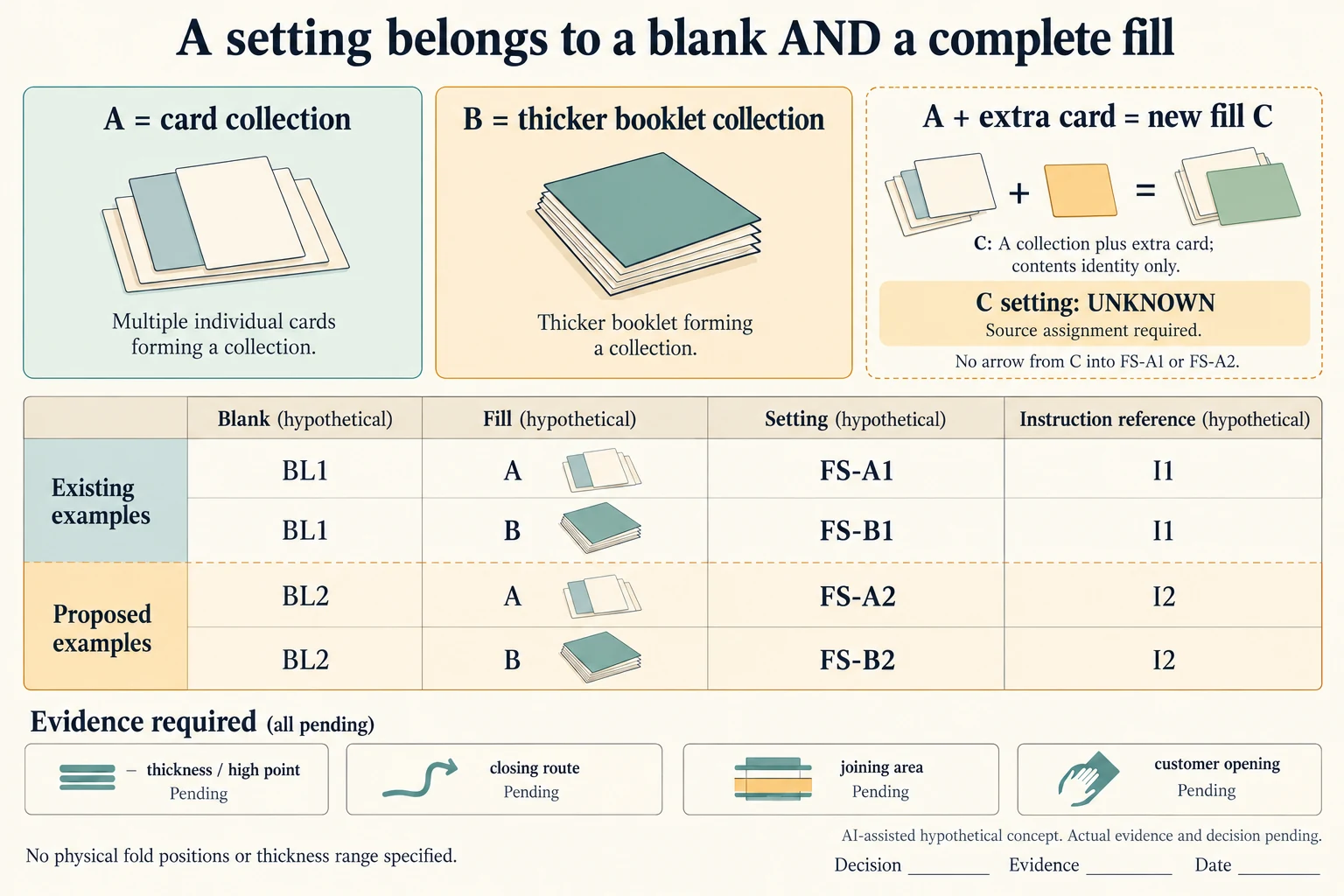
Treat the setup as a keyed relationship between a blank revision and a complete fill. Invented BL1 uses instruction I1, with FS-A1 for fill A and FS-B1 for fill B. Proposed BL2 uses I2, with proposed FS-A2 and FS-B2 respectively. The setting names identify source questions, not physical crease coordinates or confirmed available positions on a manufactured blank.
Scroll horizontally if columns extend beyond the view.
| Hypothetical configuration | Named object | Relationship | Input or next scope |
|---|---|---|---|
| BL1_A | BL1_A | uses setting | FS-A1 |
| BL1_A | BL1_A | uses instruction | I1 |
| BL1_B | BL1_B | uses setting | FS-B1 |
| BL1_B | BL1_B | uses instruction | I1 |
| BL2_A | BL2_A | uses setting | FS-A2 |
| BL2_A | BL2_A | uses instruction | I2 |
| BL2_B | BL2_B | uses setting | FS-B2 |
| BL2_B | BL2_B | uses instruction | I2 |
| UNMAPPED_C24 | C | requires | SOURCE_SETTING_ASSIGNMENT |
The CSV gives each of the four blank/fill combinations its own setting and instruction rows, plus thickness/high-point, closing-route, joining-area and customer-opening requirements. Do not take FS-B2 from a new drawing while following I1 from the earlier proposal. A setting ID is meaningful only against its blank and complete fill. Both A and B need their relevant review after the change, rather than allowing the thinner card collection to stand in for the booklet fill.
Now suppose an additional card changes A into a new complete fill C. The download deliberately leaves C’s setting assignment unknown. A similar-looking thickness or a familiar product name does not authorize FS-A1 or FS-A2. Ask the source which setting the new contents use and retain the changed contents, orientation and local high point with the reply. If the actual blank has only one available setting, record that fact instead of manufacturing several choices.
Packhelp’s catalogue establishes an adjustable book-wrap category; it is not a setting chart for BL1 or BL2 and establishes no universal thickness range. The original fill-B extra movement remains an exception requiring clarification, not evidence of accepted closure. Confirm the operator’s actual setup and customer opening separately, with delivered preparation and local work assigned to their owners.
Download the book wrap blank setting revision record (.csv). It includes the original table fields and scenarios alongside the added relationships. HYPOTHETICAL rows are editorial examples or required review scopes, not actual records. Actual quantity, configuration, component and file identities, materials, process, specification, copy, method, condition, observation, owner, decision, evidence and dates are blank. ACTUAL_BLANK is a separate empty starting row; enter permitted project evidence before using an actual record. A blank means unknown.
Use the Define Flat and Assembled Packaging Delivery Scope for its separate question. Use the Packaging Dieline Changes Need an Impact Record for its separate question. Use the Keep Box Insert and Sleeve Variants Matched During Packing for its separate question.
Source scope checked 16 October 2026. References cover only the named materials, processes or guidance. Added configurations and geometry are hypothetical, not supplier specifications, tests or production approval; they set no universal tolerances or machine limits. Confirm the actual material, process, drawing and formed sample for the project.
Discuss this packaging specification with Packrivo. We coordinate independent suppliers. MOQ: 500 pieces per product/design; illustrative quantities are not production offers. Confirm materials, samples, price and timing for your project.