
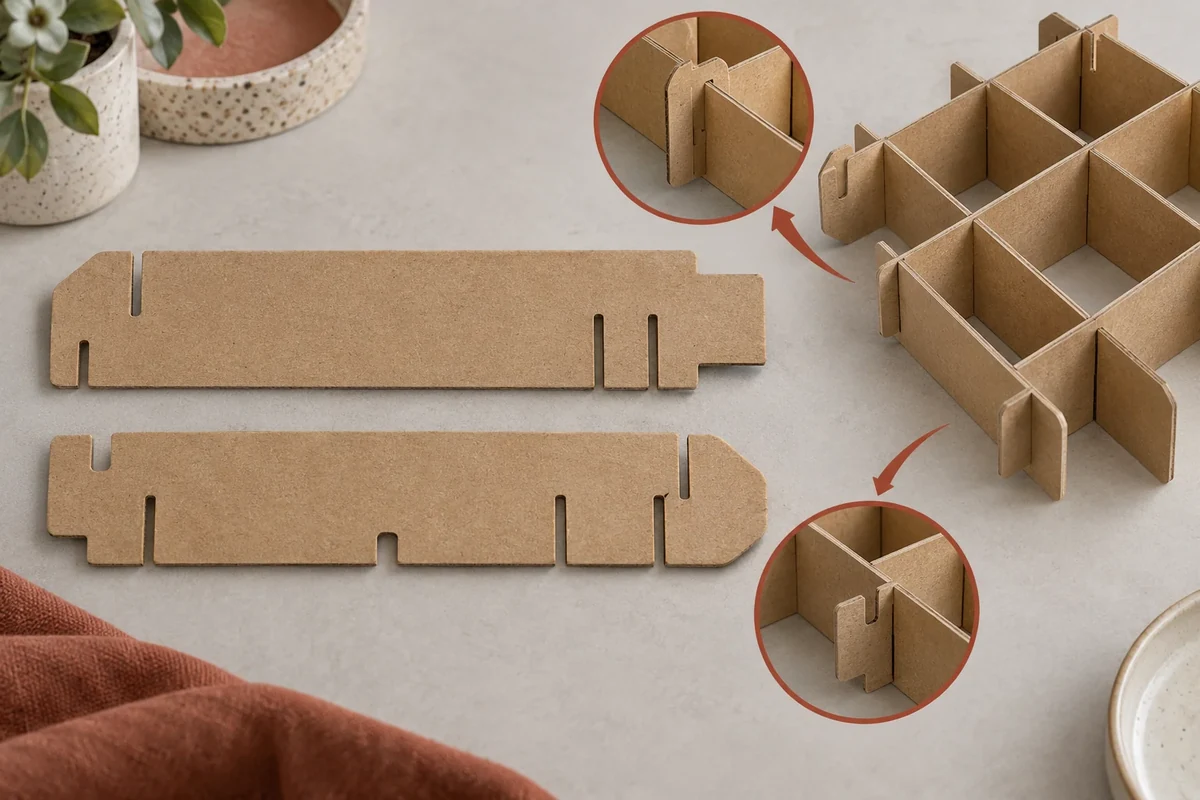
Identify differently handed divider parts on the actual drawings before writing the assembly and loading plan. Keep left, right and shared parts distinct, with their installed orientations shown. A mirrored-looking illustration does not establish that two pieces are interchangeable.
This sheet applies when the proposed divider has differing parts. If the source confirms one common part, record that fact instead of inventing left and right versions.
Use the drawing to define part identity
The divider reference establishes the component direction. Ask the supplier which pieces differ in outline, slots, folds or another construction detail. Identify those differences on the proposal rather than assigning a part by colour alone.
Give each differing part a stable ID and name the orientation when installed. A loose part turned over can look like its counterpart while creating another slot relationship. Show the print side or reference face if relevant.
The grid-divider direction connects parts to cells. This sheet adds the identification work needed before those parts are interlocked or loaded.
Map identity through assembly
Show where each part is picked, oriented and installed. Include the point at which another piece hides its identifying feature. The instruction should make the correct relationship available before that point.
Keep shared parts explicitly shared if the source confirms them. A separate part number for every position can create unnecessary ambiguity when one piece is genuinely repeated.
| Part field | Left or differing part | Right or counterpart | Assembly check |
|---|---|---|---|
| Identity | Actual drawing/part ID | Actual drawing/part ID | Source confirms difference |
| Reference face | Installed orientation | Installed orientation | Before interlocking |
| Distinct feature | Slot/fold/outline location | Corresponding feature | Visible pick reference |
| Installed position | Named cell or side | Named cell or side | Formed layout view |
| Supply | Counts and grouping | Counts and grouping | Delivered set matches plan |
| Change | Affected revision | Affected revision | Instruction rechecked |
Use the supplied-state guide to define whether parts arrive loose, bundled or preassembled. The identification method should match the actual handoff.
Follow a hypothetical unequal-cell divider
Suppose a gift set uses different-width cells around two products. The proposed divider includes two strips with different slot positions. The buyer names them D-L and D-R using the supplier drawing and marks the installed reference faces.
A reviewer follows the assembly plan. If the strips are swapped, the record shows the mismatch at the named slot rather than calling the whole divider too tight. The supplier can clarify the pick or orientation instruction.
If the source later proposes a common strip for both sides, the sheet records that construction change. It doesn’t retain an unnecessary handed distinction merely because the first drawing used one.
Make the instruction usable after bundling
Ask the supplier how the differing pieces can be identified in their delivered state. A temporary marker on an engineering model may not belong on a production part. Record the proposed identification method and its scope.
A specific question is: ‘Please confirm the delivered identity and installed reference face for D-L and D-R.’ A final formed photo alone leaves the pick step open.
Review the revised assembly with actual parts and complete contents. This tool records identity and sequence; any protective or retention requirement needs separate evidence. Correct part selection doesn’t establish those results.
Send the differing parts together
Bring the part drawings, installed map, supplied-state request and open pick questions through Packrivo’s enquiry. The next response should confirm which pieces differ and how their identities survive through packing.
One common part identity can still require two physical strips
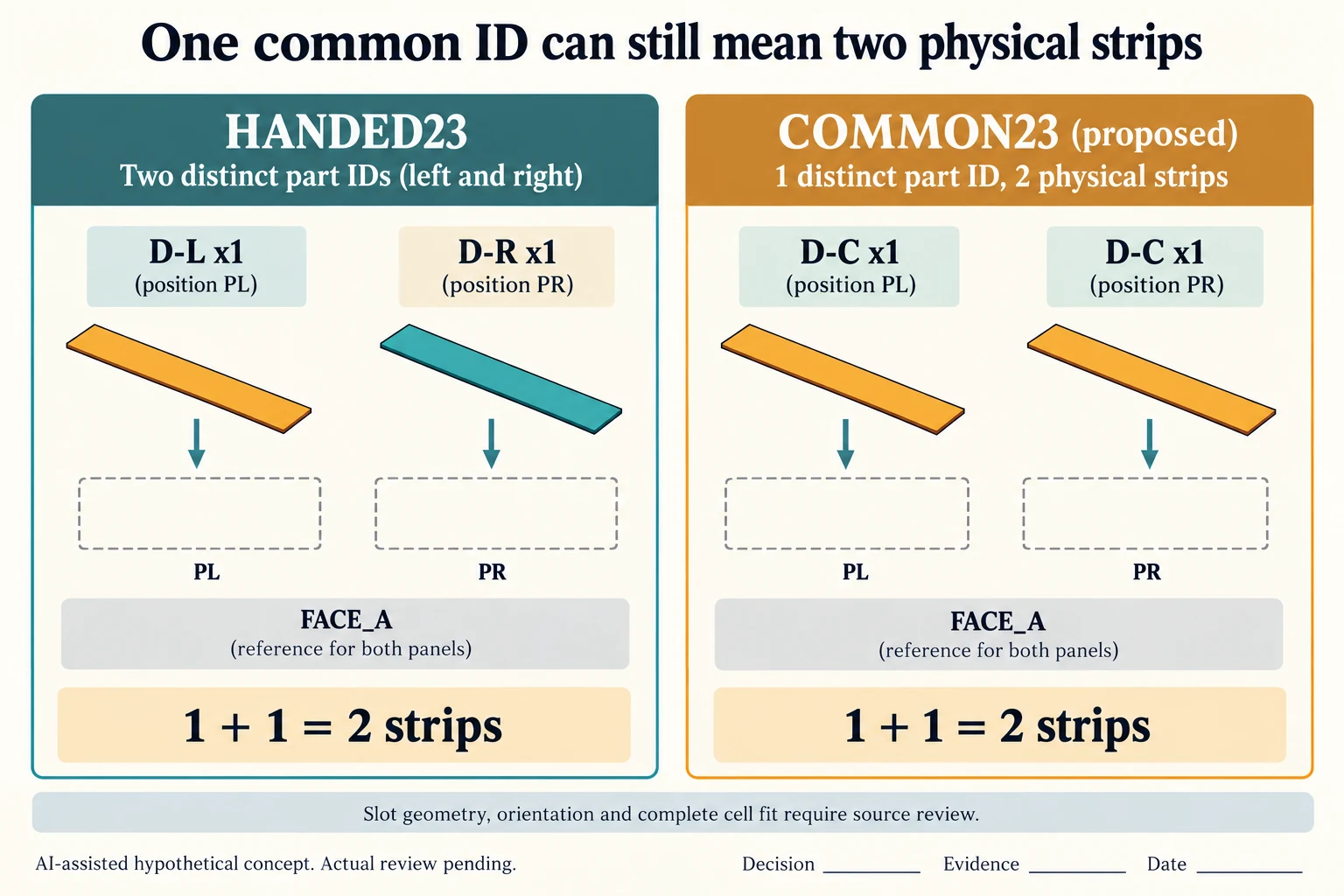
Use one invented assembly with installed positions PL and PR referenced to FACE_A. HANDED23 requires one D-L at PL and one D-R at PR: two strips in total. COMMON23 is a proposal for one D-C at PL and another D-C at PR, also two strips. One shared part identity reduces the number of distinct IDs in this example; it does not reduce the physical strip requirement to one.
Scroll horizontally if columns extend beyond the view.
| Hypothetical configuration | Named object | Relationship | Input or next scope |
|---|---|---|---|
| HANDED23 | D-L | assigned to | PL; 1 strips |
| HANDED23 | D-R | assigned to | PR; 1 strips |
| HANDED23 | ASSEMBLY | calculated from | HANDED23_PL|HANDED23_PR; 2 strips |
| COMMON23 | D-C | assigned to | PL; 1 strips |
| COMMON23 | D-C | assigned to | PR; 1 strips |
| COMMON23 | ASSEMBLY | calculated from | COMMON23_PL|COMMON23_PR; 2 strips |
The CSV preserves a separate one-strip assignment row for each position, with source group and installed-face references, plus a derived two-strip total linked to those rows. The original unequal-cell, two-product example remains a separate source question about slot positions and handed geometry. No common drawing has been returned, and the proposed D-C identity establishes no interchangeability or successful fit.
Ask the source to confirm geometry before replacing handed labels. Then review picking identity, installed orientation, the located slot match, complete cell fit and supplied-state labels for the chosen configuration. Loose, bundled and preassembled delivery can expose or hide identity at different moments. Use a documented engineering reference where needed without assuming a production printing or marking method.
Do not turn a loose strip over and infer that it belongs in the other installed position. The actual slot, fold and outline relationship must match the fixed reference face. A divider quantity map also does not establish vertical load support, buckling resistance or transport protection. Keep actual counts, source reply, assembly observation and decision evidence blank until the responsible parties identify and review the actual parts.
Download the handed divider quantity position map record (.csv). It includes the original table fields and scenarios alongside the added relationships. HYPOTHETICAL rows are editorial examples or required review scopes, not actual records. Actual quantity, configuration, component and file identities, materials, process, specification, copy, method, condition, observation, owner, decision, evidence and dates are blank. ACTUAL_BLANK is a separate empty starting row; enter permitted project evidence before using an actual record. A blank means unknown.
Use the A Tall Paperboard Divider Can Lose Stability Under Compression for its separate question. Use the Define Flat and Assembled Packaging Delivery Scope for its separate question. Use the Keep Box Insert and Sleeve Variants Matched During Packing for its separate question.
Source scope checked 16 October 2026. References cover only the named materials, processes or guidance. Added configurations and geometry are hypothetical, not supplier specifications, tests or production approval; they set no universal tolerances or machine limits. Confirm the actual material, process, drawing and formed sample for the project.
Discuss this packaging specification with Packrivo. We coordinate independent suppliers. MOQ: 500 pieces per product/design; illustrative quantities are not production offers. Confirm materials, samples, price and timing for your project.