
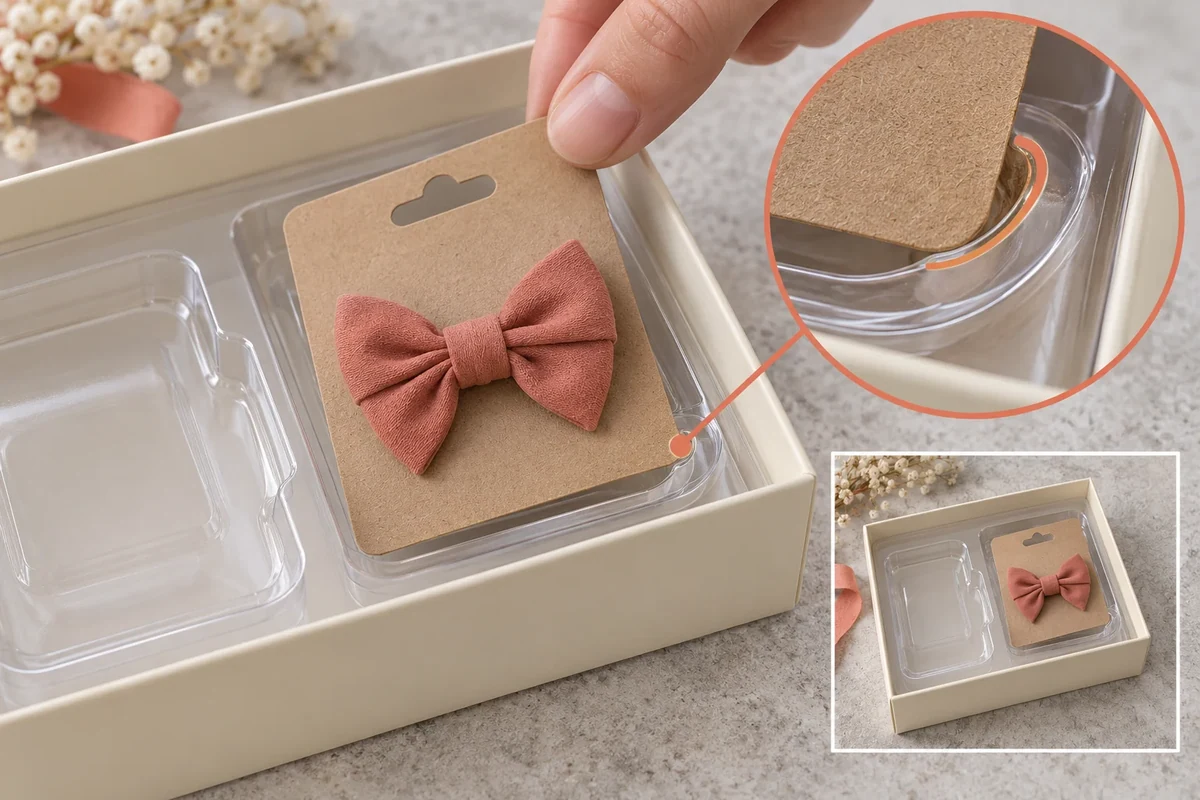
Name the formed tray edge that the product or hand touches, and record the action at that contact. Keep the actual material and sample state with the observation. A general request for a smoother tray can lose the location needed for the supplier to assess the proposed construction.
This map documents an interface and user action. It does not declare an edge safe, compliant or defective from a concept image.
Identify the edge on the actual tray
The thermoformed-tray reference establishes the formed tray and cavity context. Ask the supplier to show the actual perimeter, cut or formed edge in its proposal. The maker’s general capabilities do not verify the finish of your sample.
Give the relevant edges stable IDs on a top and side view. Distinguish the outer perimeter, cavity rim and any removal opening. Record whether the sample represents the final material and edge construction.
Include the product and any inner wrap or holder. A product resting on a broad cavity surface creates a different question from a hand reaching across its rim.
Record the touching action
Describe the stage when contact occurs: loading, closing, first grip or product removal. Keep the starting pack state visible. A hand touching a loose tray on a desk doesn’t necessarily represent access inside the complete box.
If the reviewer changes the grip or moves another item, preserve the action as a deviation or another proposed sequence. It can help explain the issue while leaving the original action unresolved.
| Edge-map field | Entry | Evidence |
|---|---|---|
| Edge ID | Perimeter, cavity rim or opening | Marked wider view |
| Construction | Actual material and edge proposal | Supplier response/sample identity |
| Contacting part | Product, wrap or hand | Located close view |
| Action stage | Loading or named access action | Starting and contact states |
| Changed action | Extra support or movement | Deviation recorded |
| Next response | Specific edge question | Revision and review scope |
Use the sample checklist for acceptance scope. Any requirement about edge condition needs a responsible agreement and appropriate evidence, beyond this location record.
Follow a hypothetical carded-gift tray
Suppose a formed tray holds a carded accessory in an outer box. During removal, the card edge meets one part of the cavity rim. The buyer names that tray edge E3 and card corner CC1, retaining the installed starting view.
The source is asked to review E3/CC1 and the intended removal route. A generic tray material description leaves that particular interface unanswered. The buyer avoids assigning a cutting or forming cause from a photograph.
A revised proposal may change the cavity opening, edge construction or card route. Each change remains identified so the next sample can be compared against the same task.
Keep material facts separate from judgement
Ask: ‘Please confirm the proposed edge construction at E3 and the evidence needed for the stated contact requirement.’ That names the location and leaves technical assessment with the responsible source.
Record observations in plain terms, including contact location or a changed grip. Do not label a concept edge with an unsupported safety result. If a specialist review is required for the use, keep it as a separate open item.
After a material or geometry revision, update the sample identity and repeat the relevant action. An unchanged outside tray outline does not necessarily describe the same contacted edge.
Send the located interface
Bring the edge map, actual component information and action views through Packrivo’s enquiry. The next response should address the named edge and use condition, followed by review under the agreed scope.
A material change and an edge change need different comparisons
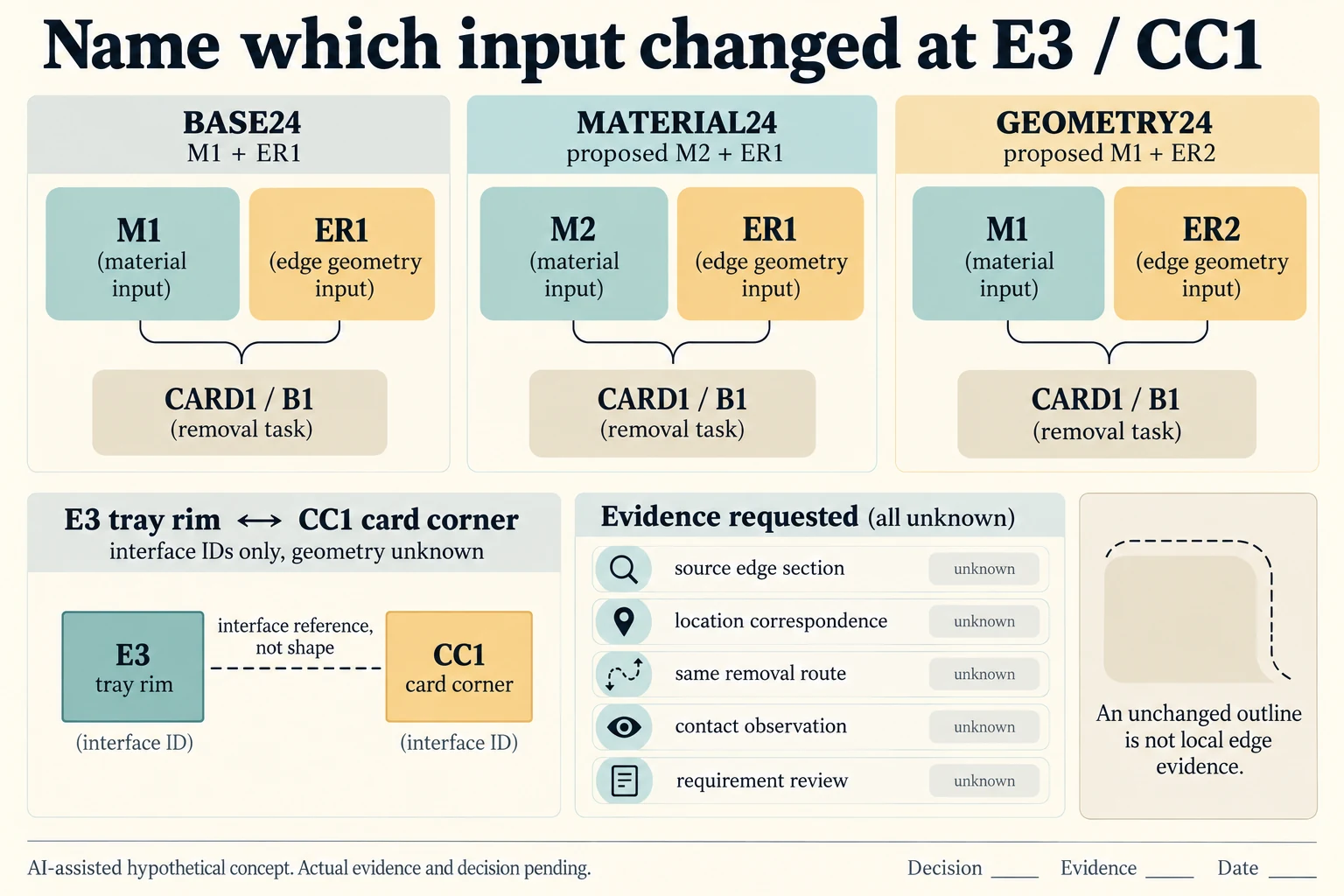
Identify the original E3/CC1 removal interface, then separate two candidate responses. BASE24 names material M1 and edge revision ER1. MATERIAL24 proposes M2 with ER1 retained. GEOMETRY24 retains M1 but proposes ER2. CARD1, box B1 and the requested removal task remain identified. These are invented reference combinations; no actual material grade, edge radius or forming setting is specified.
Scroll horizontally if columns extend beyond the view.
| Hypothetical configuration | Named object | Relationship | Input or next scope |
|---|---|---|---|
| BASE24 | BASE24 | uses material | M1 |
| BASE24 | BASE24 | uses edge revision | ER1 |
| BASE24 | BASE24 | uses interface | E3_CC1 |
| MATERIAL24 | MATERIAL24 | uses material | M2 |
| MATERIAL24 | MATERIAL24 | uses edge revision | ER1 |
| MATERIAL24 | MATERIAL24 | uses interface | E3_CC1 |
| GEOMETRY24 | GEOMETRY24 | uses material | M1 |
| GEOMETRY24 | GEOMETRY24 | uses edge revision | ER2 |
| GEOMETRY24 | GEOMETRY24 | uses interface | E3_CC1 |
Each combination has its own source-section, location-correspondence, same-route, actual-contact and requirement-review scopes in the CSV. Ask whether the E3 location still corresponds when ER2 changes the opening or rim. Reusing an edge ID is useful for following an issue, but it is not evidence that the local geometry stayed unchanged. If the feature moves or disappears, the source needs to identify its replacement location.
A material-only reply does not answer whether the revised sample presents the same contacted edge, and an unchanged outside outline does not establish the local construction. Keep a product/card contact observation separate from a hand-contact requirement. Loading, closing, first grip and removal also remain separate stages, with the contacting product, wrap or hand identified in the original-scope rows.
Averra’s public tray page supports the custom thermoformed-tray context. Its general manufacturing and medical capabilities are not this gift’s edge evidence or a safety conclusion. The thermoformed-wall article addresses local construction information, while this record determines which edge and action the proposed change must represent. Actual condition, observations and responsible judgement stay blank.
Download the formed tray edge revision comparison record (.csv). It includes the original table fields and scenarios alongside the added relationships. HYPOTHETICAL rows are editorial examples or required review scopes, not actual records. Actual quantity, configuration, component and file identities, materials, process, specification, copy, method, condition, observation, owner, decision, evidence and dates are blank. ACTUAL_BLANK is a separate empty starting row; enter permitted project evidence before using an actual record. A blank means unknown.
Use the Thermoformed Tray Wall Thickness Can Vary Even When the Starting Sheet Is Uniform for its separate question. Use the Jewelry Box Insert Fit: Seven Measurements Before Sampling for its separate question. Use the Packaging Sample Revisions: Compare Versions Before Approval for its separate question.
Source scope checked 16 October 2026. References cover only the named materials, processes or guidance. Added configurations and geometry are hypothetical, not supplier specifications, tests or production approval; they set no universal tolerances or machine limits. Confirm the actual material, process, drawing and formed sample for the project.
Discuss this packaging specification with Packrivo. We coordinate independent suppliers. MOQ: 500 pieces per product/design; illustrative quantities are not production offers. Confirm materials, samples, price and timing for your project.