
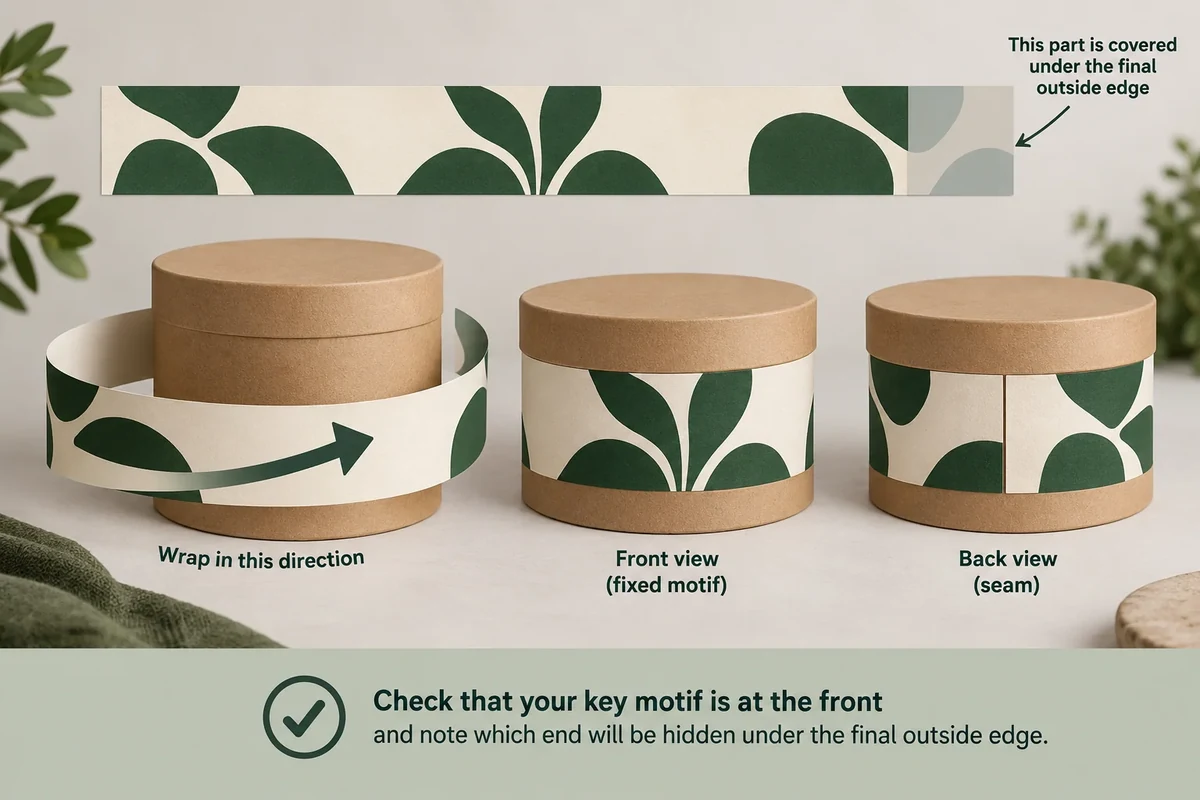
Locate the start edge and overlap of a wrap label on the actual container before approving artwork. Mark which copy becomes hidden and which edge finishes outside. Review the applied sample in its intended front view, with the same application direction used in the brief.
A flat label file shows all artwork at once. The customer sees it around a container, with one edge covering another if overlap is proposed. Give that join a location before the artwork becomes fixed.
Choose a front and an application direction
Identify the container’s intended front using a physical feature or a working reference mark. State how the container will stand during application. If it has no fixed front, choose the presentation view you want to review.
Avery’s label application guidance discusses alignment against a container seam or a straight reference. Use that principle to name your application reference. Its instructions do not define the overlap for your proposed label.
Mark the label’s starting edge and the direction it travels around the container. Identify the edge that will finish on top. Keep that direction with the artwork file; reversing it can hide a different portion of copy.
The label surface and use guide addresses the wider material proposal. This map focuses on the seam and artwork visibility after wrapping.
Separate overlap geometry from hidden content
Ask the supplier to confirm the proposed label length and overlap on the actual container geometry. Keep the container revision and label revision together. A nominal diameter alone may leave the application position or shape unclear.
Show the proposed covered area on a copy of the flat artwork. Mark any instruction, design feature or data that falls there. Avoid treating a hidden segment as still available to the customer simply because it exists in the file.
Keep required information outside an unresolved covered area until the responsible artwork owner confirms its placement. If a data carrier is involved, follow its relevant implementation requirements rather than squeezing it into the join by eye.
Record the desired seam view. It may be a rear presentation face, but that choice should come from actual handling and display, not an automatic rule that every seam belongs at the back.
Use a seam and hidden-copy map
Make a flat strip sketch and a formed container sketch with matching reference points. Add the following record beside them.
| Field | Flat label | Applied sample |
|---|---|---|
| Start edge | Named edge and artwork reference | Position against container front |
| Travel direction | Direction across flat strip | Actual wrap direction |
| Outside edge | Edge that finishes on top | Seam location and visible edge |
| Covered area | Copy or motif under overlap | Actual hidden content |
| Reference | Label and container revisions | Matched sample and application note |
If application direction is undecided, show both proposals separately. Do not blend their favourable views into one apparent approved layout.
Follow a hypothetical round gift container
Suppose a brand uses a wrap label around a round gift tin. The main motif is on the front, while a small care line sits near one end of the flat strip. The proposed overlap could cover the end of that line.
The buyer marks the starting edge, travel direction and covered region before asking the supplier to review length and application. The artwork owner then moves the care line to an available area if that proposal is confirmed.
The applied sample is viewed from the intended front and from the seam side. The record notes the actual covered copy and edge position. It does not infer adhesive suitability or long-term performance from a neat overlap.
Preserve the hidden-copy check after length changes
For the hypothetical tin label, identify the starting edge E1 and the final outside edge E2. Give the care line a separate artwork ID. The seam map then shows which portion of that line would sit under E2 in the proposed wrap direction.
If the label length changes, revisit the covered region before sending the file. A designer who shortens a blank-looking end can still alter seam position or the area hidden after application. Keep the original and revised strip maps rather than replacing one without a record.
Ask the supplier: ‘Please confirm the applied overlap and E2 position against the marked container front for label revision L2.’ That makes the sample question specific. A flat label proof answers the artwork layout but leaves the applied position open.
After the sample is applied, compare the visible copy with the same map. Record any different application direction as a changed condition. If the intended method is confirmed, carry that direction into the instruction and artwork handoff together. The useful result is an applied reference that the next operator can reproduce, without implying the overlap demonstrates adhesive suitability.
Give the artwork owner a formed reference
Send the strip map, container front, application direction and supplier overlap response through the packaging enquiry. Approve the artwork against the applied configuration. Keep the seam map available for later revisions so a length or direction change reopens the hidden-copy check.
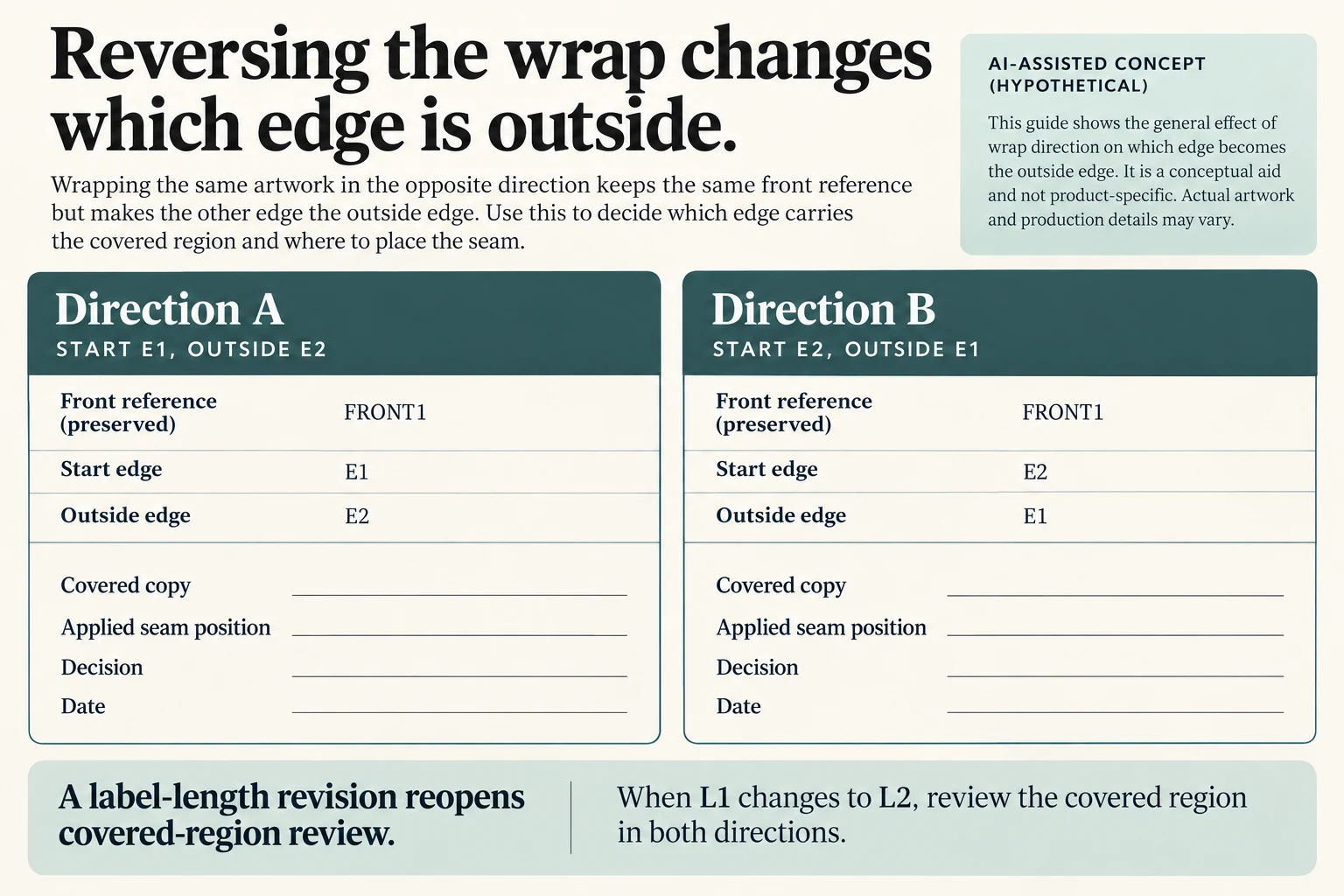
Keep both wrapping directions through a label-length revision
Use two hypothetical application directions around the same FRONT1 reference. DIR_A starts at E1 and leaves E2 outside; DIR_B starts at E2 and leaves E1 outside. Neither direction nor any overlap dimension is approved.
Scroll horizontally if columns extend beyond the view.
| Scenario scope | Exact object or route | Hypothetical input or output | Calculation or record boundary |
|---|---|---|---|
| Start edge | DIR_A_L1 | Unobserved; actual fields blank | Fictional DIR_A L1: start E1, common front FRONT1 |
| Outside edge | DIR_A_L1 | Unobserved; actual fields blank | Fictional DIR_A L1: outside E2 |
| Hidden copy review | DIR_A_L1 | Unobserved; actual fields blank | Care-line hidden region unknown; length/direction specific |
| Applied seam position | DIR_A_L1 | Unobserved; actual fields blank | Actual seam position and copy visibility in applied state unknown |
| Start edge | DIR_A_L2 | Unobserved; actual fields blank | Fictional DIR_A L2: start E1, common front FRONT1 |
| Outside edge | DIR_A_L2 | Unobserved; actual fields blank | Fictional DIR_A L2: outside E2 |
| Hidden copy review | DIR_A_L2 | Unobserved; actual fields blank | Care-line hidden region unknown; length/direction specific |
| Applied seam position | DIR_A_L2 | Unobserved; actual fields blank | Actual seam position and copy visibility in applied state unknown |
| Start edge | DIR_B_L1 | Unobserved; actual fields blank | Fictional DIR_B L1: start E2, common front FRONT1 |
| Outside edge | DIR_B_L1 | Unobserved; actual fields blank | Fictional DIR_B L1: outside E1 |
| Hidden copy review | DIR_B_L1 | Unobserved; actual fields blank | Care-line hidden region unknown; length/direction specific |
| Applied seam position | DIR_B_L1 | Unobserved; actual fields blank | Actual seam position and copy visibility in applied state unknown |
| Start edge | DIR_B_L2 | Unobserved; actual fields blank | Fictional DIR_B L2: start E2, common front FRONT1 |
| Outside edge | DIR_B_L2 | Unobserved; actual fields blank | Fictional DIR_B L2: outside E1 |
| Hidden copy review | DIR_B_L2 | Unobserved; actual fields blank | Care-line hidden region unknown; length/direction specific |
| Applied seam position | DIR_B_L2 | Unobserved; actual fields blank | Actual seam position and copy visibility in applied state unknown |
For each direction, retain separate L1 and L2 length-revision records. Record the covered care-line region and applied seam position against that exact direction and revision. A shorter strip can shift which copy is hidden even when the part removed looked blank in the flat file.
The proposed front stays stable so the directions remain comparable. The applied front and seam-side views are still needed; do not combine the better view from each direction into one apparent approved arrangement. A legible care line and a neat outside edge do not supply adhesion or long-term performance evidence.
Download the wrap label overlap position record (.csv). It covers the original scenarios and this added comparison. HYPOTHETICAL rows are invented planning examples. Actual quantity, value, configuration, method, owner, observation, condition, decision, evidence and dates are blank because no actual project record has been obtained. Copy a relevant row and replace its type with ACTUAL only when entering permitted project evidence; keep the example and actual record separate. ACTUAL_BLANK is an empty starting row. A blank is unknown, never approval.
The related Label Adhesion for Packaging Needs Surface and Use Details guide concerns a separate requirement. Use this record for the specific comparison above rather than treating that guide as evidence of a completed result.
Keep the intended application route in the roll and sheet application formats. Retain changed applied evidence with the sample-version comparison.
References retain their stated general-guidance or manufacturer-example scope. Worked figures and records are teaching examples, not observed orders, stock, prices or measured performance.
Discuss this packaging specification with Packrivo. We coordinate independent suppliers. MOQ: 500 pieces per product/design; illustrative quantities are not production offers. Confirm materials, samples, price and timing for your project.