
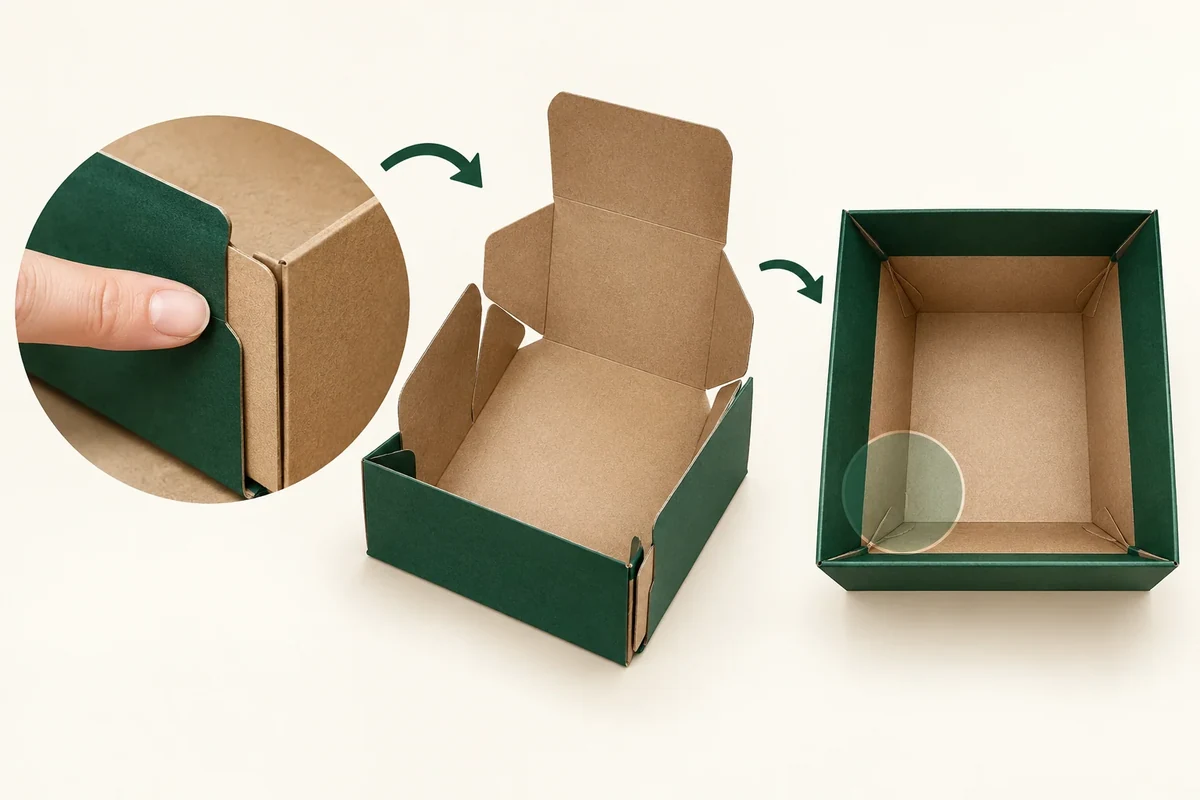
Check prepared bottom joints before loading the carton, with the supplier’s actual forming instruction beside the sample. Record what arrives completed, which actions staff perform and the final position they inspect. Once the contents cover the base, a missed setup question becomes harder to locate.
This method produces a before-load checklist for one carton revision. It should be written from the confirmed proposal rather than a generic instruction associated with the words auto bottom.
Observe the delivered preparation
The prepared-bottom reference identifies pre-glued flaps in one display configuration. That supports distinguishing supplied joints from forming work. It doesn’t define the base sequence of every other carton.
Photograph the sample as delivered and identify the proposed joints. Ask the supplier which joint surfaces are completed and which remain operator actions. Mark any hidden detail that needs clarification.
Use the delivery-state guide for the wider handoff. This checklist narrows that scope to the empty base immediately before loading.
Keep the sample material and drawing revision named. A plain model can help explain the route, but a substituted construction should not become the final joint reference silently.
Write observable checklist entries
Use entries a packer can see against the drawing, such as the named flap in its confirmed final position. Avoid a vague instruction to make the base secure. The responsible source should confirm the intended relationship.
Include any pressing, seating or alignment step that belongs in the forming instruction. If an extra action appears during review, record it as a question before making it the new default.
| Checklist entry | Reference | Evidence or status |
|---|---|---|
| Delivered joints identified | Supplier-marked prepared areas | Confirmed or awaiting view |
| Forming sequence available | Current instruction revision | Each action named |
| Final joint position visible | Formed drawing/detail | Before-load inspection image |
| Extra action recorded | Located part and stage | Supplier response needed |
| Loading permitted | Agreed final empty-base state | Responsible operator checkpoint |
| Version current | Material, drawing and sample IDs | Superseded references removed |
Copy the checklist into the packing record with the actual part names. A checkbox should refer to a confirmed visible condition, not an unsupported capacity claim.
Follow a hypothetical prepared-base sample
Suppose a gift brand receives a carton sample with prepared base joints. During expansion, one fold remains partly inward. The buyer records that location while the carton is still empty and asks whether another seating action belongs in the instruction.
The record keeps ‘delivered joint present’ separate from ‘final formed position confirmed’. Both can be true or unresolved at different times. A loaded closed photo would conceal that distinction.
After a supplier response, the buyer updates the specific checklist entry and reviews another setup on the same named construction. The contents are added only after the before-load state is documented.
For an auto bottom outer carton, this empty-base check should remain separate from the later top-sealing operation. The body name doesn’t combine the two approvals.
Keep an exception visible at the bench
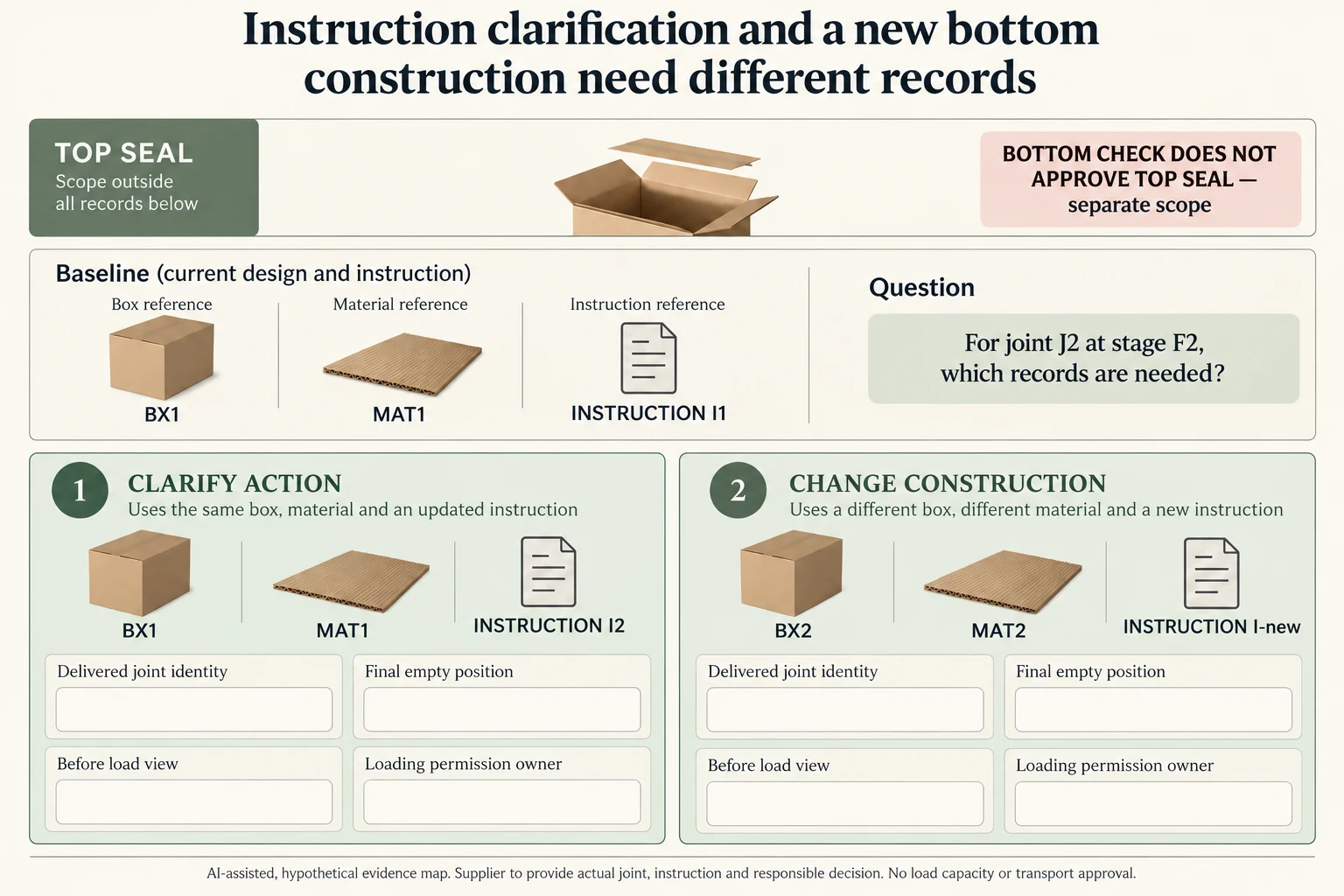
Call the hypothetical unresolved joint J2 and the forming stage F2. A useful question is: ‘Please confirm J2’s final position after F2 and the inspection view before loading.’ It gives the supplier a part and action to answer.
If the response revises the material or joint construction, create a new checklist version. Keep the earlier exception in its original record rather than deleting evidence of why the instruction changed.
This is a process communication aid. Load, handling and distribution requirements need their own agreed evaluation with the full configuration; a checked empty base does not establish them.
Send the before-load gap
Bring supplied and formed views, the current instruction and open joint IDs to the packaging enquiry. The next action should confirm the actual setup condition, then connect that confirmation to the packing record.
A new instruction and a new prepared bottom reopen different records
Keep the fictional J2 question at stage F2 attached to BASE22, using BX1/MAT1/I1. Compare CLARIFY_ACTION22, which retains BX1 and MAT1 but proposes I2, with CHANGE_CONSTRUCTION22, which proposes BX2/MAT2 and its own instruction reference. A new instruction file is not automatically a changed joint, and a new material or joint should not inherit every old checklist entry.
Scroll horizontally if columns extend beyond the view.
| Hypothetical configuration | Named object | Relationship | Input or next scope |
|---|---|---|---|
| BASE22 | BASE22 | uses drawing | BX1 |
| BASE22 | BASE22 | uses material | MAT1 |
| BASE22 | BASE22 | uses instruction | I1 |
| CLARIFY_ACTION22 | CLARIFY_ACTION22 | uses drawing | BX1 |
| CLARIFY_ACTION22 | CLARIFY_ACTION22 | uses material | MAT1 |
| CLARIFY_ACTION22 | CLARIFY_ACTION22 | uses instruction | I2 |
| CHANGE_CONSTRUCTION22 | CHANGE_CONSTRUCTION22 | uses drawing | BX2 |
| CHANGE_CONSTRUCTION22 | CHANGE_CONSTRUCTION22 | uses material | MAT2 |
| CHANGE_CONSTRUCTION22 | CHANGE_CONSTRUCTION22 | uses instruction | I_NEW |
For each proposal, separate four fields: delivered joint identity, final empty position, the before-load view and the responsible loading-permission owner. Evidence that a joint was prepared before delivery does not show that its final formed position was reached. Conversely, a view of an empty formed base needs the current construction identity so it is not mistaken for the intended prepared joint.
Ask whether the source response clarifies an existing required seating action or changes the construction itself. Record the actual answer and replace the affected instruction and inspection reference together. If an extra pressing, alignment or seating step has not been confirmed, retain it as the original exception rather than making it a default from observation alone. Loading should not conceal the evidence gap before the owner resolves the actual before-load condition.
The CSV preserves the original inward-fold example, supplied-versus-formed distinction and separate top-seal scope, then maps the new instruction and material/drawing alternatives. All actual observations, methods, permissions and evidence are blank. A completed process checklist cannot establish load or distribution performance; any such requirement needs its own agreed full-configuration evaluation. The next useful reply identifies exactly which reference changed and which empty-base evidence it will provide.
Download the prepared bottom carton before loading check record (.csv). It includes the original table fields and scenarios alongside the added relationships. HYPOTHETICAL rows are editorial examples or required review scopes, not actual records. Actual quantity, configuration, component and file identities, materials, process, specification, copy, method, condition, observation, owner, decision, evidence and dates are blank. ACTUAL_BLANK is a separate empty starting row; enter permitted project evidence before using an actual record. A blank means unknown.
Use the Define Flat and Assembled Packaging Delivery Scope for its separate question. Use the Custom Packaging Sample: Approval Checks That Matter for its separate question. Use the Packaging Sample Revisions: Compare Versions Before Approval for its separate question.
Source scope checked 16 October 2026. References cover only the named materials, processes or guidance. Added configurations and geometry are hypothetical, not supplier specifications, tests or production approval; they set no universal tolerances or machine limits. Confirm the actual material, process, drawing and formed sample for the project.
Discuss this packaging specification with Packrivo. We coordinate independent suppliers. MOQ: 500 pieces per product/design; illustrative quantities are not production offers. Confirm materials, samples, price and timing for your project.