
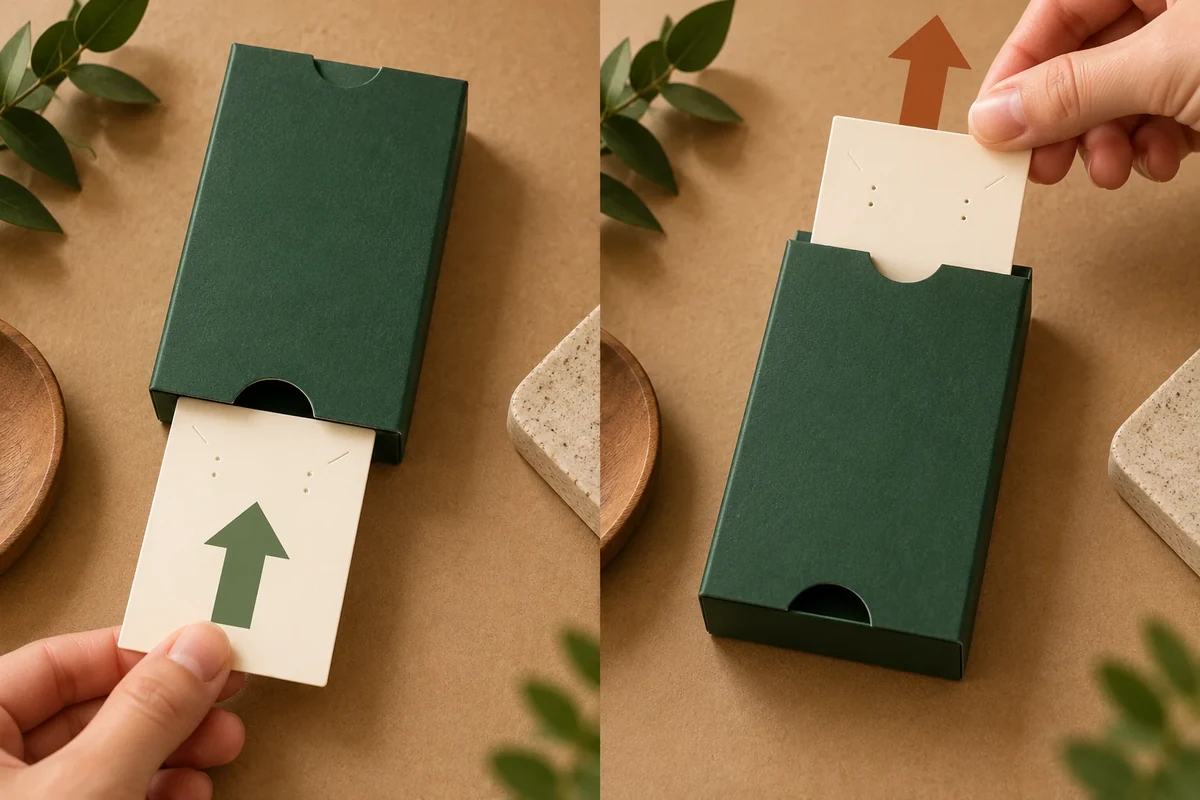
Name the loading end and customer opening separately on a carton panel map before artwork is fixed. Record who uses each end, what direction the product travels and which printed face is visible. Even when both actions use the same end, they need separate instructions and review evidence.
A label such as top can change meaning when the carton is turned for packing. Stable panel and end names make the handoff more useful than relying on an unlabelled photograph.
Use a fixed front reference
Choose the intended sales front and its reading direction on the working drawing. Name the two ends against that reference. Keep the names unchanged when a screenshot or paper model is rotated.
The reverse tuck reference provides one example where end-flap orientation differs. Use the actual supplier drawing to confirm your proposal. The action map doesn’t prescribe straight or reverse tuck as a universal answer.
Show the product in its complete packed orientation. Include a backing card or attachment whose leading edge changes the entry. The loose item’s appearance doesn’t settle which end the packer should use.
Keep the end map linked to the current artwork handoff. A front-panel or structure revision can change the reading and opening relationships.
Record two users and two actions
For loading, identify the operator’s starting position, leading product edge and closing order. For customer access, identify the starting grip, release feature and removal route. Do not assume the second is the reverse of the first.
If both use one end, record that shared location explicitly. The packing action can still involve a fixture or support that the customer will not have.
| Action record | End/panel identity | Input and evidence |
|---|---|---|
| Packing entry | Named loading end | Leading edge and full envelope |
| Packing closure | End used after insertion | Confirmed flap order |
| Customer start | Named preferred opening | Grip and visible instruction |
| Product removal | Exit end and orientation | Loaded action sequence |
| Artwork relationship | Front/back reading faces | Sales and opening views |
| Alternative route | Permitted or unreviewed end | Separate status and evidence |
A preferred end and an alternative end should not share one approval cell unless both actions were actually reviewed under the agreed scope.
Follow a hypothetical jewelry-card carton
Suppose a jewelry card has a hanging hole at one end and a projecting ornament at the other. Staff insert the card from the lower end in the proposed packing sequence, while customers are directed to the upper end.
The buyer labels those routes separately and photographs the leading edge during loading. The customer review begins with the carton in its sales orientation, without turning it to use the easier end.
If the upper removal catches at the card hole, the record names that contact and the customer route. A successful lower loading action does not close it. The reverse tuck product direction can carry the structural proposal alongside this user/action diagram.
Make the instruction survive a rotated view
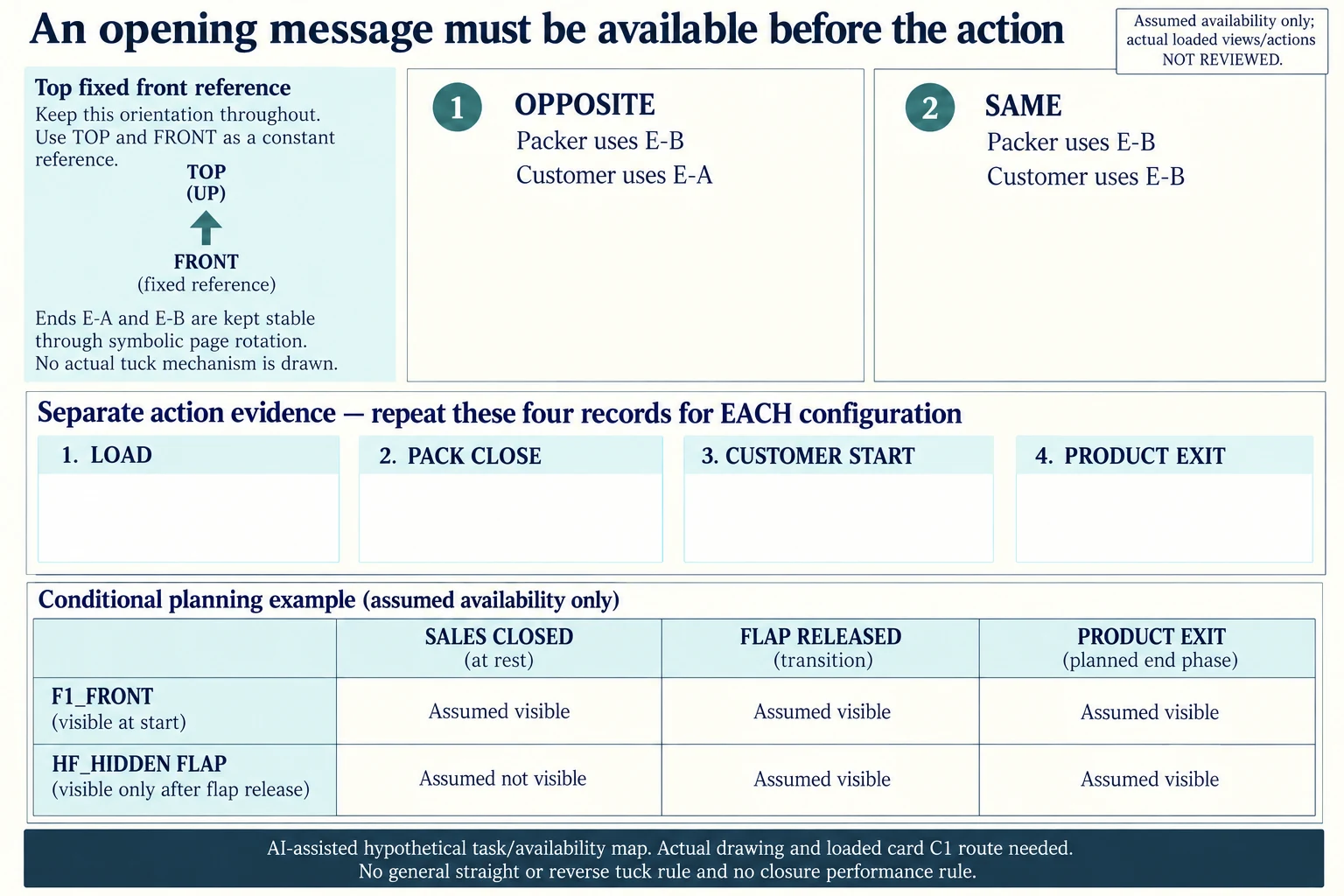
In the hypothetical diagram, call the ends E-A and E-B and keep an upright front arrow. Write ‘packer uses E-B’ and ‘customer uses E-A’ as two entries. Those names remain meaningful when the pack is laid horizontally.
Ask the supplier: ‘Please confirm the E-A removal route for card C1 with the proposed end construction.’ It locates the question more clearly than requesting an easier opening without identifying the user or end.
If the artwork team moves the instruction, review its visible face at the start of the customer action. A message printed on a hidden flap may be unavailable until after the action it is meant to explain.
Send the two-action map
Bring the fixed-front drawing, complete product envelope and separate loading/opening records to Packrivo’s enquiry. This original tool clarifies responsibilities and panel relationships; it does not establish closure durability or protection.
Check when the opening instruction becomes available
Compare OPPOSITE22, where the packer uses E-B and the customer uses E-A, with SAME22, where both use E-B. Shared location does not merge the actions: the packer may have a different support or starting orientation from the customer. Keep loading, packing closure, customer start and product exit as distinct records under either proposal.
Scroll horizontally if columns extend beyond the view.
| Hypothetical configuration | Named object | Relationship | Input or next scope |
|---|---|---|---|
| OPPOSITE22 | PACKER | uses end | E-B |
| OPPOSITE22 | CUSTOMER | uses end | E-A |
| SAME22 | PACKER | uses end | E-B |
| SAME22 | CUSTOMER | uses end | E-B |
| INSTRUCTION_AVAILABILITY | F1_FRONT | assumed visible at | SALES_CLOSED; VISIBLE_BY_ASSUMED_STATE |
| INSTRUCTION_AVAILABILITY | F1_FRONT | assumed visible at | FLAP_RELEASED; VISIBLE_BY_ASSUMED_STATE |
| INSTRUCTION_AVAILABILITY | F1_FRONT | assumed visible at | PRODUCT_EXIT; VISIBLE_BY_ASSUMED_STATE |
| INSTRUCTION_AVAILABILITY | HF_HIDDEN_FLAP | assumed not visible at | SALES_CLOSED; NOT_AVAILABLE_AT_START |
| INSTRUCTION_AVAILABILITY | HF_HIDDEN_FLAP | assumed visible at | FLAP_RELEASED; VISIBLE_BY_ASSUMED_STATE |
| INSTRUCTION_AVAILABILITY | HF_HIDDEN_FLAP | assumed visible at | PRODUCT_EXIT; VISIBLE_BY_ASSUMED_STATE |
Add an instruction-availability question to the fixed-front map. In one explicitly assumed planning example, F1's front message is visible in SALES_CLOSED, while a message on hidden flap HF is available only after FLAP_RELEASED. PRODUCT_EXIT is another later phase. These are conditional availability labels, not observations of the actual carton or supplied instructions.
If a message is needed to explain the first release action, locating it only on HF creates an unresolved handoff: the customer would need to perform the action before reaching its explanation. Ask the artwork owner for a position available at the intended starting view, or ask the use owner to revise the instruction strategy. Do not infer availability from a flat artwork layout showing every flap simultaneously.
The download retains the original C1 hole/projection, E-A removal-contact and alternative-route questions. It adds the two user/end configurations and location/phase relationships without inventing copy, flap geometry or an opening mechanism. A rotated working view keeps E-A/E-B names fixed. Actual visibility, grip, loaded sequence, permissions and decisions remain blank; neither successful loading nor a visible instruction establishes customer removal, closure durability or protection.
Download the carton loading end customer opening map record (.csv). It includes the original table fields and scenarios alongside the added relationships. HYPOTHETICAL rows are editorial examples or required review scopes, not actual records. Actual quantity, configuration, component and file identities, materials, process, specification, copy, method, condition, observation, owner, decision, evidence and dates are blank. ACTUAL_BLANK is a separate empty starting row; enter permitted project evidence before using an actual record. A blank means unknown.
Use the Packaging Artwork Handoff Checklist for Print Approval for its separate question. Use the Write Mounting Instructions With Front and Back Views for its separate question. Use the Custom Packaging Sample: Approval Checks That Matter for its separate question.
Source scope checked 16 October 2026. References cover only the named materials, processes or guidance. Added configurations and geometry are hypothetical, not supplier specifications, tests or production approval; they set no universal tolerances or machine limits. Confirm the actual material, process, drawing and formed sample for the project.
Discuss this packaging specification with Packrivo. We coordinate independent suppliers. MOQ: 500 pieces per product/design; illustrative quantities are not production offers. Confirm materials, samples, price and timing for your project.