
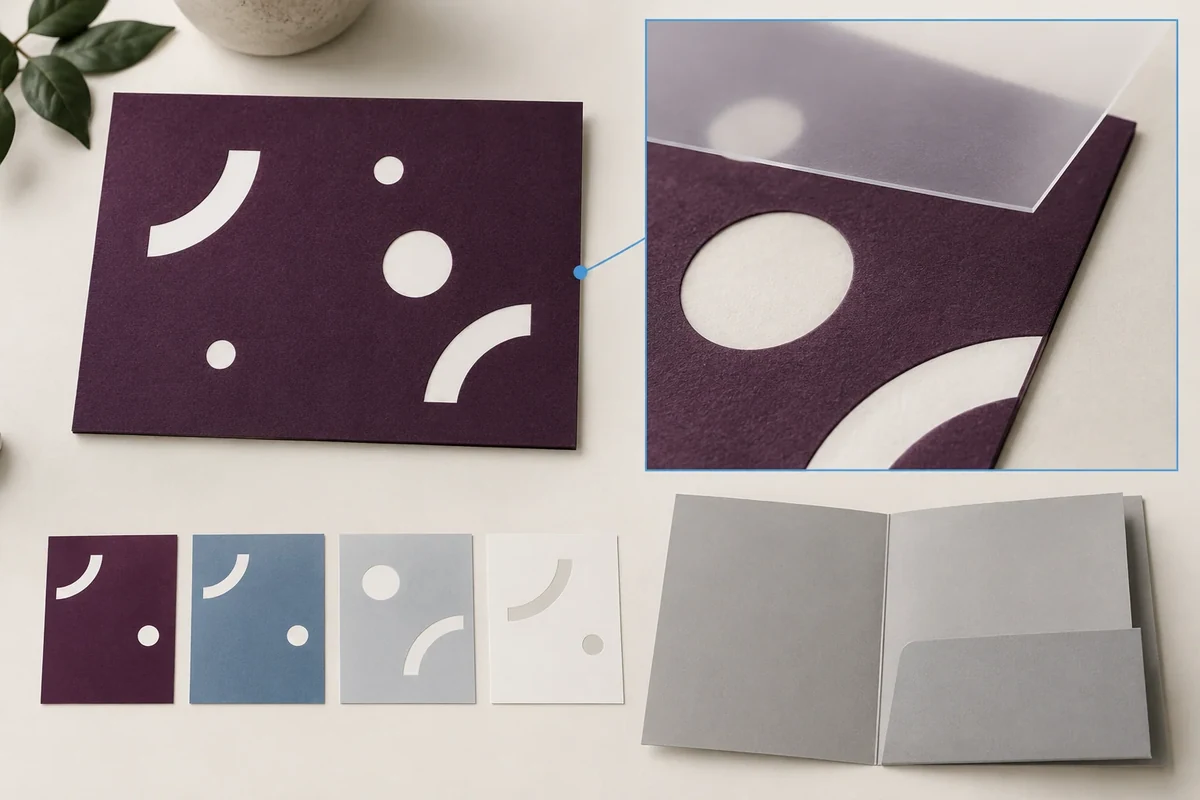
Review reversed packaging type with its background color construction and finishing layer attached. Identify each negative text object and the selected printer’s reverse-type rule, then inspect the actual-size proof or sample specified for that question. Positive-type acceptance should remain a separate record.
Name the negative text and its surrounding field
The original Glenroy flexographic guidelines distinguish reverse type from positive type and discuss background/color registration concerns. That process-specific example supports asking the actual printer for its own reverse-type requirements. It does not establish one minimum size for every carton or label.
Mark the negative text object, panel and background on the artwork. Record whether the background is a single named color, several separations or another offered construction. Keep the font and intended printed scale with that object rather than evaluating the text alone.
Identify any gloss, varnish, film or other proposed finish crossing the background and letters. The finishing relationship should be named on the same panel map so the proof or sample is reviewed in its intended state.
Separate the technical rule from the appearance decision
The coating technical sheet provides a named coating/substrate/application example. Its grade properties are relevant only to that proposal, not to every reversed-text finish. Ask the printer or finisher to confirm the actual finish over the object and the evidence supplied for reviewing it.
Inspect the negative letter shapes at the intended printed size and retain an enlarged view only to locate a specific observation. Record filled-in areas, unclear boundaries or another visible reading issue in ordinary terms, with the proof/sample identity and conditions. Let the printer assess the process-specific cause.
If the response proposes changing the background, type or finish, list exactly which field changes. The designer should return a revised output showing the whole object, not a cropped corrected word separated from its actual background.
Use a reverse-type background and finish map
The hypothetical gift-sleeve entries below are an original decision aid, not an industry file standard.
| Object relationship | Example input | Owner and next evidence |
|---|---|---|
| Negative text T2 | Small brand line reversed from front panel F1 | Designer supplies object and font state |
| Background A1 | Printer’s offered color/separation proposal | Printer names actual reverse-type rule |
| Finish V1 | Offered coating over the named area | Finisher confirms grade and boundary |
| Output scale | Actual-size artwork reference | Designer confirms scale and panel |
| Observation | Located reading/stroke question | Printer returns assessment and revised evidence |
| Accepted state | Text/background/finish revision together | Buyer records the complete appearance decision |
Keep a changed background in the comparison
Imagine a reversed brand line on a dark gift sleeve. One proposal changes the background construction while retaining the same text outline. That is a changed technical scope even if the screen preview appears similar.
Request a response that identifies both the background and text rule. Review the finish relationship on the resulting proof or sample and retain the accepted artwork version. The decision should name the complete state; it should not approve the text while the finish remains an unspecified later addition.
Handoff the complete negative-text object
The artwork handoff method keeps the output connected to its printer requirements. Use the color-reference record for the agreed background appearance.
The designer identifies the object and file. The printer confirms the process rule; the finisher confirms the relevant layer. The buyer accepts a named appearance reference or keeps the object open. This makes the next action answerable without broad claims that small reversed type always works.
Share the negative text, background/finish map and selected printer question through the packaging brief. MOQ is 500 pieces per design; print, sample and commercial details are confirmed for the project.
Treat a combined background and finish as a separate candidate
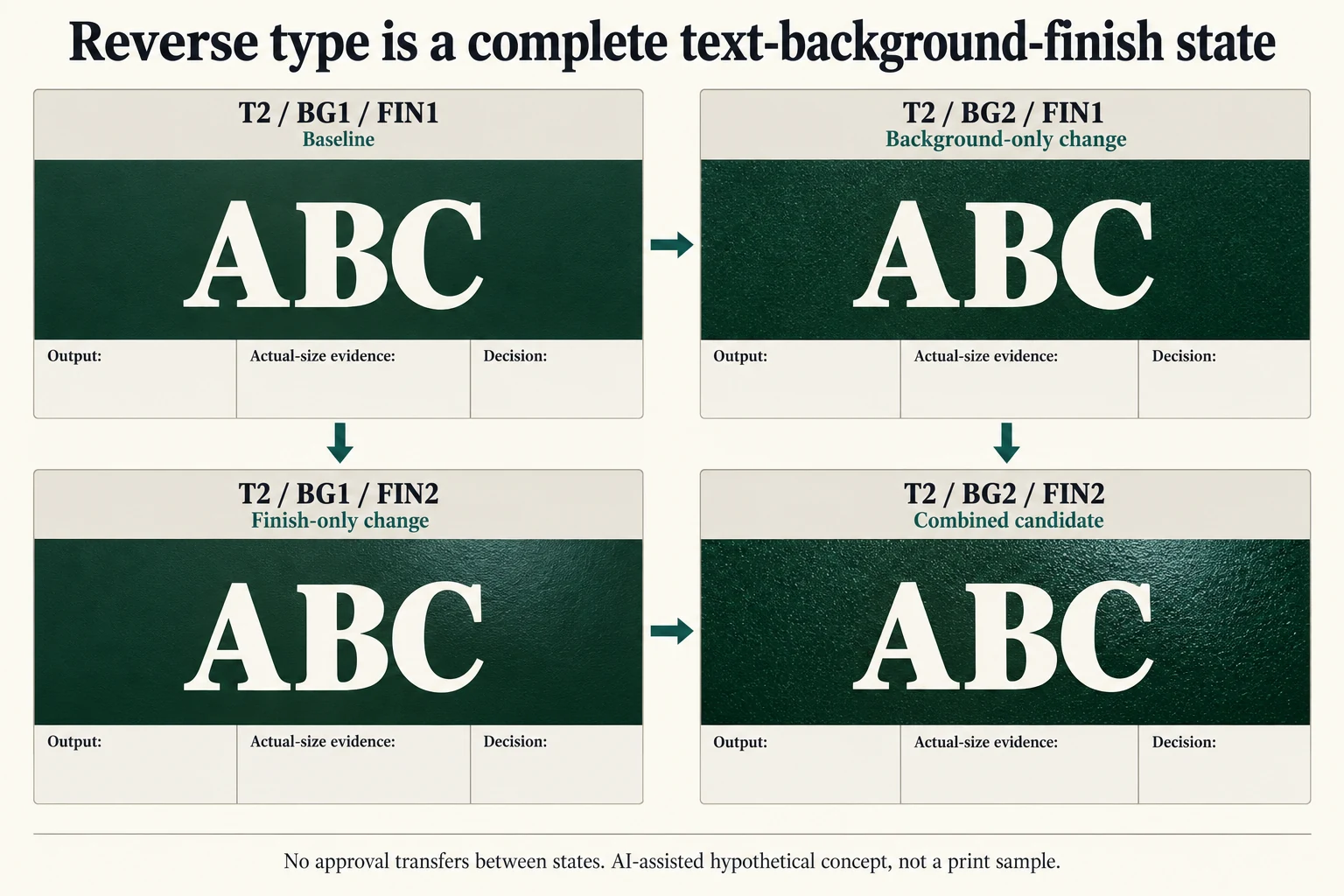
Keep T2 fixed and name the proposed baseline background BG1 and finish FIN1. A fictional comparison can then contain BG2/FIN1 as a background-only change, BG1/FIN2 as a finish-only change, and BG2/FIN2 as a combined candidate. All four states retain panel F1. The labels do not specify a color recipe, coating grade or technical performance.
Scroll horizontally if columns extend beyond the view.
| Hypothetical configuration | Named object | Relationship | Input or next scope |
|---|---|---|---|
| BG1-FIN1 | BG1-FIN1 | uses background | BG1 |
| BG1-FIN1 | BG1-FIN1 | uses finish | FIN1 |
| BG1-FIN2 | BG1-FIN2 | uses background | BG1 |
| BG1-FIN2 | BG1-FIN2 | uses finish | FIN2 |
| BG2-FIN1 | BG2-FIN1 | uses background | BG2 |
| BG2-FIN1 | BG2-FIN1 | uses finish | FIN1 |
| BG2-FIN2 | BG2-FIN2 | uses background | BG2 |
| BG2-FIN2 | BG2-FIN2 | uses finish | FIN2 |
The combined candidate cannot inherit a whole-state decision by adding two separate approvals. A response for BG2/FIN1 was made with FIN1; a response for BG1/FIN2 was made with BG1. Neither is evidence of the complete BG2/FIN2 state. Request its actual-size output and the relevant proof or sample with the offered finish represented. Keep missing evidence visible even when the screen composite looks unchanged.
For each state, the printer confirms the applicable reverse-type rule and background construction, the finisher confirms the layer and boundary, and the buyer reviews the complete appearance. If the type outline changes too, give it a replacement text identity instead of continuing to call it unchanged T2. An enlarged letter detail can locate an issue but cannot replace intended-size reading with its real background and finish.
The download retains the original A1/V1 relationship and the original background-change questions, then maps every new configuration to T2, F1, its background and finish. Each has separate technical, actual-size and complete-appearance review requests. Screen swatches in the teaching image are uncalibrated symbols; they do not show how any selected print will fill, reflect or read. Real observations, decisions and source evidence remain blank.
Download the reversed packaging type background finish proof record (.csv). It includes the original table fields and scenarios alongside the added relationships. HYPOTHETICAL rows are editorial examples or required review scopes, not actual records. Actual quantity, configuration, component and file identities, materials, process, specification, copy, method, condition, observation, owner, decision, evidence and dates are blank. ACTUAL_BLANK is a separate empty starting row; enter permitted project evidence before using an actual record. A blank means unknown.
Use the Packaging Artwork Handoff Checklist for Print Approval for its separate question. Use the Packaging Color Approval Starts With a Physical Reference for its separate question.
Source scope checked 16 October 2026. References cover only the named materials, processes or guidance. Added configurations and geometry are hypothetical, not supplier specifications, tests or production approval; they set no universal tolerances or machine limits. Confirm the actual material, process, drawing and formed sample for the project.
Discuss this packaging specification with Packrivo. We coordinate independent suppliers. MOQ: 500 pieces per product/design; illustrative quantities are not production offers. Confirm materials, samples, price and timing for your project.