
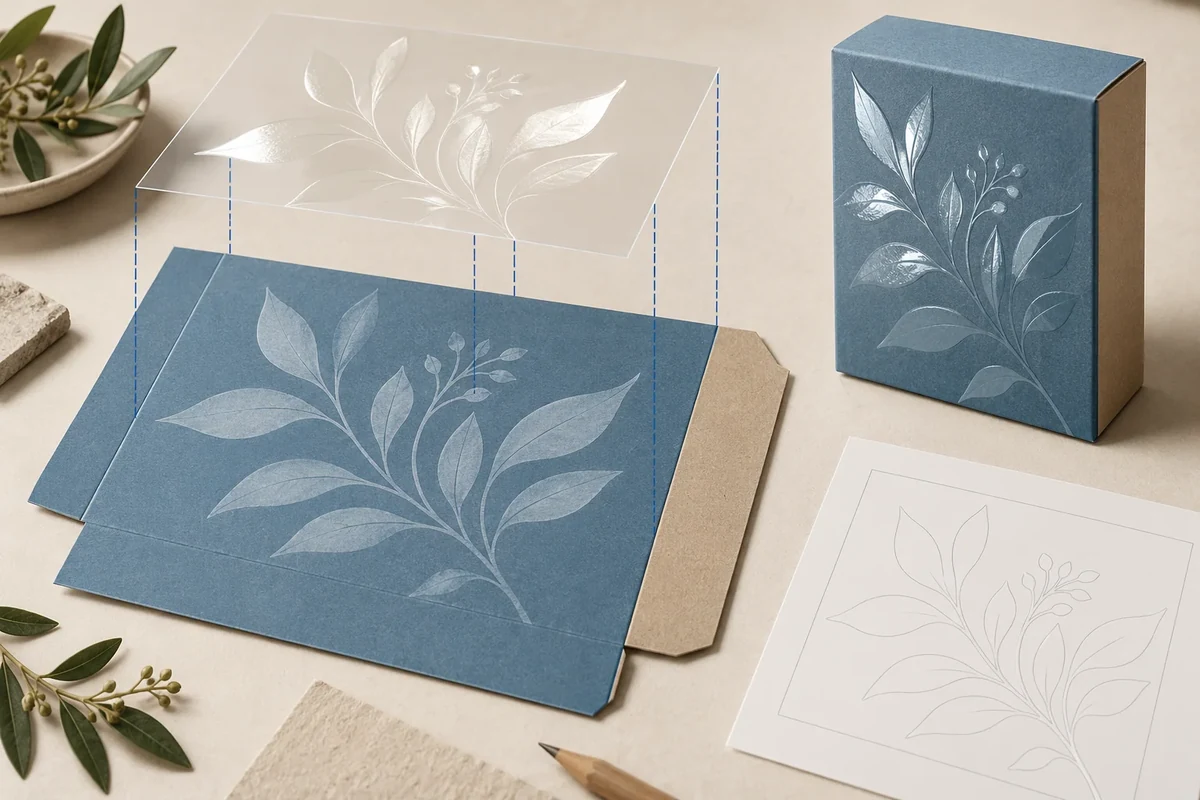
Give every spot-gloss mask a named panel, artwork revision and visible boundary. Map excluded fold and glue areas beside the intended gloss so the printer can confirm the actual coating and registration proposal. The buyer should review where the mask lands, not only how shiny the preview looks.
Keep the gloss mask separate from the printed artwork
The original coating-maker spot-varnish reference identifies a gloss UV overprint varnish and spot use under its specific conditions. Use it as a coating/process example. The selected printer still confirms the actual grade, application and mask alignment for your panel.
Name the gloss object and the panel it belongs to. Link the mask file to the artwork and drawing revision used for printing. Mark which logo, illustration or other supplied object the gloss follows and which areas it intentionally leaves uncoated.
Show folds, cut edges and glue areas on the same working view. These are location fields for printer/converter confirmation, not an invitation to apply a generic registration tolerance. Keep any technical clearance in the selected supplier’s own proposal.
Attach the coating grade to the zone decision
The ACTEGA grade sheet is an example of a coating whose own technical description identifies glueability and stamping limitations. That demonstrates why the exact grade matters; it does not mean every gloss layer has identical behavior.
Ask the printer and converter to identify the coating grade and any excluded bonding areas on the offered drawing. If the mask crosses a joint, retain that as a question for the people responsible for both coating and gluing. A decorative mask preview cannot settle the joint.
Review a named proof or formed sample with the mask and artwork boundaries visible. Record a shifted edge, incomplete coverage or another located observation alongside the evidence type and conditions. The next response should identify the object and proposed correction.
Use a mask and panel boundary worksheet
The hypothetical example below follows a gift-box logo; it is an original project map, not a printer standard.
| Mask relationship | Example input | Next confirmation |
|---|---|---|
| Mask V1 | Gloss follows logo A1 on panel F1 | Mask/artwork/drawing revisions match |
| Visible boundary | Intended outline around supplied logo | Printer’s registration proposal |
| Fold zone | Named fold outside the intended gloss | Converter’s actual exclusion requirement |
| Glue zone J1 | Bonding face located on current drawing | Coating-grade and joint confirmation |
| Evidence | Proof or formed sample S1 | Located boundary observation |
| Decision | Accept or revise the mask alignment | Printer response and buyer appearance owner |
Keep a changed mask in the same revision trail
Imagine a gloss logo close to a gift-box corner. If the printer proposes moving the mask inward, show the changed mask next to the printed logo and drawing. Record whether the supplied appearance or only a process boundary changed.
The designer should return a revised mask file with its exact identity. The printer confirms the application and evidence scope, while the converter confirms the relevant joint/fold zones. The buyer then accepts the complete visible arrangement or leaves a specific boundary open.
Send the mask conflict with its owner
The artwork handoff checklist keeps the supplied mask and output together. Use the drawing-change method if a moved boundary affects a folded or glued interface.
Bring the named mask, panel and unresolved coating/joint question through the packaging brief. Packrivo can help prepare the question and compare responses. MOQ is 500 pieces per design; the actual coating, samples and commercial terms are confirmed for the project.
A safer-looking exclusion can change the intended gloss coverage
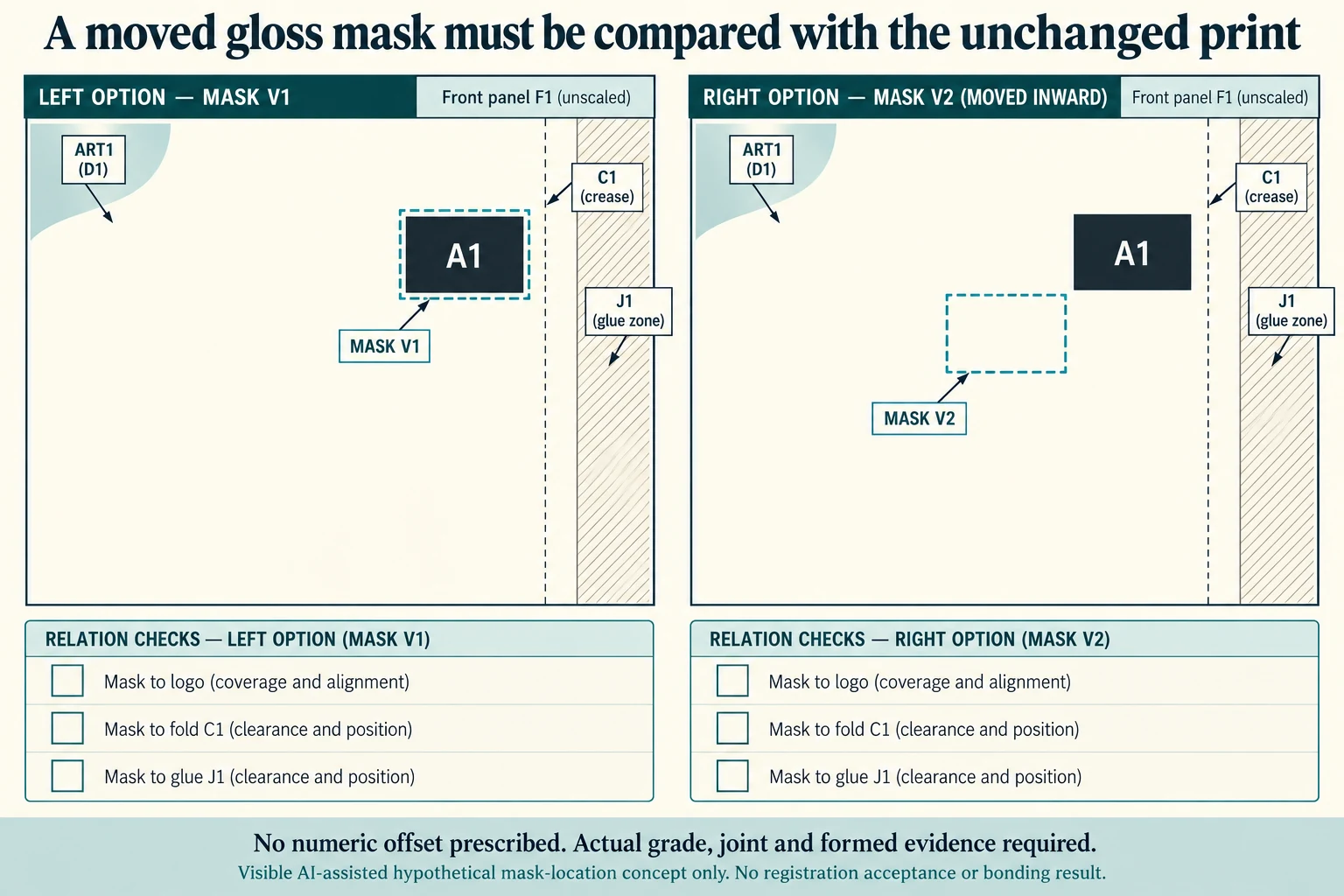
Extend the original corner example without moving the printed logo. MASK_BASE20 uses V1 with D1/ART1/A1 on F1. MASK_INWARD20 proposes V2 shifted inward while D1, ART1 and A1 remain unchanged. The shift has no invented numeric offset. A mask moved away from a corner can change its relationship to the logo, so it should not be described as the same appearance merely because one exclusion looks easier to manage.
Scroll horizontally if columns extend beyond the view.
| Hypothetical configuration | Named object | Relationship | Input or next scope |
|---|---|---|---|
| MASK_BASE20 | MASK_BASE20 | uses drawing | D1 |
| MASK_BASE20 | MASK_BASE20 | uses artwork | ART1 |
| MASK_BASE20 | V1 | coverage registration | A1 |
| MASK_BASE20 | V1 | fold exclusion | C1 |
| MASK_BASE20 | V1 | glue exclusion | J1 |
| MASK_INWARD20 | MASK_INWARD20 | uses drawing | D1 |
| MASK_INWARD20 | MASK_INWARD20 | uses artwork | ART1 |
| MASK_INWARD20 | V2 | coverage registration | A1 |
| MASK_INWARD20 | V2 | fold exclusion | C1 |
| MASK_INWARD20 | V2 | glue exclusion | J1 |
Keep three named relationships for each version: mask-to-A1 for intended coverage and registration, mask-to-C1 for the fold question, and mask-to-J1 for the glue-zone question. Review the proposed V2 outline beside the unchanged print rather than sending a cropped glossy mark alone. If V2 deliberately leaves part of the logo uncoated or changes the intended outline, the buyer needs that presentation difference identified.
The printer confirms the offered coating, application and evidence scope; the converter confirms the relevant fold and joint proposal. A confirmed exclusion does not establish the coating's appearance or bonding result on every surface. Ask for a formed sample when the actual corner or joint matters, keeping the same drawing and artwork references. Technical distances and compatibility remain supplier-specific inputs, not values taken from a decorative render.
The download keeps V1's original worksheet and adds both full file configurations and six separate relationships. It does not close the mask-to-logo question when the fold or glue response arrives. The buyer can select a changed visible arrangement knowingly or request another mask, while unresolved source questions remain attached to their exact targets. The teaching image uses unscaled outlines to expose the difference; it is not a production separation, registration tolerance or tested joint.
Download the spot gloss mask panel boundary review record (.csv). It includes the original table fields and scenarios alongside the added relationships. HYPOTHETICAL rows are editorial examples or required review scopes, not actual records. Actual quantity, configuration, component and file identities, materials, process, specification, copy, method, condition, observation, owner, decision, evidence and dates are blank. ACTUAL_BLANK is a separate empty starting row; enter permitted project evidence before using an actual record. A blank means unknown.
Use the Print Trapping Creates Controlled Overlap to Manage Registration Gaps for its separate question. Use the A Gloss Reading Describes a Reflection Geometry Rather Than a Universal Finish Score for its separate question. Use the Packaging Artwork Handoff Checklist for Print Approval for its separate question. Use the Packaging Dieline Changes Need an Impact Record for its separate question.
Source scope checked 16 October 2026. References cover only the named materials, processes or guidance. Added configurations and geometry are hypothetical, not supplier specifications, tests or production approval; they set no universal tolerances or machine limits. Confirm the actual material, process, drawing and formed sample for the project.
Discuss this packaging specification with Packrivo. We coordinate independent suppliers. MOQ: 500 pieces per product/design; illustrative quantities are not production offers. Confirm materials, samples, price and timing for your project.