
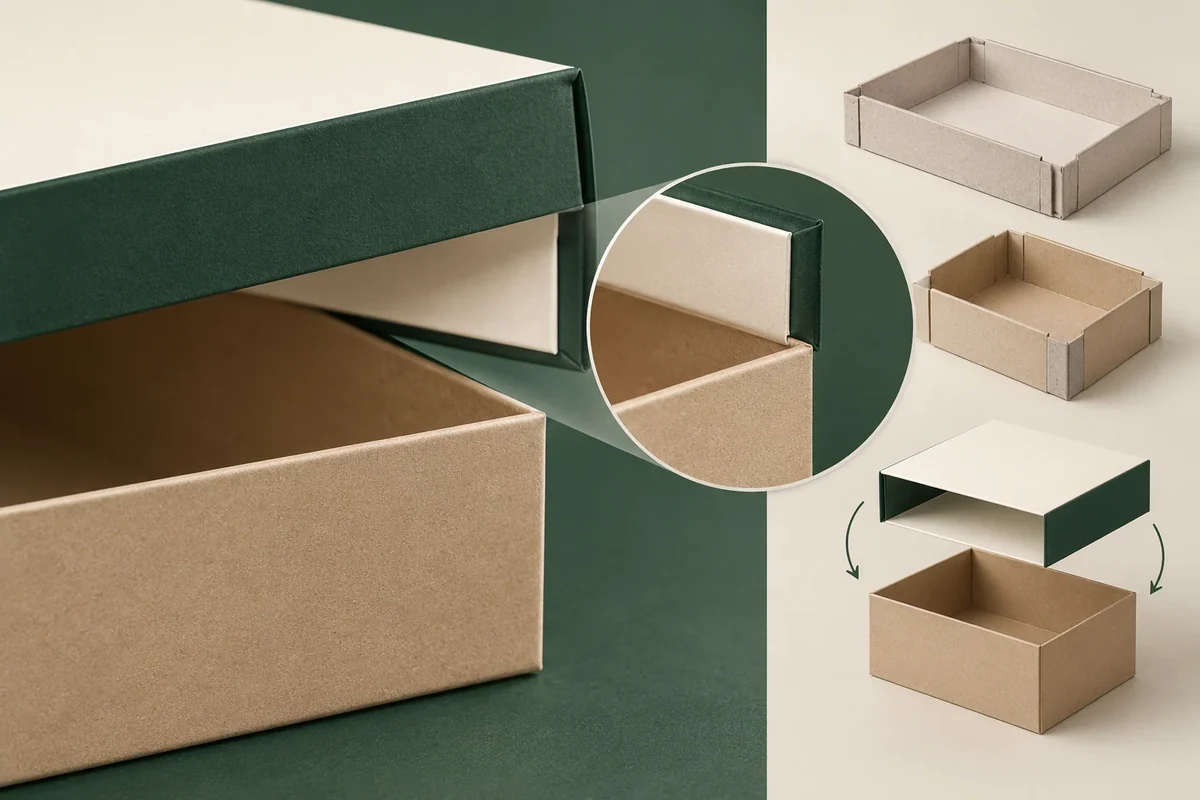
Review rigid-box lid fit with the proposed wrap edges turned into their final positions. Identify which wrapped surfaces meet as the lid closes and opens. Keep a record of local contact, sample state and material revision so the supplier can separate a wrap-edge issue from a wider box-dimension question.
An unwrapped structural model can help explore the box form. It leaves a different interface from a finished wrapped proposal. State which sample you are reviewing before using its fit as an approval reference.
Identify the turned edges in the finished interface
PackMojo’s rigid-box process explanation describes wrap material extending slightly into the box interior. This supports reviewing the turned edge as part of the finished construction. It doesn’t define the turn-in depth or clearance for every rigid box.
Ask the supplier to mark where the lid and base wrap turns finish. Add the proposed lining or neck if present. Keep each layer named on a side section so a reviewer can identify the part that touches.
Record the material and sample state. If the sample is unprinted, unfinished or built with a substitute wrap, say so. Its fit observation shouldn’t silently become approval of the final surface stack.
Review contact during closure and opening
Place the base in the agreed position and lower the lid using the intended grip. Observe where contact starts. Keep the action consistent rather than pressing at another corner to make a difficult fit look complete.
Lift the lid again and inspect the contacting edge. Describe the visible location, such as the inner lid rim against the base’s rear turned edge. A plain ‘tight lid’ comment loses the interface information.
Use the dimension acceptance method when a measurement is needed. Name whether the dimension belongs to underlying board, finished wrapped part or the loaded set.
Keep contact and visual edge appearance in separate notes. One records the movement; the other records what a customer sees. A change that improves one may require another look at the other.
Use a wrap-edge interface checklist
Attach a close-up and a wider location view for each contact. Mark unknown layer details as supplier questions.
| Interface field | Entry | Evidence |
|---|---|---|
| Meeting surfaces | Named lid and base edges | Marked side section |
| Turned layers | Wrap, lining and other proposed parts | Supplier construction reply |
| Starting contact | Location and closure stage | Photo before further pressure |
| Opening contact | Location during lift | Short action record |
| Sample identity | Part, wrap and drawing revision | Matched sample set |
| Requested response | Interface clarification or revised proposal | Supplier reply linked to same location |
Keep an unwrapped and wrapped observation in separate rows if both exist. Their difference is useful evidence of sample scope, but it doesn’t prove a single cause without the construction details.
Follow a hypothetical lid-fit question
Suppose a brand reviews a small gift box first as a structural model and then with the proposed ivory wrap. The wrapped lid contacts a rear edge earlier in the closing action. The buyer photographs that location and records the two different sample states.
The supplier is asked to identify the finished layer arrangement at the rear interface and propose the next review. The buyer doesn’t add an arbitrary allowance to every side of the box. The record gives the supplier a precise location to assess.
If a revision changes the turn-in or lining, record that construction change and repeat the same lid action. If dimensions change instead, link the new drawing. A label such as ‘version two’ is insufficient when two different interfaces may have changed.
This is a fit communication method. It doesn’t prescribe wrapping machinery, universal tolerances or a lid-force test. Any acceptance method must be agreed for the actual construction and intended use.
State which finished interface the record covers
In the hypothetical lid record, call the rear interface R1 and the opposite front interface F1. Record contact at R1 during initial lowering, while F1 has no visible contact under the same action. This distinguishes a local question from an assumption that every side needs the same dimensional change.
Keep the wrapped and structural-model samples named separately. If the supplier confirms different wrap or lining proposals between them, add those layers to the section. If it cannot yet confirm them, retain that construction gap rather than treating the comparison as proof of a cause.
A useful question is: ‘Please confirm the finished layer arrangement at R1 on sample S2 and the proposed revision to that interface.’ It gives the source a location, sample and requested response. An outside-size reply alone may not answer it.
Review the next sample in the same starting position and record when the lid first meets R1. Keep any new contact elsewhere as a separate row. The interface can be accepted under an agreed fit method after that review, while an unknown wrap construction or another contact remains open. One improved closing photograph shouldn’t erase those distinctions.
Send the interface evidence with the sample revision
Use Packrivo’s enquiry to send the marked section, sample state, contact photos and specific open question. Review the supplier’s revised wrapped sample before treating that interface as settled. Keep the approved parts and wrap revision together for any later reorder.
Separate a layer-stack revision from a dimension revision
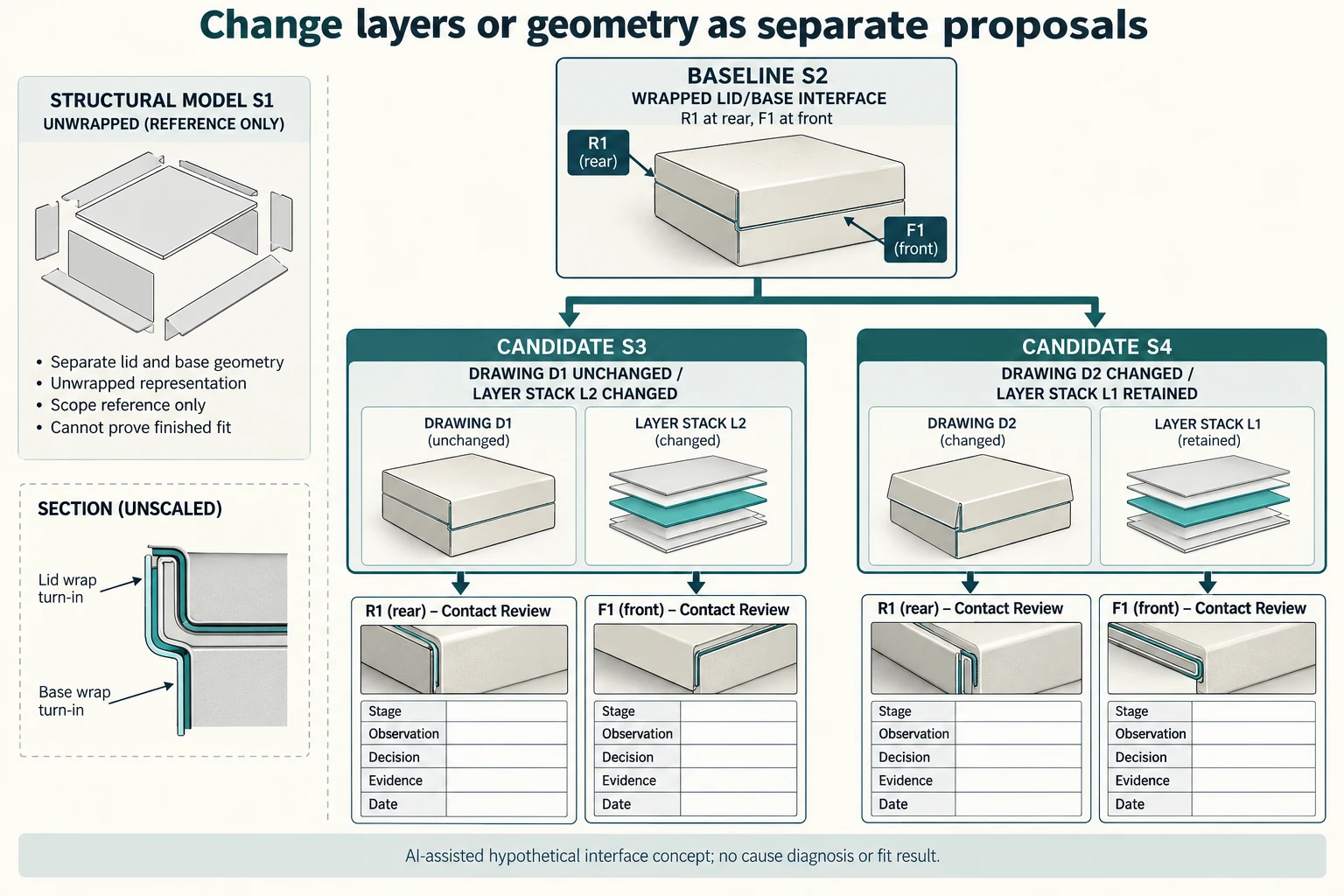
The original S1 structural model and S2 wrapped example answer different questions. Extend the record by naming S2's drawing D1 and layer stack L1. Consider S3 as a proposal retaining D1 but changing the stack to L2; consider S4 as a separate proposal changing the drawing to D2 while retaining L1. These are hypothetical alternatives, not approved corrections or a diagnosis of why the lid met R1.
Scroll horizontally if columns extend beyond the view.
| Hypothetical configuration | Named object | Relationship | Input or next scope |
|---|---|---|---|
| S2 | S2 | uses drawing | D1 |
| S2 | S2 | uses layer stack | L1 |
| S3 | S3 | uses drawing | D1 |
| S3 | S3 | uses layer stack | L2 |
| S4 | S4 | uses drawing | D2 |
| S4 | S4 | uses layer stack | L1 |
Keep both R1 and opposite F1 in every candidate's review. At each interface, distinguish initial lowering from opening contact. A supplier response that changes the rear turn-in may still need an observation at the front after the lid moves. Conversely, changing an overall dimension can affect several locations and should not be described as a purely local layer correction.
Ask which actual finished surfaces are included in L1 and L2: lid wrap turn, base wrap turn, lining or neck where present. If the proposed stack is not confirmed, preserve the missing construction field. Do not infer a total layer thickness from a photograph or assign a universal allowance. The unwrapped S1 record stays outside the finished-state acceptance chain; it cannot substitute for either proposed wrapped candidate.
The CSV retains the original fictional rear early-contact and front no-visible-contact statements under S2 only. It adds configuration-to-drawing and configuration-to-stack relationships, then separate R1/F1 lowering/opening requests. Actual contact stage, method, observation, measurement and disposition remain blank. A useful next reply identifies S3 or S4 and the interface evidence it will provide, so a favorable photograph at one edge cannot close another edge or the complete finished fit.
Download the rigid box turned edge lid clearance record (.csv). It includes the original table fields and scenarios alongside the added relationships. HYPOTHETICAL rows are editorial examples or required review scopes, not actual records. Actual quantity, configuration, component and file identities, materials, process, specification, copy, method, condition, observation, owner, decision, evidence and dates are blank. ACTUAL_BLANK is a separate empty starting row; enter permitted project evidence before using an actual record. A blank means unknown.
Use the Nominal Lid Clearance Can Disappear Across Component Dimension Ranges for its separate question. Use the Packaging Sample Revisions: Compare Versions Before Approval for its separate question.
References apply to the materials, processes or guidance named in each source. Worked configurations and dimensions are teaching examples, not tested specifications or production limits. Use the project’s material specification, drawing and formed sample for approval.
Discuss this packaging specification with Packrivo. We coordinate independent suppliers. MOQ: 500 pieces per product/design; illustrative quantities are not production offers. Confirm materials, samples, price and timing for your project.