
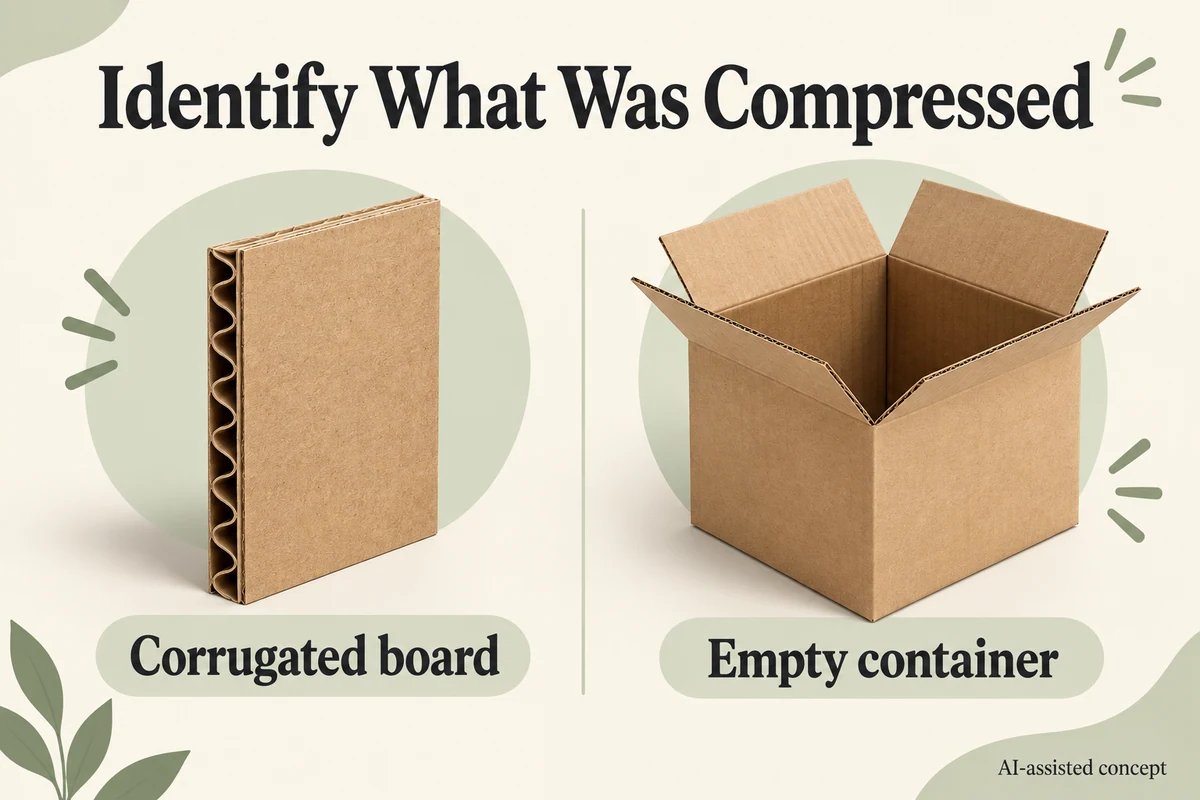
An edge crush result describes corrugated board; a box compression result describes an assembled container under its stated test. Check the object, loading direction and unit before comparing supplier numbers. Neither a board figure nor an empty-box result alone establishes a safe payload or stack height for filled shipping cartons.
This guide explains the evidence distinction. No supplier values, laboratory results or actual carton performance have been examined.
Identify the object and the reported quantity
The FEFCO testing directory separates board Method 8 from packaging Method 50. Its public English booklet gives these different scopes:
| Evidence | What is compressed | Reported quantity under the cited method |
|---|---|---|
| Method 8 edgewise crush resistance | A board specimen loaded along the flutes | Maximum force normalized by specimen edge length, in kN/m |
| Method 50 compression resistance | An empty corrugated container, with or without interior fittings, in the agreed direction | Maximum container force, in N |
The booklet’s Method 8 dates from 1982 with amendments through 1997. Method 50 is dated November 1994, amended March 1997, and includes a later precision study. They are historical public procedures, not a guarantee of the latest 2026 technical revision. Their scope does not authorize an improvised buyer test or a universal acceptance limit.
The current public scope of ISO 3037:2022 specifies a non-waxed edge method with force along the flute axis. A report called ECT still needs its actual method identified; the name alone does not settle whether two results are comparable. The full paid ISO standard was not acquired.
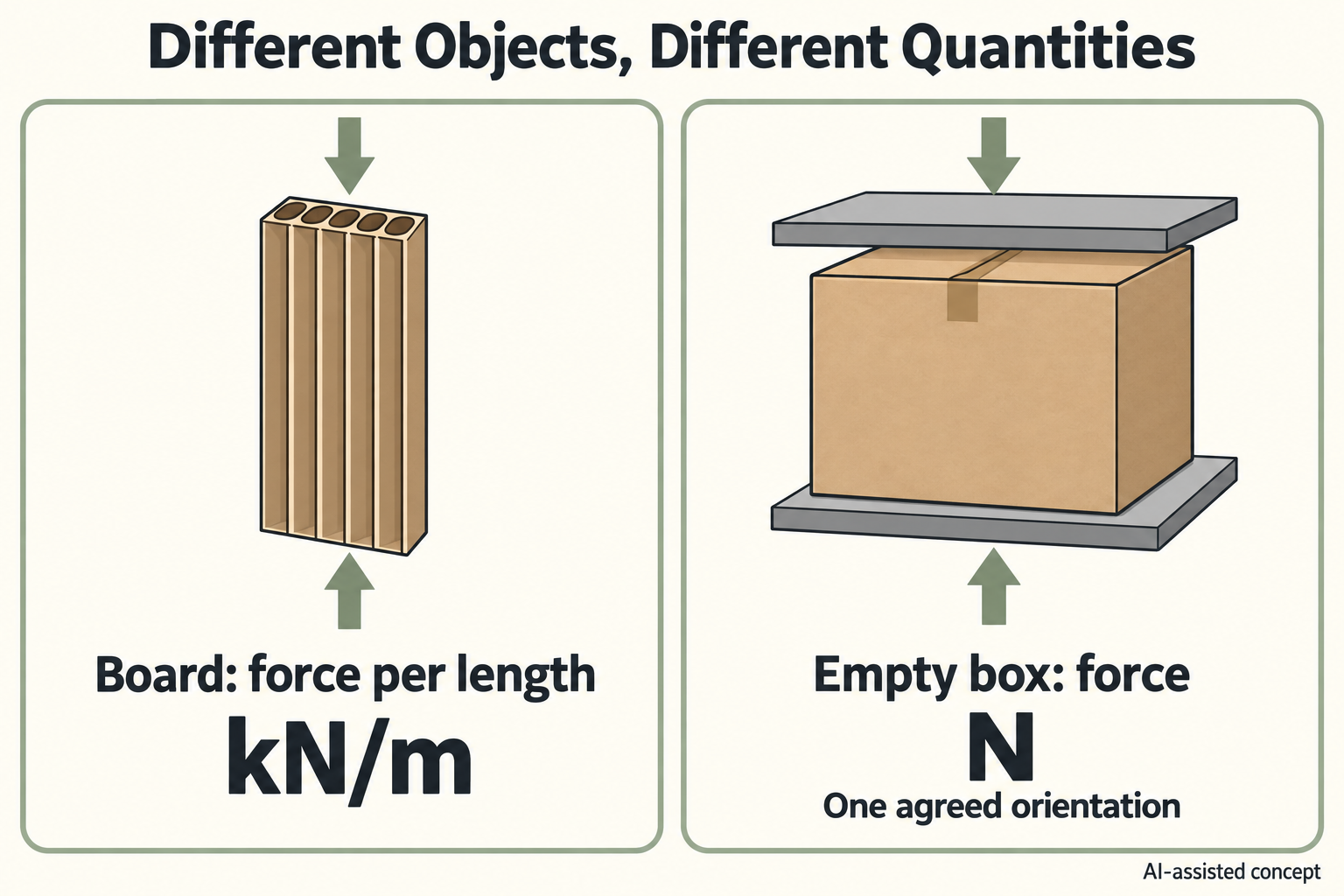
A force-per-length figure cannot be ranked beside whole-box force
Kilonewtons per metre and newtons express different quantities. Converting kN/m to N/m changes the unit scale but still leaves a force-per-length quantity. It does not turn that board result into a measured container force.
Imagine a hypothetical jewelry brand comparing two outer-carton proposals. One supplier returns board ECT information. Another returns a compression result for an erected empty carton with dividers. The buyer has not received two answers to the same question.
If the immediate decision is between board alternatives, request comparable board-property evidence. If it is between carton constructions, ask what evidence addresses each proposed assembled container. Keep the first board figure useful for its material question without treating the second supplier’s different evidence as a directly comparable score.
Two cartons using the same declared board ECT can still differ in dimensions, construction and fittings. Those differences must remain visible when the buyer asks about the container. ECT can be an engineering input; it is not a one-number prediction of every carton configuration.
Separate an empty container from the loaded stacking question
Suppose a candle brand receives an empty-carton compression result but wants to plan storage of cartons holding candle gift boxes. The received report and the desired decision concern different states.
Describe the actual packed arrangement to the technical reviewer: contents, holders, closures, orientation and intended load arrangement. Do not fill those gaps by assigning an invented safety factor or dividing a peak-force figure into a stack count.
The public scope of ISO 12048:1994 addresses complete, filled transport packages and distinguishes compression from stacking tests using a compression tester. ISO lists it as reviewed and confirmed in 2022. The abstract is not the full procedure or a project-specific acceptance rule.
A peak compression result is therefore not automatically evidence for a load maintained under the intended stacking conditions. The responsible reviewer must identify which evaluation or supported engineering assessment answers that question. This article supplies neither a test setup nor permission to stack an actual shipment.
Ask for the evidence that answers the purchasing decision
For the hypothetical jewelry comparison, ask each supplier whether its document concerns board, an empty container or the complete filled package. Then identify the decision still unanswered. A board-only reply leaves container-level evidence open; an empty-box reply leaves the proposed loaded stacking question open.
Before comparing like objects, check their actual method, preparation, loading direction, conditioning and result definition. An upright specimen illustration does not prove that a report used the required flute direction, and a carton photograph does not establish its tested orientation or fittings.
The existing conditioning guide and report-configuration guide help retain those details. The distribution-test scope guide addresses the wider packed system. Use them after identifying the quantity the supplier actually measured.
Sources accessed 9 October 2026. FEFCO’s directory is undated; its linked methods retain their stated historical dates. ISO edition and scope information was read publicly without obtaining the complete paid methods. Packrivo coordinates sourcing and supplier questions; appropriate technical parties own testing, interpretation and acceptance. Any accompanying diagram is an AI-assisted schematic, not a measured result or standards-certified apparatus.
Normalize a unit without turning board evidence into box evidence
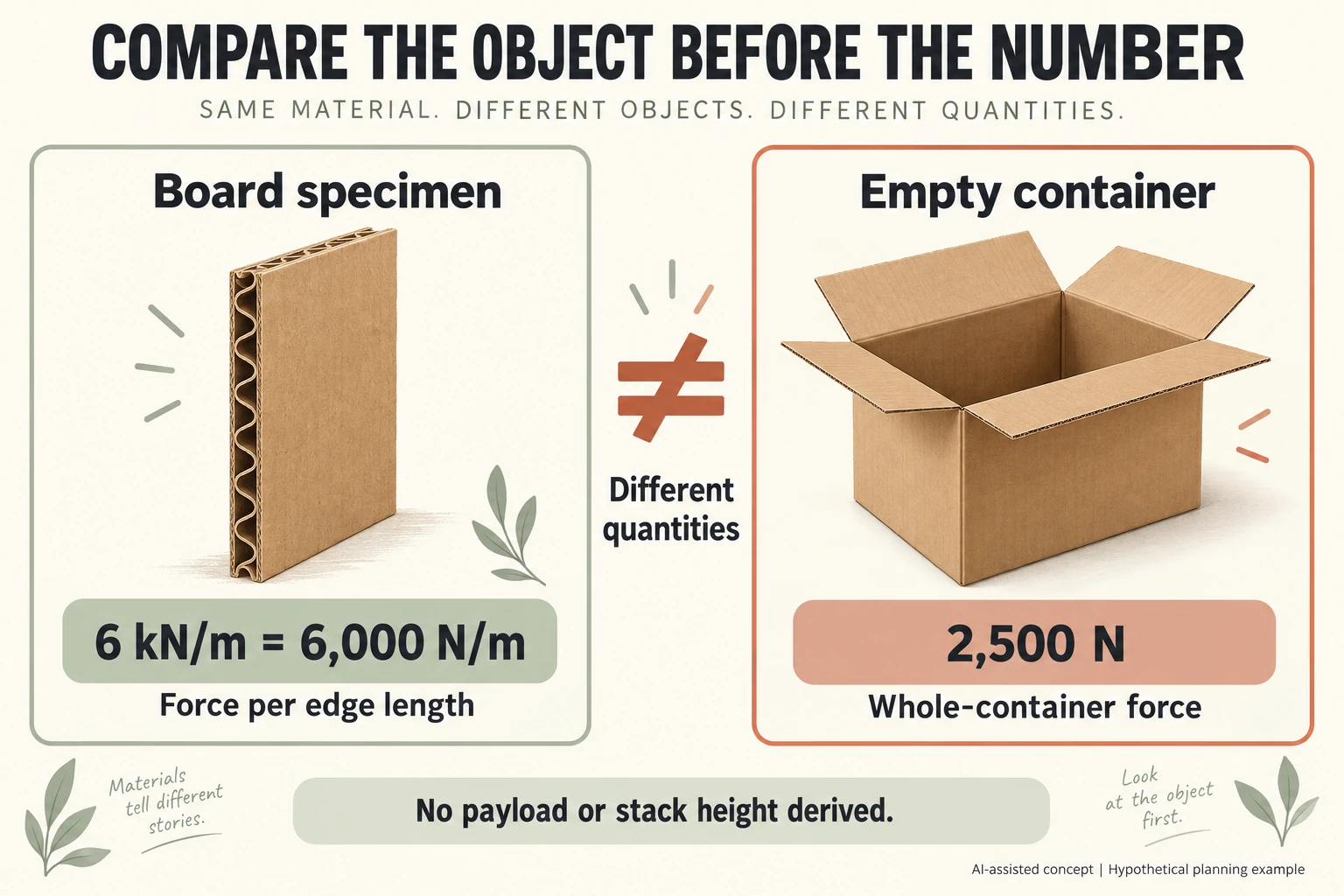
Two invented replies name different objects: E-H gives a board value of 6 kN/m, while C-H gives an empty-container value of 2,500 N. Neither report exists. These teaching values are not results for packaging offered by Packrivo.
Scroll horizontally if columns extend beyond the view.
| Invented reply | Object and quantity | Permitted arithmetic | Unanswered question |
|---|---|---|---|
| E-H: 6 kN/m | Board; force per edge length | 6 kN/m = 6,000 N/m | Complete-carton evidence |
| C-H: 2,500 N | Empty container; whole force | No conversion to board value | Actual filled-system stacking |
| Filled system requested | Contents and conditions to identify | No stack count | Appropriate evaluation and criteria |
Multiplying the board value by 1,000 changes its unit scale, while leaving force per length. It cannot produce whole-box force in N. Ranking 6,000 beside 2,500 would compare different quantities; dividing either figure into payload would add assumptions the replies do not support.
The CSV leaves method, edition, conditioning, direction and fittings blank because these fictional replies omit them. Even two board results need their actual methods and conditions checked. FEFCO separately describes board edge resistance and empty-container compression, with historical dates retained in its public booklet. These symbolic objects are not test apparatus. The filled-package question needs its own complete-system evidence and technical judgement; no safety factor or stack permission follows.
Download the edge crush test vs box compression test record (.csv). HYPOTHETICAL rows are invented examples. Use ACTUAL_BLANK for permitted project inputs; replace that row label only when recording actual facts. Empty evidence, observation and date fields mean unknown or not performed, never acceptance. Keep checkpoints and revisions separate.
Send the measured object, exact quantity and unit, actual method record and the complete-system question that remains open. Prepare the identified scope for a Packrivo inquiry. Packrivo coordinates independent suppliers. These records establish no supplier offer, service availability or MOQ exception; its published baseline is 500 pieces per product/design.