
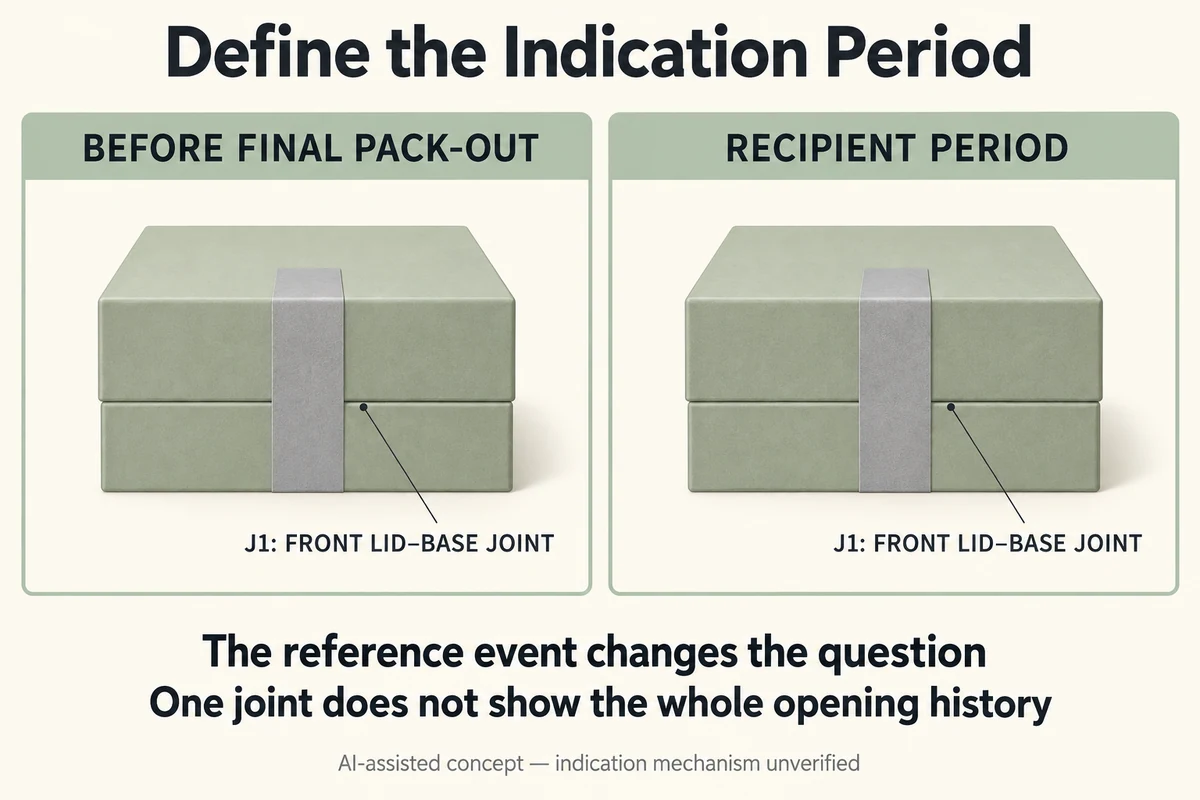
A closure seal answers a recipient-facing question only when its physical change is tied to a specified event, at a named joint, during a defined period. A mark can suggest that a seal was disturbed; it cannot, on its own, identify who acted, why they acted, or whether the entire gift box stayed unopened.
A Visible Indication Depends on Its Material and Trigger
An ordinary closure sticker may hold or decorate a lid without having a designed opening indication. An indication-oriented construction instead relies on a particular change when a specified action occurs. The location of that change matters as much as the marketing term.
| Indication concept | Event described in manufacturer literature | Where the change is intended to appear |
|---|---|---|
| Facestock indication | An attempt to detach the label | In the label’s face material |
| Surface-transfer indication | Detachment from the receiving surface | On the box surface previously under the label |
| Destructible material | An attempted removal that damages the film | In the seal material itself |
These are mechanism categories, not verified options for any particular gift box. Avery Dennison’s 2019 historical portfolio distinguishes facestock-retained indications, transferred surface indications and destructible films. That document describes historical constructions, not their present availability or suitability.
One identified example is 3M’s 7381/7866 technical data sheet, revised June 2024. It describes a VOID indication in the facestock during an attempted removal, with a corresponding transfer to the receiving surface. It also explains that suitable adhesion is necessary, that opaque graphics can conceal the indication and that dispensing can trigger the feature prematurely.
Its typical technical information and industrial-use cautions are not proof of performance on a wrapped gift box. This named product is an illustration from manufacturer literature, not a Packrivo-offered or verified grade.
The trigger must be described accurately. A label reacting to an attempted peel is reporting an event involving that label; it is not directly observing every possible movement of the lid. Equally, an indication visible only after a label has been lifted might not answer a recipient who expects an exterior, before-opening inspection.
Authorized Packing Can Consume the Indication
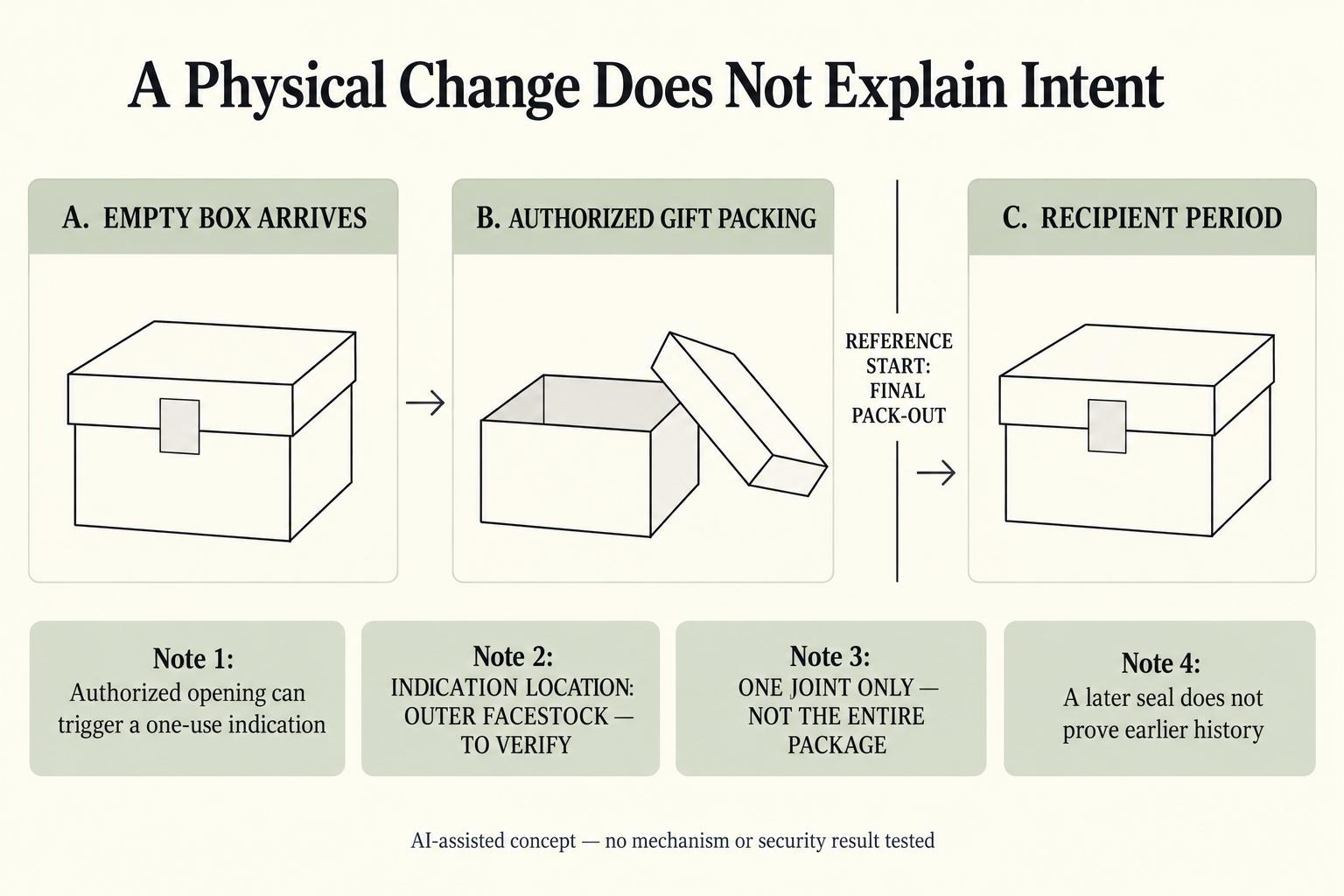
Consider a hypothetical brand that receives assembled, empty lift-off gift boxes already closed. A proposed one-use seal spans the front lid-to-base joint, J1. Before any recipient receives a gift, the brand’s packing team must lift each lid, insert the item and complete the presentation.
If that necessary opening disturbs the sealed joint in the way that triggers the proposed mechanism, the indication may already be consumed during legitimate preparation.
A recipient seeing the changed material later cannot distinguish that event from an unauthorized act merely by reading the mark. The same ambiguity can arise if a giver legitimately opens a completed gift to add a note. The material responds to a physical event, not to permission or motive.
Two clocks are therefore possible.
Since the supplier first closed the empty box includes the packing team’s expected opening.
Since final gift pack-out refers instead to the completed, filled package intended for handover.
For this hypothetical brand, choose the second clock for the recipient-facing design requirement. Do not promise that a one-use indication intended to cover the first clock can meaningfully certify the second.
This choice does not rewrite the box’s earlier history. No later seal or clean-looking closure proves what happened before the chosen reference event. If the brand genuinely needs evidence about empty-box handling as well, that is a separate question requiring separately established evidence, not a conclusion to extract from one mark.
The Recipient-Period Requirement Belongs to One Joint
For J1, the brand can make a specific provisional choice:
After final pack-out, an attempted disturbance of the label bridge at the front lid-to-base joint should produce a distinguishable change in the outward-facing facestock that a recipient can inspect without first peeling the seal.
The defined interval, named joint and expected viewing location are part of the requirement, not outcomes already demonstrated.
A proposal that only exposes a transferred mark on the surface underneath the detached label may answer a different inspection question. A proposed destructible film may create a material break instead of a printed pattern. Neither is automatically wrong; neither can be treated as equivalent to the chosen facestock-visible requirement without an actual proposal and relevant evidence.
There are two linked feasibility questions.
First, does the specified disturbance produce the proposed change on the actual finished J1 surface, with its wrap or coating?
Second, does the recipient see the change with the actual artwork and intended viewing condition?
Packrivo’s label adhesion article covers surface and application records; its removal-observation article covers what can be observed after peeling. The separate decision here is whether an observed physical event communicates the intended recipient-period meaning.
One Indicated Joint Is Not a Complete Opening History
Even if a proposed indicator performs at J1 under agreed conditions, it says nothing by itself about other package joints or other possible opening paths.
No visible change at J1 is not proof that the entire gift box was never opened. A visible change is also not proof of dishonest tampering: packing, a giver’s ordinary handling or another disturbance could have caused the relevant physical event.
The usable outcome is a bounded design statement:
“J1 is the front lid-to-base seal on the final filled gift box. The intended reference begins at final pack-out. Review whether an attempted disturbance at J1 leaves an unambiguous, recipient-visible change in the outer facestock under the intended viewing condition. The mechanism, substrate response and visibility remain unverified. Do not interpret the indication as proof of intent or whole-package integrity.”
That statement gives a sourcing and project-coordination discussion a concrete purpose without pretending to approve a security process.
Unlike the return-mailer second-seal decision, which concerns closing a used package again, this decision is about the meaning and limits of one potential indication after a declared start event.
It remains a proposed requirement until an identified construction and relevant physical evidence support it.
Artwork coverage can hide the required indication location
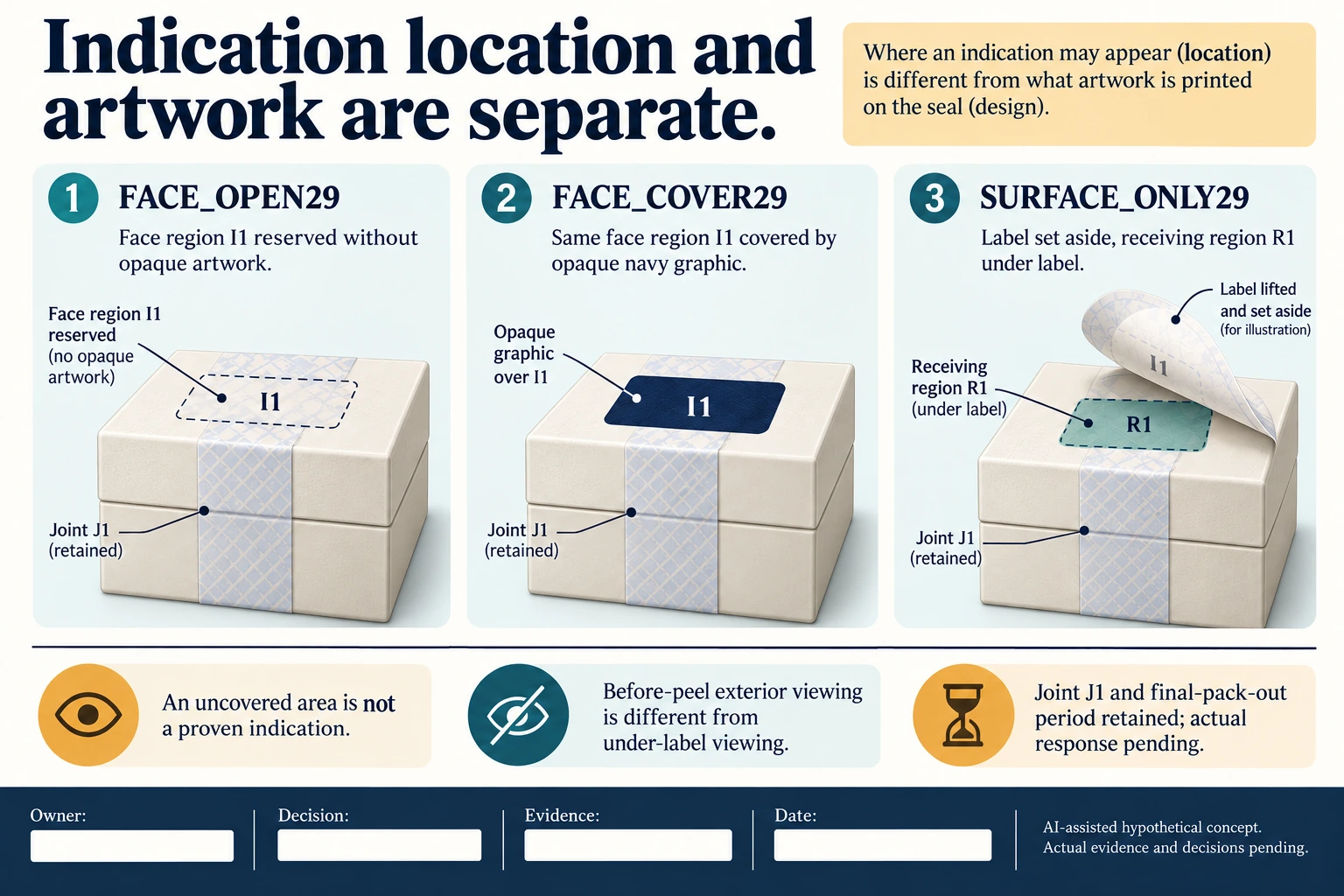
Hold the original J 1 final-pack-out reference period constant, then vary where the proposed recipient would see an indication. FACE_OPEN29 reserves face area I 1 without opaque artwork. FACE_COVER29 adds an opaque graphic over I 1. SURFACE_ONLY29 instead describes a proposed indication on receiving area R 1 underneath a removed label. These are layout and mechanism premises, not actual VOID responses or tested constructions.
Scroll horizontally if columns extend beyond the view.
| Hypothetical configuration | Named object | Relationship | Input or next scope |
|---|---|---|---|
| FACE_OPEN29 | FACE_OPEN29 | proposed location | I1_FACE |
| FACE_OPEN29 | FACE_OPEN29 | proposed artwork | NO_OPAQUE_ARTWORK |
| FACE_OPEN29 | FACE_OPEN29 | proposed view | EXTERIOR_BEFORE_PEEL |
| FACE_COVER29 | FACE_COVER29 | proposed location | I1_FACE |
| FACE_COVER29 | FACE_COVER29 | proposed artwork | OPAQUE_GRAPHIC_AT_I1 |
| FACE_COVER29 | FACE_COVER29 | proposed view | EXTERIOR_BEFORE_PEEL |
| SURFACE_ONLY29 | SURFACE_ONLY29 | proposed location | R1_RECEIVING_SURFACE |
| SURFACE_ONLY29 | SURFACE_ONLY29 | proposed view | ONLY_AFTER_LIFT |
| SEAL29 | J1 | retains | FINAL_PACKOUT_REFERENCE_PERIOD |
| FACE_OPEN29 | CLEAR_AREA_I1 | does not prove | INDICATION_RESPONSE |
| FACE_COVER29 | OPAQUE_GRAPHIC | reopens | INDICATION_VISIBILITY |
| SURFACE_ONLY29 | R1_AFTER_LIFT | not equivalent to | FACE_VISIBLE_BEFORE_PEEL |
An uncovered I 1 is a place to investigate visibility, not proof that the label develops an indication there. Covering it introduces a separate masking question: even if a proposed mechanism responds, the final graphic can obscure what the recipient is expected to inspect. Do not carry a plain-material demonstration into printed-layout acceptance without reviewing the actual construction and artwork together.
SURFACE_ONLY29 answers another viewing sequence. If R 1 is accessible only after lifting the seal, it cannot simply replace a requirement to inspect the exterior before peeling. A particular material may combine face and transferred indications, as the identified 3M example describes; that does not make all constructions interchangeable. The download preserves mechanism location, artwork coverage and intended inspection state as different relationships.
None of the three proves tamper prevention, motive, whole-package integrity or the package’s earlier history. Retain the selected interval and joint while asking the converter which actual construction, surface and printed face can address the requirement. Avery’s 2019 portfolio remains historical;3M 7381/7866’sJune 2024 TDS is a specific example with adhesion, graphics and premature-dispensing limits. No current offer, trigger, ageing result or dispensing process is accepted here.
Download the closure seal artwork obscures face indication review record (.csv). It includes the original table fields and scenarios alongside the added relationships. HYPOTHETICAL rows are editorial examples or required review scopes, not actual records. Actual quantity, configuration, component and file identities, materials, process, specification, copy, method, condition, observation, owner, decision, evidence and dates are blank. ACTUAL_BLANK is a separate empty starting row; enter permitted project evidence before using an actual record. A blank means unknown.
Use the Record Removal Conditions Before Asking for a Removable Label for its separate question.
Source scope checked 17 October 2026: Avery Dennison’s 2019 portfolio is historical. The named 3M 7381/7866 TDS revised June 2024 describes a particular material with adhesion, graphic-masking and premature-dispensing limitations; neither source proves current availability, security or an actual gift-box response. The added configurations and calculations are hypothetical, with actual evidence and decisions pending.
Discuss this packaging specification with Packrivo. We coordinate independent suppliers. MOQ: 500 pieces per product/design; illustrative quantities are not production offers. Confirm materials, samples, price and timing for your project.