
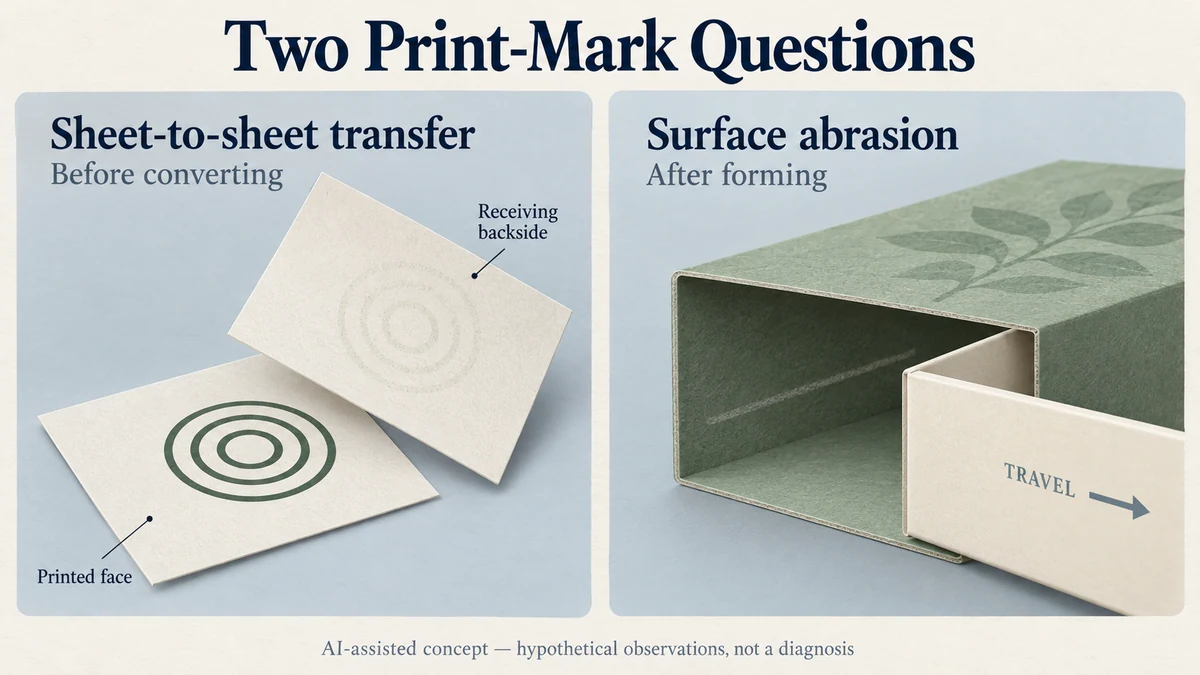
A printed image appearing on the back of another sheet and a pale mark on a finished packaging sleeve should not automatically receive the same treatment. The first observation may point to ink transfer while printed sheets were stacked. The second may point to mechanical contact during converting, assembly or use.
For a small jewellery, candle or gift brand, the practical decision is where to begin the investigation. Preserve the contacting sheet pair when an ink-shaped transfer appears before converting. When a formed sleeve develops a visible surface mark during tray movement, establish the contact path before requesting an anti-scuff finish.
Neither appearance proves its cause. Both require evidence from the relevant production stage.
Wet-Ink Setoff Involves Transfer Between Adjacent Sheets
In sheetfed printing, wet-ink setoff occurs when ink transfers from a printed surface to an adjacent sheet before or during the ink-setting and drying process.
Sappi’s Sheetfed Ink Setoff technical guide, Version 001, © 2012, describes ink transfer onto the backside of a neighbouring sheet. It distinguishes relatively light transfer from blocking, in which sheets become stuck together by an ink or coating film under pressure.
That distinction matters when reviewing a printed care card.
Suppose a dark artwork shape is visible on the back of the next sheet in a pile. If the deposited mark corresponds to the printed image on the contacting sheet, wet-ink setoff becomes a relevant possibility.
The physical relationship between the sheets is more informative than the description "the print rubbed off."
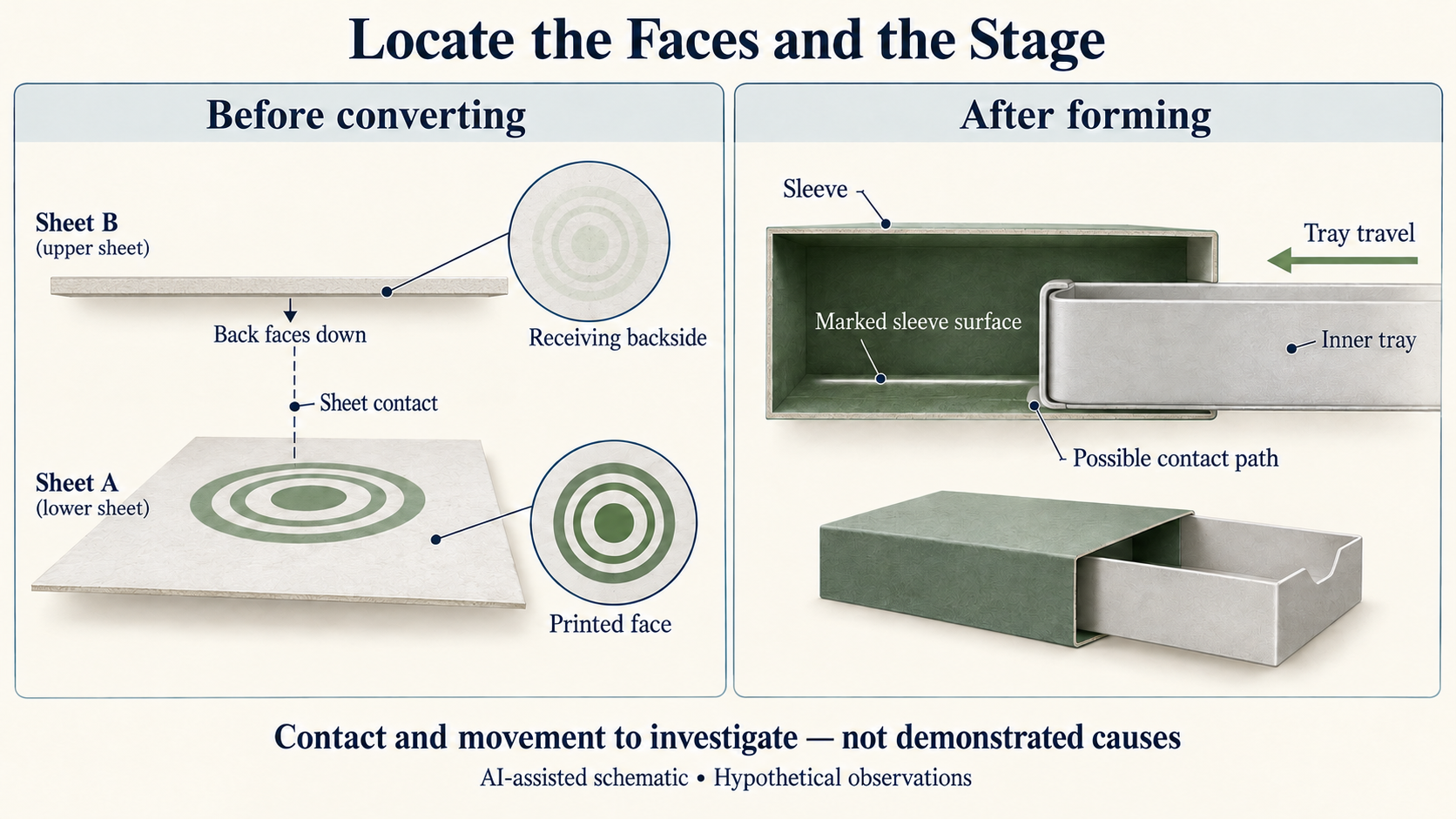
Look for the original contacting faces, the position of the mark relative to the artwork and the stage at which it was first observed. An image merely visible through the original paper is not the same observation as ink deposited onto a separate sheet.
A matching pattern alone does not establish when the transfer occurred or which production condition caused it.
Sappi identifies ink-setting behaviour, substrate compatibility, sheet separation, pressure and handling among the considerations in conventional sheetfed work. The same guide cautions that ink feeling dry to the touch may not be fully polymerised.
The buyer should therefore request the printer’s process-specific review rather than prescribe a universal drying interval, press adjustment or protective coating.
Surface Abrasion Involves Mechanical Contact and Movement
A surface mark created through rubbing involves a different physical question: what contacted the printed surface, and what movement or pressure occurred?
Sappi’s separate Ink Chalk and Scuff technical guide, Version 001, © 2012, describes ink scuffing as dry pigment transfer through abrasive mechanical contact. It discusses ink-film resilience, paper surface characteristics and mechanical action as relevant factors.
A pale line on a printed sleeve could be consistent with local surface wear. It might involve pigment loss, a change in finish appearance or damage to another surface layer. The line alone cannot identify which layer changed.
The location and direction of the mark become important.
A narrow line along the travel path of an internal tray presents a different investigation from a matching ink image transferred between flat sheets in a stack. The printer and converter may need to consider the tray’s contact points, sleeve construction, printed surface and the stage at which the mark was first present.
Mechanical marking can also occur during finishing or handling before the package is assembled. A mark found on a formed sleeve should not automatically be attributed to the consumer’s opening action.
Two Hypothetical Packaging Observations Lead to Different Questions
Consider two independent, hypothetical examples. They are teaching scenarios, not Packrivo production cases or measured test results.
Example A: A Care Card Transfers an Image Before Converting
A gift brand receives evidence of printed care-card sheets before cutting and folding.
Sheet A carries a dark printed motif on its front. The backside of adjacent Sheet B shows a corresponding dark pattern in the area where the two sheets contacted.
The relevant evidence is the relationship between the printed front and receiving back, not simply the darkness of the mark.
Preserve the identified pair and its original orientation. Photograph the affected faces and their relationship before any additional handling where practicable. If the sheets have already been separated, retain their identities without trying to recreate the transfer.
The printer needs to establish the actual print process and review when the mark was observed relative to printing, delivery, stacking, storage and converting.
The specific investigation concerns whether the ink or coating film transferred through contact before it was sufficiently set or dry, and what production evidence could distinguish that possibility from another explanation.
An anti-scuff coating specification does not, by itself, explain the apparent image transfer between these sheets.
Example B: A Formed Sleeve Shows a Pale Line After Tray Travel
A candle gift brand reviews a formed printed sleeve containing a sliding tray.
After the tray moves through the sleeve, a pale line is noticed along an internal printed area. The observation is not an image-shaped deposit on the backside of a neighbouring printed sheet.
The initial question is whether the line existed before the tray moved. If no earlier view exists, the time of its appearance remains uncertain.
The next question concerns the actual interface: which tray edge or surface approaches the marked sleeve area, in what direction, and under which assembly or handling conditions?
The converter can review the sleeve and tray geometry. The printer can assess whether the visible change concerns the ink film, surface finish or another material layer.
If a contact point is implicated, a construction change and a surface-treatment change remain different possible responses. Neither should be described as an effective remedy without relevant comparison evidence.
A pale line is not, on its own, proof of deficient abrasion resistance.
The Two Mechanisms Can Interact Without Becoming the Same Defect
Setoff and scuffing are not necessarily independent of the full printing and finishing process.
Sappi’s historical guidance discusses how measures associated with sheet separation can also affect later surface abrasion. That illustrates why an investigation should consider the complete print-to-converting sequence instead of treating every mark as a request for a stronger topcoat.
It does not justify a buyer specifying spray powder, press chemistry, temperature or machine settings.
The guides concern established commercial printing processes, particularly conventional sheetfed inks. Their drying explanations and production advice should not be applied automatically to UV-curable inks, toner-based digital printing or other systems with different mechanisms.
Where the printing method is not confirmed, identifying that method belongs at the beginning of the technical investigation.
A project may also have both observations: ink transfer in a printed stack and a separate surface mark after forming. Resolving one does not demonstrate that the other has been resolved.
Preserve the Evidence That Changes the Printer’s Next Investigation
For suspected setoff, the useful submission is the original sheet pair, its face orientation, the image-to-transfer relationship and the earliest known production stage of the observation. Ask the printer to investigate the actual setting, drying and stacking conditions and identify what evidence supports its assessment.
For suspected abrasion, provide the marked component, its preceding condition where documented, the opposing contact surface and the relevant movement or finishing stage. Ask the printer and converter to determine what material layer changed and whether contact or construction needs further investigation.
Do not wipe the suspected transfer, deliberately rub a sample to create a new mark, or replace the original evidence with an unrecorded rearrangement. Any formal testing method and acceptance criteria should be established by the responsible technical parties for the actual materials and intended handling conditions.
For the located surface and preceding action, use the surface-scuff observation guide. That record describes what was seen without establishing the cause. Keep a proposed finish change in the print-finish brief, and connect replacement evidence through the sample revision record.
Packrivo can help coordinate the packaging specification, supplier questions and subsequent sample-review requirements. It does not independently certify ink drying, scuff resistance or the success of a proposed treatment.
The useful outcome is not a universal anti-scuff finish. It is a more precise investigation: sheet-to-sheet ink transfer during printing and stacking, or surface change associated with an identified mechanical contact.
That distinction determines which evidence the printer needs before the packaging proposal changes.
Sources checked 10 October 2026. The two Sappi technical guides show Version 001 and © 2012; copyright is not a confirmed publication date. They address historical conventional sheetfed printing guidance, not universal press settings, current certification or a diagnosis of the illustrated marks. No actual sample, printing process or proposed treatment was tested.
Check the receiving face before comparing the mark
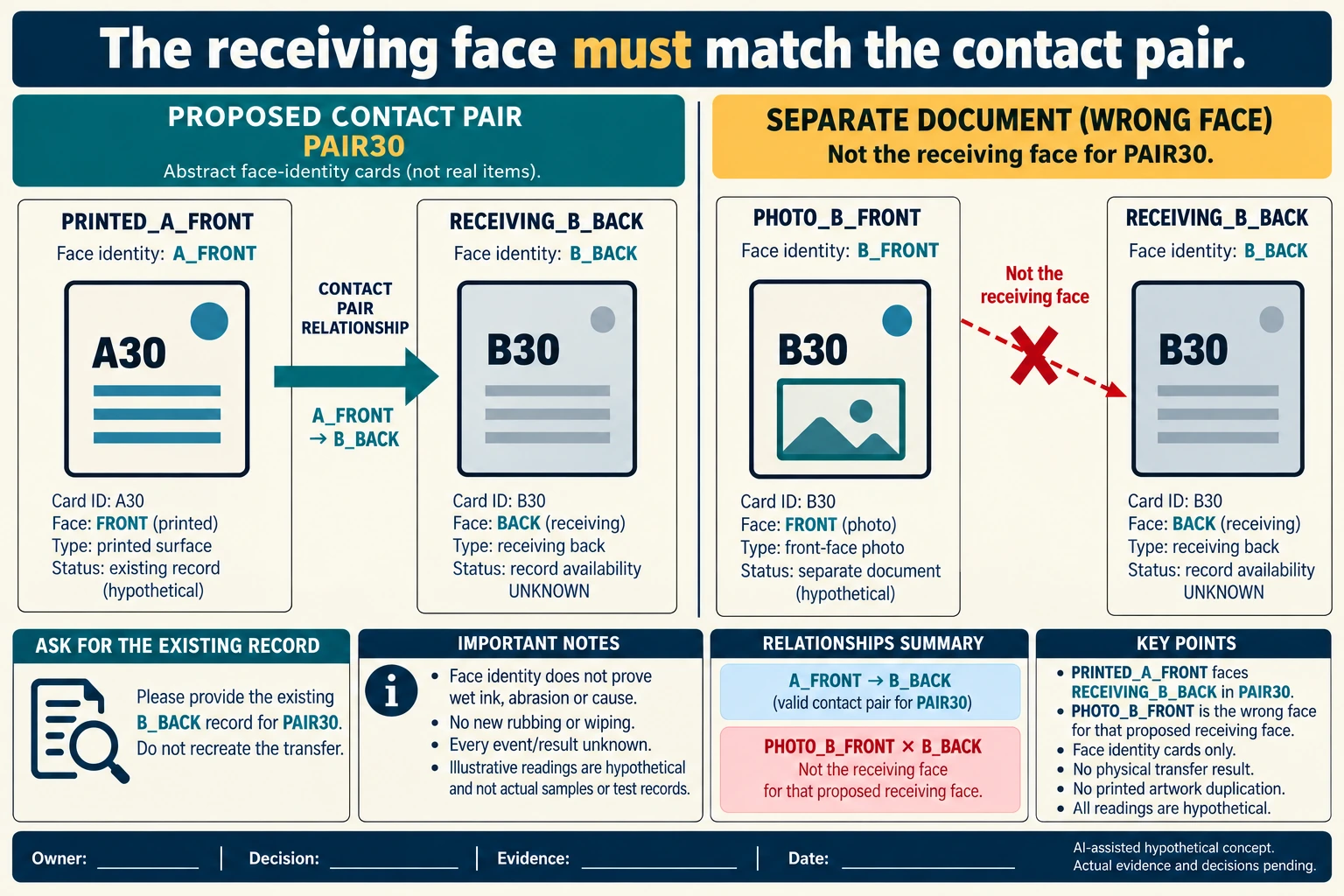
Name a new hypothetical contact pair PAIR30: printed A_FRONT faces B_BACK. A returned image, PHOTO_B_FRONT, instead identifies the front of sheet B. It may document a real face in a future project, but under these invented identities it does not show the receiving back named in the proposed contact. Comparing motif positions without resolving that mismatch can send the printer the wrong investigation.
Scroll horizontally if columns extend beyond the view.
| Hypothetical configuration | Named object | Relationship | Input or next scope |
|---|---|---|---|
| PAIR30 | A_FRONT | proposed faces | B_BACK |
| PHOTO_B_FRONT | PHOTO_B_FRONT | documents | B_FRONT |
| PAIR30 | PHOTO_B_FRONT | does not document | B_BACK |
| PAIR30 | B_BACK | requires | EXISTING_FACE_RECORD_IF_AVAILABLE_NO_RECREATE |
| PAIR30 | CORRECT_FACE_IDENTITY | does not prove | INK_STATE_TIMING_TRANSFER_OR_ABRASION_CAUSE |
| PAIR30 | MISSING_FACE_VIEW | remains | UNKNOWN_NOT_CLEAN |
| PAIR30 | SHEET_PAIR_QUESTION | not closed by | ANTI_SCUFF_SLEEVE_PROPOSAL |
The next useful request is the existing B_BACK record with its orientation and sheet identity, if one exists. Do not turn a missing record into a claim that no transfer was present, and do not recreate contact to obtain a more convincing pattern. A_FRONT and B_BACK still need their actual relationship established; naming them in the worksheet is not evidence that they touched.
This face check comes before choosing wet setoff or later abrasion as the explanation. A corresponding deposit on the correct receiving face can support a focused question, while a view through the original sheet or a photograph of its other side concerns another observation. Even a correctly located pair does not establish ink state, timing or unique cause. Keep the earliest documented stage beside each view.
For a formed sleeve with a pale line, retain the moving contact and preceding surface condition separately. A supplied anti-scuff finish proposal does not close the sheet-pair question, and a printer’s setting/drying response does not prove that a sleeve travel mark was resolved. The worksheet makes the missing face record answerable without prescribing a press change, rubbing action or drying interval.
Download the setoff contacting sheet face identity evidence record (.csv). It includes the original table fields and scenarios alongside the added relationships. HYPOTHETICAL rows are editorial examples or required review scopes, not actual records. Actual quantity, configuration, component and file identities, materials, process, specification, copy, method, condition, observation, owner, decision, evidence and dates are blank. ACTUAL_BLANK is a separate empty starting row; enter permitted project evidence before using an actual record. A blank means unknown.
Use the Describe Surface Scuffs Before Requesting a Finish Change for its separate question.
Source scope checked 17 October 2026: Sappi Sheetfed Ink Setoff and Ink Chalk and Scuff show Version 001 and copyright 2012; those are not verified publication dates. Conventional sheetfed process explanations distinguish investigations and may use overlapping terminology; no actual printing cause, universal press setting or accepted treatment is established. The added configurations and calculations are hypothetical, with actual evidence and decisions pending.
Discuss this packaging specification with Packrivo. We coordinate independent suppliers. MOQ: 500 pieces per product/design; illustrative quantities are not production offers. Confirm materials, samples, price and timing for your project.