

Drops on the outside of a cold package do not, by themselves, show that liquid escaped from its contents. Moisture already in the surrounding air can become liquid on a sufficiently cold surface. A genuine contents leak can also occur, so calling the drops “condensation” without relevant evidence would be equally premature.
The useful purchasing decision is to identify the possible water route before attributing the observation to a closure defect, a packaging material or a handling condition. Exterior appearance is a starting observation, not a diagnosis.
This article uses a hypothetical cold glass container and presentation sleeve. It does not establish an actual temperature, liquid source, product condition or storage requirement.
Water Vapour Can Become Liquid on the Outside Surface
The US National Weather Service’s dew-point explanation describes the condition at which water vapour condenses into liquid droplets. For a package arriving in a warmer, moist environment, its surface can remain colder than the surrounding air during the transition.
If the relevant surface is cold enough relative to the local dew point, water can form there from the surrounding vapour. That route does not require liquid inside the package to pass through a lid, joint or wall.
The National Weather Service’s description of a cooled-mirror dew-point sensor illustrates the same surface-condensation principle. The sensor is not a packaging test, and its operating details are not instructions for investigating a gift shipment.
Surface temperature and air temperature are different quantities. A room’s temperature alone cannot establish whether a particular container face is below its relevant dew point. Nor does a package merely feeling cold supply a measured comparison.
The article’s point is the existence of this external-vapour route, not an invented threshold or drying time for a real package.
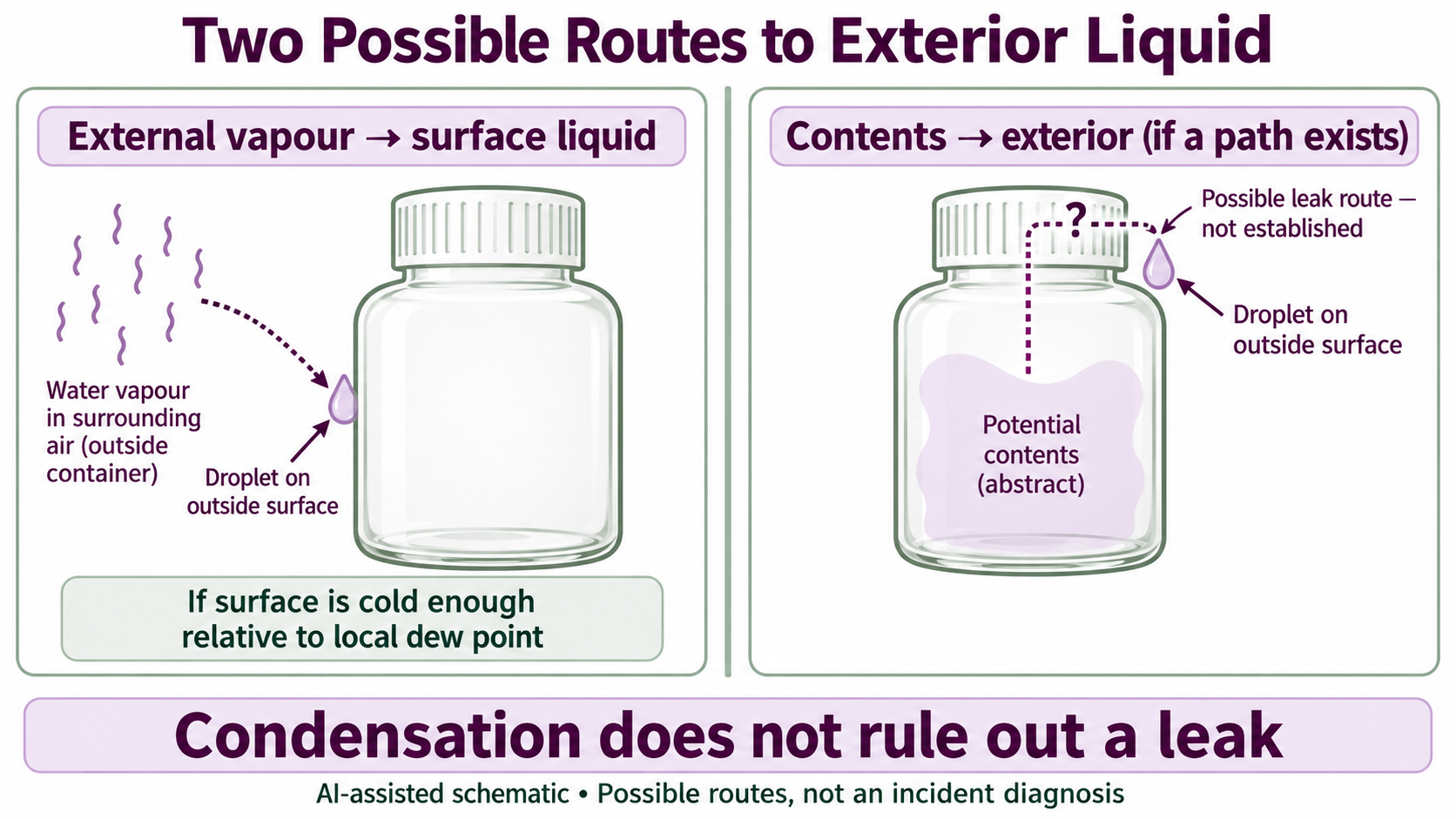
A Closed Cold Container Can Have More Than One Possible Water Route
Consider a hypothetical glass container inside a paperboard presentation sleeve. It moves from a cooler environment into warmer, moist air, and droplets are later noticed on exposed glass outside the sleeve.
That history is consistent with a condensation question. It does not prove that condensation occurred or that the closure remained sound. No surface-temperature, dew-point or closure observations have been supplied for this example.
A contents leak would have a different starting route: liquid from within would reach the exterior through an opening, defect or other passage. External splashing or contact with a wet neighbouring package could introduce water from another source again.
The same exterior area might receive more than one contribution. Condensation and leakage are not mutually exclusive labels that a photograph can select between.
The buyer should therefore preserve the distinction between where liquid is visible and where it originated. Drops near a closure may be relevant to an investigation, but their location alone does not settle the source. An area away from the closure does not, by itself, rule a leak out either.
The Temperature Transition Explains Why Timing Matters
A cold object does not necessarily reach the new surroundings’ temperature immediately. Different parts of a packaged system can have different temperature histories as heat transfers through the arrangement.
The exposed glass, a paper sleeve and a surrounding transport carton need not be at the same temperature at the same time. Contact, enclosure and the prior condition can affect that history.
Consequently, an observation made immediately after arrival and one made later can concern different surface conditions. A record saying only “warehouse humidity” may omit the colder object that made the local condensation route relevant.
Changes in visible drops as the package’s conditions change can inform the investigation. They do not retrospectively prove that every earlier drop came from vapour or that no liquid crossed the closure.
There is no universal waiting period in this explanation. Applying a time borrowed from another product, package or climate would invent a remedy without the relevant basis.
Separate the Source of Liquid From Its Effect on Packaging
Even if external condensation were established, its effect on the packaging would remain a separate question. Liquid reaching paper, a printed surface or an adhesive interface can matter regardless of whether it came from air, contents or another external source.
A finding about origin does not establish that the sleeve is undamaged, that a label performs as intended, or that the packaged product is suitable for its intended use.
It also helps to distinguish this mechanism from other moisture discussions. Vapour moving through a film wall is not the same as vapour becoming liquid at an outside surface. Uneven moisture exchange that changes paper shape is not, by itself, a contents-leak finding. Liquid wetting of a cut edge raises a separate contact-path question.
The packaging conditioning guide helps retain relevant preparation history. It does not replace identifying the present liquid source or condition. The sample checklist supplies a broader review context, rather than a diagnosis for an unexplained wet package.
Ask Which Evidence Would Distinguish the Competing Routes
For an actual incident, the relevant parties need the package configuration, location of liquid and exposure history. If a temperature explanation is proposed, the surface and surrounding-air conditions must be identifiable rather than inferred from a general weather report.
If a contents leak remains possible, that possibility needs its own appropriate investigation. A plausible condensation explanation should not be used to close it without evidence.
Similarly, finding a closure concern does not mean that surrounding vapour could not also have contributed to surface moisture. The goal is to resolve the routes that matter to the actual purchasing or packaging decision, not to choose the most convenient label.
Packrivo can coordinate package details and supplier questions. It does not certify closure integrity, perform a leak or climate test, or establish the condition of a real packaged product through this explanation. The appropriate technical parties must determine any investigation and resulting acceptance decision.
Exterior drops identify a location where liquid is present. They do not identify its source until the relevant route and conditions are established.
Source scope: The two public NOAA/NWS pages were accessed on 11 October 2026; individual publication dates were not established. Their meteorological and sensor explanations support the dew-point principle, not a warehouse target, storage protocol, packaging lifetime or incident diagnosis. No relative humidity, dew point, temperature, drying period, leak result or actual product finding is assigned to the hypothetical example.
Match the surface and observation state to the local dew point
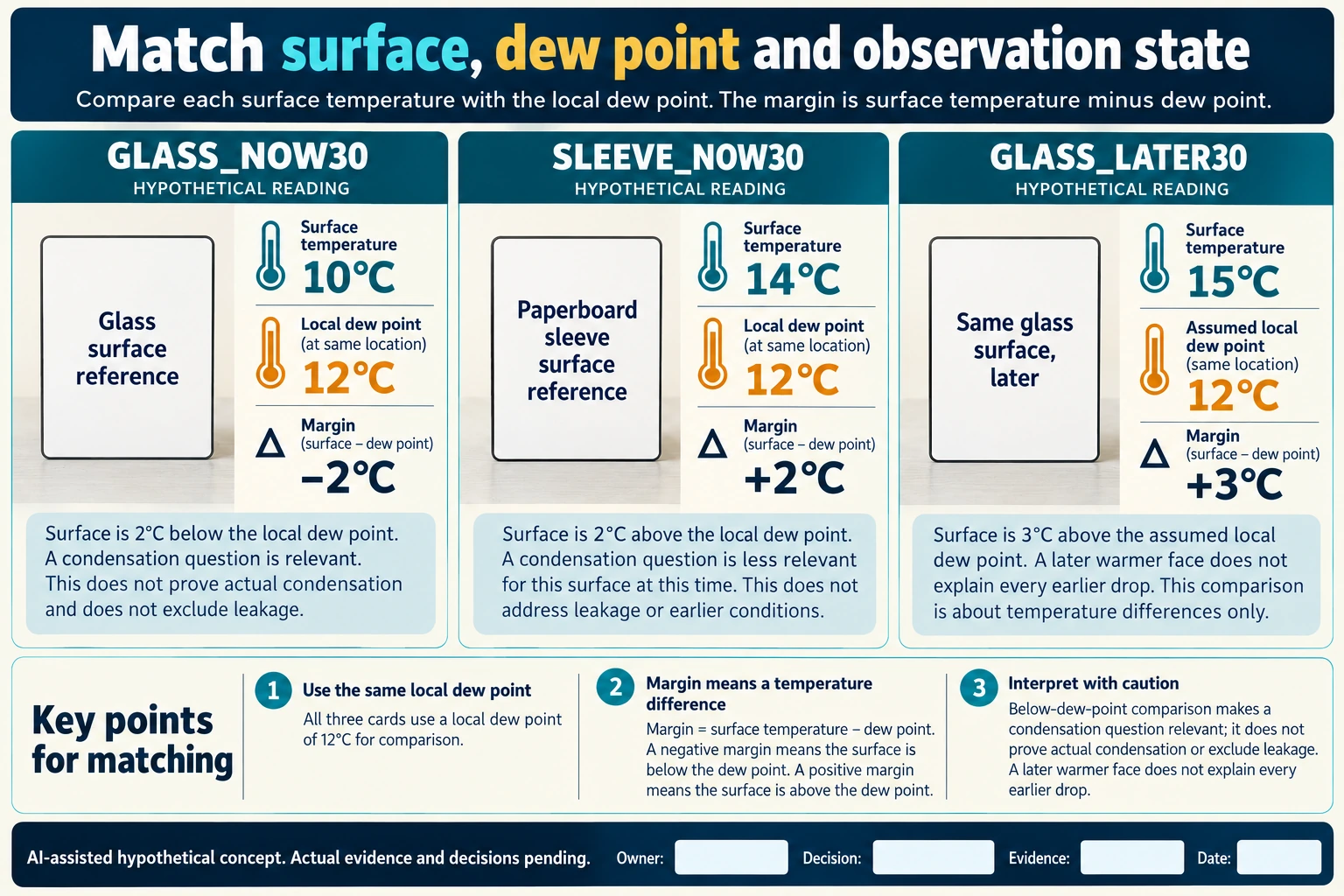
Use three invented temperature records, not a warehouse instruction. At NOW30, assume local dew point 12°C. GLASS_NOW30 has surface temperature 10°C, while SLEEVE_NOW30 has 14°C. Their surface-minus-dew-point margins are−2°C and+2°C. The same environment can therefore support different surface comparisons at the same observation state.
Scroll horizontally if columns extend beyond the view.
| Hypothetical configuration | Named object | Relationship | Input or next scope |
|---|---|---|---|
| GLASS_NOW30 | SURFACE_TEMPERATURE | assumed input | 10 degC |
| GLASS_NOW30 | LOCAL_DEW_POINT | assumed input | 12 degC |
| GLASS_NOW30 | SURFACE_MINUS_DEWPOINT | calculated from | GLASS_NOW30_SURFACE-GLASS_NOW30_DEWPOINT; -2 degC_difference |
| SLEEVE_NOW30 | SURFACE_TEMPERATURE | assumed input | 14 degC |
| SLEEVE_NOW30 | LOCAL_DEW_POINT | assumed input | 12 degC |
| SLEEVE_NOW30 | SURFACE_MINUS_DEWPOINT | calculated from | SLEEVE_NOW30_SURFACE-SLEEVE_NOW30_DEWPOINT; 2 degC_difference |
| GLASS_LATER30 | SURFACE_TEMPERATURE | assumed input | 15 degC |
| GLASS_LATER30 | LOCAL_DEW_POINT | assumed input | 12 degC |
| GLASS_LATER30 | SURFACE_MINUS_DEWPOINT | calculated from | GLASS_LATER30_SURFACE-GLASS_LATER30_DEWPOINT; 3 degC_difference |
| GLASS_NOW30 | NEGATIVE_MARGIN | raises | CONDENSATION_QUESTION_NOT_OBSERVED_RESULT |
| DEW30 | CONDENSATION_POSSIBILITY | does not exclude | CONTENTS_LEAK |
| GLASS_LATER30 | LATER_POSITIVE_MARGIN | does not resolve | EVERY_EARLIER_DROP_OR_OTHER_SURFACE |
| DEW30 | ROOM_TEMPERATURE | not substitute for | SPECIFIC_SURFACE_AND_LOCAL_DEWPOINT_PAIR |
The negative glass margin makes the surrounding-vapour condensation question relevant under the stated premise; it does not report observed condensation or certify the closure. The positive sleeve margin does not explain water that may have reached it from another face, a leak or an external wet contact. Liquid location and origin remain different records.
At LATER30, assume the glass surface is 15°C and local dew point remains 12°C, giving+3°C. This later comparison cannot reconstruct the earlier surface history or prove that every earlier drop came from vapour. Conversely, a plausible earlier condensation condition cannot exclude a simultaneous contents leak. No relative humidity, cooling rate or waiting time is inferred from these inputs.
For an actual incident, the useful request links each reported surface temperature to its location, timing and corresponding local-air dew-point evidence. A generic room temperature is not that pair. Let the responsible parties define any investigation and review the liquid’s separate effect on paper, print and interfaces. The NWS cooled-mirror explanation is a physical example, not a packaging leak-test protocol.
Download the package surface dew point location time comparison record (.csv). It includes the original table fields and scenarios alongside the added relationships. HYPOTHETICAL rows are editorial examples or required review scopes, not actual records. Actual quantity, configuration, component and file identities, materials, process, specification, copy, method, condition, observation, owner, decision, evidence and dates are blank. ACTUAL_BLANK is a separate empty starting row; enter permitted project evidence before using an actual record. A blank means unknown.
Use the Agree Conditioning Before Comparing Packaging Samples for its separate question.
Source scope checked 17 October 2026: NOAA/NWS dew-point and cooled-mirror pages support surface-versus-dew-point physics; individual publication dates were not established. No humidity target, drying schedule, leak test, actual liquid source or product acceptance is supplied. The added configurations and calculations are hypothetical, with actual evidence and decisions pending.
Discuss this packaging specification with Packrivo. We coordinate independent suppliers. MOQ: 500 pieces per product/design; illustrative quantities are not production offers. Confirm materials, samples, price and timing for your project.