
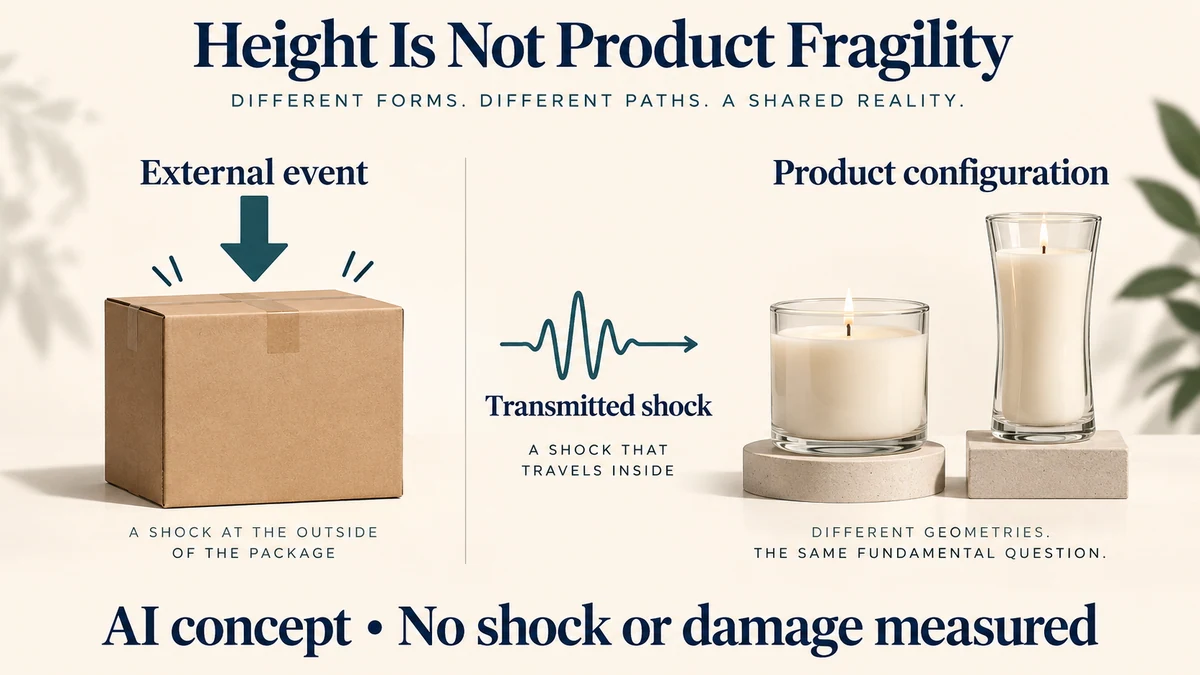
Two products exposed to the same parcel-drop condition need not experience the same damaging response. Drop height describes one part of the external event. Product shock fragility concerns how a particular product tolerates the shock that reaches it.
For a gift brand selecting packaging for glass vessels, treating a height as a universal fragility rating can hide both questions. The cushioning must change the transmitted event, and the product must withstand the resulting event in its relevant configuration.
The fall and the stopping event supply different information
A falling object gains motion before it meets the landing surface. The package then deforms, contacts other parts and brings the contents through a change in motion. Height alone does not describe how quickly that change occurs at the product.
The OpenStax explanation of impulse relates momentum change to force acting over time. A change in velocity spread across one time history is not the same force history as that change occurring through another.
For packaging, the support’s deformation and the actual contacts affect how the product is slowed. A bare external drop description cannot supply the product’s acceleration trace, pulse duration or local stresses.
Even a measured peak acceleration leaves the rest of the pulse undescribed. A brief peak and a longer exposure may have different implications for the product. The relevant interpretation needs a defined shock event, not an isolated number copied from another object.
Shock fragility belongs to the product configuration
ASTM’s public description of D3332-99(2023) distinguishes determining a product’s critical velocity change from determining its critical acceleration. Its scope concerns mechanical-shock fragility using shock machines.
Those are product-characterization questions. The catalogue does not turn a specified parcel height into a measured glass-strength value.
A product can also mean a unit or consumer package carried within an outer shipping container under the standard’s stated scope. The evidence must identify its actual specimen boundary. Bare glass, a filled candle with lid and a retail-packed candle are different configurations.
A change to geometry, mass, connections or a fragile detail can change the damage concern. The relevant criterion might involve glass fracture, a loosened component or an unacceptable functional change. A product’s appearance and a general fragile label do not define that criterion.
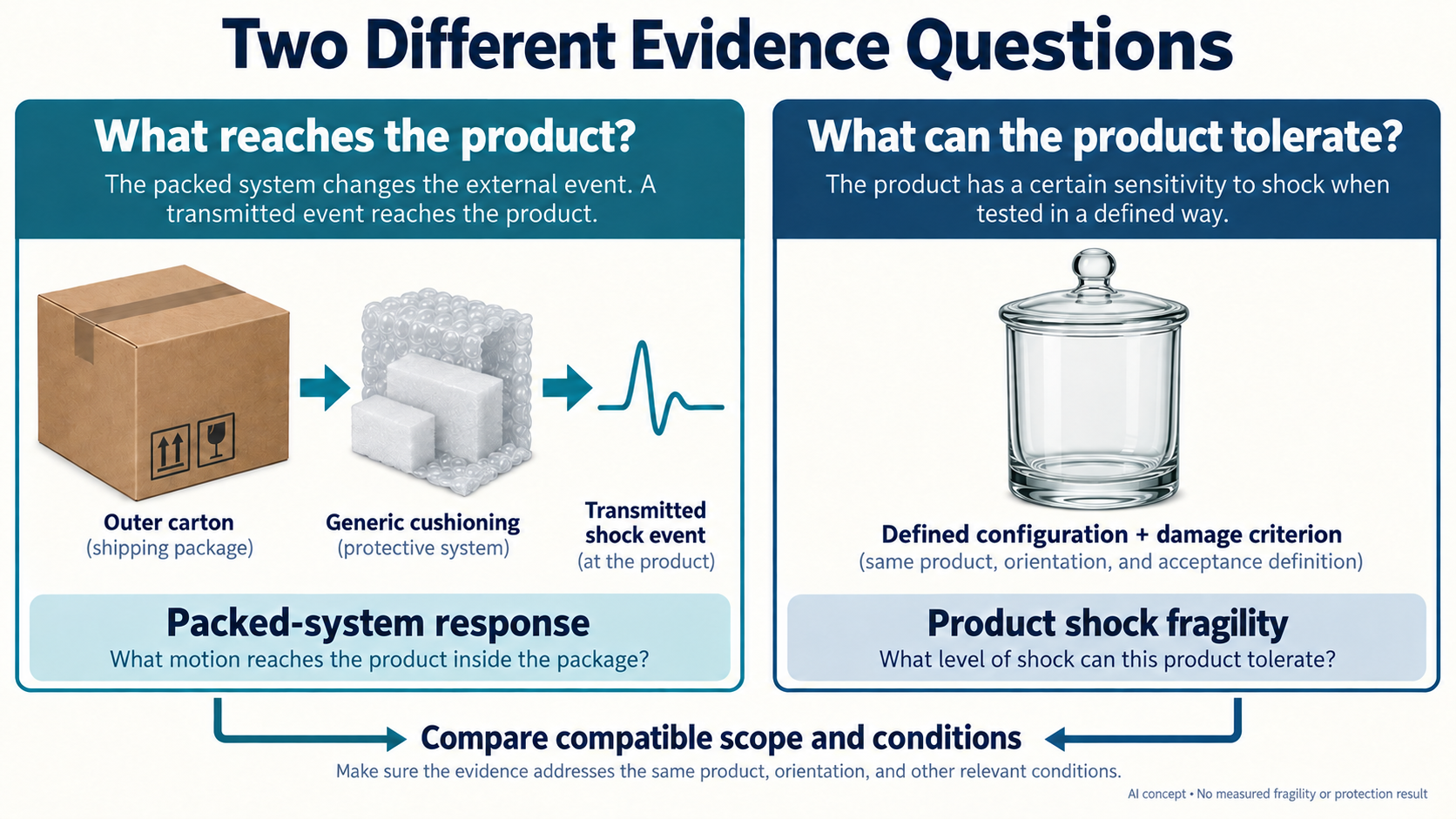
Follow a hypothetical two-vessel comparison
Suppose a candle brand has two proposed glass-vessel configurations. Both are intended to travel in the same outer-box format, but their shape and packed contents differ. Neither has a measured shock-fragility result in this example.
A statement that both packages will be evaluated from the same selected height does not establish that the vessels have equal fragility. It also does not prove that the same support produces equal product acceleration in both configurations.
The brand therefore has two separate evidence needs. It needs an appropriate basis for each product’s damage concern, and relevant evidence for the shock transmitted by the actual packed system.
If one configuration changes its lid or holder, retain that change in the comparison. A familiar carton name cannot make the revised assembly mechanically identical.
This hypothetical example provides no damage probability, acceptable acceleration, critical velocity change or recommended drop height. It explains why one height cannot substitute for the missing product-specific information.
A cushion result and a fragility criterion need compatible scope
A dynamic cushioning result characterizes the tested material or arrangement under its stated impact conditions. It is not automatically the product’s own damage boundary.
Conversely, a product-fragility result does not prove that a chosen insert keeps the product below the relevant boundary throughout transport. The installed cushioning and contact paths still matter.
Before connecting those results, the responsible technical reviewer needs matching product state, measurement meaning, impact conditions and acceptance concern. A laboratory value describing one orientation or fixture cannot silently cover every installed arrangement.
The glass contact map helps identify where the product meets the holder, lid, accessories and outer packing. It supplies useful geometry but no measured fragility threshold.
The distribution-test scope guide defines the complete system and objective. Keep that system evaluation distinct from characterization of the protected product.
Decide which missing evidence prevents the comparison
If a proposal gives only a drop height, product shock sensitivity remains unresolved. If it supplies product fragility but no relevant packed response, the protection decision remains unresolved. If both exist but describe incompatible specimens or shock conditions, their connection needs technical review.
This gives the brand a focused next question: which product configuration and damage criterion does the available evidence cover, and what event reaches that product in the proposed pack?
Packrivo can coordinate those inputs and supplier questions. It does not establish a glass-strength rating or run shock-fragility tests through project coordination.
A height identifies an external test condition. A protection decision also needs the product’s relevant shock tolerance and the response of the complete packaging around it.
Source scope: Checked 11 October 2026. ASTM D3332-99(2023) was listed active, updated 4 October 2023; only its public catalogue scope was read, not the paid method. OpenStax’s public physics explanation supplies the general momentum/time relationship. No vessel, drop, shock pulse or damage threshold was measured for the examples.
Equal peak and duration can still give different impulse
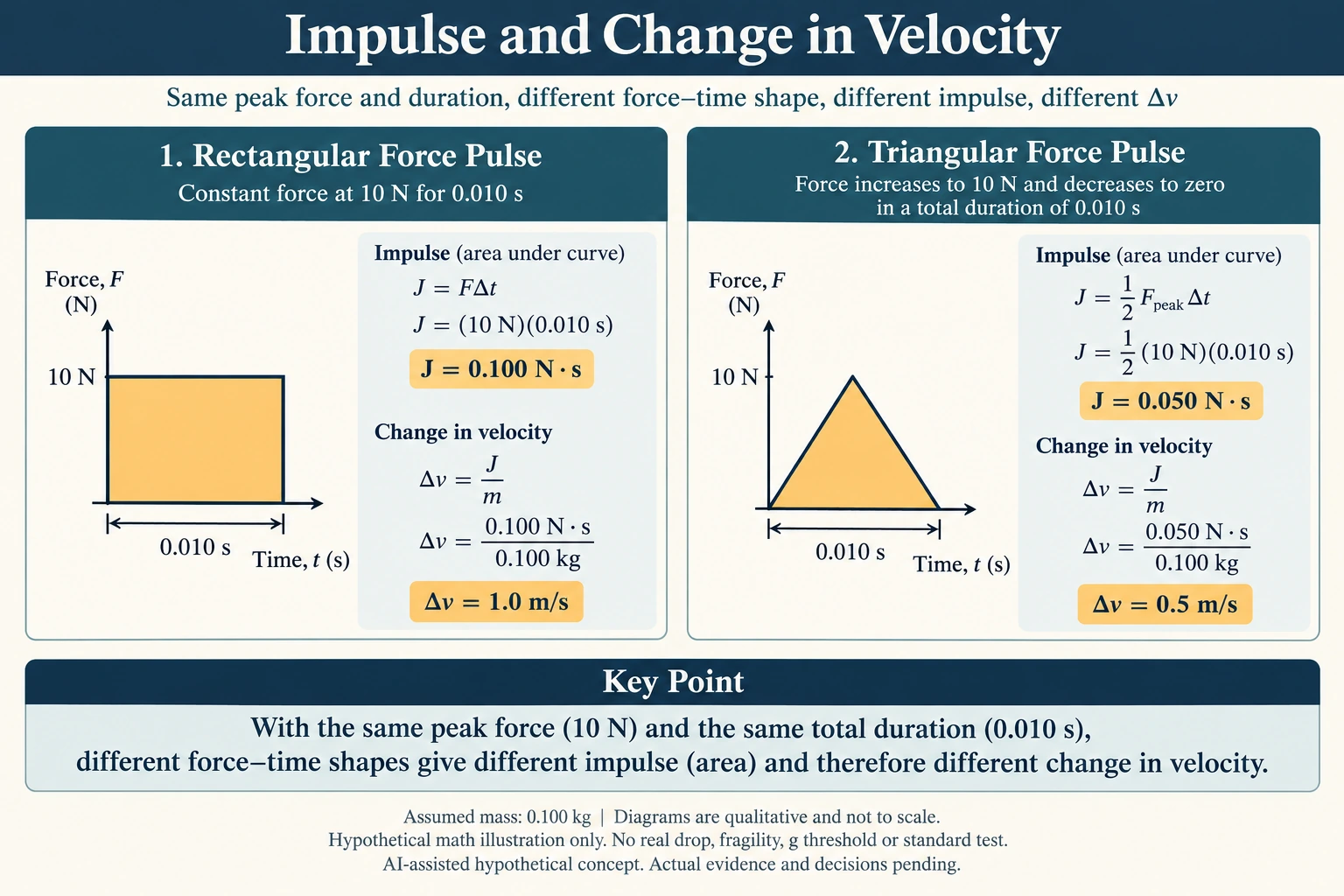
Use two ideal one-direction force histories, zero outside the stated interval. RECT has 10 N throughout 0.010 s. TRI rises and falls as an ideal triangle with the same 10 N peak and 0.010 s total duration. These are mathematical waveforms, not drop or shock-machine records.
Scroll horizontally if columns extend beyond the view.
| Hypothetical configuration | Named object | Relationship | Input or next scope |
|---|---|---|---|
| RECT | IMPULSE | calculated from | RECT_AREA_FACTOR*RECT_PEAK*RECT_DURATION; 0.1 N*s |
| RECT | IDEAL_VELOCITY_CHANGE | calculated from | RECT_IMPULSE/RECT_MASS; 1 m/s |
| TRI | IMPULSE | calculated from | TRI_AREA_FACTOR*TRI_PEAK*TRI_DURATION; 0.05 N*s |
| TRI | IDEAL_VELOCITY_CHANGE | calculated from | TRI_IMPULSE/TRI_MASS; 0.5 m/s |
| IDEAL_MODEL | FORCE_HISTORY | assumes | ZERO_OUTSIDE_INTERVAL_ONE_DIRECTION |
| IDEAL_MODEL | CALCULATED_DELTA_V | not a | MEASURED_CRITICAL_FRAGILITY_THRESHOLD |
The rectangular area is 10×0.010=0.100 N·s; the triangular area is one half of that, 0.050 N·s. For an independently assumed 0.100 kg mass, the corresponding ideal velocity changes are 1.0 and 0.5 m/s. Even matching peak and duration cannot erase the different waveform area.
The calculation supplies no acceleration limit, damage probability or critical velocity change. In particular, neither theoretical velocity change is an ASTM-measured fragility threshold. A real product response requires its actual configuration, contacts, pulse and relevant damage concern.
The buyer can therefore ask whether a summary retains the time history or only a peak-and-duration label. Public D3332 Method A velocity-change and Method B acceleration scopes do not make this arithmetic a paid-method test. Keep product fragility and the shock transmitted through the complete pack as separate evidence needs.
Download the shock pulse shape equal peak duration impulse record (.csv). It includes the original table fields and scenarios alongside the added relationships. HYPOTHETICAL rows are editorial examples or required review scopes, not actual records. Actual quantity, configuration, component and file identities, materials, process, specification, copy, method, condition, observation, owner, decision, evidence and dates are blank. ACTUAL_BLANK is a separate empty starting row; enter permitted project evidence before using an actual record. A blank means unknown.
Use the Packaging Distribution Tests: Define the Packed System for its separate question. Use the Glass Candle Packaging: Map Contact Before Approval for its separate question.
Source scope checked 17 October 2026: OpenStax supports impulse from force-time history. ASTM D3332 public Method A velocity-change and Method B acceleration scopes distinguish fragility quantities. Neither a paid full method nor actual pulse, critical threshold, drop approval or product result was established. The added configurations and calculations are hypothetical, with actual evidence and decisions pending.
Discuss this packaging specification with Packrivo. We coordinate independent suppliers. MOQ: 500 pieces per product/design; illustrative quantities are not production offers. Confirm materials, samples, price and timing for your project.