
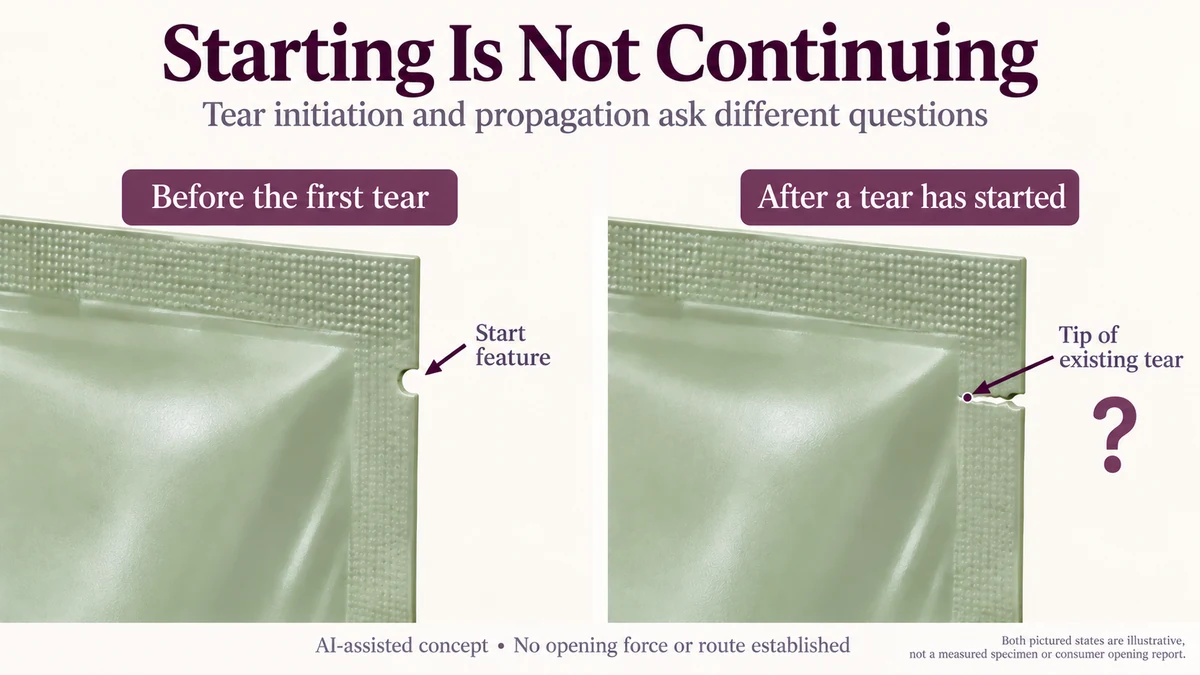
A film pouch can be difficult to start opening yet tear readily once a crack exists. It can also start at an intended feature without continuing along the desired route. Those are different mechanical questions, and an intact-film tensile result does not establish either complete opening behavior.
For a gift brand, distinguish the first tear event from the continuation of that tear before deciding which material or finished-opening evidence is relevant. Neither a strength number nor an easy first movement guarantees a usable opening route.
The examples here are hypothetical. No tear force, notch dimension, film grade or consumer-opening result is supplied.
Starting a Tear Introduces a Local Failure Event
Before tearing begins, the film has to develop a crack or separation in the material at a particular location. The local geometry affects how the applied action is concentrated there.
A start feature can alter that local geometry without changing the identity of the bulk film. Its presence does not imply that the film has become generally weaker in every loading arrangement, nor that a particular finished pouch is suitable to open.
The public description of ASTM D1004-21 concerns tear initiation in flexible plastic film and sheeting using a specified specimen arrangement that creates a local stress concentration. That identifies a distinct question; its laboratory specimen is not a drawing for a consumer pouch notch.
An initiation result remains tied to the method and material conditions it actually covers. It cannot be converted into a required consumer force or a universal start-feature dimension from the public description alone.
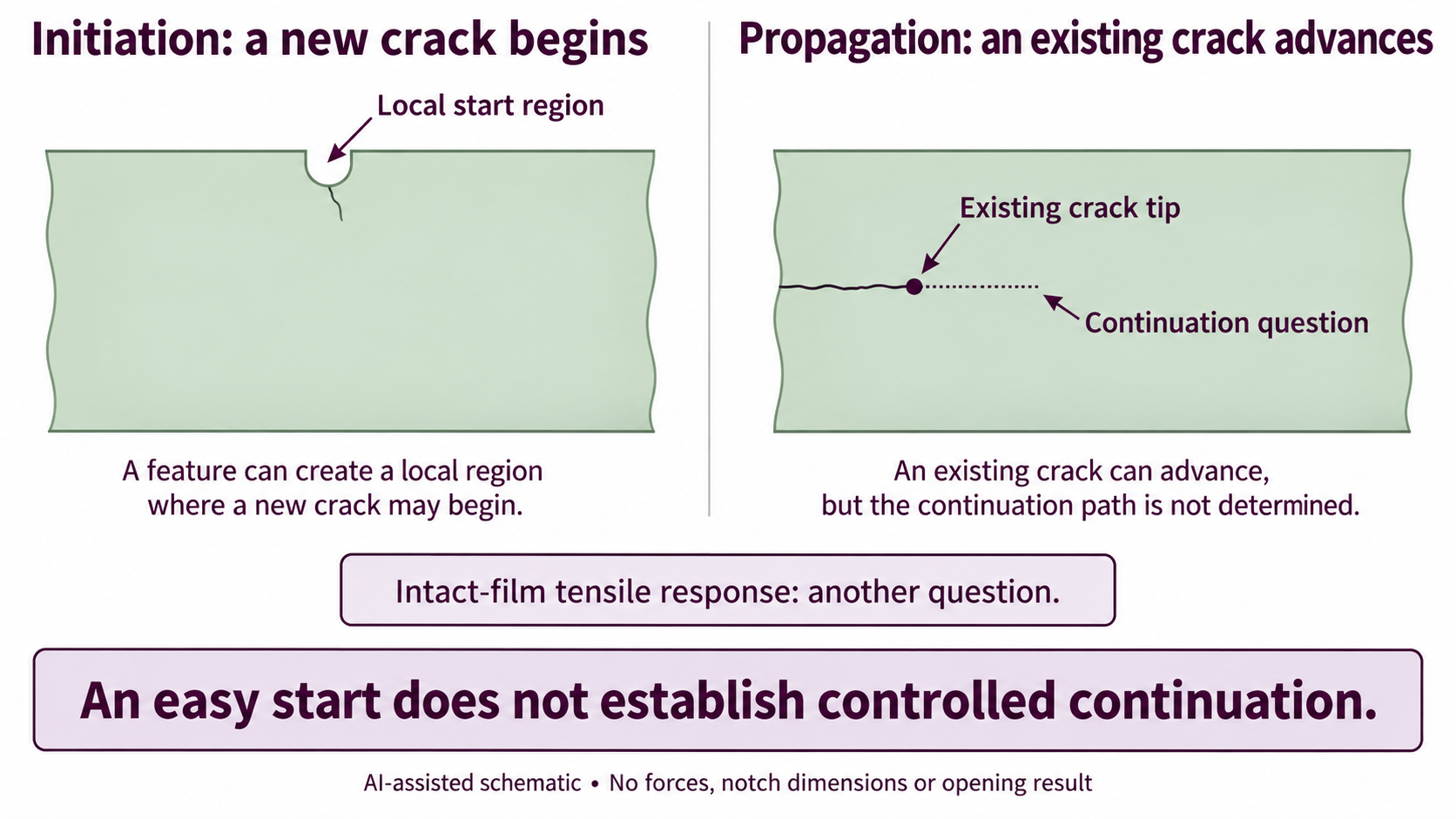
An Existing Tear Has a Moving Front
Once a crack exists, opening can involve extending it through previously intact material. The material ahead of the tear front and the loading around that front now matter.
ASTM D1938-19 identifies tear-propagation resistance as a separate film and thin-sheeting assessment. Its public scope concerns continuation of a tear, rather than creating the first crack in an otherwise equivalent consumer opening.
That distinction explains why two results with the word “tear” in their names should not be treated as interchangeable. Their starting state, specimen arrangement and measured response differ.
The direction of tearing, material construction and its tendency to extend can also affect the result. No universal ratio connects an initiation result to a propagation result, and a thickness change does not automatically allow a simple normalization across materials.
A Start Feature Does Not Define the Entire Opening Route
Imagine a hypothetical inner film pouch with an intended opening-start feature. The brand wants the recipient to begin at that feature and then create a usable opening without removing an unintended part of the pouch.
There are two separate observations to resolve: whether the first tear starts in the intended place and what happens after it starts.
Suppose the initial movement appears straightforward in a conceptual demonstration. That does not assign a measured force or establish that the advancing tear follows the required route. The continuation could depend on the film direction, converted geometry, layers and way the finished pouch is handled.
This is not a report that any particular pouch veers, stretches or fails. It identifies the remaining question once the first event has been considered.
Changing only the start feature may change initiation while leaving the continuation unresolved. Conversely, evidence about an already started tear may leave the first-event requirement open. The buyer should not approve one stage by renaming evidence from the other.
Intact Tension, Film Tearing and Seal Separation Are Different Arrangements
A tensile result for an initially intact film specimen concerns its response to stretching in the stated arrangement. It does not reproduce the advancing crack of a tearing event merely because force is involved in both.
Separating two sealing surfaces is another distinct question. A pouch can have film material around a seam and a joined interface between its surfaces; the observed opening event needs to be located rather than described only as “the pouch broke.”
The hot-melt joint guide discusses fracture locations in an adhesive carton joint, not the tear resistance of a flexible film. Even a correctly described adhesive result cannot be substituted for an in-film opening question.
Likewise, a torn state does not prove who caused it or what earlier event occurred. The label-removal observation guide addresses a different evidence boundary after removal; appearance should not be turned into unsupported opening history.
Retain the Construction and Direction Behind the Result
If a report is offered to explain an opening proposal, establish whether it concerns initiation, propagation or another loading arrangement. Keep the evaluated film identity, direction, thickness and layered construction attached to that result.
A multilayer film is not automatically represented by a result for one constituent layer. A direction-specific comparison does not establish the response in every direction. Changes to the converted pouch can also affect how the opening action reaches the material.
These qualifications do not make material data useless. They make it possible to use the data for the question it actually answers, without claiming a finished opening route from a single specimen number.
Decide Which Part of Opening Is Still Unestablished
For the hypothetical pouch, the buyer’s useful output is a clear statement of the unresolved stage: starting the tear, continuing it, or the behavior of the complete converted opening.
The converter or appropriate technical party can then identify relevant evidence for that stage and its intended use. This article does not prescribe cutting, a destructive home test or an acceptance force.
Packrivo can coordinate construction details and supplier questions. It does not certify consumer opening, edge safety, tamper indication or tear performance through project coordination.
Getting a tear started and making it continue as intended are different requirements. Keep the crack’s starting state visible when selecting the evidence.
Source scope: Public ASTM catalogue information accessed 11 October 2026. The official listings identify D1004-21 and D1938-19 as active; a later D1938 retrieval attempt failed while the official indexed entry remained available. The complete paid methods were not obtained. Their laboratory scopes are not consumer-opening procedures, and no film result, notch recipe, force limit or cross-method conversion is established.
A propagation report still needs the proposed tear direction
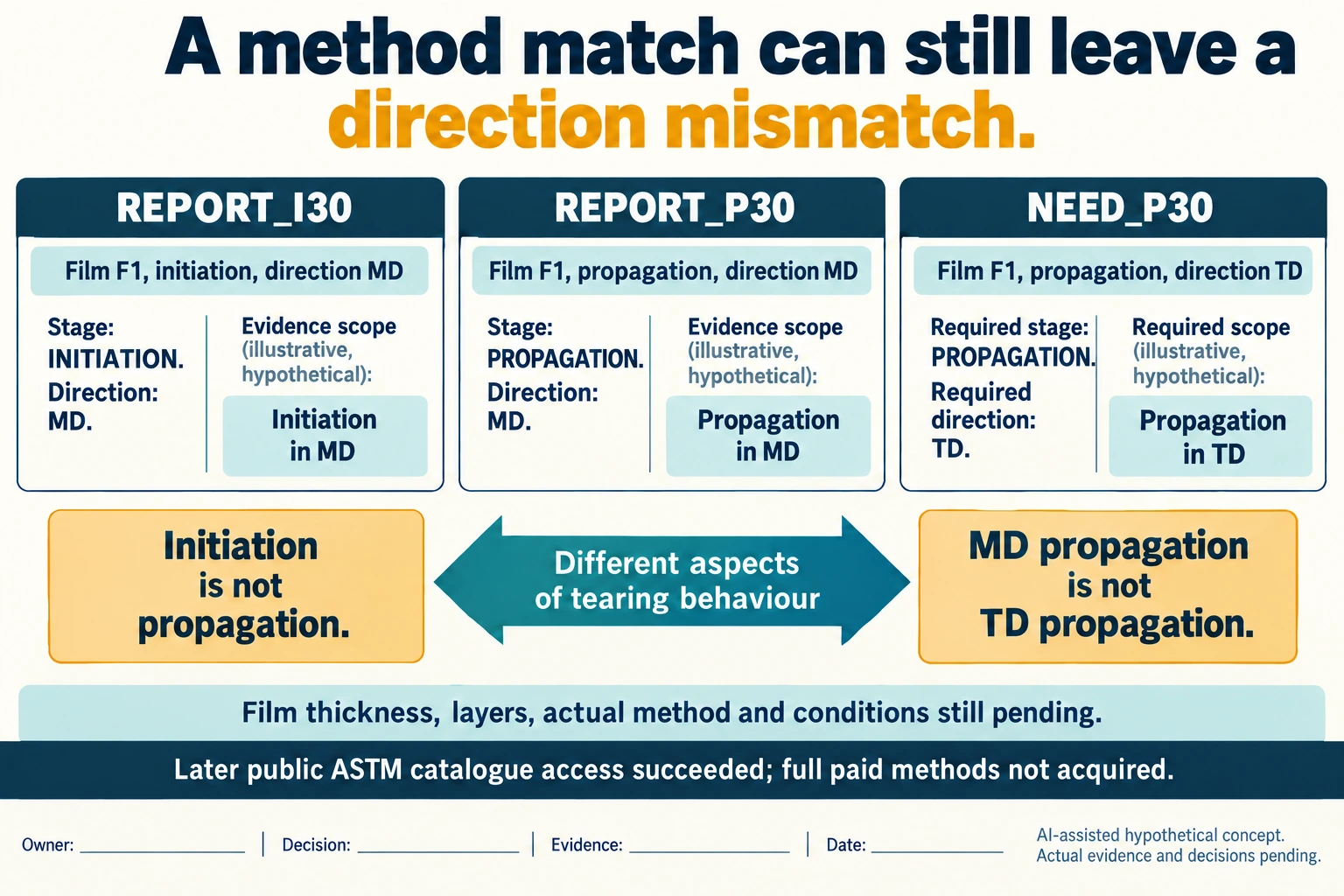
Use three fictional scope identities, not test results. REPORT_I30 names film F1, initiation and direction MD. REPORT_P30 names the same film reference, propagation and MD. NEED_P30 concerns propagation in TD. The tokens name differing directions without prescribing a specimen, notch, cutting operation or force.
Scroll horizontally if columns extend beyond the view.
| Hypothetical configuration | Named object | Relationship | Input or next scope |
|---|---|---|---|
| REPORT_I30 | REPORT_I30 | names film | F1 |
| REPORT_I30 | REPORT_I30 | names stage | INITIATION |
| REPORT_I30 | REPORT_I30 | names direction | MD |
| REPORT_P30 | REPORT_P30 | names film | F1 |
| REPORT_P30 | REPORT_P30 | names stage | PROPAGATION |
| REPORT_P30 | REPORT_P30 | names direction | MD |
| NEED_P30 | NEED_P30 | names film | F1 |
| NEED_P30 | NEED_P30 | names stage | PROPAGATION |
| NEED_P30 | NEED_P30 | names direction | TD |
| NEED_P30 | REPORT_I30 | does not cover | PROPAGATION_STAGE |
| NEED_P30 | REPORT_P30 | does not cover | TD_PROPAGATION_BY_MD_SCOPE |
| NEED_P30 | ACTUAL_APPLICABILITY | requires | FILM_LAYERS_THICKNESS_METHOD_CONDITIONS_CONVERTED_STATE |
| TEAR30 | PUBLIC_LAB_SCOPE | does not establish | CONSUMER_FORCE_NOTCH_OR_FINISHED_OPENING_SUCCESS |
REPORT_I30 does not answer the propagation question because its starting event differs. REPORT_P30 matches the stage word but not the proposed direction. Keeping the material name constant cannot fill either mismatch. The useful missing-data request is therefore direction-specific propagation evidence under a suitable actual scope, rather than another undifferentiated tear-strength number.
The actual film layers, thickness, conversion state, method and conditions remain necessary. MD/TD shorthand must be tied to the actual film and intended route, not guessed from the pouch’s artwork orientation. A multilayer construction or changed finished seam can introduce further differences; none is settled by these three cards.
The later source review successfully obtained the public D1004-21 and D1938-19 catalogues after historical access failures. Active status and Last Updated fields do not mean that the complete paid methods were acquired or run. Initiation, propagation, intact tension and seal separation remain distinct, and public laboratory scopes supply neither a consumer-opening force nor a successful finished-pouch route.
Download the film tear report propagation direction coverage record (.csv). It includes the original table fields and scenarios alongside the added relationships. HYPOTHETICAL rows are editorial examples or required review scopes, not actual records. Actual quantity, configuration, component and file identities, materials, process, specification, copy, method, condition, observation, owner, decision, evidence and dates are blank. ACTUAL_BLANK is a separate empty starting row; enter permitted project evidence before using an actual record. A blank means unknown.
Use the An Opened Hot-Melt Carton Joint Can Break at Different Layers for its separate question.
Additional official reference: ASTM D1004-21 public catalogue, ASTM D1938-19 public catalogue. Later ordinary public access succeeded. Only public scope and significance/use were read, not paid methods; Last Updated is not a verified publication or effective date.
Source scope checked 17 October 2026: ASTM D1004-21 and D1938-19 public Scope/Significance and Use were read after later ordinary GET success. Active and Last Updated dates are not verified first-publication/effective dates. Paid methods were not acquired; initiation/propagation/thickness/brittleness scope limits do not prescribe consumer notches, cross-method conversions or opening approval. The added configurations and calculations are hypothetical, with actual evidence and decisions pending.
Discuss this packaging specification with Packrivo. We coordinate independent suppliers. MOQ: 500 pieces per product/design; illustrative quantities are not production offers. Confirm materials, samples, price and timing for your project.