
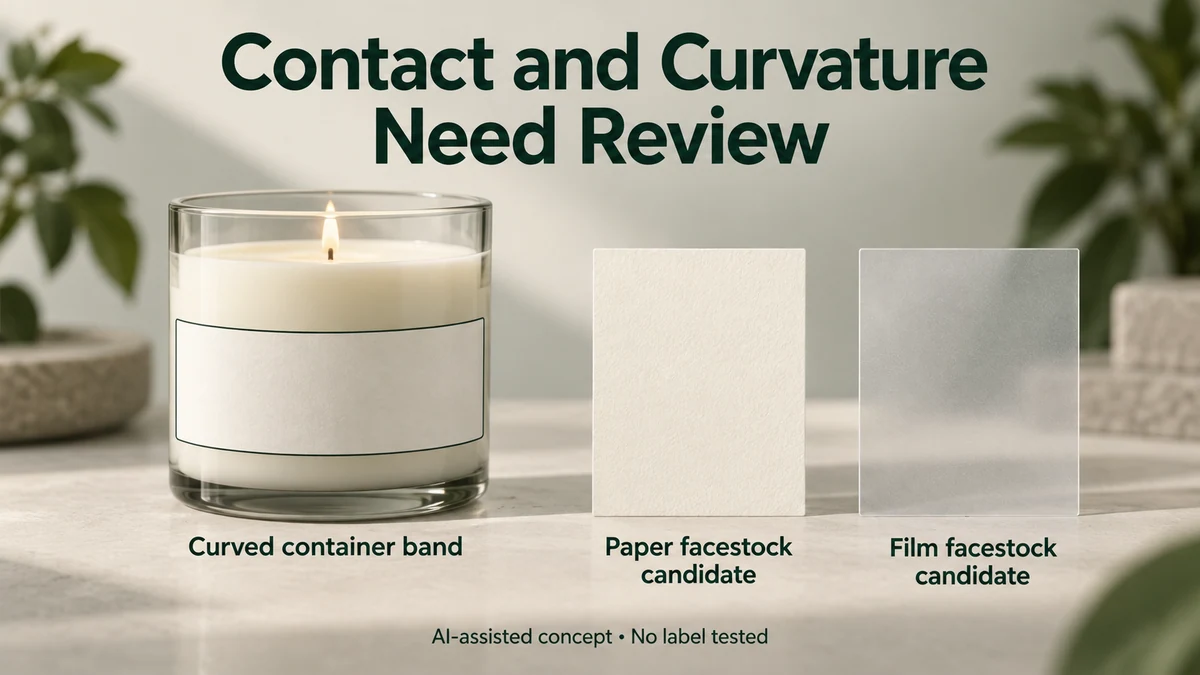
A label lifting at the edge of a curved candle jar does not automatically need a stronger adhesive. The pressure-sensitive adhesive must first establish intimate contact with the finished container surface. At the same time, the label facestock may resist being held in a curved shape.
These two effects work together. A construction can have an adhesive suitable for the surface but a facestock that places too much restoring demand on the bond. Another construction may bend easily yet fail to establish sufficient contact with the actual finish.
For a small jewellery, candle or gift brand, the useful next question is not simply which adhesive is stronger. It is whether the proposed change improves contact, reduces the facestock’s tendency to spring back, changes the area being covered, or addresses more than one of those problems.
Adhesive Contact Depends on the Finished Surface
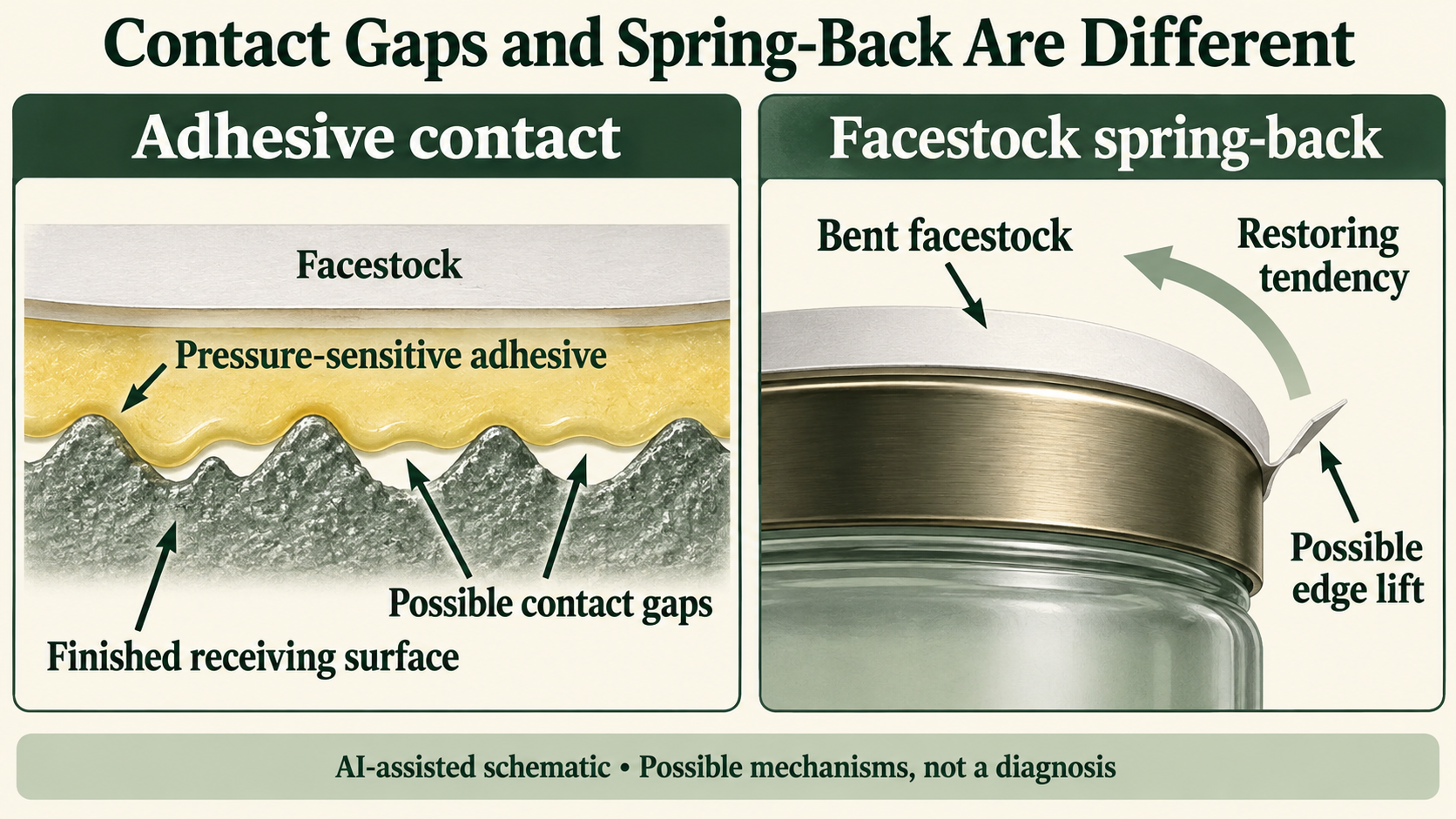
A pressure-sensitive adhesive needs intimate contact with the material receiving it. The visible label area is not necessarily the area where effective adhesive contact has formed.
A smooth-looking container may have a coating or another finish that changes how the adhesive interacts with its surface. Texture can also matter. If an adhesive does not conform sufficiently to a textured surface, some regions may make contact while others remain separated.
3M’s material-bonding guidance explains that wet-out—the adhesive establishing intimate contact with the substrate—is necessary for bonding. Surface energy and cleanliness influence that contact.
Its separate surface-science explanation adds an important qualification: roughness can increase the available surface area, but excessive roughness can also prevent an adhesive from flowing into contact with it.
This means neither a nominally large label area nor a general description such as “glass jar” is enough to establish compatibility.
For an actual packaging proposal, the receiving surface is the finished surface the adhesive meets—not merely the underlying container material. The label construction and application conditions must be considered against that surface.
Wet-out is also not a complete performance verdict. Establishing contact is necessary, but the resulting bond must still withstand the demands placed on it.
A Bent Facestock Can Keep Pulling Against the Bond
A label has a physical structure beyond its adhesive.
When a relatively stiff facestock is bent around a container, it may tend to return toward its original flatter shape. The adhesive must retain the label against that restoring tendency.
This is often called facestock memory or spring-back.
Avery Dennison’s discussion of neck-label detachment explains how paper construction can create a memory effect when labels are applied to curved surfaces. It also notes that inks, varnishes and embellishments can influence stiffness and label behaviour.
The principle is relevant to considering other curved packaging surfaces, but Avery Dennison’s discussion specifically concerns bottle-neck labels. It does not establish a universal material choice for candle jars or gift packaging.
A tighter curve generally asks the same facestock to bend more sharply. Whether that creates a practical edge-lift problem depends on the complete construction, the actual curved area and the adhesive bond.
This also explains why changing only the adhesive may miss the problem.
If the facestock continues to impose substantial restoring demand, an adhesive change addresses the holding side of the relationship without necessarily reducing the demand itself.
Conversely, a more conformable facestock may reduce the bending problem but cannot compensate automatically for poor adhesive contact with the receiving surface.
Avery Dennison’s 2019 Small Diameter Portfolio discusses combinations of flexible facestocks and compatible adhesives. It also identifies stiffness, ink and varnish coverage, and label overlap as factors affecting performance.
That historical product brochure supports reviewing the construction as a combination. It does not establish present availability or an approved construction for this article’s example.
A Label Can Fit the Container Shape Without Staying Attached
Geometric fit and adhesive contact are related but different questions.
A label outline may follow the boundaries of a curved container correctly. Its artwork may appear level, and its upper and lower edges may occupy the intended area.
That establishes a possible geometric fit. It does not show that the adhesive has formed sufficient contact or that the facestock will remain conformed to the curve.
Likewise, a correctly shaped paper mockup cannot reproduce the contact behaviour of an adhesive-coated label or the bending behaviour of its finished facestock.
This distinction becomes important when reviewing a proposed fix.
If the flat outline is unsuitable for a tapered or irregular container, changing its shape or coverage may be necessary. If the outline already fits the intended band, another shape adjustment alone may not resolve edge lift caused by inadequate contact or spring-back.
A brand should avoid using the success of one question—artwork alignment or outline fit—as evidence that the other has been answered.
Compare Paper and Film as Complete Construction Candidates
Consider a hypothetical candle brand with one identified curved container and an already-defined label band.
The brand wants to retain the same artwork. A converter is considering two conceptual alternatives:
-
Candidate P: A relatively stiff paper facestock.
-
Candidate F: A more conformable film facestock.
Neither candidate has been manufactured, applied or tested for this example. No adhesion reading, successful construction or material superiority is assumed.
For Candidate P, the buyer needs to consider how readily the paper can remain curved over the intended band. If its tendency to flatten is substantial, the adhesive may face continuing demand at the label boundaries.
For Candidate F, greater conformability could reduce that mechanical demand. But the film proposal still needs an appropriate adhesive, surface compatibility, printing and finishing construction, and application method.
The film is not automatically the better label. Paper constructions also differ in flexibility, and films do not all behave alike.
The useful comparison separates two questions.
First, can the adhesive establish suitable contact?
Review the actual finished container, its relevant surface condition, and the converter’s proposed adhesive and application instructions. A facestock change does not establish that the adhesive will wet out the surface.
Second, what bending demand does the facestock impose?
Compare how the proposed complete constructions accommodate the identified curvature, including any printing, coating or embellishment that could affect their behaviour.
Where technically feasible, comparing facestocks while retaining other defined variables can help clarify the material difference. If the proposed paper and film require different adhesives or other construction changes, they must instead be evaluated as different complete constructions. An observed difference cannot then be attributed to the facestock alone.
A visible lifted edge would not, by itself, establish which mechanism caused it.
A construction that appears to conform initially may still require an agreed observation under its intended conditions. An edge that remains attached during one brief observation does not establish performance throughout storage, handling or use.
The next candidate should be selected through a defined construction comparison, not through an assumed result.
Select the Next Change According to the Unresolved Mechanism
The same visible defect can lead to different design questions.
If the principal concern is contact with the receiving finish, the next comparison should address the surface–adhesive combination and the intended application conditions. Changing the facestock alone would not explain how the adhesive meets that surface.
If the principal concern is bending demand, the converter can consider a more conformable facestock or a different finished construction. Simply requesting greater tack does not reduce the facestock’s tendency to return toward flatness.
If the label spans a curved transition, raised feature or unsuitable contact region, reconsider its position or coverage. Reducing coverage or changing geometry may alter the problem, provided the required information and intended appearance remain accommodated.
If both poor contact and spring-back are plausible, the next proposal may need to change the adhesive and facestock together. This is a combined-construction comparison, not evidence that either individual change would have succeeded.
These choices are alternative technical directions, not diagnoses from photographs.
The actual observations, construction details and review conditions must determine which explanation deserves further examination.
Review the Applied Construction Rather Than an Adhesive Name
Before comparing the next candidates, identify the finished container version and the intended label band.
The converter should explain the proposed facestock, adhesive, relevant finishes and dimensions. The application owner should confirm how the actual labels will be applied and which conditions the comparison will cover.
A useful review should distinguish contact-related concerns from possible facestock-return effects as far as the available evidence permits. It should also describe where any visible lifting occurs and what the observation does—and does not—establish.
For the broader surface and application inputs, see Packrivo’s label adhesion and surface-use guide.
If the unresolved question concerns the flat outline on a tapered container, use the separate tapered-container label geometry guide. That shape decision does not replace review of the finished pressure-sensitive construction.
If the problem occurs while the label separates from its backing rather than after application to the container, liner release needs its own review.
Packrivo can coordinate the packaging brief and supplier questions. It does not establish a label’s physical performance through project coordination alone.
The practical outcome is a better-directed next comparison: improve actual surface contact, reduce facestock bending demand, revise coverage, or review a combined construction.
A stronger adhesive is only a meaningful answer when it addresses the actual unresolved mechanism.
Source/access note — Sources checked 10 October 2026. 3M and Avery Dennison public pages are undated. The 2019 Small Diameter Portfolio is historical product guidance, not a verified exact publication day, present availability or a tested candle-jar construction.
Identify the changed inputs before attributing an improvement
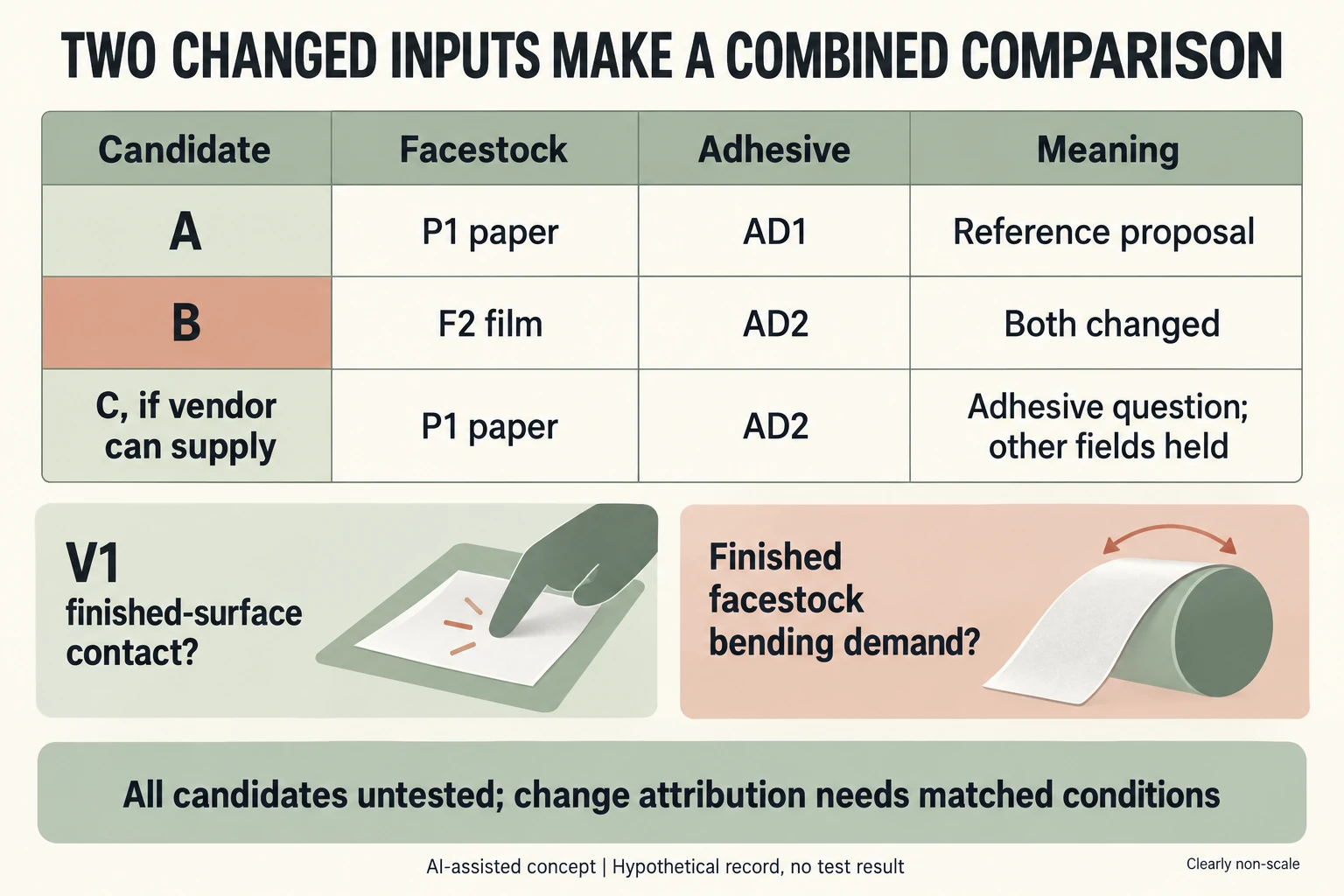
Use invented reference A with paper facestock P1 and adhesive AD1. Proposal B changes both to film F2 and AD2. A conditional C would retain P1 with AD2 only if the vendor can actually provide a suitable construction. No candidate has been made, applied or observed.
Scroll horizontally if columns extend beyond the view.
| Candidate | Facestock | Adhesive | Comparison meaning |
|---|---|---|---|
| A | P1 paper | AD1 | Reference proposal |
| B | F2 film | AD2 | Two changed inputs |
| C, conditional | P1 paper | AD2 | Adhesive question only if other relevant fields held |
| All | Actual print/finish to identify | Receiving finish V1 to identify | No diagnosis or material winner |
If B later looks different from A, that comparison cannot isolate facestock as the cause when adhesive also changed. C is a proposed way to ask a narrower question, not evidence of compatibility or supplier availability. Other relevant variables still need matching.
Keep V1's finished surface, application conditions, artwork/finish and observation stage with each candidate. Record visible edge position and timing before assigning poor contact or spring-back as the cause. The diagram's contact and bending icons show questions rather than actual wet-out, force or microscopy. No label outline or liner-release approval substitutes for this applied-construction record.
Download the label edge lifting curved jars record (.csv). HYPOTHETICAL rows are invented examples. Use ACTUAL_BLANK for permitted project inputs; replace that row label only when recording actual facts. Empty evidence, observation and date fields mean unknown or not performed, never acceptance. Keep checkpoints and revisions separate.
Send every changed construction field and the actual finished surface before requesting a matched comparison or cause review. Packrivo coordinates independent suppliers. These records establish no supplier offer, service availability or MOQ exception; its published baseline is 500 pieces per product/design.