
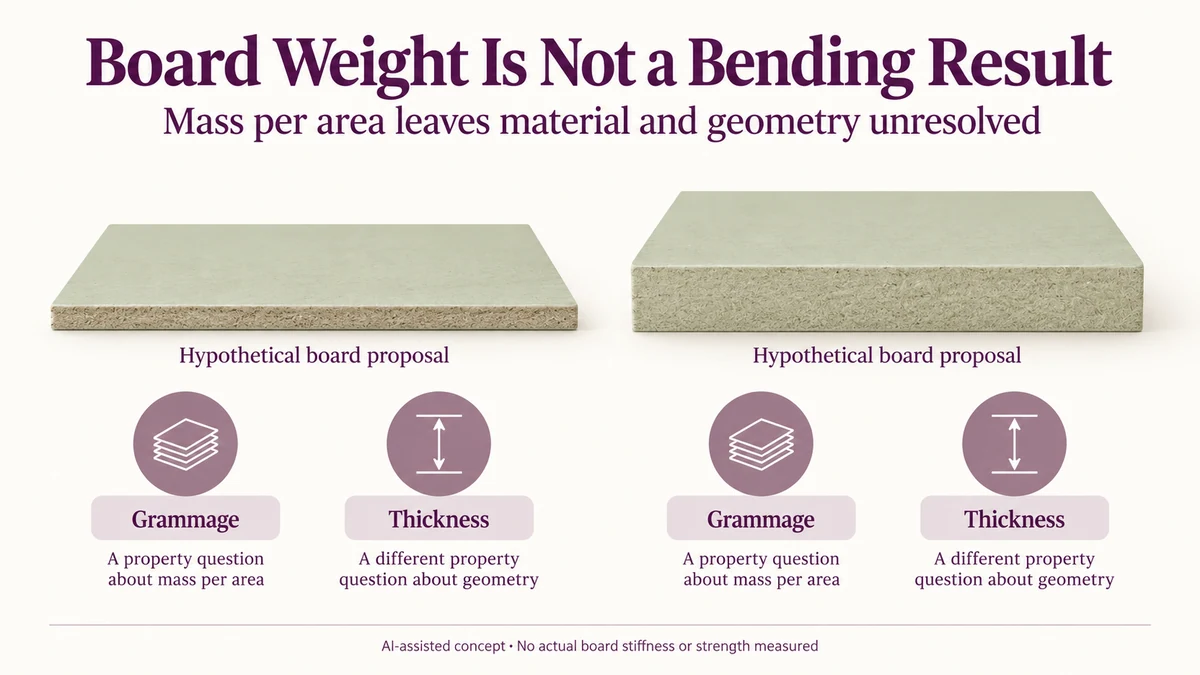
Two paperboard proposals with the same grammage need not bend alike. Grammage describes mass per unit area; it does not, by itself, identify thickness, material stiffness, direction or the arrangement in which a panel is supported and loaded.
For a gift brand choosing a card or panel, the useful decision is whether the available bending evidence relates to the required shape and function. “Same gsm” is not a complete stiffness comparison, and a thicker proposal is not automatically an approved stronger package.
The beam example below is an explicitly ideal mathematical model. It is not a tested paperboard grade, a carton load rating or an equal-grammage comparison.
Grammage, Thickness and Bending Describe Different Quantities
A grammage figure states how much material mass is associated with a given area. A thickness or caliper figure states the distance through the construction. A bending result describes a mechanical response under its stated arrangement.
Holmen’s paperboard technical information lists grammage, thickness and bending-related properties separately. Its bending descriptions also retain machine and cross direction, rather than treating the sheet as one universal response.
Those distinctions explain why a proposal described only as a board weight can leave a panel-function question unanswered. Equal mass per area does not establish that material has been distributed through the same thickness or has the same mechanical behavior.
The buyer needs the relevant construction and property basis, not a presumed conversion from gsm to stiffness.
Thickness Enters an Ideal Beam’s Flexural Geometry
For an ideal homogeneous rectangular beam, elastic bending involves the product EI: material modulus E combined with the section’s second moment of area I about the relevant bending axis.
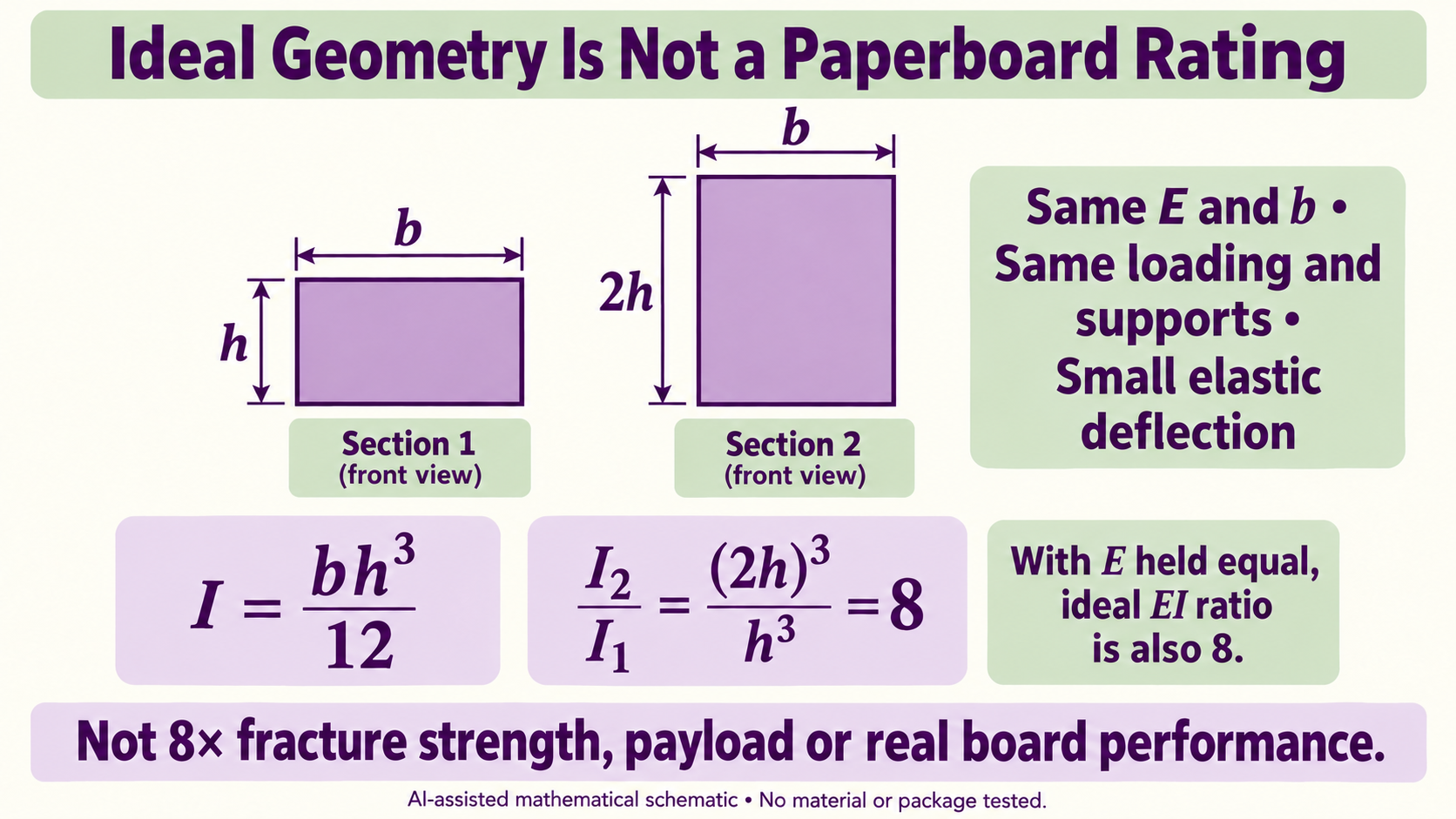
For width b and thickness h, that ideal rectangular section has:
I = b h³ / 12
The homogeneous-beam passage in MIT OpenCourseWare’s Spring 2015 lecture transcript states this relationship and explains that the loading and support configuration also affect deflection.
The equation separates a material property from a geometric property. Increasing thickness changes the geometry strongly in this model, but changing material stiffness can also change EI. Thickness alone does not identify the full response.
This relationship is not a claim that real layered paperboard always behaves as a uniform, homogeneous beam or that its response can be predicted from caliper without other information.
Doubling Thickness Gives Eight Times the Ideal Section Term Only Under the Assumptions
Consider two invented homogeneous rectangular strips. They have the same modulus E and width b, and are compared under the same span, loading, support and small-deflection elastic assumptions. Their thicknesses are h and 2h.
The ratio of their section terms is:
I₂ / I₁ = (2h)³ / h³ = 8
Because E is assumed identical, their ideal EI ratio is also 8. This is a mathematical flexural-rigidity comparison, not an observed material result.
It does not mean eight times the fracture strength, eight times the box payload or eight times the lifetime. It does not say that two real boards of equal gsm have this ratio. Their E, thickness, structure and direction may differ, and none has been measured in the example.
The purpose is to show why a mass-per-area description omits a potentially important geometric term. It is not a formula for selecting a board grade from a sample’s appearance.
Two Loose Layers Are Not Automatically One Double-Thickness Beam
The ideal 2h strip above is one homogeneous section. Placing two separate h-thick pieces together does not automatically create the same section acting as one solid member.
The pieces can have a different connection and ability to slide or share bending. An assembled or laminated construction requires an appropriate basis for how its layers act together; complete composite action should not be assumed from the sum of their thicknesses.
The same caution applies to corrugated structures and other layered arrangements. Their geometry and load paths cannot be silently replaced with those of a single homogeneous rectangle.
Thus neither “twice the thickness” nor “two layers” independently supplies the ideal eightfold result for an actual packaging panel.
Sheet Direction and Finished Geometry Belong to the Application
A card’s dimensions, support and loading differ from those of a complete box. A crease, cutout, mounted product or connection can affect how the finished piece moves, and the relevant bending direction needs to remain identifiable.
The board-grain and crease guide addresses material direction at a fold. That direction information is useful, but it does not create a bending result or hinge-life rating for the finished proposal.
The earring-card clearance guide addresses the mounted product’s spatial arrangement. A card meeting those clearances still needs a relevant basis if the function depends on how it bends.
An initial elastic bending question also differs from time-dependent creep, repeated-hinge movement and rupture. Evidence for one should not be relabeled as a complete durability or protection finding.
Choose a Bending Comparison for the Required Job
For a proposed card or panel, first identify what must remain acceptably shaped, where it is supported and how the intended use loads it. Then consider the board’s actual thickness, construction, direction and relevant bending evidence.
If two quotations specify the same grammage but omit those details, equal bending performance remains unestablished. If a supplier provides a stiffness result, retain the method and direction behind it rather than treating it as a universal measure of package strength.
Packrivo can coordinate the specifications and supplier questions. It does not perform bending tests, calculate an approved payload or certify board performance through project coordination.
Grammage describes mass per area. A bending decision also needs the material, flexural geometry and application that the mass figure does not define.
Source scope: Public sources accessed 11 October 2026. Holmen’s technical PDF is issued 10 December 2025; the relevant property definitions were used, not its grade ratings or marketing claims. MIT’s Spring 2015 transcript was read at the homogeneous-beam passage, not used to transfer the wider sandwich-panel analysis to paperboard. The h-to-2h example is ideal mathematics only; no modulus, deflection, rupture load, actual board ratio or packaging performance has been established.
Separate the board comparison from the ideal geometry calculator
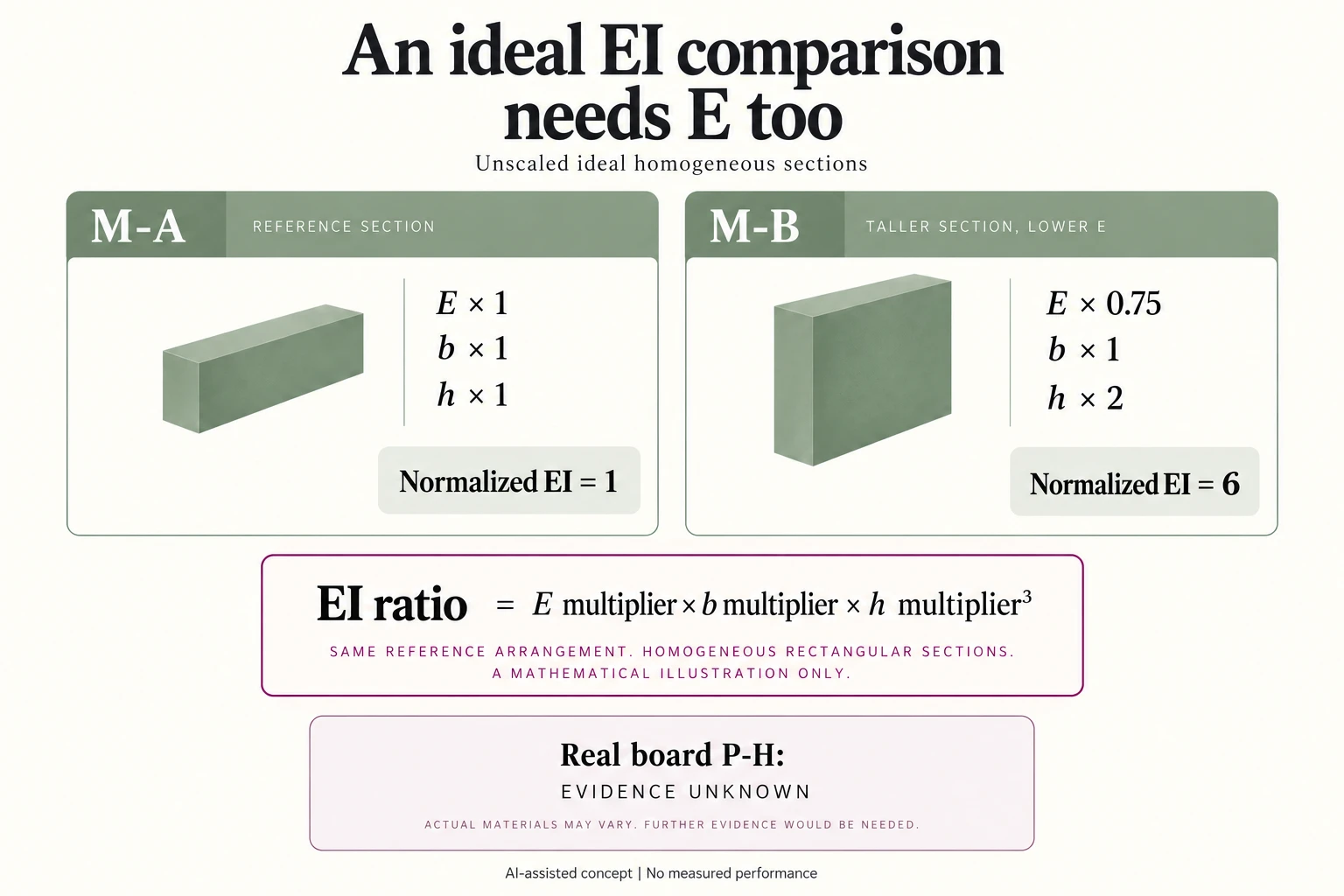
The original h-to-2h model holds E and b equal. This additional normalized example deliberately changes E to show which assumption controls the ideal EI comparison. The multipliers are invented mathematical inputs, not measured board properties.
Scroll horizontally if columns extend beyond the view.
| Ideal case | E multiplier | b multiplier | h multiplier | Normalized EI |
|---|---|---|---|---|
| M-A reference | 1 | 1 | 1 | 1 |
| M-B changed E and h | 0.75 | 1 | 2 | 6 |
| Real board P-H | Unknown | Unknown | Unknown | Not calculated |
For these ideal homogeneous rectangular sections, normalized EI equals E_multiplier × b_multiplier × h_multiplier³. M-B therefore gives 0.75 × 1 × 2³ = 6 relative to M-A. The eightfold geometry term remains, while the changed E multiplier changes the ideal EI ratio. Neither 6 nor 8 is a real paperboard rating.
This example intentionally supplies no grammage, density, modulus in physical units, deflection or load. It cannot compare two quoted boards or establish that they have equal gsm. Direction, construction and finished support still need an appropriate technical basis.
Use the separate real-board row for construction identity, direction and applicable bending evidence. Do not enter a normalized ideal multiplier as a measured material value. The CSV includes explicit model-assumption and real-evidence fields so these records cannot silently merge.
Download the paperboard gsm versus stiffness record (.csv). HYPOTHETICAL rows are invented examples. Use ACTUAL_BLANK for permitted project inputs; replace that row label only when recording actual facts. Empty evidence, observation and date fields mean unknown or not performed, never acceptance. Keep checkpoints and revisions separate.
Bring the actual board identity, direction and panel function to the original enquiry route; keep the ideal calculator as explanation rather than an approval basis. Packrivo coordinates independent suppliers. These records establish no supplier offer, service availability or MOQ exception; its published baseline is 500 pieces per product/design.