
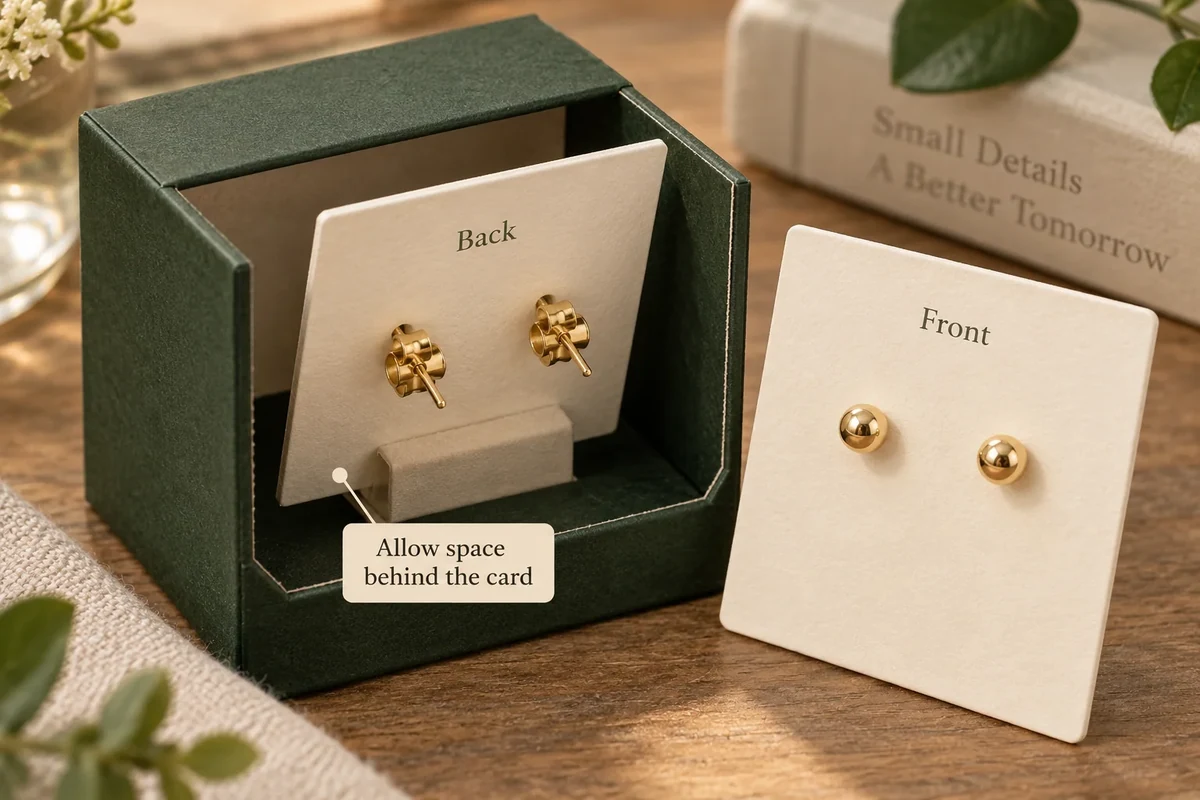
Review an earring mounting card with the actual pair, posts and backs fitted in the intended packing position. Check the front presentation, the space behind the card and the complete box closure. Record how the pair is attached and removed before approving hole positions or a shared card for several earring styles.
The Jewelry Mounting Cards: Check Attachment and Rear Clearance provides a structural reference for the mounted pair. Include post projection, fitted backs and rear clearance in the supplier question; a card drawing does not approve the earring attachment.
A front-only photograph can hide the part that occupies the most awkward space. The backs may sit behind the card, a drop may reach its lower edge, or the posts may project toward the box wall. Include those features in the physical review rather than treating the card as a flat artwork panel.
Define the complete mounted pair
Give the earring style and mounting card separate identifiers. Show the pair from the front, side and rear with the intended backs attached. Record which parts of the jewelry contact the card and which need clearance from the insert, lining or surrounding package.
Describe how the posts pass through the card and where the backs sit afterward. If the design uses another attachment, explain that arrangement instead. Ask the jewelry owner to confirm the intended fastening and removal method so the packaging sample uses the real product as designed.
Record the card's finished size, material description, thickness if known and physical orientation. Keep artwork and cutout revisions identifiable. Two cards with the same printed logo can have different openings or stiffness; a photograph of the front alone cannot identify that difference.
Measure the mounted envelope rather than adding a guessed allowance to the earring's face dimensions. The envelope includes the card, jewelry, backs and any raised detail in the intended position. Define where each dimension starts and the condition of the assembly during measurement.
The measurement agreement guide helps you label those references. Its purpose here is to make the rear projection and complete height understandable to everyone reviewing the card.
Separate alignment from clearance
Alignment concerns where the pair sits on the display face. Clearance concerns how its mounted form occupies the surrounding space. Check those as separate questions so a symmetrical presentation doesn't hide contact between a post and the box.
Mark the proposed hole or attachment locations on the supplier's card drawing. Ask the supplier to confirm how those features will be made on the selected card construction. Keep dimensions and acceptance limits project-specific; there is no single useful hole spacing for every pair of earrings.
Seat the loaded card in the proposed box or support. Record how it is retained and whether it can move toward a wall or lid during the agreed handling review. If it tilts intentionally, include that position in the drawing and measurement record.
The Canadian Conservation Institute's guidance for metal objects provides context on avoiding physical contact damage during storage and handling. The jewelry owner and suppliers still need to establish suitable contact materials and the particular arrangement for this product.
Use this original worksheet to keep the observed geometry and handling questions together. It is a planning record, not an industry test method.
| View or stage | Record | Decision it supports |
|---|---|---|
| Front face | Pair alignment, drop length and displayed width | Attachment locations and presentation |
| Rear face | Back positions and post projections | Space behind the mounted card |
| Card in support | Retaining points and intended angle | How the loaded card seats |
| Complete closure | Box and lid contact observations | Whether the arrangement needs revision |
| Removal | Access to backs and the release sequence | Whether the customer can remove the pair as intended |
Trial the actual fastening and release
Have the intended packer load the card using the agreed method. Note whether the operator can reach the rear fastening points and whether attaching the second earring disturbs the first. Record the extra handling needed without changing the jewelry fastening to suit an unreviewed card.
Close the complete pack with all accompanying components. A care card behind the mounting card may compete for rear space; tissue above it may change the packed arrangement. Use the versions you intend to supply and name them in the review record.
Open the package and inspect the pair before removal. Note visible movement, card distortion or contact marks, if any, with their locations and the conditions observed. Avoid calling a mark a material failure until the responsible parties have investigated its cause.
Follow the removal sequence with the jewelry owner or another authorized reviewer. The customer may need to reach the backs before lifting the pair. If the card cannot be removed from its support, explain how that access is intended to work while the card stays in place.
For a hypothetical stud pair, the buyer might compare a freestanding card with a card retained in an insert slot. The first proposal makes the rear easier to reach; the second changes how the card sits. Those are questions to trial, not findings from a completed Packrivo project.
Keep each product style's review separate. A longer post or different back can change the envelope even if the printed card is unchanged. The multi-SKU fit matrix helps record which arrangements a shared card has actually been reviewed with.
Give the supplier an attachment brief
Send the mounted front, side and rear views with the card drawing and measured references. Add the intended box position, fastening sequence and customer removal order. Highlight unresolved rear clearance or access questions rather than asking for a card that merely "fits earrings."
Request a candidate that includes the attachment details you need to evaluate. A printed flat proof can settle copy and layout while leaving mounting and closure open. Keep those decisions distinct when reviewing the supplier response.
A paperboard insert direction may help describe a proposed support around the card. State how the loaded card is retained and where the rear fastening must remain accessible.
Bring that attachment brief to Packrivo's packaging inquiry with the actual earring style and backs identified. A useful discussion starts with the complete mounted pair and ends with a clear plan for reviewing its front, rear and release.
Compare rear space and projection from the same face
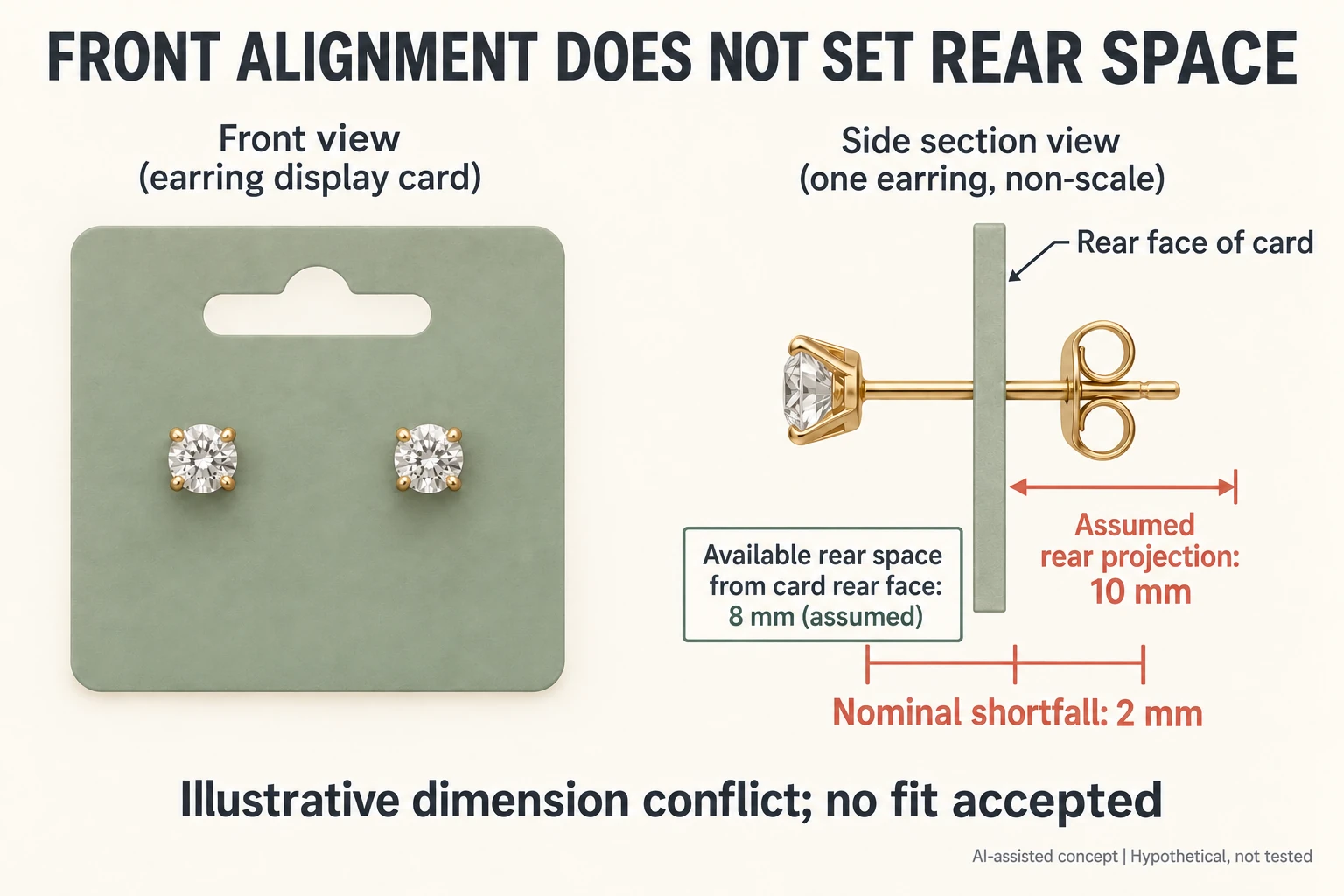
Assume each member of invented stud pair E1 has a rear projection of 10 mm measured normal to the rear card face, while the available space from that same face is 8 mm. The nominal shortfall is 10 – 8 = 2 mm. These are hypothetical inputs, not a sample measurement or permitted interference.
Scroll horizontally if columns extend beyond the view.
| Member | Available rear space | Rear projection | Nominal shortfall | Decision |
|---|---|---|---|---|
| Left stud | 8 mm | 10 mm | 2 mm | Geometry needs revision/review |
| Right stud | 8 mm | 10 mm | 2 mm | Separate actual observation required |
| Front pair | Alignment only | Not a depth measurement | Not applicable | Rear scope remains open |
Use one datum and direction for both inputs. A measurement from the front jewelry face cannot be substituted for rear clearance. The side sketch shows one representative mounted stud; it does not measure either actual member of E1 or prescribe hole spacing.
Keep the two member records even if the invented values match. Different backs or posts can change an actual envelope. Do not compress a back, force the card into place or modify the jewelry to erase the arithmetic conflict. Ask for a revised arrangement, then review fastening, closure and customer access separately. No universal clearance or acceptance limit follows.
Download the earring card packaging dimensions record (.csv). HYPOTHETICAL rows are invented examples. Use ACTUAL_BLANK for permitted project inputs; replace that row label only when recording actual facts. Empty evidence, observation and date fields mean unknown or not performed, never acceptance. Keep checkpoints and revisions separate.
Send both mounted members with matching rear-datum dimensions, backs and intended fastening/removal sequence. Packrivo coordinates independent suppliers. These records establish no supplier offer, service availability or MOQ exception; its published baseline is 500 pieces per product/design.