
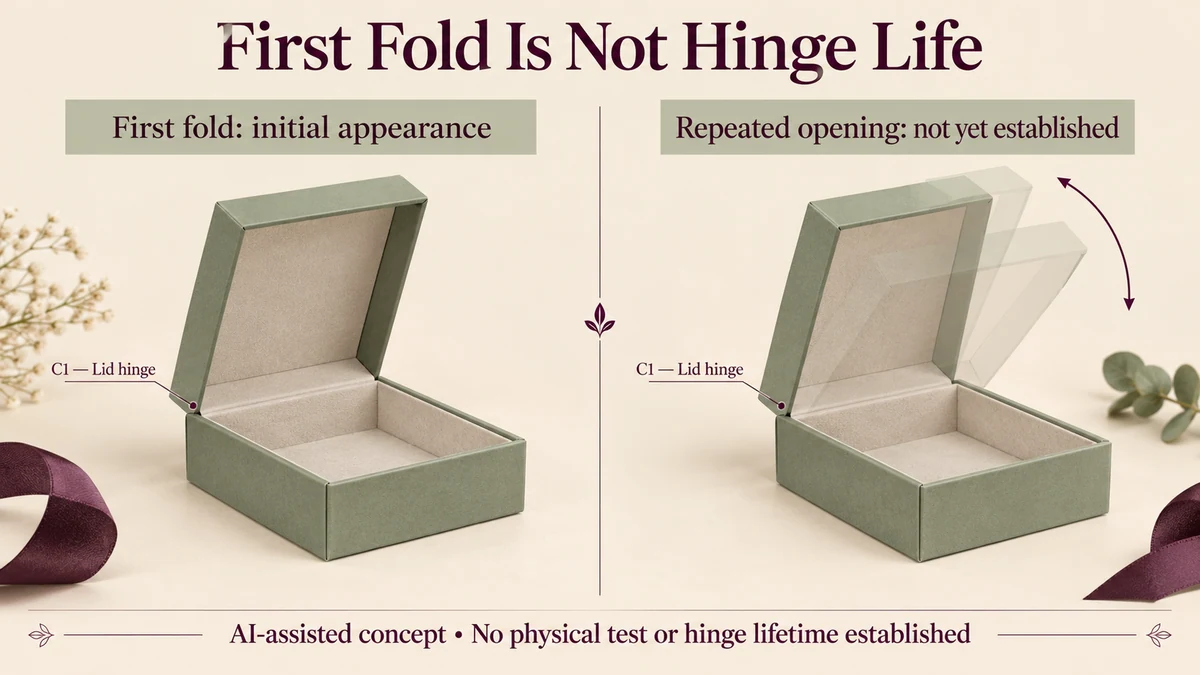
A paperboard lid can fold cleanly the first time without demonstrating how long its hinge will remain functional through repeated opening and closing.
A Folding Carton gives a relevant panel-and-crease arrangement for describing the hinge. Identify the actual board, grain, finish and repeated opening job before asking what sample evidence is needed; a clean first fold does not establish hinge life.
A neat formed crease answers an initial appearance and forming question. A paper folding-endurance result answers a material-specimen question. Neither establishes the repeated-opening life of an assembled jewellery or gift box.
For a keepsake box intended to be opened many times, the useful evidence must relate to the proposed finished hinge, its actual opening route and the function the lid needs to retain. Without that evidence, repeated-opening performance remains unknown.
A Crease Creates a Flexible Region Before the Lid Is Used
A paperboard crease is more than a line telling the converter where to fold.
In multi-ply paperboard, creasing deliberately changes the local structure. Controlled separation between internal layers can reduce resistance to bending and allow the board to form a relatively narrow hinge.
Holmen’s paperboard creasing guidance explains the relationship between internal layer separation, crease geometry and folding resistance. It also describes why the creasing operation must suit the particular paperboard construction.
This creates an important distinction: internal layer separation associated with a designed crease is not automatically the same as an unacceptable crack or a failed hinge.
The purpose is to allow the board to bend where intended without uncontrolled damage to the visible surface or surrounding structure.
A clean first fold suggests that the proposed construction has achieved an acceptable initial appearance under the observed forming conditions. It does not reveal everything that has happened inside the board, nor does it establish how that local region will behave after further movement.
The existing Packrivo guide to print cracking on a formed fold addresses the initial flat-to-formed appearance comparison. That observation remains useful, but it is not a repeated-opening endurance result.
Repeated Bending Changes the Loading History
Once formed, an integral paperboard hinge becomes the location through which much of the lid’s bending movement is accommodated.
Opening the lid changes the curvature and internal stresses around that region. Closing it changes them again.
Depending on the construction and movement, repeated bending can produce further local deformation, changes in bending resistance, progressive surface damage or loss of hinge integrity. None of these outcomes should be assumed for a particular box without evidence.
The key distinction is that a hinge’s condition can change after its first successful movement.
A clean outer surface does not necessarily establish unchanged internal structure. Equally, a visible crease does not automatically mean that the hinge has failed.
There is direct experimental support for treating initial and subsequent folding behaviour separately.
In a 2011 experimental study of scored, coated paperboard, Nagasawa and colleagues examined bending resistance, residual deformation angles and hysteresis during repeated folding motion. Their work showed that the subsequent bending response involves characteristics not fully described by the initial bending response alone.
The investigation used a defined laboratory specimen and limited repeated movements. It was not a consumer-package lifetime study and cannot supply a reusable-opening count for an assembled gift box.
Its practical contribution is narrower and more valuable: an initial bending result is not a complete description of what happens when the same crease moves again.
Paper Strip Folding Endurance Is Not Finished-Hinge Life
A material folding-endurance result can be useful, but the object being tested matters.
ISO 5626:1993, Paper — Determination of Folding Endurance, describes methods that repeatedly fold a narrow paper strip under longitudinal stress until it breaks.
The publicly available ISO abstract identifies several tester types, including MIT and Schopper. The standard concerns paper specimens under defined laboratory conditions. It does not describe an endurance qualification for a complete hinged gift box.
The equipment itself makes the difference visible.
Yasuda Seiki’s No.307 MIT folding-endurance tester applies a defined load while bending a specimen repeatedly in alternating directions until fracture.
That is a controlled specimen-level loading history.
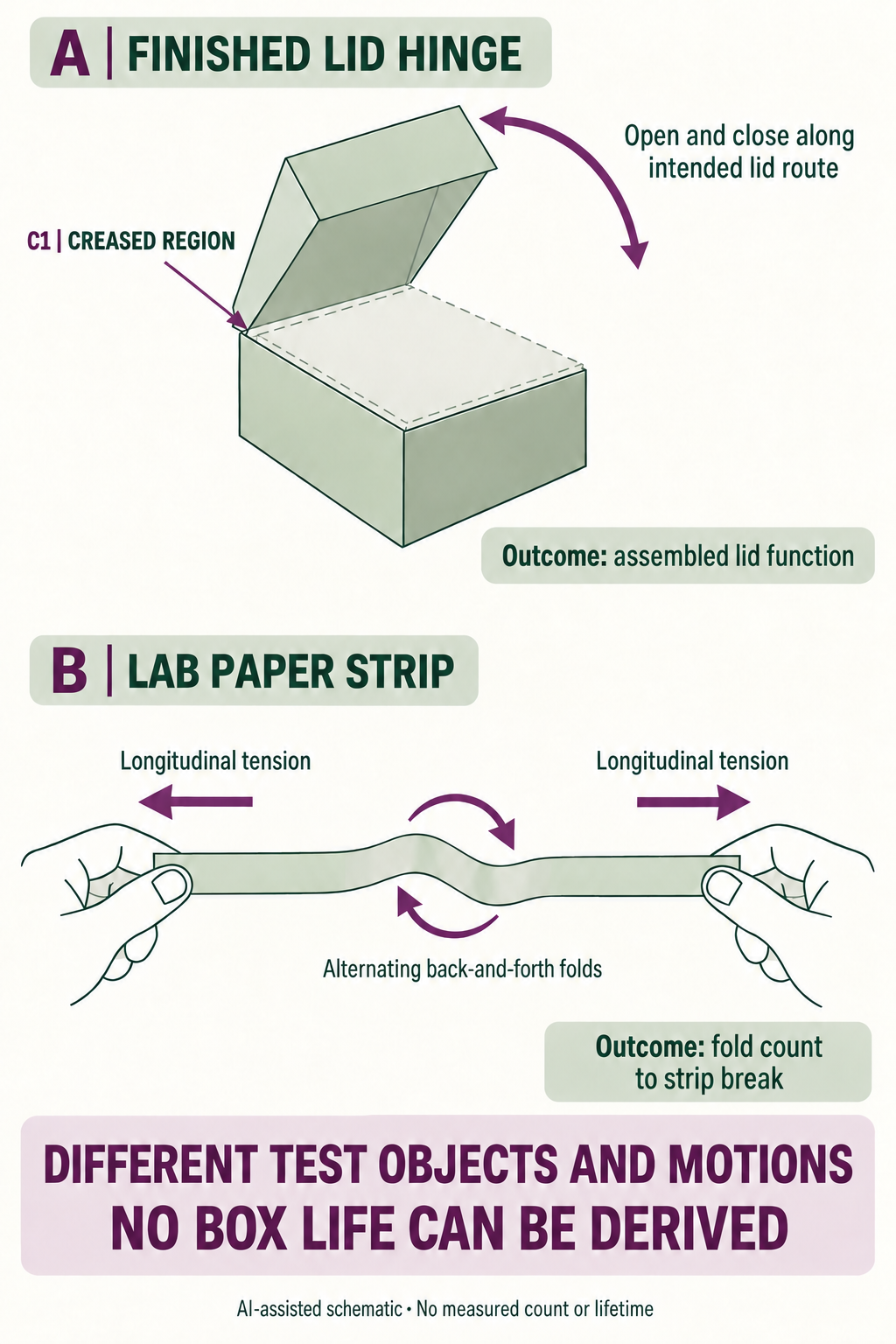
An integral gift-box hinge has a different arrangement. The hinge is already creased and connected to panels. Its lid follows a designed opening arc and returns along that route. The movement need not reverse the board into alternating opposite fold directions as a laboratory strip does.
The finished construction may also include printing, coating, laminated wrapping, adhesive joints or other components that affect the way the lid moves and remains attached.
Three differences prevent a direct conversion from a strip count to box openings.
First, the test objects differ. The laboratory result belongs to its paper specimen and specified conditions; the buyer’s question concerns a converted hinge within a particular assembly.
Second, the loading histories differ. Alternating bending of a stressed strip is not mechanically interchangeable with opening and closing a lid along one designed hinge route.
Third, the endpoints differ. A strip test counts folding endurance to the method’s break condition. A box can become unsuitable for its intended use through hinge tearing, lid misalignment, closure interference or another functional problem even without complete separation of the paperboard.
A strip result may help a technically responsible supplier compare candidate materials under equivalent test conditions. It cannot independently establish how many times the finished box can be opened.
There is no universal conversion between the two counts.
A Hypothetical Keepsake Lid Shows the Missing Evidence
Consider an entirely hypothetical jewellery brand planning a paperboard keepsake box with an integral hinged lid.
The proposed construction has a rear crease, C1, joining the lid to the base. During initial forming, the lid takes its intended shape and the visible crease appears clean.
This is an assumed example, not a manufactured or tested Packrivo sample. No repeated openings, material results or hinge lifetime have been measured.
The brand now wants customers to keep the box and reopen it when storing or removing jewellery.
The original clean fold does not answer that new requirement.
Suppose a material supplier could provide an MIT-type paper folding-endurance report for the proposed board. The technical reviewer would still need to identify what specimen was evaluated, the applicable method and the conditions behind its reported result.
Even an authentic strip result would not reproduce C1’s finished construction.
During intended use, the customer lifts the assembled lid through its designed opening path, then returns it toward closure. The board bends at the previously formed hinge, with the adjoining panels and other components influencing the assembly’s behaviour.
In the strip experiment, the specimen is held under defined tension and folded repeatedly in alternating directions until fracture.
Both involve bending paper-based material, but they do not impose the same constraints or answer the same failure question.
The brand therefore cannot carry forward the first-fold appearance approval as a repeated-opening approval. Nor can it label a material strip count as a number of successful customer openings.
The appropriate decision is to keep the proposed keepsake function unresolved until suitable finished-hinge evidence is available, or to reconsider the construction or intended use.
No successful opening count follows from this hypothetical comparison.
Finished-Hinge Evidence Must Follow the Intended Lid Motion
A repeated-opening requirement should be attached to the actual hinge configuration, not to the board grade alone.
The first distinction is between forming the box and using it.
An initial forming fold may occur during manufacture or packing. The customer then encounters an already formed lid. Those are different stages in the hinge’s loading history.
For a repeat-use proposal, the technical review needs to identify the intended opening direction, range of lid movement, closing route and the way the customer is expected to handle the assembly.
The proposed material and construction must also remain identifiable. Changes to board structure, grain relationship, crease design, printed or laminated finish, wrapping or hinge reinforcement may change the result.
Packrivo’s board grain and crease-direction guide addresses the material-direction question. A confirmed grain map is useful construction information, but it does not itself establish repeated-hinge endurance.
The next requirement is a functional endpoint.
A technical evaluation may need to consider whether the hinge remains attached, whether the lid retains its intended alignment, whether closing remains possible and whether unacceptable visible damage develops.
These are different possible observations, not an assertion that any particular defect will occur.
The responsible parties must establish which conditions matter for the proposed product and what exposure the evidence is intended to represent.
Even counting the movements requires an agreed meaning. A single opening movement and a complete open-and-close operation are not interchangeable units unless the report explicitly defines them.
A finished-hinge result should identify the configuration, motion history, observed condition and endpoint it actually covers. If the evaluation stops without reaching failure, its supported conclusion ends with that observed exposure. It cannot establish an unmeasured failure point or unlimited service life.
The buyer does not need to prescribe a crease-setting adjustment or invent a destructive testing procedure. The useful request is for the converter or qualified technical party to propose evidence appropriate to the intended assembled-hinge use.
A Functional Hinge Is Only One Part of a Reusable Box
An assembled box may contain more than one feature affected by repeated use.
A lid can remain attached while a closure becomes unreliable, a wrapped edge separates, an insert shifts or another component no longer performs as intended.
Evidence about the hinge alone cannot establish the repeated-use performance of the complete packaging system.
The reverse limitation also matters. An assembly that appears serviceable after an initial opening has not necessarily demonstrated repeated-hinge life.
Keep the levels of evidence separate:
- First-fold appearance establishes the observed formed condition.
- Material folding endurance describes the specified specimen and laboratory loading history.
- Finished-hinge evidence describes the evaluated hinge construction and movement.
- Complete-package repeated-use evidence must also address the other functions relevant to the intended use.
These results can inform one another, but one should not be renamed as another.
If the brand intends only a presentation lid that will be opened once, repeated-use evidence may fall outside that agreed functional requirement.
If the brand intends a keepsake box that customers will repeatedly open, the same first-fold observation is not enough. The hinge construction and intended use need a separate technical basis.
A repeated-use marketing promise may also require broader review of the entire package and the specific claim being made.
Keep the Repeated-Opening Decision Open Until the Evidence Matches
A clean crease is useful evidence that a paperboard construction formed as observed. It is not a life rating.
A laboratory strip folding count can describe resistance under a defined specimen test. It is not a count of completed customer openings.
For a repeat-use gift box, the practical decision is whether the proposed finished hinge has relevant evidence for the intended opening route, construction and functional endpoint.
Where that evidence is missing, the brand can request an appropriate technical evaluation, revise the hinge construction or limit its intended-use description to what has actually been supported.
Packrivo can coordinate the construction details and supplier questions. It does not conduct or certify hinge endurance testing through project coordination.
The distinction to preserve is simple: successful initial formation, material folding endurance and repeated operation of an assembled hinge are three different results.
Source scope: Primary sources reviewed 11 October 2026. ISO 5626:1993 is edition 2, published in November 1993 and confirmed on 24 March 2026; its public abstract was reviewed, not the paid nine-page procedure. Holmen’s creasing chapter and Yasuda Seiki’s No.307 product page have no identified publication dates; their technical descriptions are not universal performance guarantees. The cited 2011 experimental paper was publicly accessible in full but concerns defined scored-paperboard specimens and limited repeated bending, not finished packaging service life. No actual Packrivo sample, test or repeated-opening performance has been established.
Define the operation before comparing hinge evidence
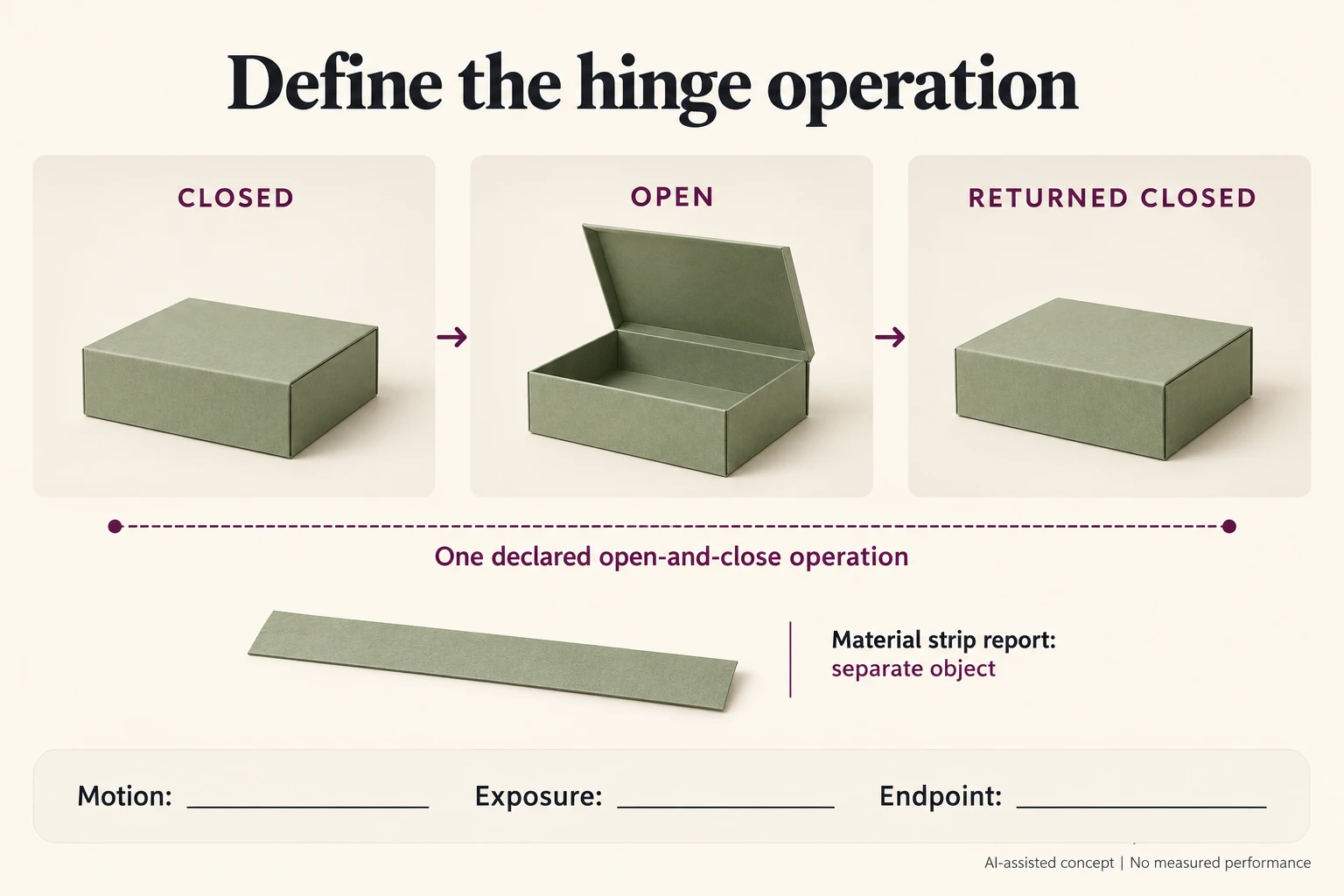
An exposure log becomes ambiguous if one person counts a lid lift and another counts a complete opening and return. The invented C1 example below fixes the motion vocabulary first; it supplies no target count or lifetime.
Scroll horizontally if columns extend beyond the view.
| Record | Declared example | What remains open |
|---|---|---|
| Configuration H-A | Integral C1 hinge, board P-H, wrap W-H, lid route M-H | Actual material and assembly identity |
| Operation U-H | Start closed; follow M-H to the agreed open position; return closed | Range and handling conditions to agree |
| Exposure entry | Completed U-H operations and any interrupted motion recorded separately | Actual exposure and dates blank |
| Endpoint E-H | Attachment, alignment, closing and visible condition as separate observations | Technical acceptance basis and results blank |
If a movement stops partway, record the interruption instead of silently counting it as a full U-H. If the lid route changes, start a new motion definition even when the board identity stays the same. A count is comparable only within its declared operation.
A report that stops while the hinge remains functional establishes only the observed condition at that exposure. It does not locate an unobserved failure point. Keep a scheduled review position, a stopped exposure and a failure observation in different fields.
The figure is a vocabulary aid. It shows no wear progression and does not prescribe a cycling procedure, test load or customer-life promise. A material strip report can remain a linked reference without being entered as completed box operations.
Download the paperboard hinge repeated opening record (.csv). HYPOTHETICAL rows are invented examples. Use ACTUAL_BLANK for permitted project inputs; replace that row label only when recording actual facts. Empty evidence, observation and date fields mean unknown or not performed, never acceptance. Keep checkpoints and revisions separate.
For an intended repeat-use lid, bring the configuration, operation definition and unresolved functional endpoint to the enquiry already linked above. Packrivo coordinates independent suppliers. These records establish no supplier offer, service availability or MOQ exception; its published baseline is 500 pieces per product/design.