
Compare third-party logistics (3PL) packing charges using both order counts and the physical products inside those orders. Define which units each charge uses before calculating a total. Two offers can reverse their cost ranking when products per order change, even with the same number of orders.
Translate the actual charge into a counting rule
An order, a physical product, a picked component and a gift presentation are different units. A three-product order might need three individual gifts or one shared presentation. The actual service determines that relationship.
The complete-set quote method establishes comparable packaging scope. A service-fee comparison adds the billable events: which unit starts the charge, which additional units increase it, and what work each amount includes.
Ask whether “item” means physical pieces, SKU lines, a preassembled bundle or a component picked separately. A product quantity alone cannot settle the count of card, box or other material picks under an actual tariff.
Compare two invented fee structures
Assume every physical product in this example receives one individual gift pack. All 100 orders use that same accepted service; only products per order differ. The fictional fees are in GBP and do not describe any provider’s offer.
Route A charges GBP 1 per order plus GBP 0.30 for each product after the first. Route B charges GBP 0.75 per individual gift pack, with no additional order charge in this isolated model.
Scroll horizontally if columns extend beyond the view.
| Assumed mix of 100 orders | Products and gift packs | Products after the first in each order | A total | B total |
|---|---|---|---|---|
| 80 one-product and 20 three-product orders | 80 + 60 = 140 | 20 x 2 = 40 | 100 + 40 x 0.30 = 112 | 140 x 0.75 = 105 |
| 50 one-product and 50 three-product orders | 50 + 150 = 200 | 50 x 2 = 100 | 100 + 100 x 0.30 = 130 | 200 x 0.75 = 150 |
B is GBP 7 lower for the first mix. A is GBP 20 lower for the second. Comparing 100 orders under each offer without their internal quantities would miss that reversal.
For N orders and P physical products, A is 0.70N + 0.30P, while B is 0.75P under these assumptions. Their crossing occurs at P/N = 0.70/0.45, approximately 1.5556 products per order. This is an algebraic boundary for the invented charges, not a forecast of baskets or an actual tariff tier.
Keep the gift unit and excluded charges visible
If three products share one gift presentation, B’s pack count is no longer P. Write the actual gift-pack count separately and recalculate; don’t keep using the individual-pack assumption after the service changes.
Receiving, storage, shipping, returns, minimum service amounts, taxes and other charges are excluded here. An actual complete comparison must add the relevant quoted scope consistently. The example does not establish the full amount payable to a warehouse.
Use provider literature to locate questions
ShipMonk’s own pricing FAQ discusses first-item pick fees and additional picks for specified custom packaging or cards. That supports asking how charges count work. It supplies neither of the fictional tariffs above and does not confirm that either service is available for this gift configuration.
Return the order mix, service definition and billable-unit counts to the quote owner. Request actual prices and inclusion rules against that same workload. The useful output is a cost comparison that preserves what each fee counts, rather than a headline per-order amount assumed to cover every product and gift.
Sources and scope
ShipMonk pricing methods supports the stated general concepts within this scope: Original provider FAQ examples of first-item pick fees and custom packaging/card additional picks. No provider price,minimum,availability,performance or whole-service promise copied. Access checked 15 October 2026.
The worked scenario is original editorial analysis with assumed inputs, not a supplier offer, customer record or measured Packrivo result. Commercial feasibility and physical suitability remain project-specific.
Test the adjacent whole-product counts around the crossing
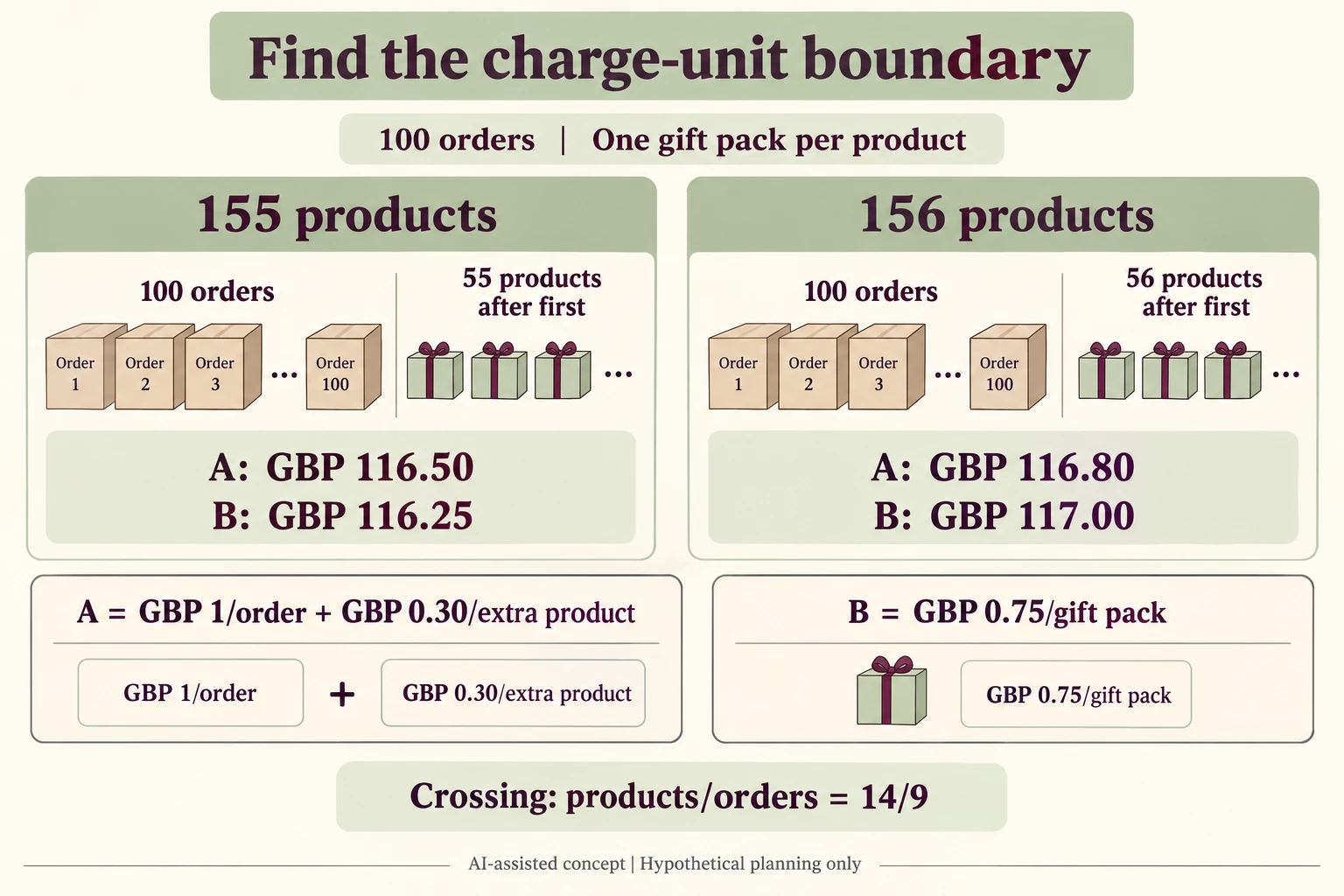
Keep the original fictional GBP fee rules and individual-gift assumption. This additional near-boundary check uses 100 orders containing 155 or 156 physical products, each receiving one gift pack. It does not specify a real basket forecast or provider tariff.
Scroll horizontally if columns extend beyond the view.
| Scope ID | Exact entity | Stage / role | Hypothetical basis |
|---|---|---|---|
| ORD155 | MIX15517_r01 | INPUT | Hypothetical100-order workload |
| PROD155 | MIX15517_r01 | INPUT | Products kept separate from order count |
| PACK155 | MIX15517_r01 | INPUT | One individual gift per physical product |
| EXTRA155 | MIX15517_r01 | CALCULATION | 155 -100 |
| A155 | FEEA17_r01 | WORKLOAD_COMPARISON | 100 x1 +55 x0.30 |
| B155 | FEEB17_r01 | WORKLOAD_COMPARISON | 155 x0.75 |
| ORD156 | MIX15617_r01 | INPUT | Hypothetical100-order workload |
| PROD156 | MIX15617_r01 | INPUT | Products kept separate from order count |
| PACK156 | MIX15617_r01 | INPUT | One individual gift per physical product |
| EXTRA156 | MIX15617_r01 | CALCULATION | 156 -100 |
| A156 | FEEA17_r01 | WORKLOAD_COMPARISON | 100 x1 +56 x0.30 |
| B156 | FEEB17_r01 | WORKLOAD_COMPARISON | 156 x0.75 |
| CROSS | FEECOMPARE17_r01 | CALCULATION | 0.70 /0.45 |
ORD, PROD and PACK are different count scopes in each mix. EXTRA is P−100. At 155 products, A is £116.50 and B is £116.25; at 156, A is £116.80 and B is £117.00. These two whole-product cases straddle CROSS=0.70/0.45, about 1.5556 products per order.
FEEA17_r01 and FEEB17_r01 are new fictional rule identities, not ShipMonk offers. Receiving, storage, shipping, returns, minimum charges, taxes and other costs remain excluded. Actual counts, tariff evidence and dates stay empty; the calculation makes no transaction or provider recommendation.
Download the 3PL packing fees record (.csv). HYPOTHETICAL rows are invented examples. Use ACTUAL_BLANK for permitted project inputs; replace that row label only when recording actual facts. Empty evidence, observation and date fields mean unknown or not performed, never acceptance. Keep checkpoints and revisions separate.
Bring the exact scope rows and unresolved evidence in a Packrivo enquiry. Replace planning inputs with actual authorised records before treating the scenario as an available arrangement. Prepare a Packrivo packaging enquiry. Packrivo coordinates independent suppliers. These records establish no supplier offer, service availability or MOQ exception; its published baseline is 500 pieces per product/design.
What this changes in a packaging enquiry
Prepare packaging quantities from the physical pack configuration and order mix, then compare the 3PL counting rules against that same workload. Confirm whether a gift box, insert or card counts as a separate handling item. The two illustrative fee structures are not current provider quotations.