

Grouping gift variants can reduce packing changeovers, but the sequence must still meet order deadlines. Compare the actual transition work and waiting created by each order. A schedule that saves setup while delaying promised gifts is not automatically preferable.

Name the changeover work
Identify which inserts, sleeves, instructions, tools or print settings change between variants. Common components can remain only when the permitted combination allows it.
The variant-matching method keeps unfinished packs and outgoing materials visible. Timing should include the actual clearing and first-arrangement check rather than only carrying a tray across the bench.
Five changes versus one
Assume six orders have the sequence A, B, A, B, A, B. Each switch between variants takes an invented four minutes; initial setup and packing each order are equal under both schedules.
Scroll horizontally if columns extend beyond the view.
| Proposed sequence | Switches between orders | Assumed changeover time |
|---|---|---|
| A, B, A, B, A, B | 5 | 20 minutes |
| A, A, A, B, B, B | 1 | 4 minutes |
Grouping reduces modeled changeover by 16 minutes. This does not establish an actual operation time or error-rate improvement.
Put each order’s deadline beside the sequence. If a B order must leave before the grouped A work finishes, the apparently cheaper schedule may be infeasible. A smaller grouped block or an earlier B position can preserve the deadline at another transition cost.
Keep transitions directional when they differ
Moving from A to B may take different work from B to A. A print-device setting or a retained common component can make the transition asymmetric. Use the observed direction-specific time when relevant instead of applying one convenient average.
Unfinished gifts also need a location and identity when interrupted. A new sequence can create more paused work or delay private message printing. Count those actual effects in the full trial.
Large batches may use more working stock and space. The changed schedule should retain those resource limits rather than assuming unlimited staging.
Choose an order that meets both constraints
List fixed deadlines first, then compare feasible sequences with their transitions and waiting. Retain the chosen sequence’s first-arrangement checks and material identities. The output is a deadline-compatible order with bounded changeover assumptions, not a general rule that the largest possible variant batch is best.
Sources and scope
Australian Government supports the stated general concepts within this scope: General inventory categories, reorder points and stocktake. Access checked 14 October 2026.
OSHA supports the stated general concepts within this scope: US warehousing ergonomic hazards. Access checked 14 October 2026.
The worked scenario is original editorial analysis with assumed inputs, not a supplier offer, customer record or measured Packrivo result. Commercial feasibility and physical suitability remain project-specific.
Check the early order before choosing the shortest changeover plan
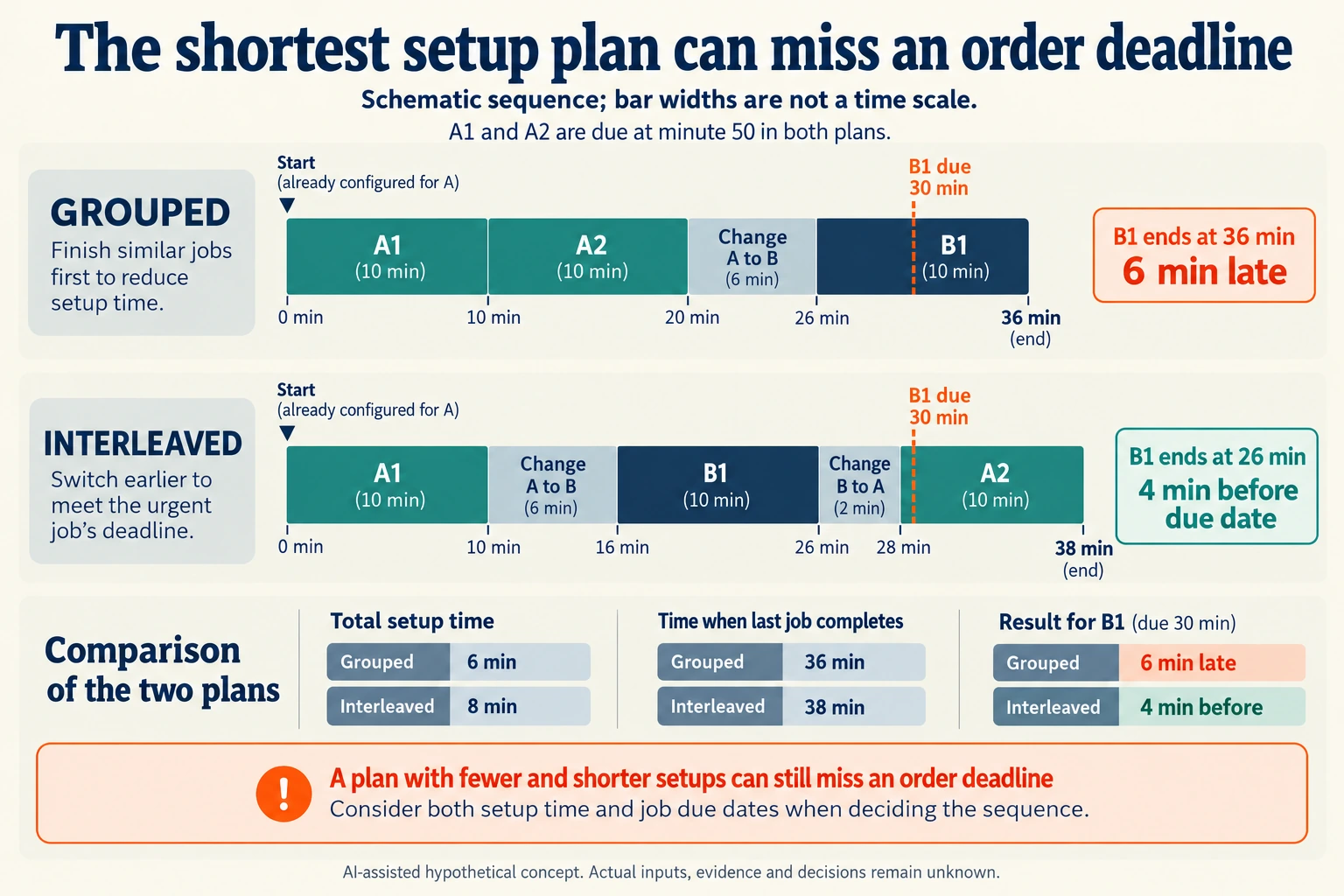
Keep the original six-order comparison above separate from this new three-job case. Assume the bench is already configured for A. A1, A2 and B1 each need ten minutes of packing. Changing A to B takes six minutes; returning B to A takes two. B1 is due at minute 30, while A1 and A2 are due at minute 50. These are invented jobs, times and deadlines.
Scroll horizontally if columns extend beyond the view.
| Hypothetical scenario | Item or operation | Planning relationship | Assumed input or calculation |
|---|---|---|---|
| GROUPED33 | A1_COMPLETION | calculated from | JOB_MIN; 10 minutes_from_start |
| GROUPED33 | A2_COMPLETION | calculated from | GROUPED33_A1_END+JOB_MIN; 20 minutes_from_start |
| GROUPED33 | B1_COMPLETION | calculated from | GROUPED33_A2_END+JOB_MIN+A_TO_B; 36 minutes_from_start |
| INTERLEAVED33 | A1_COMPLETION | calculated from | JOB_MIN; 10 minutes_from_start |
| INTERLEAVED33 | B1_COMPLETION | calculated from | INTERLEAVED33_A1_END+JOB_MIN+A_TO_B; 26 minutes_from_start |
| INTERLEAVED33 | A2_COMPLETION | calculated from | INTERLEAVED33_B1_END+JOB_MIN+B_TO_A; 38 minutes_from_start |
| GROUPED33 | SETUP_WORK | calculated from | A_TO_B; 6 minutes |
| INTERLEAVED33 | SETUP_WORK | calculated from | A_TO_B+B_TO_A; 8 minutes |
| GROUPED33 | B1_AFTER_DUE | calculated from | GROUPED33_B1_END-B_DUE; 6 minutes |
| INTERLEAVED33 | B1_BEFORE_DUE | calculated from | B_DUE-INTERLEAVED33_B1_END; 4 minutes |
| GROUPED33 | LAST_JOB_COMPLETION | calculated from | max(GROUPED33_A1_END,GROUPED33_A2_END,GROUPED33_B1_END); 36 minutes |
| GROUPED33 | A1_DEADLINE_SLACK | calculated from | A_DUE-GROUPED33_A1_END; 40 minutes |
| GROUPED33 | A2_DEADLINE_SLACK | calculated from | A_DUE-GROUPED33_A2_END; 30 minutes |
| INTERLEAVED33 | LAST_JOB_COMPLETION | calculated from | max(INTERLEAVED33_A1_END,INTERLEAVED33_A2_END,INTERLEAVED33_B1_END); 38 minutes |
| INTERLEAVED33 | A1_DEADLINE_SLACK | calculated from | A_DUE-INTERLEAVED33_A1_END; 40 minutes |
| INTERLEAVED33 | A2_DEADLINE_SLACK | calculated from | A_DUE-INTERLEAVED33_A2_END; 12 minutes |
Grouping A1, A2 and B1 uses six changeover minutes. Their completion times are 10, 20 and 36. B1 is six minutes late. Interleaving A1, B1 and A2 uses eight changeover minutes, with completion times 10, 26 and 38. That sequence meets the assumed deadlines even though its last completion is two minutes later.
The CSV identifies the order, directional changes, completion endpoints and deadline comparison for each plan. It does not infer setup work from a count of changes alone. Before choosing an actual sequence, confirm permitted combinations, customer priorities, work in progress and staging space with their owners. The calculation grants no permission to alter a deadline.
Download the directional packaging changeover deadline sequence record (.csv). It includes the original table fields and scenarios alongside the added relationships. HYPOTHETICAL rows are editorial examples or required review scopes, not actual records. Actual quantity, configuration, component and file identities, materials, process, specification, copy, method, condition, observation, owner, decision, evidence and dates are blank. ACTUAL_BLANK is a separate empty starting row; enter permitted project evidence before using an actual record. A blank means unknown.
Use the Assembly Tools and Per-Pack Consumables Need Separate Planning Units for its separate question. Use the Check Prepared Bottom Joints Before Loading for its separate question.
Source scope checked 17 October 2026: The linked public inventory and workplace guidance does not prescribe a changeover formula. Directional setup, completion and deadline examples are original hypothetical planning analysis, not observed work or safety approval. The added configurations and calculations are hypothetical, with actual evidence and decisions pending.
What this changes in a packaging enquiry
If frequent packaging changes are slowing a launch, first identify the actual change: box forming, insert selection, artwork variant or personal card. Ask whether the delivered component grouping can support the intended sequence. A simpler order sequence cannot establish that different designs share a production setup or MOQ.
Discuss this packaging specification with Packrivo. We coordinate independent suppliers. MOQ: 500 pieces per product/design; illustrative quantities are not production offers. Confirm materials, samples, price and timing for your project.