

Choose a packing-bench refill quantity by comparing replenishment interruptions with the stock and containers held in the work area. Larger lots can reduce trips, while smaller lots occupy less ready space. Keep the same shift demand and actual refill route when comparing them.

Count the material at the point of use
Define a refill unit: a complete component kit, one insert or another named material. Its counting basis should match the operation. The assembly-resource unit map separates components, consumables and reusable tools.
Record the actual container footprint and replenishment task. A twenty-piece tray and a sixty-piece tray may differ in accessibility and identification as well as capacity. A unit count does not establish that the larger tray fits safely.
Begin with a full tray in both scenarios
Assume a shift needs 240 kits. A small tray holds twenty and a larger tray sixty. Both begin full. Each later refill takes an assumed three minutes outside the packing cycle.
Scroll horizontally if columns extend beyond the view.
| Tray capacity | Full trays needed over shift | Later refill events | Assumed refill work |
|---|---|---|---|
| 20 kits | 12 | 11 | 33 minutes |
| 60 kits | 4 | 3 | 9 minutes |
The larger tray removes eight later refill events, a modeled 24 minutes. Starting full matters: counting twelve and four later refills would incorrectly include the initial preparation in both routes.
If initial filling requires different work, record it separately in both totals. The example doesn’t claim observed savings or a universal refill duration.
Check what the larger stock displaces
Use the actual packing sequence to see whether a larger container blocks the active gift, tool access or exception position. Changing the bench layout may add movements that the simple trip calculation omitted.
Variant-specific material also matters. Holding sixty mixed kits at the bench can create a different picking task from twenty of one approved variant. Preserve identifiers and permitted combinations during every refill.
Replenishment can be done by the packer or another assigned person. A helper’s time still belongs in the total work, even if the packer no longer stops. Record the route and resource rather than calling the interruption free.
Trial a feasible refill policy
Observe tray capacity, physical access, refill duration and actual consumption. Choose a policy with named quantities and a replenishment trigger that fits the real operation. The result should show trips and working-stock needs together, without presenting a larger bench stock as an ergonomic approval.
Sources and scope
Australian Government supports the stated general concepts within this scope: General inventory categories, reorder points and stocktake. Access checked 14 October 2026.
OSHA supports the stated general concepts within this scope: US warehousing ergonomic hazards. Access checked 14 October 2026.
The worked scenario is original editorial analysis with assumed inputs, not a supplier offer, customer record or measured Packrivo result. Commercial feasibility and physical suitability remain project-specific.
Separate packer interruption from total refill work
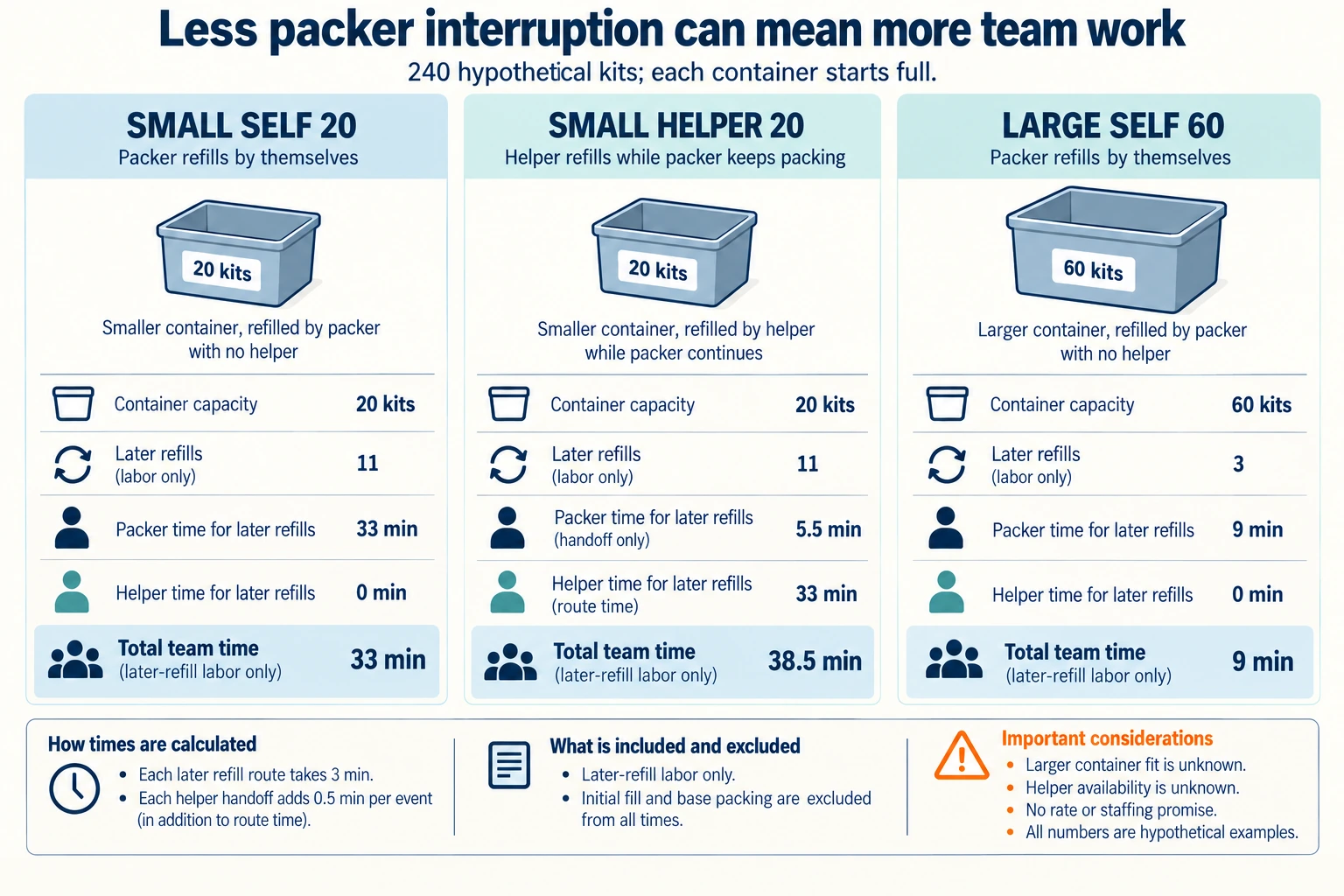
Extend the original 240-kit example with three separately assumed routes. Each container starts full. A 20-kit container needs eleven later refills; a 60-kit container needs three. Each refill route takes three minutes. A helper route also requires a separate half-minute packer handoff per event. The figures below cover later refills only, excluding initial fill, base packing and other work.
Scroll horizontally if columns extend beyond the view.
| Hypothetical scenario | Item or operation | Planning relationship | Assumed input or calculation |
|---|---|---|---|
| SMALL_SELF33 | LATER_REFILLS | calculated from | ceil(KITS/SMALL_SELF33_CAP)-1; 11 events |
| SMALL_SELF33 | REFILL_ROUTE_WORK | calculated from | SMALL_SELF33_EVENTS*ROUTE; 33 minutes |
| SMALL_SELF33 | PACKER_INTERRUPTION | calculated from | SMALL_SELF33_ROUTE; 33 minutes |
| SMALL_SELF33 | TEAM_REFILL_WORK | calculated from | SMALL_SELF33_PACKER; 33 minutes |
| SMALL_HELPER33 | LATER_REFILLS | calculated from | ceil(KITS/SMALL_HELPER33_CAP)-1; 11 events |
| SMALL_HELPER33 | REFILL_ROUTE_WORK | calculated from | SMALL_HELPER33_EVENTS*ROUTE; 33 minutes |
| SMALL_HELPER33 | PACKER_INTERRUPTION | calculated from | SMALL_HELPER33_EVENTS*HANDOFF; 5.5 minutes |
| SMALL_HELPER33 | TEAM_REFILL_WORK | calculated from | SMALL_HELPER33_PACKER+SMALL_HELPER33_ROUTE; 38.5 minutes |
| LARGE_SELF33 | LATER_REFILLS | calculated from | ceil(KITS/LARGE_SELF33_CAP)-1; 3 events |
| LARGE_SELF33 | REFILL_ROUTE_WORK | calculated from | LARGE_SELF33_EVENTS*ROUTE; 9 minutes |
| LARGE_SELF33 | PACKER_INTERRUPTION | calculated from | LARGE_SELF33_ROUTE; 9 minutes |
| LARGE_SELF33 | TEAM_REFILL_WORK | calculated from | LARGE_SELF33_PACKER; 9 minutes |
| HELPER33 | INTERRUPTION_REDUCTION | calculated from | SMALL_SELF33_PACKER-SMALL_HELPER33_PACKER; 27.5 minutes |
| HELPER33 | TEAM_WORK_INCREASE | calculated from | SMALL_HELPER33_TEAM-SMALL_SELF33_TEAM; 5.5 minutes |
With the small container and self-refilling, the packer spends 33 minutes on later refills. Using a helper leaves 5.5 packer minutes and adds 33 helper minutes, for 38.5 team minutes. The packer interruption falls by 27.5 minutes while team work rises by 5.5. A 60-kit self-refill route uses nine minutes in this invented comparison, but its larger point-of-use container has no confirmed footprint or permitted location.
A useful response names which resource is constrained and where the transferred work goes. Do not turn released packer minutes into a throughput, payroll or staffing saving. The helper must actually be available, and the proposed container, route and complete kit still need review. The display-refill article addresses entry and facing; this record compares who performs the replenishment work.
Download the packing station refill packer team labor comparison record (.csv). It includes the original table fields and scenarios alongside the added relationships. HYPOTHETICAL rows are editorial examples or required review scopes, not actual records. Actual quantity, configuration, component and file identities, materials, process, specification, copy, method, condition, observation, owner, decision, evidence and dates are blank. ACTUAL_BLANK is a separate empty starting row; enter permitted project evidence before using an actual record. A blank means unknown.
Use the Shelf-Ready Packaging: Compare Store Work and Cost for its separate question. Use the Plan Refilling Before Approving the Display Layout for its separate question.
Source scope checked 17 October 2026: General inventory and workplace guidance does not validate refill timing, staffing, storage limits or a particular station. No ergonomic assessment or supplier capability is established. The added configurations and calculations are hypothetical, with actual evidence and decisions pending.
What this changes in a packaging enquiry
Use the refill comparison to specify the delivered counting unit and grouping of boxes, inserts or cards. Ask for units per bundle or carton and identify any container that must be opened or moved at the bench. Larger replenishment batches may change handling work and working stock; they do not by themselves justify a larger purchase.
Discuss this packaging specification with Packrivo. We coordinate independent suppliers. MOQ: 500 pieces per product/design; illustrative quantities are not production offers. Confirm materials, samples, price and timing for your project.