

Place a packing check where the relevant condition can be observed before later work makes correction costly. Compare the reversal steps for the same error at each candidate position. An earlier check only helps if it can actually detect the issue it is meant to address.

Identify one observable error
Choose a condition such as a missing care card, incorrect sleeve or unseated component. Its required reference should be clear before the operator checks it.
The before-load base check shows why some conditions become hidden by later steps. Other errors remain visible longer. The useful inspection position follows the actual operation, not a universal rule to check everything at the start.
Compare the work to correct a missing card
Assume a fictional gift needs one care card. The same detected omission has the following invented correction times and consumable amounts.
Scroll horizontally if columns extend beyond the view.
| Discovery point | Assumed correction work | Assumed replacement material |
|---|---|---|
| Open gift before ribbon | 20 seconds | None |
| Ribboned gift before parcel seal | 40 seconds | None in this scenario |
| After dispatch carton sealing | 90 seconds | $0.30 replacement seal |
Discovering the omission after sealing adds 70 seconds relative to the open-gift state, plus the assumed seal. That difference concerns this correction route only. It doesn’t prove the earlier check finds every missing card.
Add the check’s own work
An inspection can require opening, viewing or matching. Include its actual effort in the comparison. Don’t multiply modeled correction savings by every order if errors occur only on some orders or their frequency is unknown.
Where frequency is unknown, keep the output as correction work per detected event. A real error record may later support a period-level model, but an invented rate cannot turn the timing comparison into a claimed saving.
Inspection and prevention also have different roles. Keeping the correct kit together may reduce a mismatch opportunity, while a later check looks for it. Neither method should be described as error-free without evidence.
Choose a checkpoint with an explicit scope
State what the operator must see, the reference used, the point before the next operation and the exception route. Keep already checked conditions separate from those still hidden or unreviewed.
Trial the checkpoint through the complete pack. The output should identify the condition, feasible viewing position and correction work at later states. It does not prescribe statistical sampling, approve a quality limit or establish a defect rate.
Sources and scope
Australian Government supports the stated general concepts within this scope: General inventory categories, reorder points and stocktake. Access checked 14 October 2026.
OSHA supports the stated general concepts within this scope: US warehousing ergonomic hazards. Access checked 14 October 2026.
The worked scenario is original editorial analysis with assumed inputs, not a supplier offer, customer record or measured Packrivo result. Commercial feasibility and physical suitability remain project-specific.
Count the qualifying catches needed to offset check work
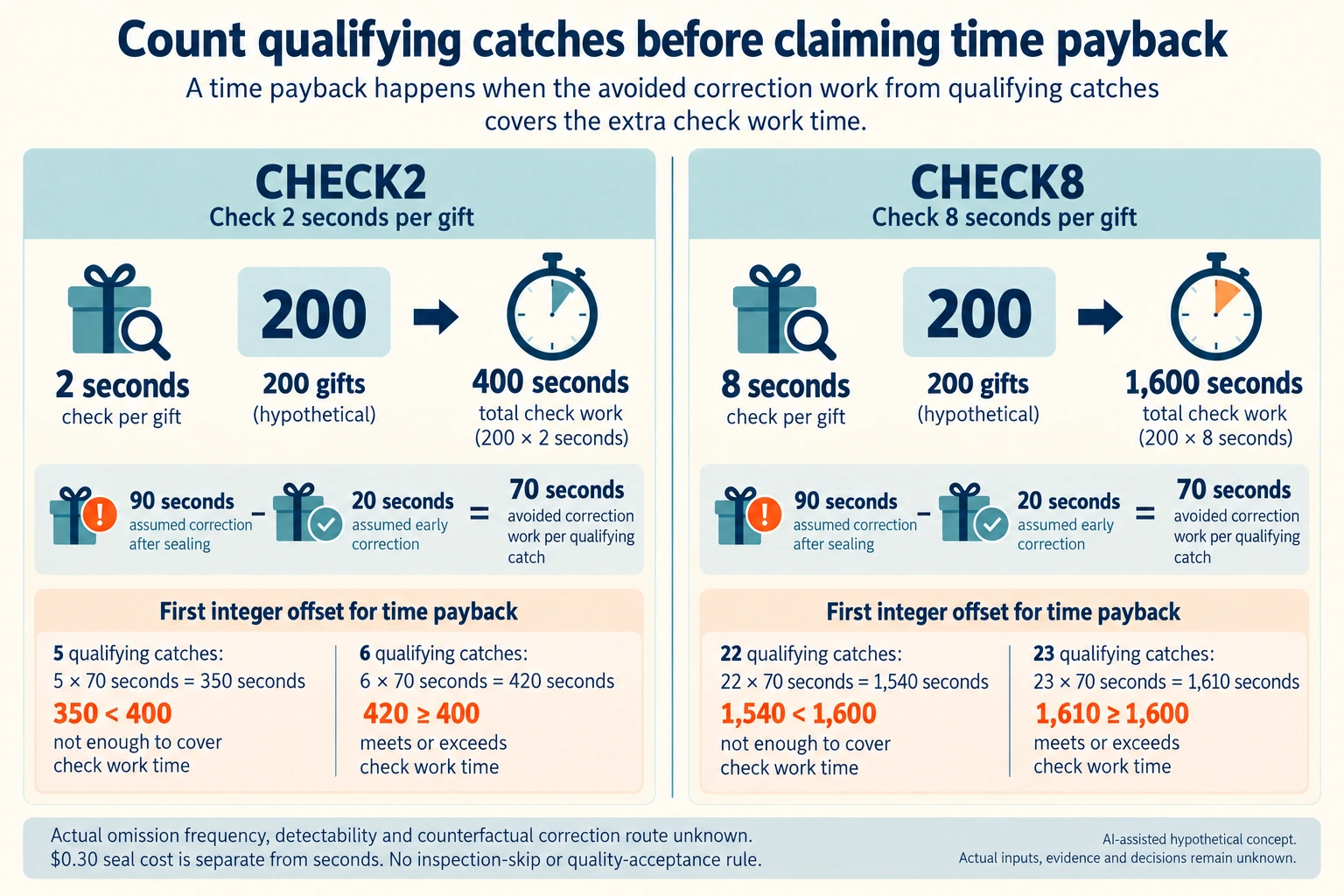
Consider a separate invented run of 200 gifts. Add a check lasting either two or eight seconds per gift. A qualifying catch would otherwise require the original 90-second sealed-gift correction, while correcting that same detectable omission early takes 20 seconds. Only under those stated conditions does each qualifying catch avoid 70 seconds of correction work.
Scroll horizontally if columns extend beyond the view.
| Hypothetical scenario | Item or operation | Planning relationship | Assumed input or calculation |
|---|---|---|---|
| CHECK33 | GIFTS | assumed input | 200 gifts |
| CHECK33 | SEALED | assumed input | 90 seconds/correction |
| CHECK33 | EARLY | assumed input | 20 seconds/correction |
| CHECK33 | SEAL_COST | assumed input | 0.3 USD/seal |
| CHECK33 | QUALIFYING_CATCH_WORK_AVOIDED | calculated from | SEALED-EARLY; 70 seconds/catch |
| CHECK2_33 | ADDED_CHECK_PER_GIFT | assumed input | 2 seconds/gift |
| CHECK2_33 | ADDED_CHECK_WORK | calculated from | GIFTS*CHECK2_33_SECONDS; 400 seconds |
| CHECK2_33 | FIRST_INTEGER_TIME_OFFSET | calculated from | ceil(CHECK2_33_COST/AVOIDED); 6 qualifying_catches |
| CHECK2_33 | ONE_FEWER_CATCH_WORK | calculated from | (CHECK2_33_OFFSET-1)*AVOIDED; 350 seconds |
| CHECK2_33 | OFFSET_CATCH_WORK | calculated from | CHECK2_33_OFFSET*AVOIDED; 420 seconds |
| CHECK8_33 | ADDED_CHECK_PER_GIFT | assumed input | 8 seconds/gift |
| CHECK8_33 | ADDED_CHECK_WORK | calculated from | GIFTS*CHECK8_33_SECONDS; 1600 seconds |
| CHECK8_33 | FIRST_INTEGER_TIME_OFFSET | calculated from | ceil(CHECK8_33_COST/AVOIDED); 23 qualifying_catches |
| CHECK8_33 | ONE_FEWER_CATCH_WORK | calculated from | (CHECK8_33_OFFSET-1)*AVOIDED; 1540 seconds |
| CHECK8_33 | OFFSET_CATCH_WORK | calculated from | CHECK8_33_OFFSET*AVOIDED; 1610 seconds |
The two-second check adds 400 seconds. Five qualifying catches avoid 350 seconds; six avoid 420, making six the first integer count that offsets the added time. The eight-second check adds 1,600 seconds. Twenty-two catches avoid 1,540 seconds and twenty-three avoid 1,610. These are threshold calculations, not observed omissions or expected savings.
Record whether an actual omission was detectable at that checkpoint and whether the sealed correction really was its counterfactual route. The original $0.30 replacement seal remains a separate cash input; this worksheet does not convert it into seconds. Required inspections, safety and acceptance rules do not become optional because a time comparison is unfavorable. Rework cost per accepted recovery is a different question from the added work of an earlier check.
Download the packing checkpoint qualifying catches time offset record (.csv). It includes the original table fields and scenarios alongside the added relationships. HYPOTHETICAL rows are editorial examples or required review scopes, not actual records. Actual quantity, configuration, component and file identities, materials, process, specification, copy, method, condition, observation, owner, decision, evidence and dates are blank. ACTUAL_BLANK is a separate empty starting row; enter permitted project evidence before using an actual record. A blank means unknown.
Use the Packaging Rework Cost per Accepted Recovered Unit for its separate question. Use the Record a Packing Trial Without Promising a Universal Speed for its separate question.
Source scope checked 17 October 2026: General workplace guidance does not set a quality inspection frequency, defect rate, acceptance rule or the invented correction times. No physical test, quality release or actual process saving was obtained. The added configurations and calculations are hypothetical, with actual evidence and decisions pending.
What this changes in a packaging enquiry
Translate the chosen inspection point into the packaging feature or supplied part that must be observable at that stage. Ask whether the proposed assembly hides the card, joint or component identifier before the check can occur. Compare the actual work and replacement material, rather than assuming that a later check has the same correction cost. A relevant configuration to compare is the Informational insert card; it is a concept reference, not confirmed suitability.
Discuss this packaging specification with Packrivo. We coordinate independent suppliers. MOQ: 500 pieces per product/design; illustrative quantities are not production offers. Confirm materials, samples, price and timing for your project.