

Track shelf stock and backroom stock separately when a retailer receives more units than its fixture holds. Sales reduce the combined inventory; moving units from the backroom to the shelf changes their location. Keeping those events distinct shows how much stock the store must accommodate and when a refill becomes impossible.
A case of 24 gifts does not require a 24-unit display. Equally, a ten-unit fixture does not prove that the store has room for the fourteen units that remain after the first fill.

Start with an accepted physical display capacity
Count the sale-ready units that fit in the agreed fixture, using the actual pack envelope and the retailer’s display arrangement. A bare product dimension or empty fixture sketch is insufficient. Customer grip and neighboring packs may restrict the usable arrangement.
The display front-wall access review addresses physical removal in full and partly empty states. Use its outcome as an input here. This calculation follows quantities after that display arrangement has been selected.
Backroom capacity needs its own basis. State whether stock is held as loose retail units, inner packs or complete cases. A space estimate based on loose boxes may exclude the cartons or handling clearance the store actually needs.
Follow one hypothetical 24-unit delivery
Assume a retailer receives 24 identical sale-ready gifts and has an accepted shelf capacity of ten. All quantities below are invented, and all units are assumed available for sale.
Scroll horizontally if columns extend beyond the view.
| Event | Shelf units | Backroom units | Combined units |
|---|---|---|---|
| Delivery and initial shelf fill | 10 | 14 | 24 |
| Six units sold | 4 | 14 | 18 |
| Six units moved to the shelf | 10 | 8 | 18 |
| Another six units sold | 4 | 8 | 12 |
| Another six-unit refill | 10 | 2 | 12 |
The first refill moves six units without changing the combined total of 18. After the second refill, only two remain in the backroom. The same six-unit refill cannot continue indefinitely because the original case contained a finite quantity.
Record held or damaged stock separately. If two backroom units are withheld, the physical count remains two but the quantity available for the next refill becomes zero. Do not quietly describe both counts as “stock left.”
Set a refill trigger that matches the operation
The store can choose a stock-state trigger, an agreed routine or another defined method. The example’s six-unit transfer is simply one scenario. A retailer might refill a whole row, move stock forward first or replace an inner tray.
Confirm how many units staff move in that operation and where they come from. The official inventory-management guidance supports recording stock by location and following sales and returns. The two-location table is an original planning application, not a prescribed retail procedure.
Changing the case multiple can change the quantity received and peak backroom stock. Keep that purchasing decision outside the initial comparison so the effect of each change remains visible.
Give the retailer both quantities
Return the accepted shelf count, maximum backroom quantity, refill unit and expected next receipt as separate fields. Include the packaging state used for the space assessment. If no actual receiving or demand schedule exists, label the timing as an assumption.
Packrivo can organize the packaging and supplier questions behind that plan through a packaging project inquiry. The table establishes quantity relationships only; it proves no sales rate, stock availability or fixture capacity. The public source was checked on 14 October 2026.
Reserve the destination positions before releasing a refill
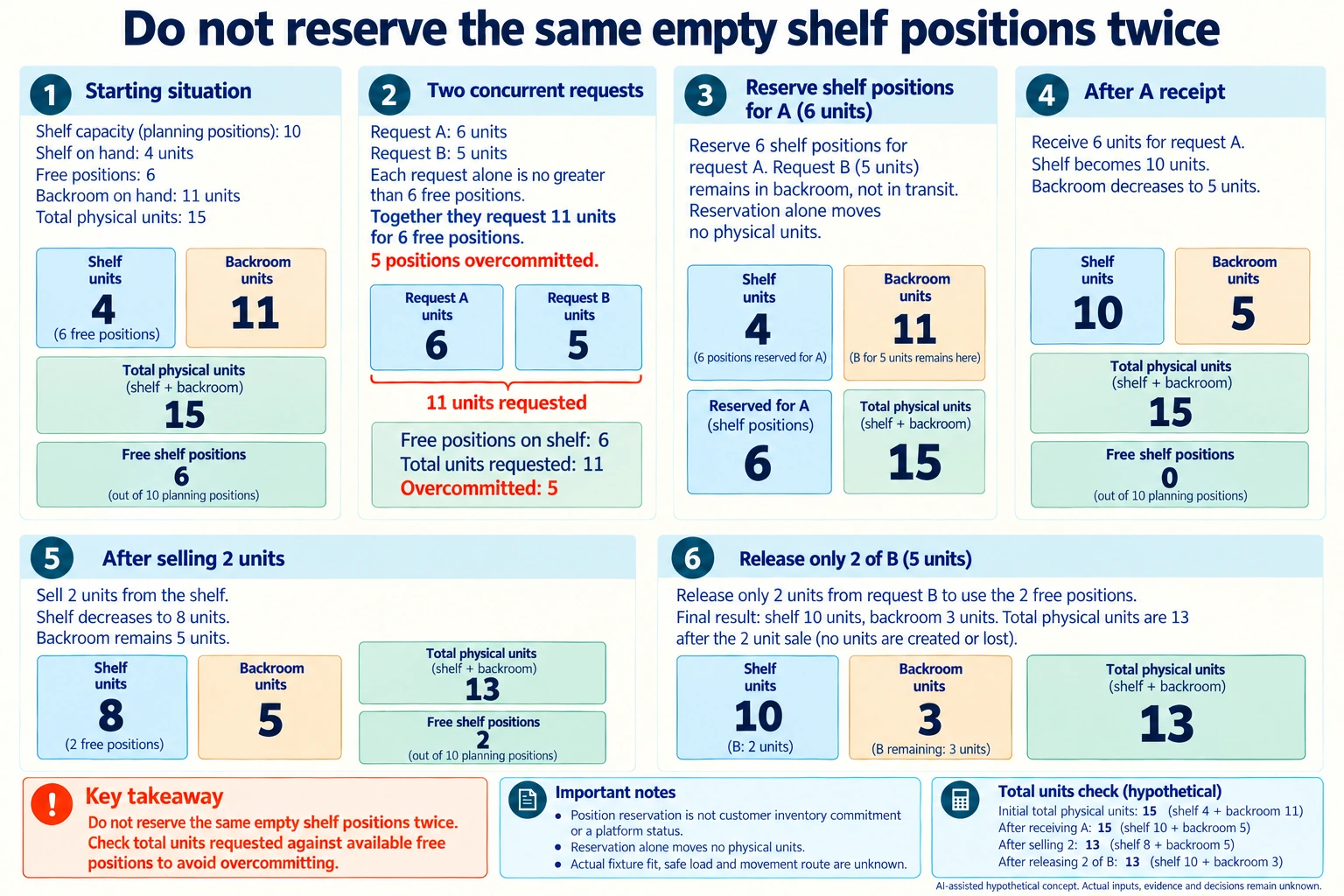
The original shelf-and-backroom cycle counts physical stock. Add a separate coordination case: a shelf has four units against an illustrative ten-position planning limit, leaving six free positions. The backroom holds eleven units. Task A requests six and task B requests five against that same destination. Each request considered alone fits the number six; together they request eleven positions, overcommitting five.
Scroll horizontally if columns extend beyond the view.
| Hypothetical scenario | Item or operation | Planning relationship | Assumed input or calculation |
|---|---|---|---|
| POSITIONS33 | FREE_PLANNING_POSITIONS | calculated from | POSITION_LIMIT-SHELF_START; 6 positions |
| POSITIONS33 | CONCURRENT_REQUESTS | calculated from | A_REQUEST+B_REQUEST; 11 units |
| POSITIONS33 | REQUESTS_ABOVE_FREE | calculated from | REQUESTS-FREE; 5 units |
| POSITIONS33 | PHYSICAL_UNITS | calculated from | SHELF_START+BACK_START; 15 units |
| A_MOVEMENT33 | IN_TRANSIT_A | calculated from | A_REQUEST; 6 units |
| A_MOVEMENT33 | BACKROOM | calculated from | BACK_START-A_REQUEST; 5 units |
| A_MOVEMENT33 | PHYSICAL_UNITS | calculated from | SHELF_START+TRANSIT+BACK_AFTER_A; 15 units |
| A_RECEIPT33 | SHELF | calculated from | SHELF_START+TRANSIT; 10 units |
| SALE33 | SHELF | calculated from | SHELF_AFTER_A-SALE; 8 units |
| SALE33 | FREE_POSITIONS | calculated from | POSITION_LIMIT-SHELF_AFTER_SALE; 2 positions |
| B_PARTIAL33 | B_PART_RELEASE | calculated from | min(B_REQUEST,FREE_AFTER_SALE); 2 units |
| B_PARTIAL33 | BACKROOM_RETAINED | calculated from | B_REQUEST-B_RELEASE; 3 units |
| B_PARTIAL33 | SHELF | calculated from | SHELF_AFTER_SALE+B_RELEASE; 10 units |
| B_PARTIAL33 | PHYSICAL_UNITS | calculated from | FINAL_SHELF+B_REMAIN; 13 units |
| POSITIONS33 | EXPECTED_PHYSICAL_BALANCE | calculated from | INITIAL_TOTAL-SALE; 13 units |
| POSITIONS33 | FINAL_MINUS_EXPECTED | calculated from | FINAL_TOTAL-EXPECTED_AFTER_SALE; 0 units |
Reserve the six positions for A before releasing its movement. B remains in the backroom. Reservation alone moves no stock. While A is travelling, shelf four plus in-transit six plus backroom five still equals fifteen physical units. After A receipt, the shelf has ten and the backroom five. If two units are then sold, two positions become free. Release only two of B’s five: the shelf returns to ten, with three retained in the backroom and thirteen physical units overall.
The decision is whether another task may claim destination space already promised to a movement. It is distinct from a customer inventory commitment, platform stock status or demand forecast. The planning position count establishes no actual fixture fit, load or safe route. Confirm those separately and record movement and receipt once. The display-refill record addresses unit positions and access; the pop-up example addresses supplies arriving after demand.
Download the concurrent shelf refill destination position reservation record (.csv). It includes the original table fields and scenarios alongside the added relationships. HYPOTHETICAL rows are editorial examples or required review scopes, not actual records. Actual quantity, configuration, component and file identities, materials, process, specification, copy, method, condition, observation, owner, decision, evidence and dates are blank. ACTUAL_BLANK is a separate empty starting row; enter permitted project evidence before using an actual record. A blank means unknown.
Use the Plan Refilling Before Approving the Display Layout for its separate question. Use the Pop-Up Shop Packaging Supplies and Refill Quantities for its separate question.
Source scope checked 17 October 2026: Public inventory guidance does not prescribe shelf-position reservations or approve fixture capacity. Position reservations in this example are planning relationships, not Shopify inventory-state definitions. The added configurations and calculations are hypothetical, with actual evidence and decisions pending.
What this changes in a packaging enquiry
Use the shelf and backroom balance to decide which quantity belongs in an inner pack or delivery case. Send the retailer's actual accepted display capacity and refill handling unit. Do not enlarge the presentation pack simply to absorb an illustrative backroom surplus. A relevant configuration to compare is the Multi-Tier Counter Displays Give Each Shelf a Refill and Picking Clearance; it is a concept reference, not confirmed suitability.
Discuss this packaging specification with Packrivo. We coordinate independent suppliers. MOQ: 500 pieces per product/design; illustrative quantities are not production offers. Confirm materials, samples, price and timing for your project.