
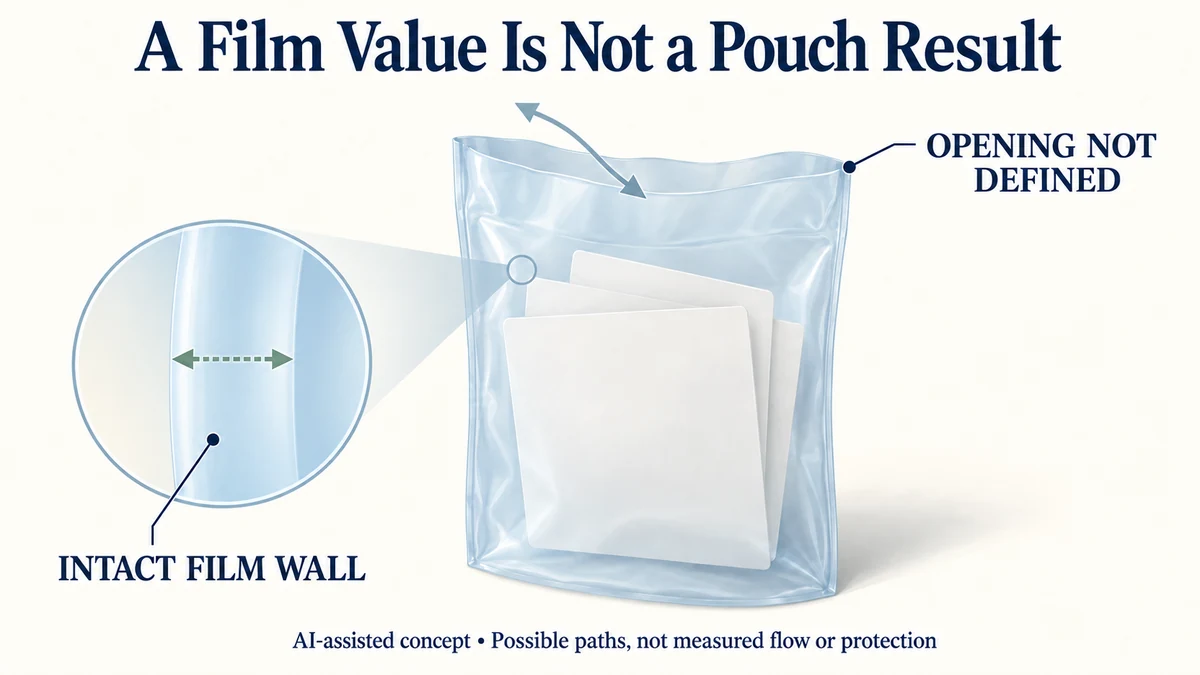
A water-vapour transmission rate (WVTR) measured on flat packaging film does not establish how well a finished pouch controls moisture exchange.
If both water vapour and oxygen are part of the requirement, use OTR and WVTR Measure Different Barrier Questions to keep the two document requests separate. Neither flat-film rate establishes the performance of the proposed finished pouch and its closure.
Water vapour can pass through an intact film wall. It may also enter or leave through an opening, an imperfect closure or another path in the assembled package. A test of one route does not automatically measure the other.
For a small jewellery, candle or gift brand considering protective pouches, the decision is whether the intended claim needs evidence about the film material, the finished pouch and closure, or both. A photograph showing water droplets beading on the surface cannot settle that decision.
Water vapour can take two different routes
Consider a polymer pouch surrounding printed care cards.
The first possible route is directly through its intact film wall.
Water-vapour molecules can move through a barrier material even when it has no visible hole. The rate depends on the material and the conditions under which transmission occurs. A film does not have to become visibly wet for water vapour to pass through it.
The second possible route is around the barrier wall.
A pouch opening, an incomplete seal, a gap at a closure or a damaged area can provide another pathway between the pouch interior and its surroundings. Depending on the actual construction and environmental conditions, that pathway may permit moisture transport or the exchange of moisture-bearing air.
The distinction matters because a film can have a comparatively low measured WVTR while the pouch made from it still has an unresolved opening.
Conversely, closing the opening does not eliminate vapour transmission through the film itself.
Neither statement assigns a measured transmission rate to a particular pouch. They identify two physical routes that must not be confused.
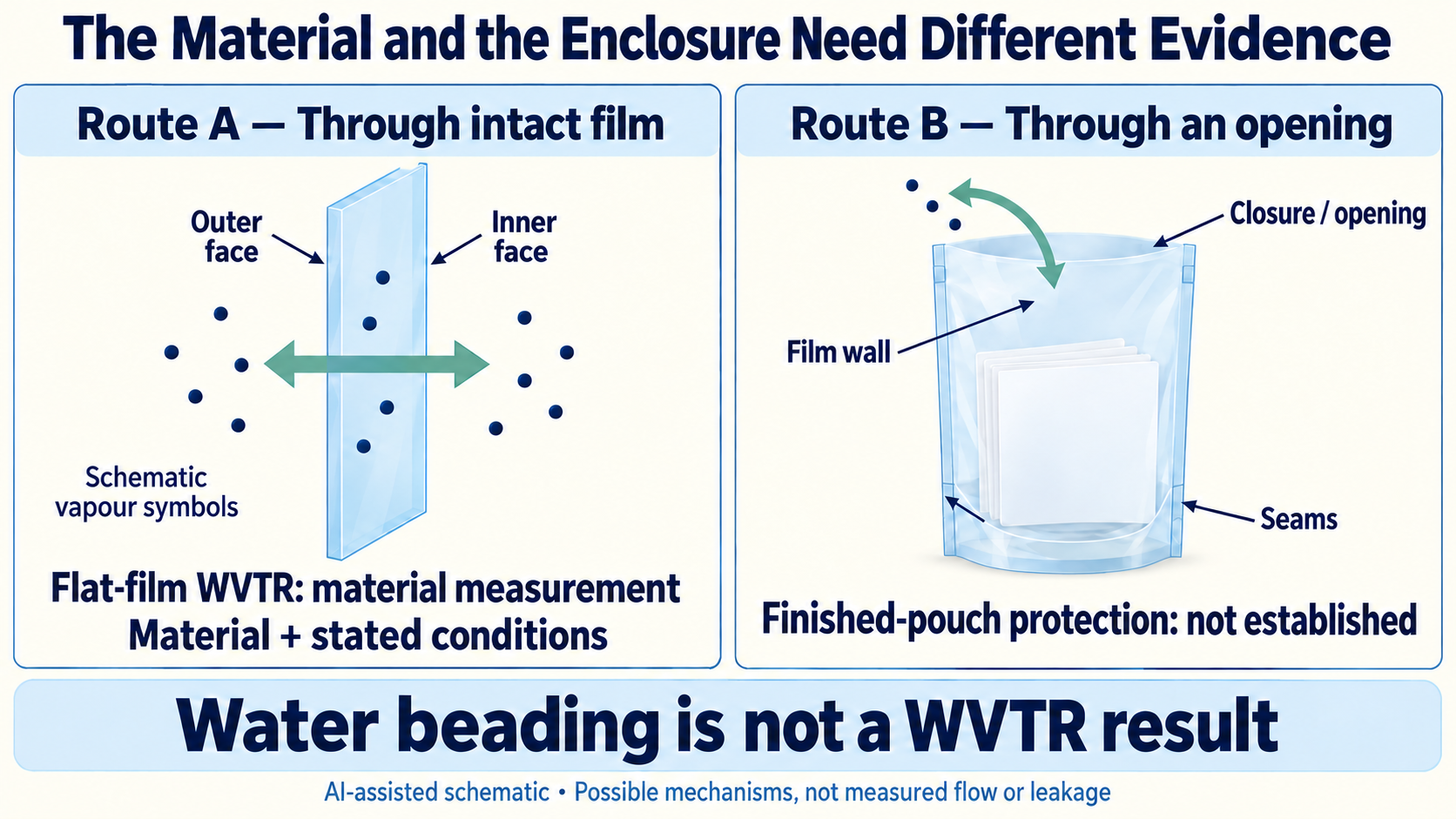
Flat-film WVTR measures the material under defined conditions
ASTM F1249-25 describes a method for determining water-vapour transmission through flexible barrier materials using a modulated infrared sensor.
Its published scope covers films and sheets up to 3 mm thick, including specified single-layer and multilayer materials. The method distinguishes water-vapour transmission rate, permeance and, for homogeneous materials, a permeability coefficient.
A reported film WVTR, commonly expressed in grams per square metre per day, describes transmission relative to the area of the tested material and the measurement period. It is not automatically a rate for the entire assembled pouch.
The temperature, humidity conditions, actual film construction and measurement method matter when interpreting or comparing results.
A lower WVTR from one film test can indicate lower measured transmission through that tested material under the stated conditions. It does not establish the relative performance of two finished pouches if their openings, seams or other constructions differ.
The ASTM scope also cautions that WVTR cannot always be assumed to vary inversely with thickness or directly with the water-vapour partial-pressure difference.
That prevents a tempting shortcut: a buyer should not simply halve a reported WVTR because a proposed film is twice as thick, or transfer a reported value to different humidity conditions through an assumed constant relationship.
Those calculations would require technical justification that the supplied number alone does not provide.
An undefined pouch opening leaves the care-card question unanswered
Imagine a hypothetical gift brand considering a translucent polymer pouch for near-white printed care cards.
The supplier provides a flat-film WVTR result. The brand also receives an illustration showing water droplets on the outside of the film.
However, the proposed pouch opening is not yet defined.
One possible design would be filled with the cards and then closed with a heat seal. Another would use a reusable fold-over opening.
These are invented design alternatives, not tested products. Neither has a measured package transmission rate.
The film data could be identical for both proposals because the wall material is the same.
But the opening presents a different physical question.
In the heat-sealed proposal, the brand would need to know how the intended finished seal is formed and whether the actual sealed construction has been assessed.
In the fold-over proposal, the brand would need to understand the remaining opening and the way the pouch is actually used.
Even where a design has an apparently continuous closure, that appearance alone cannot establish its moisture-barrier performance.
The missing information is not another decimal place in the flat-film result. It is the definition and assessment of the assembled enclosure.
The film report may still help the brand compare potential wall materials. It cannot decide whether either finished pouch will maintain a particular internal relative humidity or protect the cards for a stated period.
The cards and enclosed air also begin with their own moisture conditions. No initial moisture measurements or subsequent internal humidity measurements exist in this hypothetical example.
It would therefore be unjustified to describe either pouch as keeping its contents dry, maintaining a specified humidity or providing a particular storage life.
Water beading is not evidence of humidity retention
Water beading concerns the visible behaviour of liquid water on a surface.
WVTR concerns the movement of water vapour through a material under specified conditions.
Those are different observations.
A photograph of droplets remaining rounded on polymer film does not reveal the film’s WVTR. It does not measure moisture movement through a closure or establish what happens to the humidity inside the pouch.
Even a convincing water-beading demonstration on the central panel leaves the opening and other possible pathways unexamined.
Likewise, a measured WVTR does not by itself establish that the pouch resists liquid water at its seams or closure.
The brand should not translate either observation into a general waterproof or humidity-protection promise.
The protective claim determines which evidence is needed
If the immediate purchasing decision concerns only the film material, comparable flat-film WVTR evidence may be relevant.
The buyer can use that evidence to assess the offered material within the conditions and measurement scope stated in the report. That decision does not extend automatically to an assembled pouch.
If the intended claim concerns a closed pouch as a protective enclosure, the relevant question expands to the finished construction.
The actual opening, sealing arrangement, seams and intended use need to be defined before a qualified reviewer can determine what finished-package assessment would answer the claim.
AMETEK MOCON’s package-cartridge information illustrates the measurement distinction.
The manufacturer separately describes cartridges for film samples, flexible pouches, complete packages and closures. Its package adaptor is described as accommodating complete packages and closures, while a dedicated flexible-pouch fixture uses a different mounting arrangement.
These are examples of measurement capabilities, not test results for the proposed care-card pouch. The reviewer must still establish whether a particular method and mounting arrangement assess the intended closure and relevant vapour pathways.
A finished-package test may answer a different question from a flat-film test. It does not automatically establish internal humidity or storage duration under every intended use condition.
When the brand must support both its film selection and a finished-pouch protective statement, both levels of evidence may be needed.
That distinction gives the sourcing discussion a useful direction.
The brand can first describe the pouch’s intended function and opening arrangement through a packaging supplier brief. Once a physical construction exists, the packaging sample review guide can help organize a separate examination of the assembled pack. Neither document replaces a suitable moisture-performance assessment.
Packrivo coordinates packaging sourcing and project questions; it does not establish film permeability, seal integrity or humidity-retention performance through its own testing.
The practical purchasing decision is to keep the wall-material claim separate from the finished-enclosure claim.
A flat-film WVTR may justify further consideration of the film. Only relevant evidence addressing the assembled pouch and its intended use can support an appropriately bounded finished-package moisture-protection statement.
Source review: 10 October 2026. ASTM F1249-25 was listed as active, with its catalogue last updated on 10 November 2025. Only the publicly accessible catalogue description and scope were reviewed, not the paid complete standard. The AMETEK MOCON product page was undated; its fixture descriptions do not verify any particular pouch’s performance. No material sample, measured WVTR, assembled pouch, closure or humidity-retention result was examined for this article.
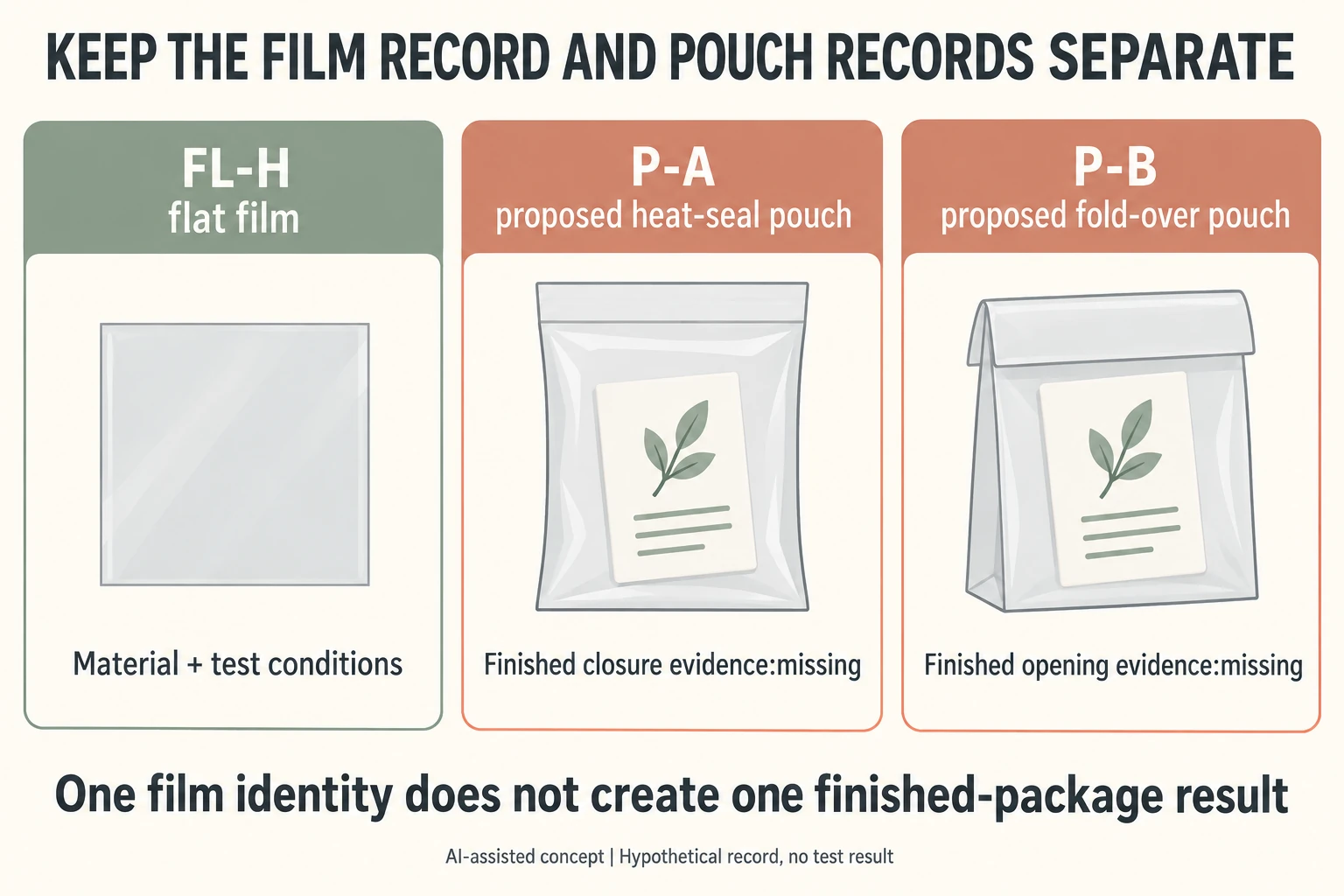
Keep each finished closure outside the flat-film result field
Imagine document F-H is offered for film FL-H, while P-A proposes a heat-sealed pouch and P-B a fold-over pouch using that film identity. This record supplies no numerical WVTR or actual document. The offered wall-material evidence and the two finished-construction questions remain separate.
Scroll horizontally if columns extend beyond the view.
| Record | Intended object | Evidence question |
|---|---|---|
| F-H / FL-H | Flat film and stated conditions | Exact material, method, temperature/humidity basis |
| P-A | Proposed heat-sealed construction | Actual complete closure and mounting/evaluation scope |
| P-B | Proposed fold-over construction | Actual opening and intended use |
| Protective wording | Finished package claim | Evidence for relevant assembly and conditions |
A shared film reference does not justify copying one finished-pouch outcome into the other. The same intended care-card contents also need their initial condition identified; the diagram does not establish moisture content or internal humidity.
The smooth band and fold are generic proposal symbols, not seal-integrity evidence. Keep actual value/unit and test conditions in the material row, and ask what the finished-package assessment includes at seams and closure. No film value, liquid-water bead or closed-looking seam supplies a humidity-retention or storage-life result here. All rates, observations, methods for the complete packages and wording decisions stay blank.
Download the film WVTR versus finished pouch record (.csv). HYPOTHETICAL rows are invented examples. Use ACTUAL_BLANK for permitted project inputs; replace that row label only when recording actual facts. Empty evidence, observation and date fields mean unknown or not performed, never acceptance. Keep checkpoints and revisions separate.
Send the exact film report and each actual finished-pouch/closure definition, then ask for the evidence level required by the intended claim. Packrivo coordinates independent suppliers. These records establish no supplier offer, service availability or MOQ exception; its published baseline is 500 pieces per product/design.