
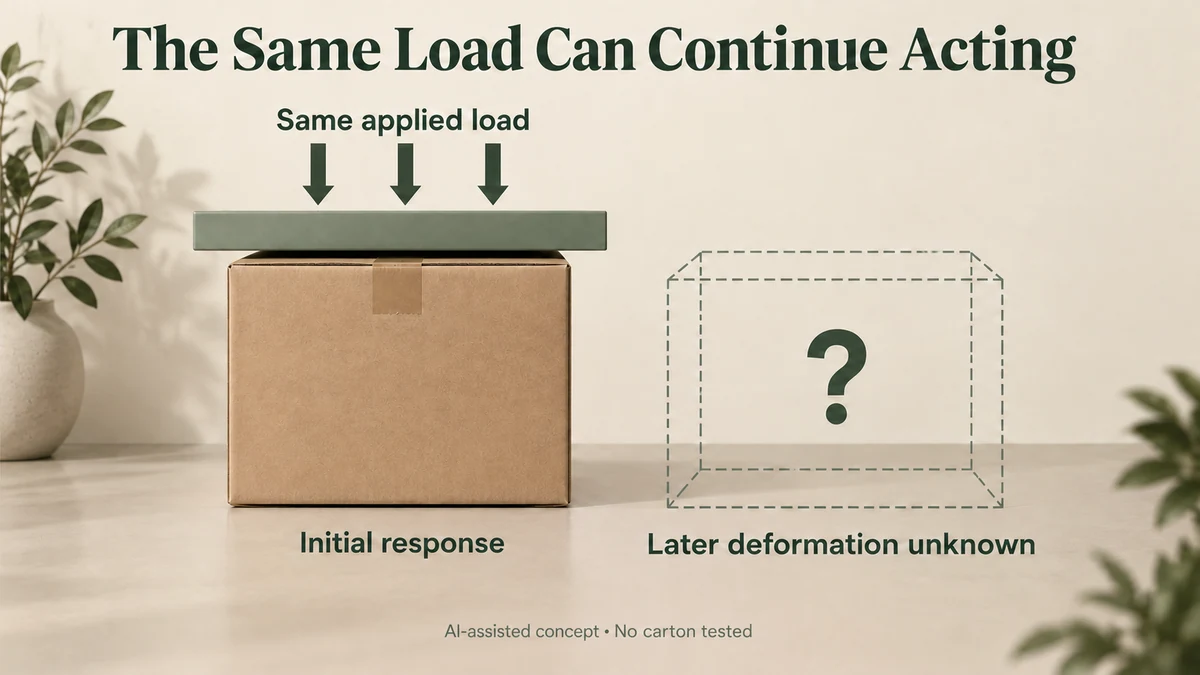
A shipping carton can continue to deform even when the weight pressing down on it stays the same. Its first response to compression does not necessarily describe what happens during a longer period of stacked storage.
That time-dependent deformation is called creep. A peak box compression test (BCT) result cannot, by itself, establish how a complete packed carton will behave under sustained loading. A storage decision needs evidence covering the relevant load, duration, packed configuration and conditions—not a stack-height estimate obtained by dividing a peak compression number by carton mass.
The First Shortening Is Not the Whole Deformation
When a vertical load is first applied to a carton, the structure responds. Corrugated walls may deflect, contact points may settle, and any supporting contents or internal packaging may participate in carrying the load.
Some movement can occur as soon as the load is applied. Further deformation may develop while that same load remains in place.
The second part is the important distinction. In creep, deformation changes with elapsed time under sustained loading. The load does not have to increase for the carton to continue changing shape.
Original research by Martin Holmvall on containerboards and stacked corrugated boxes, first published online in September 2021 and appearing in a 2022 journal issue, examines this time-dependent behavior and the variation in loading lifetimes. Separately, Westpak’s educational explanation of creep describes changes in cushioning-material thickness under persistent compressive loading.
These sources address different material and structural scopes. A measured cushioning-material response must not be presented as a measured shipping-carton response.
For a complete carton, deformation may also alter how its walls, corners, fittings and contents share the applied load. An unchanged external force does not guarantee that the internal load distribution remains unchanged.
A carton that appears satisfactory immediately after stacking therefore has not yet demonstrated its response throughout the intended storage period.
Peak Compression and Constant Loading Ask Different Questions
A reported peak BCT result generally identifies the maximum compressive force reached during the stated compression test. It is useful evidence about resistance under that test’s loading arrangement.
Sustained loading asks something else: what happens when a specified force remains applied as time passes?
The distinction is reflected in the published standards.
ASTM D642-25 addresses compressive resistance testing of shipping containers, components and unit loads. Its public description directs constant-load testing questions to ASTM D4577-19(2023).
ASTM D4577’s published scope addresses vertically applied constant loads maintained for a specified period or until failure. It can concern empty or filled containers, including palletized or unitized configurations.
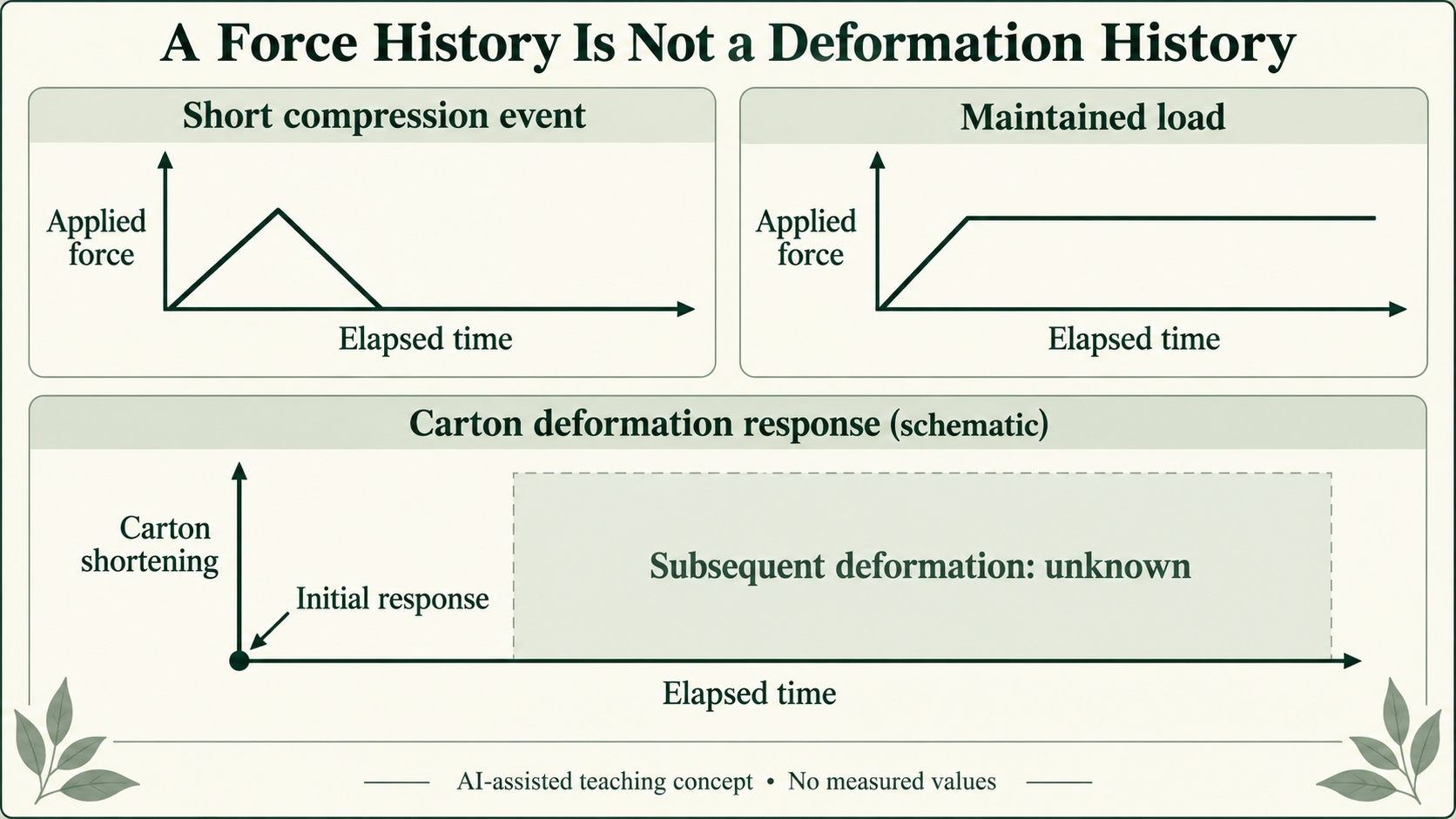
Even if two loading histories briefly reach a similar force, they are not equivalent. A compression event records a response along one loading history. A fixed-load exposure introduces elapsed time as an essential part of the question.
This is why dividing a peak BCT value by the mass of an individual carton cannot determine a safe number of stacked layers.
Force and mass are different quantities. Even after correctly expressing the mass as weight force, the resulting comparison still does not describe time-dependent deformation, contact conditions, contents, environmental exposure or variation between cartons.
There is no universal conversion from a peak compression result to a guaranteed stacking duration.
A Hypothetical Carton That Settles at the Start
Imagine a candle gift brand considering stacked storage of complete shipping cartons. Each carton contains the intended retail candle boxes, internal holders and closures.
For this hypothetical comparison, suppose a responsible technical evaluation applies the same agreed vertical force to cartons of the proposed packed configuration.
Both cartons show an initial settling response.
That starting observation does not reveal whether they will behave alike afterward.
One carton might undergo relatively little additional change within the observation period. Another might continue shortening or develop visible distortion. The rate of deformation might also change as exposure continues.
These are possible outcomes, not invented test findings. No force, displacement, duration, material performance or failure time has been measured or assigned to either carton.
The only defensible conclusion from the shared starting observation is that both responded initially to the applied load.
Their later behavior remains unknown until suitable time-dependent evidence exists.
A record showing that a carton supported a load at the beginning cannot establish that it will maintain an acceptable condition throughout an unspecified period.
A Deformation Curve Needs an Elapsed-Time Axis
For a relevant constant-load evaluation, a useful record distinguishes the applied force from the deformation that occurs while that force is maintained.
Consider a graph with elapsed time along the horizontal axis and carton shortening along the vertical axis.
The beginning identifies the response when the load is first applied. Any subsequent measured shortening during the maintained-load interval provides evidence about continuing deformation.
The curve may not have a constant slope. Its rate of change can vary, and a short observed segment does not justify a straight-line prediction into an unobserved period.
Three interpretations matter:
-
Further shortening under the maintained load: deformation has continued after the initial response. Its measured extent and rate belong to the observed interval.
-
Little additional change during the recorded interval: the carton changed little in that interval. This does not prove that deformation will never resume or that indefinite stacking is acceptable.
-
An evaluation ending before failure: the record may establish observations through the stated endpoint. It does not establish an unmeasured failure time.
The associated carton condition matters alongside the dimensional trace. Wall distortion, changes around corners, closure behavior and the condition of the packed contents can be relevant to the intended acceptance question.
A single initial photograph, final photograph or peak force cannot reconstruct that entire history.
The original corrugated-box research also addresses variation in creep lifetime. Its findings reinforce the distinction between a particular observed result and a prediction for other cartons or conditions; they do not provide a universal lifetime formula for a buyer’s proposed package.
Duration Belongs in the Storage Decision
A complete packed carton can have different load paths from an empty carton. Internal holders, products, closures and the surfaces supporting the carton can affect the assembled system’s behavior.
The intended application also matters. Storage may involve an extended stationary load, while distribution can introduce changes in handling, support, loading and environmental conditions.
Evidence from one fixed-load exposure does not automatically represent every part of that broader history.
Before treating a report as relevant to a proposed stored stack, the responsible reviewer needs to establish what was actually loaded, how the force was applied, how long it remained applied, what conditions were present and what was observed over time.
An evaluation that ended at a specified duration without observed failure answers a bounded question. It does not establish an unlimited safe storage period, nor does it automatically validate another loading arrangement.
For buyers, the useful technical question is:
For this complete packed-carton configuration, what evidence describes deformation and package condition under the proposed sustained load throughout the relevant exposure period?
If the available answer is only a peak BCT number, the time-dependent storage question remains unresolved.
The existing distribution-test scope guide provides a place to define the complete packed system and distribution objective. The test-report configuration guide helps connect reported evidence to the configuration actually evaluated.
Packrivo can coordinate packaging specifications and supplier questions. The appropriate technical parties must determine the evaluation method, evidence and acceptance requirements. No tested stacking capacity or safe storage duration is established here.
Keep a Peak Result Separate From a Storage Claim
A carton may initially resist compression and still undergo further deformation while the same load remains applied.
A peak compression result answers a resistance question within its stated test. A sustained-load record addresses behavior across an observed period. Neither result should be extended beyond its demonstrated scope without a technically supported basis.
For a proposed stacked arrangement, retain the difference between initial resistance, observed time-dependent behavior and an actual acceptance decision.
Until the complete loaded system has relevant evidence for its intended exposure, safe stack height and storage duration remain unestablished.
Source scope: Public information accessed 10 October 2026. ASTM D4577-19(2023) is the active 2023 reapproval; ASTM D642-25 is the active compression-test edition. The full paid ASTM procedures were not obtained. Westpak’s undated educational page addresses material creep and does not provide a carton-specific result. Holmvall’s original research concerns studied containerboards and corrugated boxes, not Packrivo packaging. This article is an interpretation guide, not a testing procedure or authorization to stack products.
Keep the unloaded reference when separating initial and later shortening
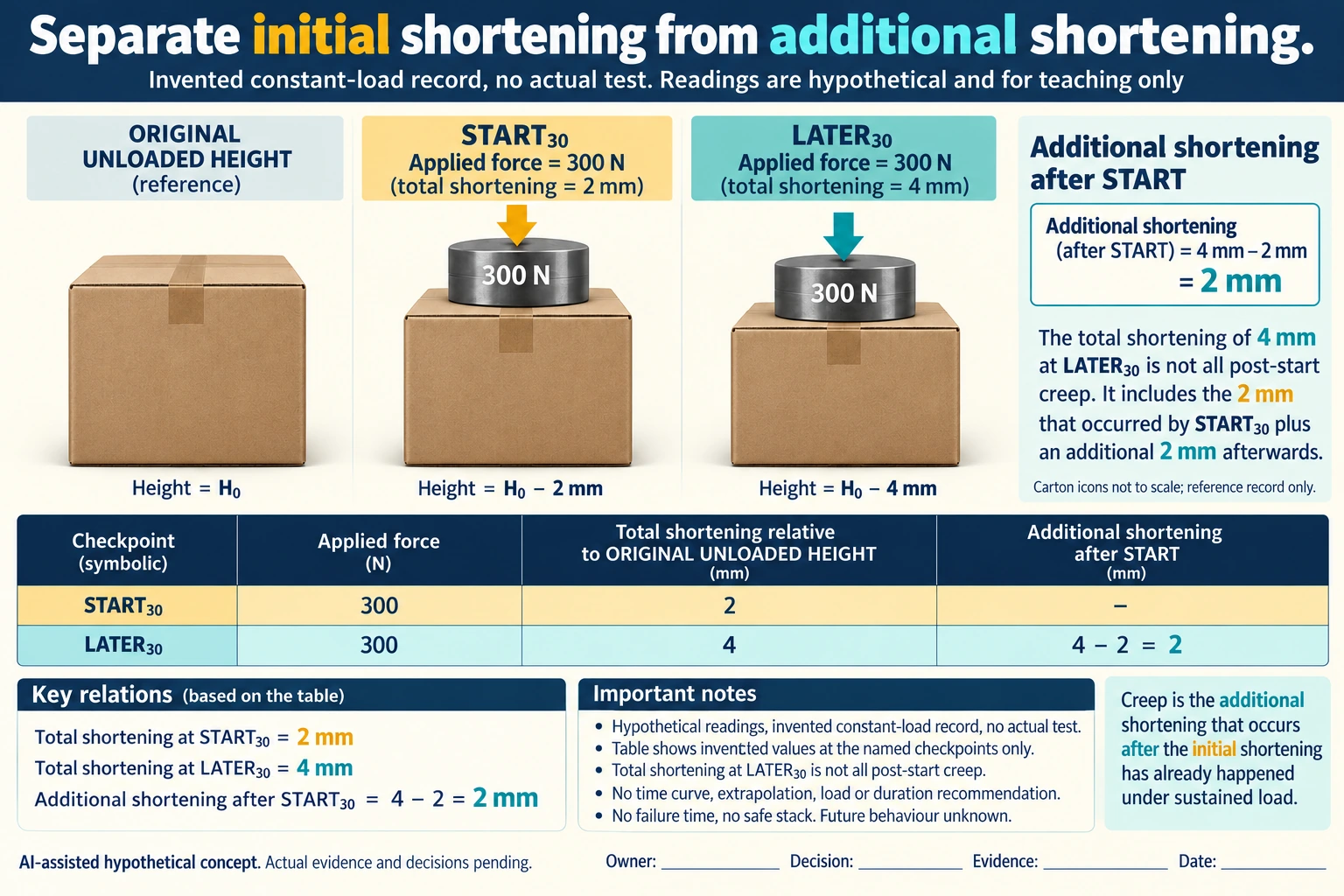
Use invented readings to define the origin of a shortening record. A hypothetical complete carton has 300 N maintained at START30 and LATER30. Relative to its original unloaded height, total shortening is 2 mm at START30 and 4 mm at LATER30. The checkpoint names supply no elapsed hours, test method or actual observations.
Scroll horizontally if columns extend beyond the view.
| Hypothetical configuration | Named object | Relationship | Input or next scope |
|---|---|---|---|
| START30 | MAINTAINED_FORCE | assumed input | 300 N |
| START30 | SHORTENING_FROM_UNLOADED_REFERENCE | assumed input | 2 mm |
| LATER30 | MAINTAINED_FORCE | assumed input | 300 N |
| LATER30 | SHORTENING_FROM_UNLOADED_REFERENCE | assumed input | 4 mm |
| LATER30 | SHORTENING_AFTER_START | calculated from | LATER30_TOTAL-START30_TOTAL; 2 mm |
| CARTON30 | TOTAL_SHORTENING | uses reference | ORIGINAL_UNLOADED_HEIGHT |
| CARTON30 | LATER30_TOTAL4 | is not all | POST_START_CREEP |
| CARTON30 | SYMBOLIC_CHECKPOINTS | do not supply | ELAPSED_TIME_RATE_FAILURETIME_OR_SAFE_STACK |
| CARTON30 | ILLUSTRATIVE_SPECIMEN | is | COMPLETE_CARTON_NOT_FOAM_MATERIAL |
Additional shortening after START30 is 4 − 2 =2 mm. Calling all 4 mm post-start creep would include the initial response in the later increment. Conversely, resetting the displayed origin to zero at START30 without retaining the original 2 mm would hide how far the carton had already changed. Keep total shortening and post-start change as different fields connected to their own reference.
The example does not establish a creep rate: no interval was supplied. It also gives no failure time, safe stack height or allowable distortion. If the intended decision concerns storage, the responsible reviewer still needs actual elapsed time, complete packed configuration, maintained load, environment and package condition. A later endpoint cannot justify straight-line extrapolation into an unobserved period.
This reference check complements matching a report to an order. A genuine constant-load report can still be misread if its displacement origin is omitted; a peak compression record cannot fill that history. Ask what was zeroed, when load was established and what each displacement refers to. The 300 N assumption is arithmetic context, never a suggested loading procedure.
Download the carton creep initial shortening reference subtraction record (.csv). It includes the original table fields and scenarios alongside the added relationships. HYPOTHETICAL rows are editorial examples or required review scopes, not actual records. Actual quantity, configuration, component and file identities, materials, process, specification, copy, method, condition, observation, owner, decision, evidence and dates are blank. ACTUAL_BLANK is a separate empty starting row; enter permitted project evidence before using an actual record. A blank means unknown.
Use the Packaging Test Reports: Match the Ordered Configuration for its separate question.
Source scope checked 17 October 2026: Holmvall research was online-first 28 September 2021 and published in a 2022 journal issue; the earlier source study obtained publisher text after an access error. ASTM D642-25 and D4577-19(2023) public scopes differ; paid methods were not acquired. Westpak material creep is not a complete carton model or lifetime guarantee. The added configurations and calculations are hypothetical, with actual evidence and decisions pending.
Discuss this packaging specification with Packrivo. We coordinate independent suppliers. MOQ: 500 pieces per product/design; illustrative quantities are not production offers. Confirm materials, samples, price and timing for your project.