
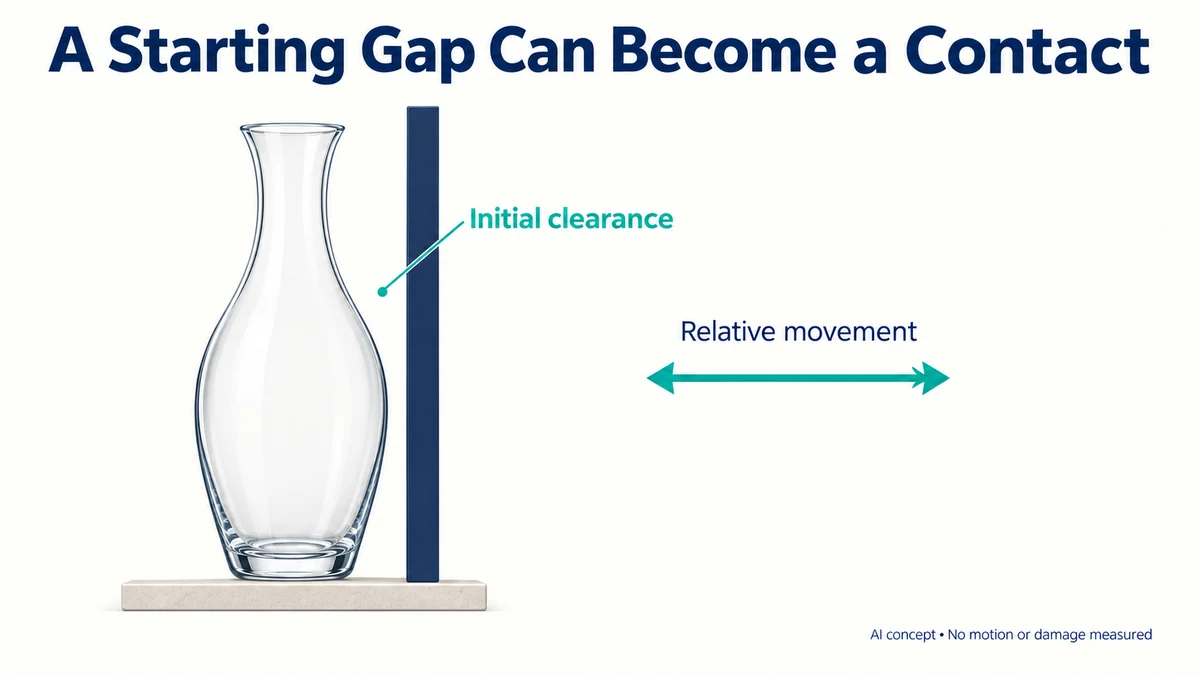
A product can have enough room to fit inside a gift pack and still move into a neighbouring part during transport. Static clearance describes a starting geometry. Repeated movement asks what happens as that clearance is consumed, reopened and consumed again.
For a Mailer with Fitted Insert, map the product, support and neighbouring surfaces in the configuration to be evaluated. A static gap in that arrangement is not evidence that the product avoids repeated contact during transport.
For a small brand shipping glass or a decorated retail pack, this distinction changes the next technical question. A positive gap does not by itself demonstrate restraint. The proposed support must be considered with the movement and contact conditions of the complete pack.
A gap separates parts only while their relative movement preserves it
Imagine an invented glass vessel held between side supports. At the initial position, there is a 2 mm space between one glass face and a nearby divider. This number is hypothetical, not a recommended allowance.
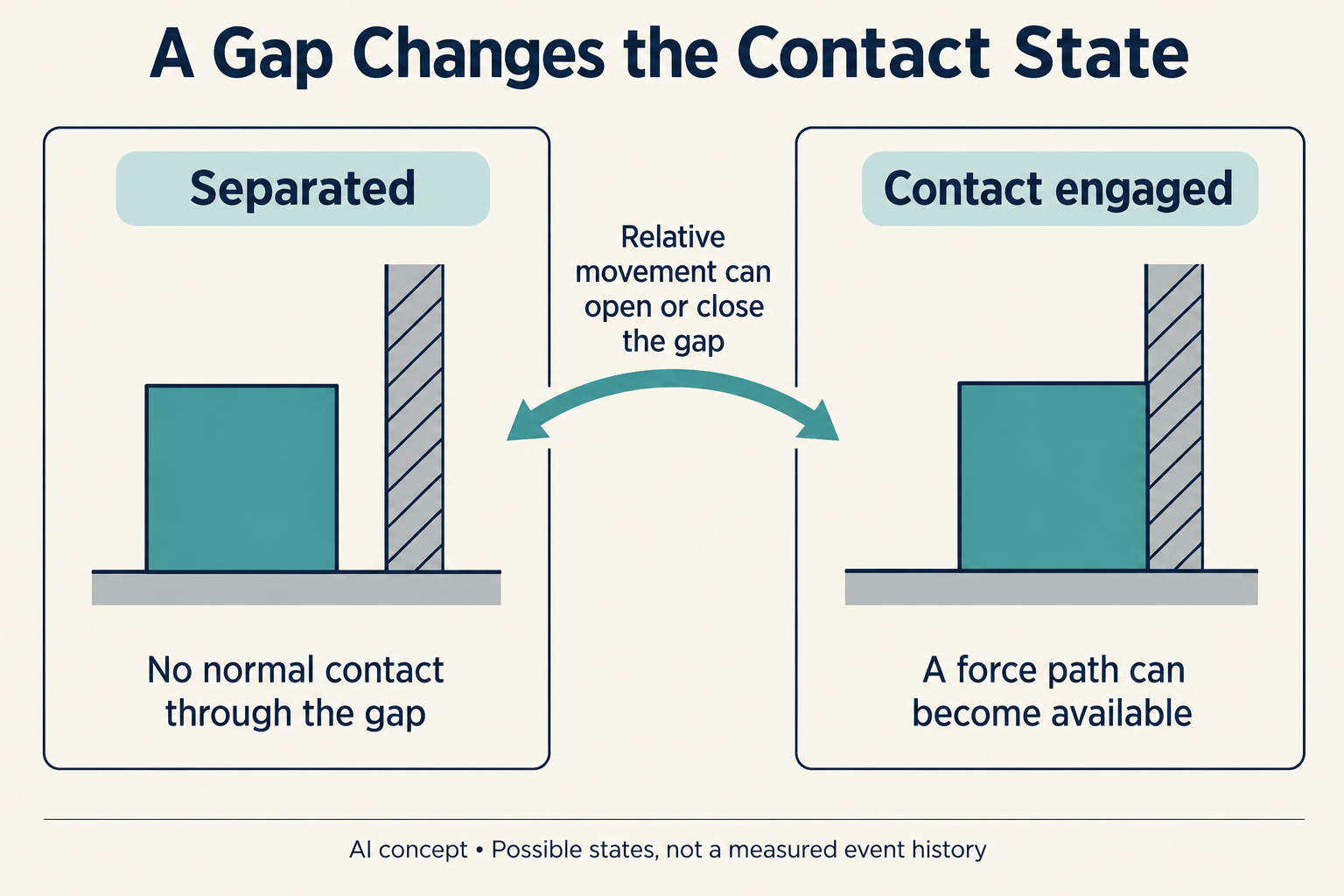
While the parts remain separated, that divider does not transmit a normal contact force through the gap. If relative movement closes the space, the contact condition changes. The divider and vessel may then interact through a force path absent from the separated state.
The important movement is relative movement. If both parts move together without approaching each other, the gap can remain open despite motion of the carton. If one moves differently from the other, the same outside motion can bring their faces closer.
That distinction prevents a common shortcut: describing carton motion as though it directly specified the vessel’s displacement relative to every support.
Repeated contact is different from continuous support
A support that remains engaged throughout an event can transmit force continuously. A loose part separated by a gap can alternate between free movement and contact. That switch changes the relationship the design relies on.
Contact need not be a single collision at the end of a journey. Under some motion conditions it can recur. Friction, material deformation and the direction of movement may also change what happens when the parts meet.
This article does not predict how often those contacts occur or what force they produce. Their existence and severity depend on the actual input, configuration and material response. A starting drawing identifies a possible interface; it cannot demonstrate an event history.
The loaded orientation map identifies neighbouring retail units and separators. Add the relevant directions of possible relative movement when the concern is intermittent contact. A tidy row arrangement cannot establish that the units remain separated in transport.
Static fit and vibration response leave different questions open
A tolerance calculation can tell you whether idealized rigid dimensions leave a gap in a defined assembly. It does not supply the dynamic displacement needed to decide whether that gap closes.
Likewise, a description of vibration amplification does not establish contact merely because movement exists. The relative movement must be considered against the located clearance and the actual constraints.
The public scope of ASTM D4728-17(2026) concerns random vibration testing of filled shipping units. It describes vibration in vertical or horizontal directions and notes that realistic levels depend on relevant field information. Its catalogue does not prescribe a universally harmless gift-box gap.
Testing a loose insert separately also leaves the assembled interaction open. Closures, neighbouring units, divider engagement and product mass can change the state being evaluated.
Follow the hypothetical 2 mm space through a design change
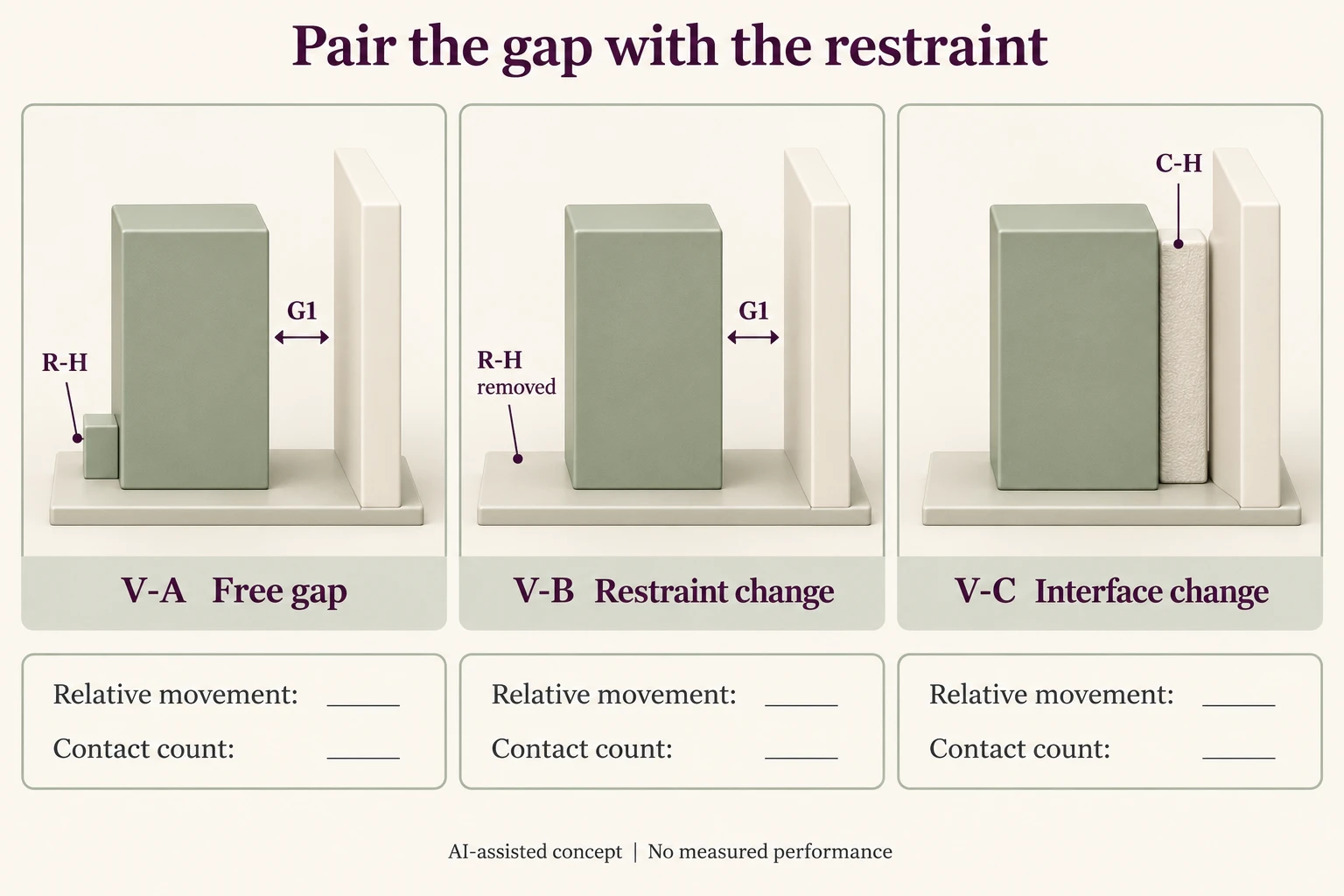
Suppose a designer proposes removing a small side restraint to make loading easier. The initial 2 mm gap to the divider remains unchanged. The change nevertheless affects how the vessel is held before the space closes.
Comparing only the gap dimension would miss that altered constraint. The technical review should identify what keeps the vessel located, which part can move relative to it and where the first new contact could occur.
Now suppose a different proposal adds a compressible contact piece. That may replace a free gap with an engaged interface, but it introduces material response and installed-compression questions. It is not automatically the better or safer design.
Neither proposal is a tested configuration here. The example shows why a clearance number and a restraint description must travel together when assessing movement.
Distinguish a contact concern from a damage diagnosis
A mark seen after transit does not prove that repeated divider contact caused it. Loading, unloading, rubbing, other neighbours and earlier handling can produce different evidence. Retain the actual condition before rearranging the contents.
Use the glass contact map to locate possible interfaces. Then connect a particular concern to appropriate complete-system evidence rather than assigning a cause from one scuff or an illustrative arrow.
For purchasing, the useful next request is specific: identify the restraint and relative movement at this located gap under the intended evaluation conditions. That request can resolve a missing design input without pretending that the drawing supplies a transit result.
Packrivo can coordinate those geometry and supplier questions. Relevant technical parties determine the evaluation and interpretation. No gap value, arrangement or contact count in this article establishes protection.
Source scope: Rechecked 16 October 2026. The current official ASTM listing identifies D4728-17(2026), updated 5 October 2026. This replaces the earlier edition/status note, which is not evidence of the current edition. Only the public catalogue scope was checked; the paid procedure was not acquired and no method limits were verified. The vessel, restraint and 2 mm gap are invented. No motion, contact force, abrasion or damage was measured.
Pair the clearance with the restraint state
This invented comparison uses the original 2 mm gap as an identified starting dimension, not a recommended clearance. It separates removal of a restraint from a proposed change to an engaged contact interface.
Scroll horizontally if columns extend beyond the view.
| Configuration | Starting interface | Changed input | Evidence gap |
|---|---|---|---|
| V-A | 2 mm free gap at G1 | Reference restraint R-H | Relative movement under intended conditions |
| V-B | Same 2 mm free gap at G1 | Remove R-H | Effect of changed constraint |
| V-C | Proposed engaged piece C-H | Replace free-gap interface | Installed compression and contact response |
| Transport observation | Not performed | None inferred | Actual motion/contact history remains blank |
Mark both bodies defining G1. Outer-carton motion is not a displacement measurement between those bodies. A record of the carton moving must not populate a cell for vessel-to-divider motion unless suitable evidence actually measures that relationship.
V-B preserves the nominal gap while changing what locates the vessel. That isolates a question a fit-only check would miss. V-C is a different interface and cannot inherit the same free-gap description merely because the outer carton stays unchanged.
Keep contact occurrence, contact count and visible surface change as separate unknowns. The map does not predict repeated collisions or diagnose a received mark. Retain received configuration evidence before rearranging it; relevant complete-pack evaluation belongs to the responsible technical party.
Download the packaging clearance vibration record (.csv). HYPOTHETICAL rows are invented examples. Use ACTUAL_BLANK for permitted project inputs; replace that row label only when recording actual facts. Empty evidence, observation and date fields mean unknown or not performed, never acceptance. Keep checkpoints and revisions separate.
Bring the located gap and restraint revision through the linked enquiry route so a static fit record is not mistaken for movement control. Packrivo coordinates independent suppliers. These records establish no supplier offer, service availability or MOQ exception; its published baseline is 500 pieces per product/design.