
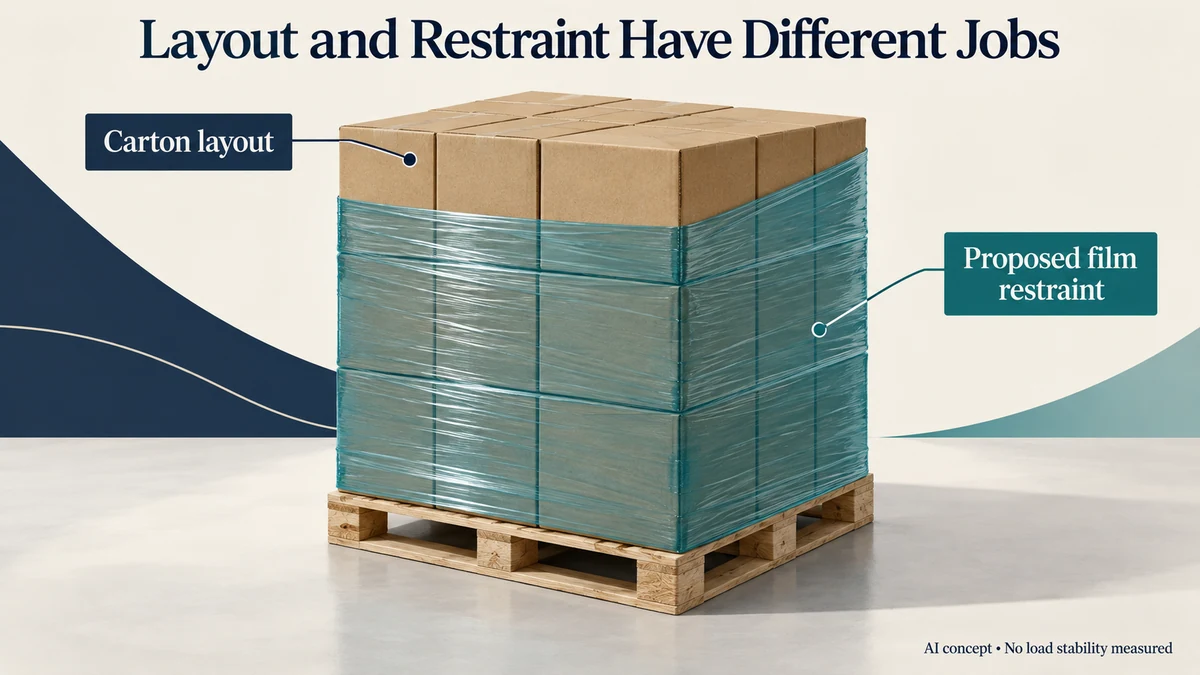
A carton layout describes how cartons sit on a pallet. Stretch wrap introduces another mechanical relationship: a tensioned film can engage the load and constrain movement. The layout and the restraint therefore answer different questions.
Use Pallet Stacking: Column and Interlocking Load Paths for the separate carton-contact and vertical load-path question. Record the actual wrap arrangement as another part of the loaded system rather than treating a pallet layout as evidence of lateral restraint.
For a gift brand comparing pallet proposals, knowing that cartons fit within the deck does not establish how the load behaves when forces act sideways. Nor does a photograph of wrapped cartons identify the restraint available at each layer or its connection to the supporting assembly.
Film tension and load contact create the constraint
A stretched film around a load carries tension. Where it turns around corners and contacts surfaces, that tension can produce forces on the load. The resulting restraint depends on the film, its applied state and the actual geometry it engages.
This is more specific than saying that plastic surrounds the cartons. Slack film, tensioned film and film that has changed its applied state do not describe the same restraint. A visible outer envelope does not measure the force holding the load together.
The film also does not engage every internal carton directly. Interior units interact through neighbouring cartons, supports and contact conditions. The outer film’s role must be understood as part of that complete arrangement.
No film tension, containment force or required wrapping recipe is supplied here. Those inputs need an appropriate technical basis for the actual unit load.
A vertical compression path does not settle sideways movement
Aligned carton edges can contribute to a vertical load path. That does not identify resistance to a carton moving relative to its neighbour or the pallet during handling.
Friction and restraint are relevant to those interfaces, but neither can be assumed from the count of cartons. A proposed vertical stacking pattern may leave a separate lateral-movement question unresolved.
Changing the pattern can also change contact relationships. Keep the proposal’s actual layout visible rather than comparing a wrapping plan for one layout against a compression discussion for another.
The complete-system guide keeps cartons, supports, closures and handling conditions within the evaluated configuration. A neatly wrapped display is configuration evidence, not evidence that the load survived its intended route.
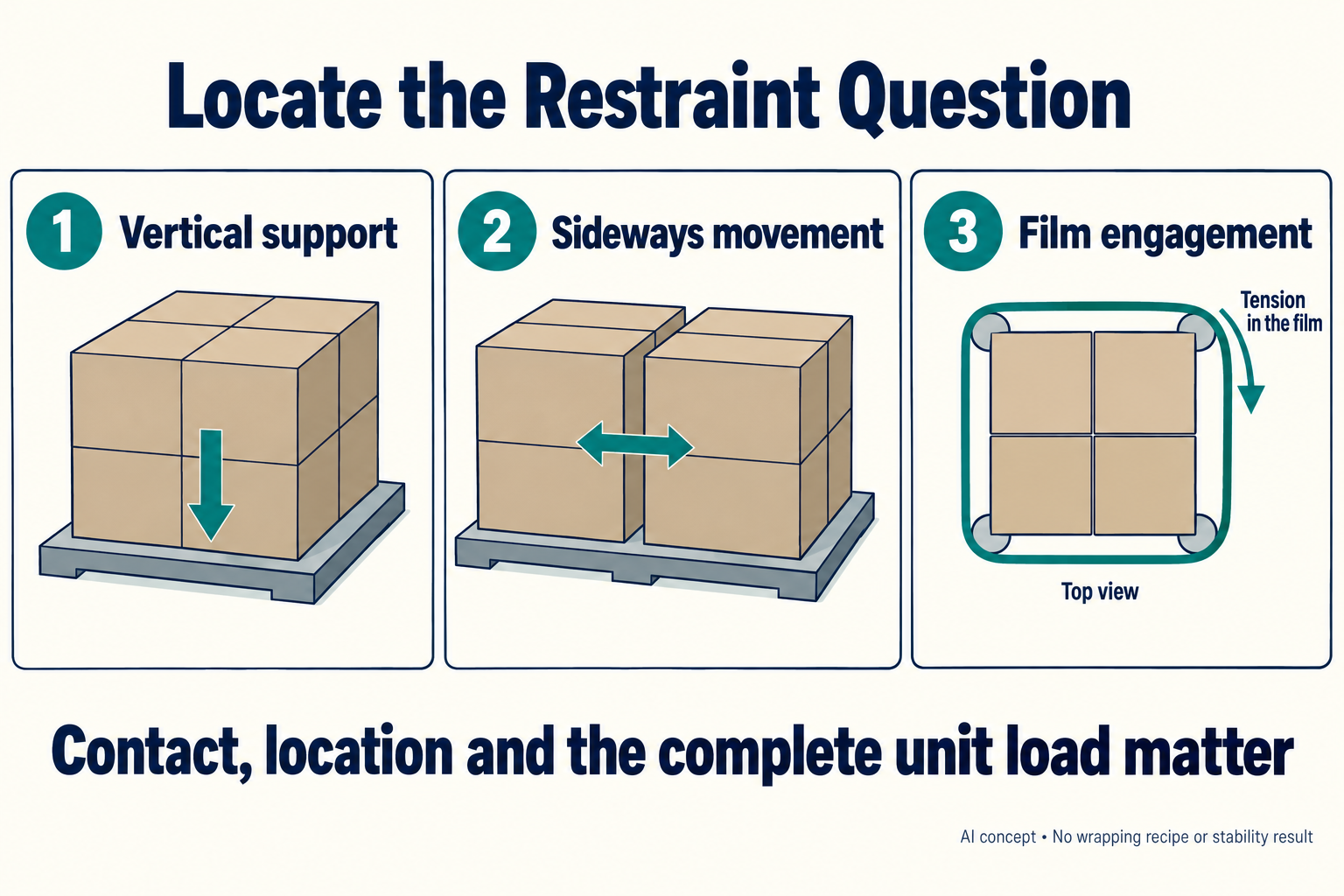
Restraint has a location, not just a total film quantity
Two proposals can use the same stated amount of film while distributing it differently around the load. Layers of film concentrated in one height band do not describe the same engagement as film placed elsewhere.
The relevant question is which parts of the load are constrained and how movement is transferred between them. Film engagement near an upper layer cannot automatically establish the connection between the whole load and its supporting pallet.
Likewise, naming a pallet material does not describe that connection. The wood-support scope guide addresses material and import scope. It does not measure load restraint or establish the pallet’s mechanical suitability.
Retain the actual pallet geometry and support contact with the restraint proposal. Avoid treating wrapping as a way to compensate for an unidentified deck, unsupported cartons or an unresolved unit-load arrangement.
Follow an invented gift-carton comparison
Suppose a brand receives two wrapping proposals for the same nominal carton layout. Proposal A describes film engagement over the upper part of the load. Proposal B describes engagement at several height regions and a different connection arrangement near the pallet.
These descriptions identify differences worth technical review. They do not establish that B is stable, that A fails or that either provides a particular handling capacity.
Ask which restraint relationships the supplier intends each region to provide. Then ask what relevant evidence covers the complete arrangement, including the actual cartons, pallet, contents and handling conditions.
If the carton surface or layout changes, preserve that change in the comparison. It may affect film contact and interfaces within the load even when the pallet footprint and total film consumption remain the same.
Use film guidance within its actual scope
ASTM D4649-20(2025) is publicly described as a guide for selecting and specifying stretch films for indoor applications including unitizing, reinforcing and palletizing. Its public scope includes storage and transport applications and excludes outdoor exposure; extreme temperature effects also require attention within its stated limits.
The public catalogue is not a wrapping instruction or a verified stability result. It supplies no project-specific tension, turn count, containment target or carton compression allowance for these hypothetical gifts.
The purchasing decision needs a restraint proposal connected to the actual unit load and evidence appropriate to its intended handling. Film grade and consumption alone cannot close that decision.
Packrivo can organize the layout, material description and supplier questions. The responsible packaging and logistics parties determine the required evaluation. Any illustration accompanying this guide is conceptual, with no measured containment force or certified pallet load.
Source scope: Checked 11 October 2026. ASTM D4649-20(2025) was listed active, updated 14 August 2025. Its public scope was read; the paid nine-page guide was not acquired. The two restraint arrangements are invented and no wrapping, handling, stability or payload result is claimed.
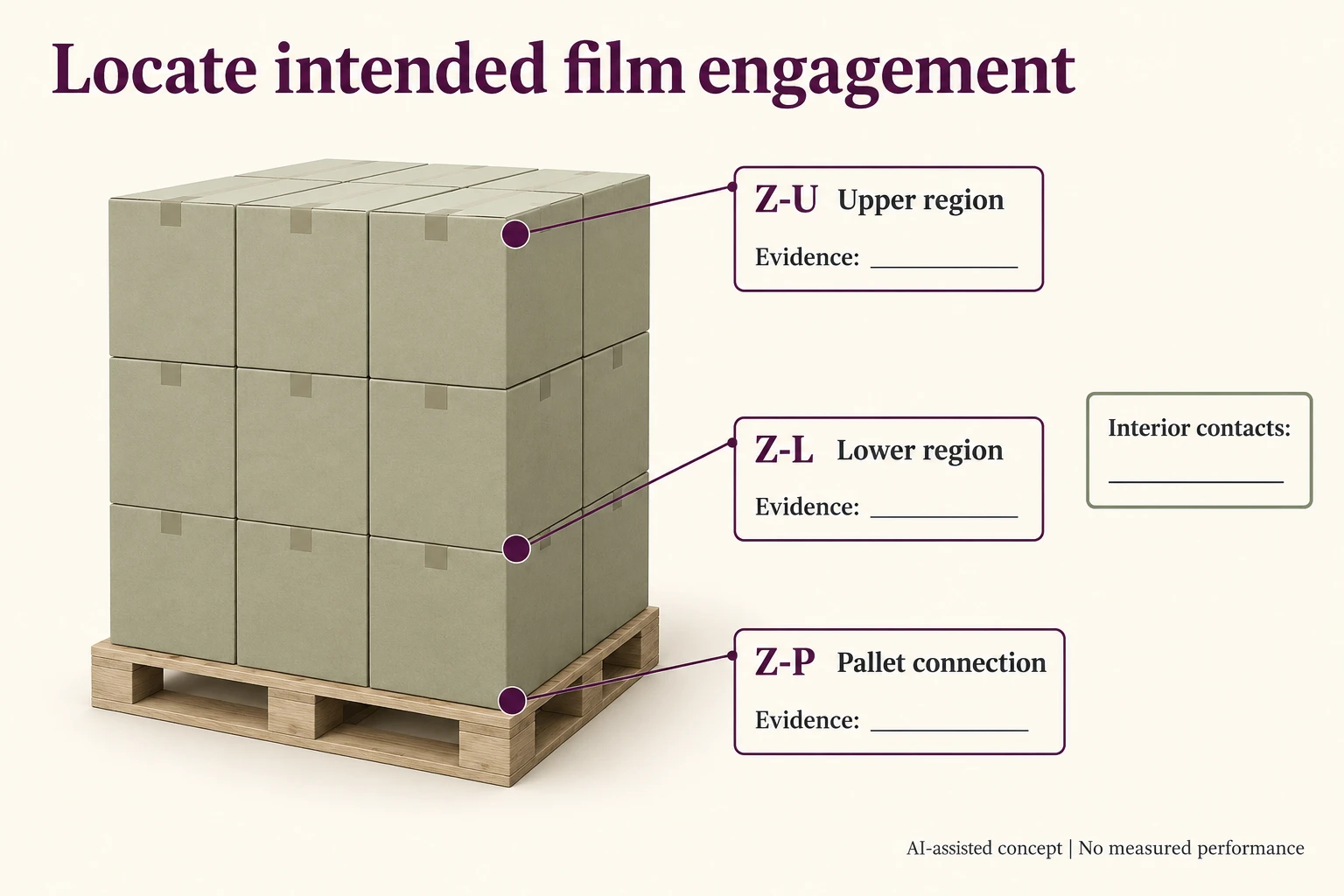
Map where the film is intended to engage
For an invented unit load U-H, identify the upper region Z-U, lower region Z-L and pallet interface Z-P separately. A film-consumption entry does not fill the engagement evidence for any of those locations.
Scroll horizontally if columns extend beyond the view.
| Location | Relationship to identify | Unresolved evidence |
|---|---|---|
| Z-U | Film and upper outer-carton region | Actual applied film state and contact |
| Z-L | Film and lower outer-carton region | Actual applied film state and contact |
| Z-P | Load connection near actual pallet assembly | Connection description and applicable evaluation |
| Interior I-H | Cartons not directly touched by outer film | Neighbour/contact and support relationships |
Keep the carton layout L-H and pallet assembly P-H attached to every restraint proposal. A changed carton finish or internal contact can change the configuration while the outer footprint and stated film quantity remain the same.
The zones are labels for questions, not a wrap recipe. They prescribe no turn count, overlap, tension, containment target or required height band. A supplier proposal can state its intended engagement at each zone; actual force and handling outcomes remain separate evidence.
If the connection near Z-P is unspecified, preserve that gap rather than inferring it from film visible around Z-U. Wood-material scope also stays separate from the pallet’s mechanical role. The complete identified unit load is the object of any requested handling evaluation.
Download the pallet stretch wrap restraint record (.csv). HYPOTHETICAL rows are invented examples. Use ACTUAL_BLANK for permitted project inputs; replace that row label only when recording actual facts. Empty evidence, observation and date fields mean unknown or not performed, never acceptance. Keep checkpoints and revisions separate.
Bring the unit-load drawing and zone-specific engagement questions through the existing enquiry route before comparing film quantity or grade. Packrivo coordinates independent suppliers. These records establish no supplier offer, service availability or MOQ exception; its published baseline is 500 pieces per product/design.