
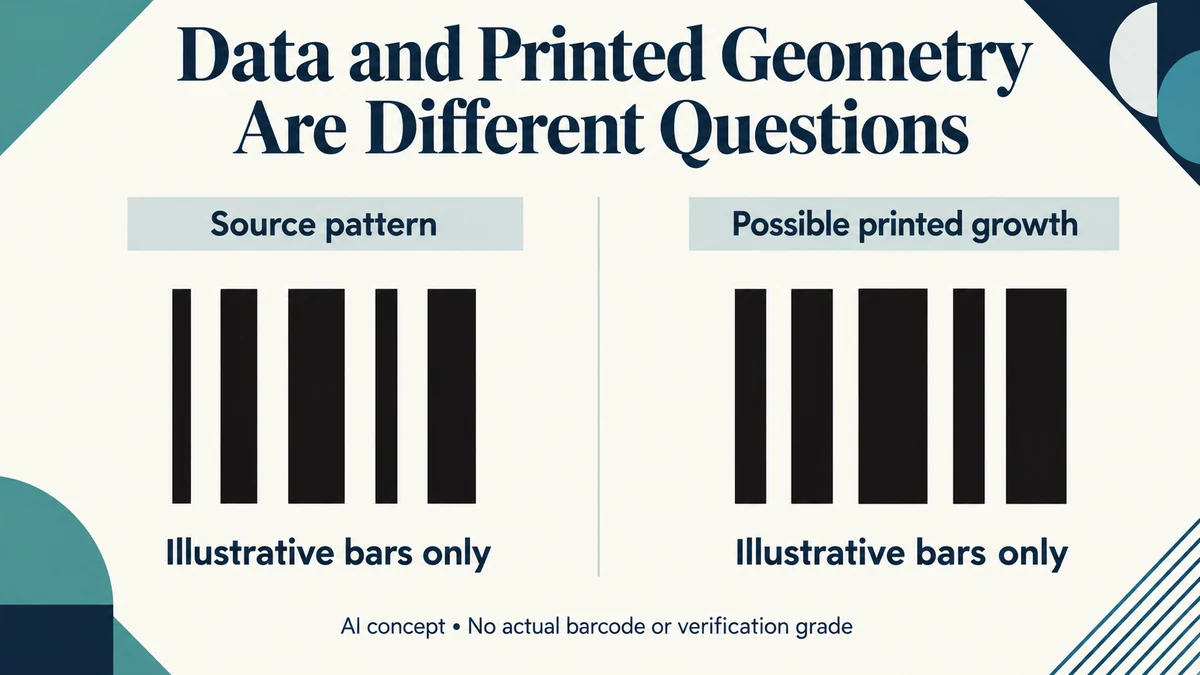
A barcode can encode the intended data while printing changes the widths of its bars and spaces. Source-data validation and printed geometry are separate questions.
For a gift brand placing an EAN/UPC symbol on packaging, the printing process may need a properly determined bar-width adjustment. A designer should not invent that adjustment from a screen image or apply one universal reduction to every printer and stock.
Keep the data decision separate from the geometry decision
The barcode source-data guide ties the generated asset to its responsible data owner. That chain matters even when the printed bars are imperfect.
Conversely, correct decoded content does not demonstrate that the printed element widths meet the relevant requirements. A read on one device is a limited observation and cannot replace suitable verification.
Before discussing a printing correction, preserve the identity of the intended symbol and its approved data. Changing an identifier is not a solution to bar growth. Editing the human-readable text beside an unchanged symbol also cannot correct either encoded data or printed geometry.
This article contains no real identifier, scannable symbol or production barcode asset.
Bar growth also consumes neighbouring space
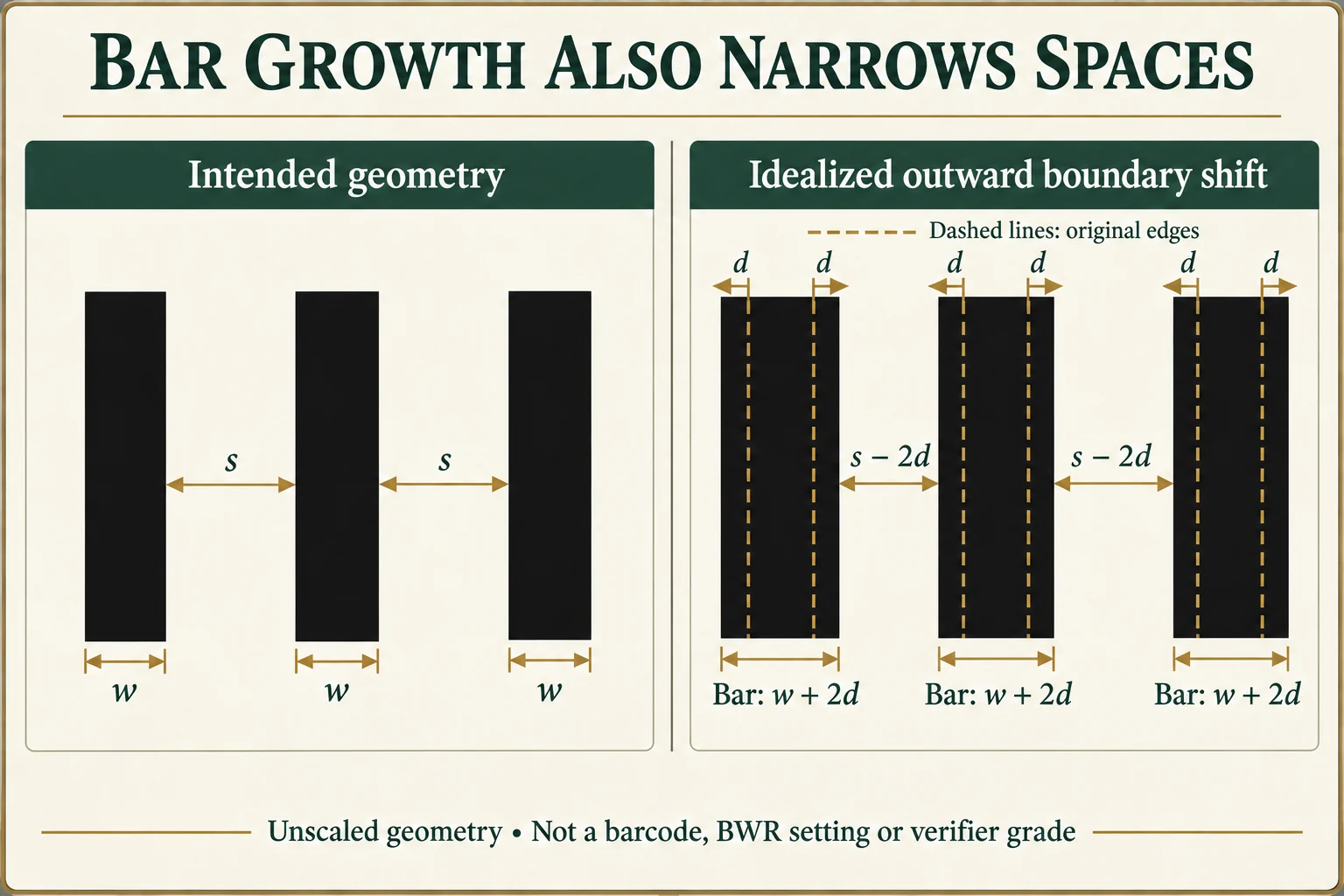
Consider an invented one-dimensional pattern with a black bar of width w and a neighbouring white space of width s. Assume, only for this simple geometric example, that each adjacent black boundary advances into the space by the same positive amount d.
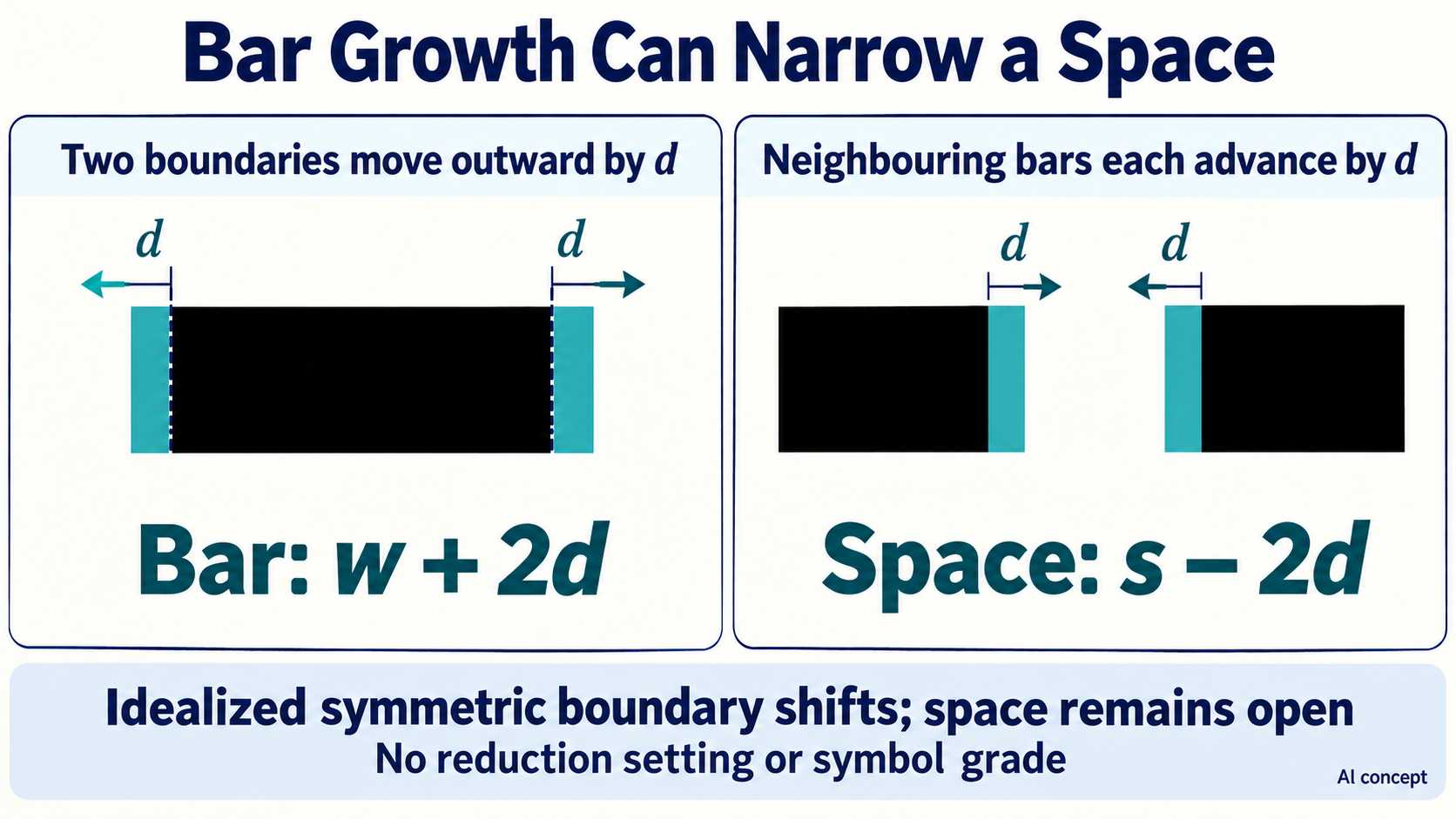
If a bar’s two boundaries both move outward by d, its width becomes w + 2d. If the two bars beside a space each advance into it by d, that space becomes s – 2d, while it remains open.
The assumed change therefore affects both black and white elements. Comparing the black bars alone can miss the narrowing spaces between them.
These expressions are original idealized geometry, not a model calibrated to any printing process. The assumption excludes uneven edges, directional distortion and other defects. It cannot predict a verifier grade or establish a suitable adjustment.
No numeric value for d is assigned. If the boundaries no longer leave an open space, the simple separated-element picture also ceases to describe that state.
Process compensation needs process evidence
GS1’s current General Specifications, Release 26.0, ratified January 2026, discusses barcode master-image production in section 5.12.4.2. Its EAN/UPC wet-ink context distinguishes bar gain from bar loss and describes bar-width adjustment determined for the particular reproduction conditions.
Where gain calls for a narrower master-image bar, the adjustment is described as bar-width reduction. The less common opposite correction addresses loss. The relevant selection also relates to the chosen X-dimension.
Those distinctions do not provide a reduction setting for this brand. The printer and barcode specialist need applicable production evidence rather than an arbitrary percentage chosen to make the screen version look thin.
Keep compensation within the responsible generation and printing workflow. Repeatedly shrinking the whole barcode image changes more than bar boundaries and is not equivalent to a controlled bar-width adjustment.
A nominally identical file can enter a different process
Suppose an invented gift sleeve retains the same approved data and placement, but the printer proposes a different stock or printing route. The data chain may remain unchanged while the earlier geometry compensation needs review.
A compensation determined for another press and substrate cannot be assumed correct because both outputs carry the same product identifier. The new production conditions require the responsible provider’s assessment.
Similarly, a proof and the production run may represent different reproduction conditions. Identify what the proof can demonstrate and keep any remaining production-quality question open.
This hypothetical change has no measured bar gain, required adjustment or verification result. It locates the reason to ask whether the earlier process evidence remains applicable.
Request process evidence without changing approved barcode data
A useful response identifies the affected generated asset, production route and proposed compensation together. Keep the exact approved data with its owner; the public worksheet uses only fictional references and deliberately contains no identifier or scannable symbol.
For an invented stock change from SUB-A to SUB-B, retain the previous compensation as history and mark applicability to SUB-B unconfirmed. Ask the printer or barcode specialist for the relevant production assessment and the correctly generated replacement asset if an adjustment is required. Do not enter a guessed numeric d or copy an arbitrary reduction percentage into the worksheet. The symbolic w+2 d and s−2 d expressions explain why both elements matter; they are not compensation settings.
Download this article’s project record (CSV). It includes field definitions, clearly hypothetical teaching rows and a blank actual-project row. Keep actual source evidence and unresolved fields with the record.
For a sourcing discussion, send the affected artwork reference, substrate/process change and the provider evidence still missing. Packrivo coordinates supplier questions; the responsible technical or commercial parties confirm the actual method, configuration and terms.
Keep Quiet Zones and finished placement in their own scope
Bar-width adjustment does not reserve an adequate clear margin around the symbol. Nor does it prevent a fold, seam or coating from affecting the finished presentation.
The finished retail-barcode proof guide addresses those package relationships. Retain them alongside the geometry question rather than treating one correctly adjusted element as approval of the complete printed symbol.
Ask the printer to identify the proposed process compensation and the evidence appropriate to the actual output. Ask the identifier owner to retain the approved data. Ask the relevant verification provider to assess the intended printed candidate within the applicable scope.
Packrivo can coordinate those inputs. It does not supply a universal bar-width-reduction recipe or certify a symbol from an illustrative diagram.
Source scope: Checked 11 October 2026. GS1 Release 26.0 section 5.12.4.2 was available through the official GS1 Austria PDF’s indexed public text. Direct reading returned a tool content-length restriction; the entire 579-page document was not read. The geometry is hypothetical and unscaled, with no actual bar gain, valid symbol, reduction setting or grade.