
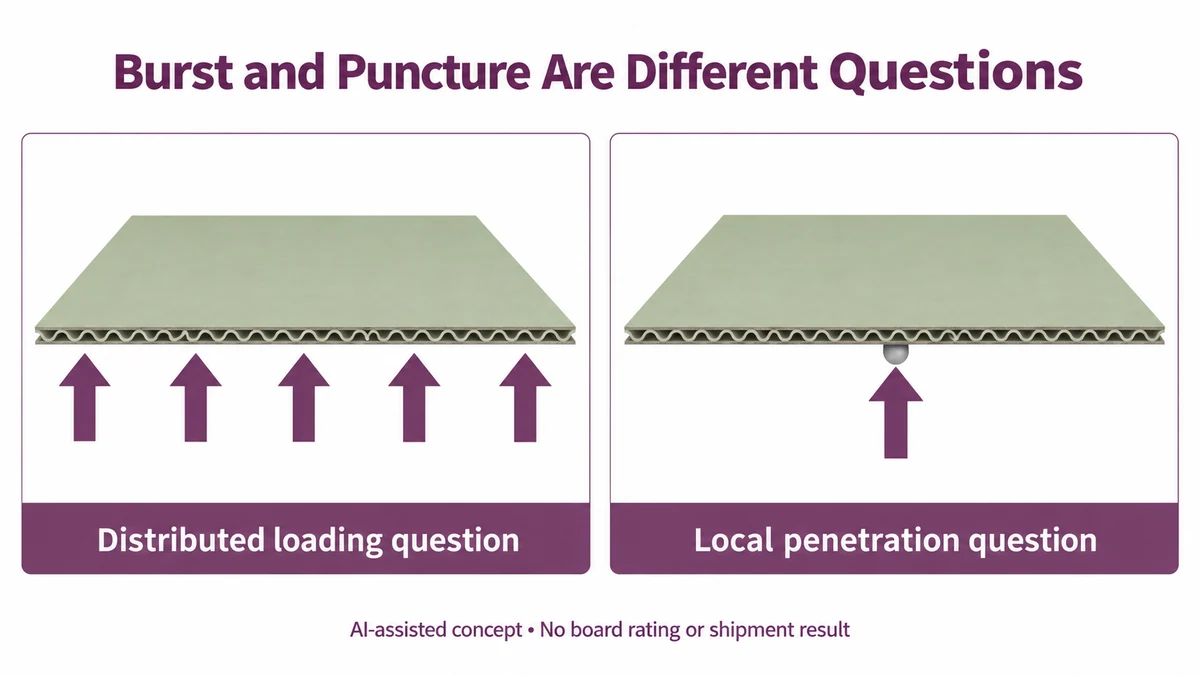
A board bursting-strength result does not establish its resistance to a projecting hard feature pushing through it. Distributed loading and localized penetration are different failure questions, even when both concern the same material.
For a Regular Slotted Shipping Cartons: Size Around the Inner Pack, show the projecting item or support that creates the local contact. Request evidence for that question separately from board bursting or carton compression; the concept does not establish puncture resistance.
For a gift brand comparing outer-carton proposals, identify the contact event that worries you before treating a reported strength value as relevant evidence. Neither material result, by itself, proves the protection of a complete packed shipment.
No board, load, penetration or transport result is measured in the hypothetical example below.
Pressure Loading and Pointed Contact Act Differently
Pressure applied over an area distributes the loading across that area. The board can deflect and develop stresses within the loaded region and its support arrangement. A pointed or projecting contact introduces a more localized interaction.
The relevant public standards retain that distinction. ISO 2759:2014 identifies a board bursting assessment based on increasing hydraulic pressure. ISO 3036:2025 identifies puncture resistance assessed with a pendulum device.
Those public descriptions establish different test questions; they do not provide the complete paid procedures or an actual packaging result.
A label such as “strong board” does not erase the difference between the loading areas, tool/contact shape and response being assessed.
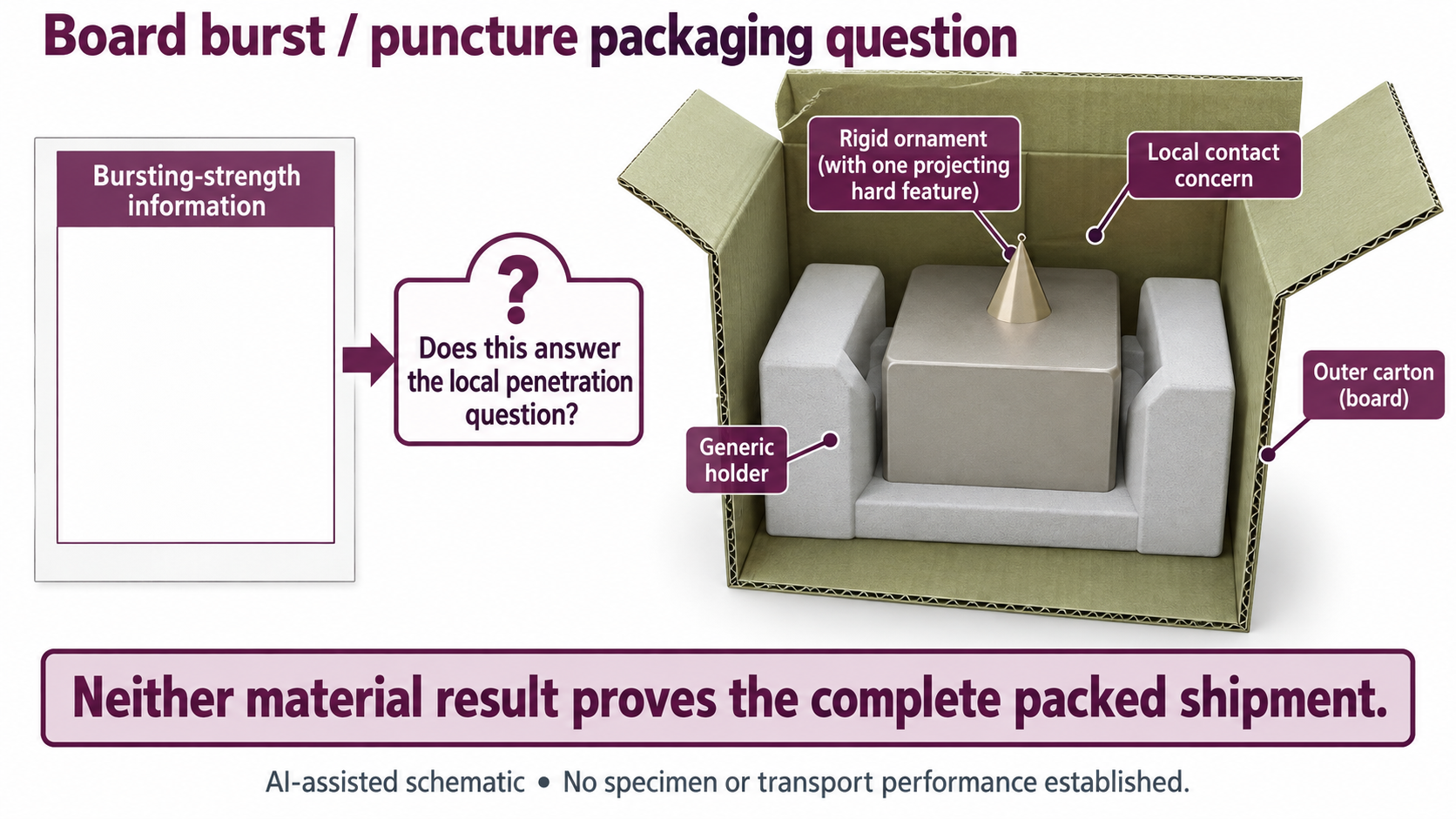
Local Penetration Involves the Contact and the Material Around It
When a hard feature presses against a limited region, the interaction depends on more than a pressure value from another arrangement. The shape and direction of contact, how the board is supported and the construction around that location matter.
An edge or projection inside the pack can raise a different contact question from an external object meeting the carton. A holder that changes where the product can move can also change the interaction presented to the board.
These are relevant inputs, not findings that either event will occur. The existence of a projecting feature does not establish a puncture or quantify a required resistance.
It does explain why a distributed-load specimen result cannot automatically resolve the concern. The requested evidence needs to address the actual mechanism and remain connected to the evaluated construction.
A Hypothetical Ornament Creates a Separate Evidence Gap
Imagine a gift brand comparing outer-carton board proposals for an ornament with a projecting rigid feature. Each quotation supplies bursting-strength information, but neither identifies relevant puncture evidence.
No pressure numbers, penetration values or supplier reports are assigned to this example. The question is whether the offered information answers the particular product-contact concern.
The burst information may remain useful for its own stated board comparison. It cannot be converted into a puncture result by renaming the metric or choosing the larger number.
The brand also needs to keep the complete packed arrangement visible: the ornament, holder, carton and the way movement or contact could reach the board. A material specimen does not reproduce all of those features.
The unresolved conclusion is therefore not “both cartons fail.” It is that the separate penetration question and the complete package’s behavior remain unestablished from the burst figures alone.
Method, Direction and Support Remain Part of Each Result
Before comparing like results, identify the board construction, applicable method, preparation and relevant direction. Keep the support and loading arrangement that give the result its meaning.
A revised grade, thickness or layered construction can change that basis. A number for another material should not become the result for the board actually being offered.
The same caution applies when results concern different mechanisms. There is no universal conversion from a bursting pressure to puncture performance, nor a generic safety factor that creates a shipment acceptance result from either.
The buyer does not need to improvise a puncturing tool or destructive test. The responsible supplier or technical evaluator should identify the appropriate evidence and limits for the actual proposal.
Keep These Questions Separate From Crush and Whole-Package Protection
The edge-crush and box-compression guide separates board edge loading from assembled-container compression. Bursting and penetration introduce other loading arrangements, not alternate names for ECT or BCT.
The packed-system protection guide considers the product, internal packing and outer container together. That complete system is still the relevant level when the brand’s question concerns protection during distribution.
The distribution-test scope guide can help describe that configuration. It does not turn a material test into a successful transport result.
A favourable material finding can be an input to technical consideration while the assembled-system requirement remains open.
Request the Evidence for the Contact Being Considered
For the hypothetical ornament, separate the board’s distributed-pressure question from the concern about a hard feature meeting a local region. Then identify whether the available evidence covers either or both, and what remains to establish for the complete pack.
Packrivo can coordinate construction details and supplier questions. It does not test bursting or puncture resistance, establish a transport rating or certify an actual carton through project coordination.
A bursting result and a puncture result describe different loading questions. Keep the contact mechanism visible before selecting a material comparison or claiming product protection.
Source scope: Public ISO catalogue abstracts accessed 11 October 2026. ISO 2759:2014 is edition 4, published July 2014 and confirmed 18 March 2025. ISO 3036:2025 is edition 2, published March 2025. Their complete paid methods were not obtained. No test pressure, penetration result, performance conversion, board rating or actual shipment outcome is established.
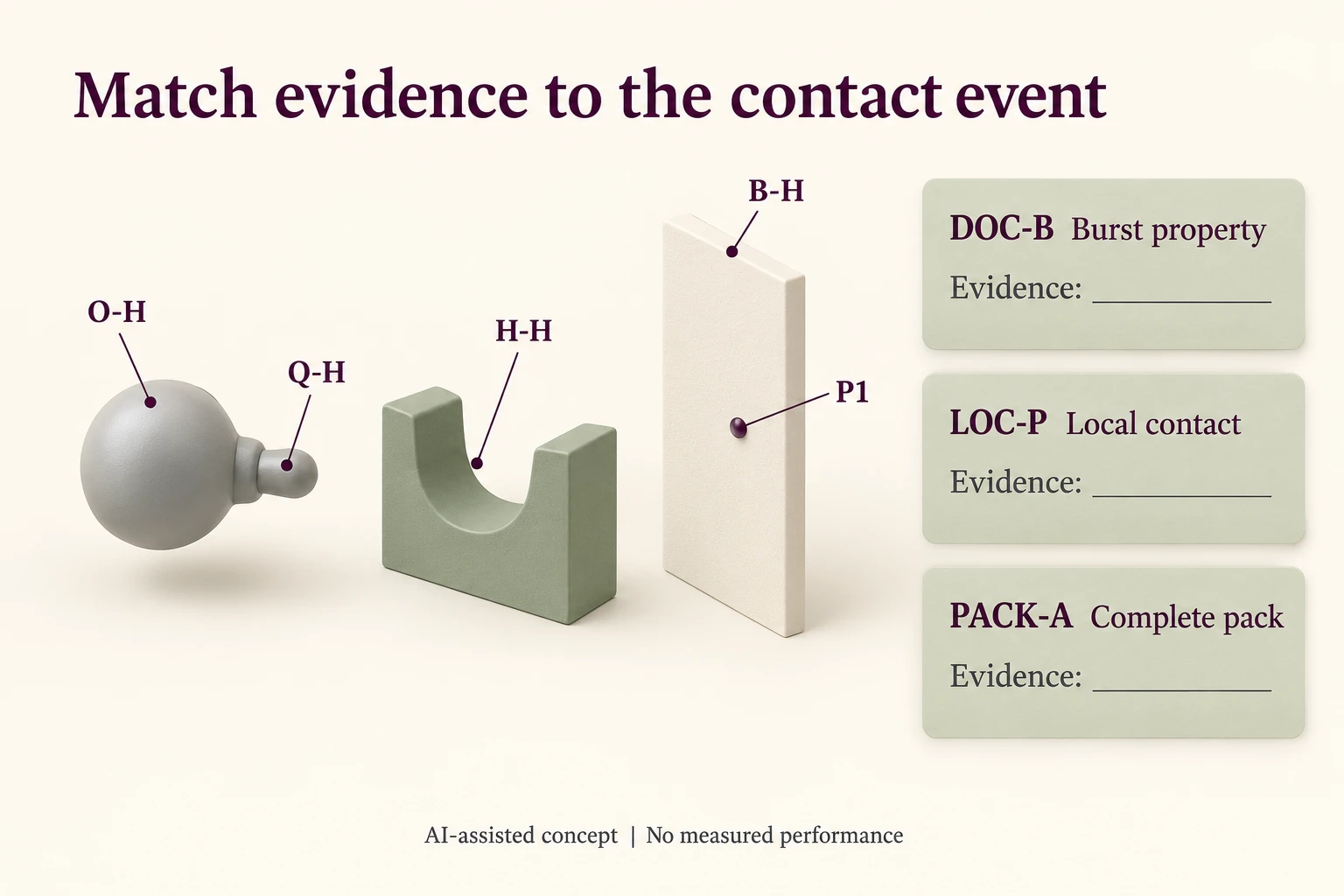
Match the board document to the contact event
The invented ornament family keeps product O-H and board B-H identified while distinguishing three questions: a distributed-pressure material record, local projection contact and the packed-system configuration. None contains a result.
Scroll horizontally if columns extend beyond the view.
| Reference | Question | Next evidence |
|---|---|---|
| DOC-B | Board bursting property | Actual method, construction and scoped result |
| LOC-P | Projection Q-H toward local board region P1 | Relevant contact/support and penetration evidence |
| PACK-A | Holder H-H within carton C-H | Complete arrangement and intended distribution scope |
| PACK-B | Proposed holder H2-H | New movement/contact configuration; no assumed remedy |
Locate Q-H and P1 on the same packed drawing, including whether the concern begins inside or outside the carton. The projection’s existence does not prove that it reaches the board. Leave movement, contact and penetration blank when unobserved.
If a revised holder changes that route, preserve PACK-A and add PACK-B. A relocation proposal can change which board region is relevant; it does not by itself establish that puncture is prevented or that a higher burst value is needed.
Retain a burst document for its actual material question rather than converting it to a local-contact result. No universal conversion, safety factor, improvised tool or destructive buyer test is supplied. The technical source should identify applicable material and complete-system evidence.
Download the burst strength versus puncture resistance record (.csv). HYPOTHETICAL rows are invented examples. Use ACTUAL_BLANK for permitted project inputs; replace that row label only when recording actual facts. Empty evidence, observation and date fields mean unknown or not performed, never acceptance. Keep checkpoints and revisions separate.
Bring the located projection, holder revision and document scope through the linked enquiry route before treating a board-strength quotation as product protection. Packrivo coordinates independent suppliers. These records establish no supplier offer, service availability or MOQ exception; its published baseline is 500 pieces per product/design.