
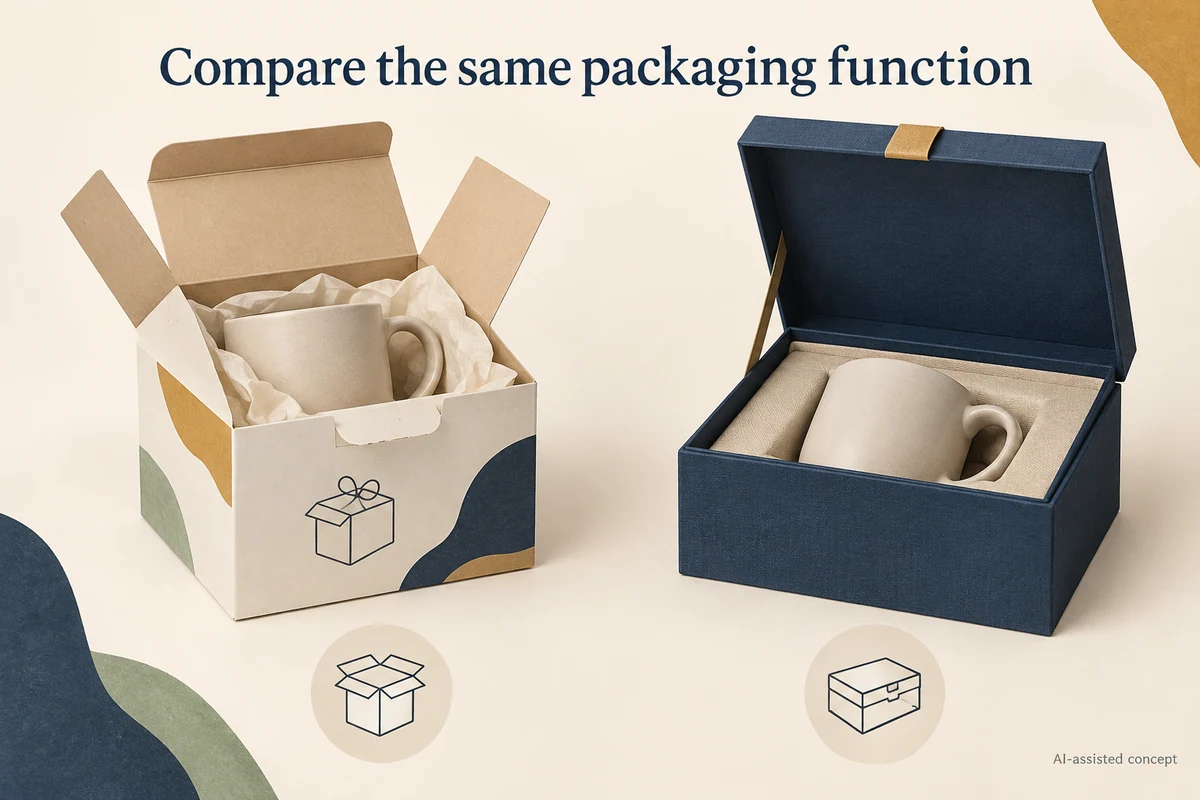
Two packaging proposals need an equivalent job before their life-cycle impacts can be compared usefully. A lighter single-use box and a heavier returnable box cannot be ranked simply by comparing the weight of one empty unit of each.
For a gift brand, first define the service being compared: the identified gift, required presentation and protection, delivery context and any intended later use. Then define which activities and flows each proposal requires to provide that service.
A functional unit describes the job being delivered
A functional unit gives a defined basis for the comparison. The US EPA's Life Cycle Assessment: Principles and Practice explains equivalent use or equivalent service when comparing product systems. A unit of material alone may not describe equivalent packaging service.
Suppose one concept is an empty carton and another includes a fitted support, return route and reconditioning. Comparing one carton with one returnable box leaves those functions and activities unevenly represented.
The ISO 14040 and ISO 14044 public catalogues identify the framework and requirements for life-cycle assessment. Their full paid standards were not reviewed here, and no packaging assessment has been performed for this article.
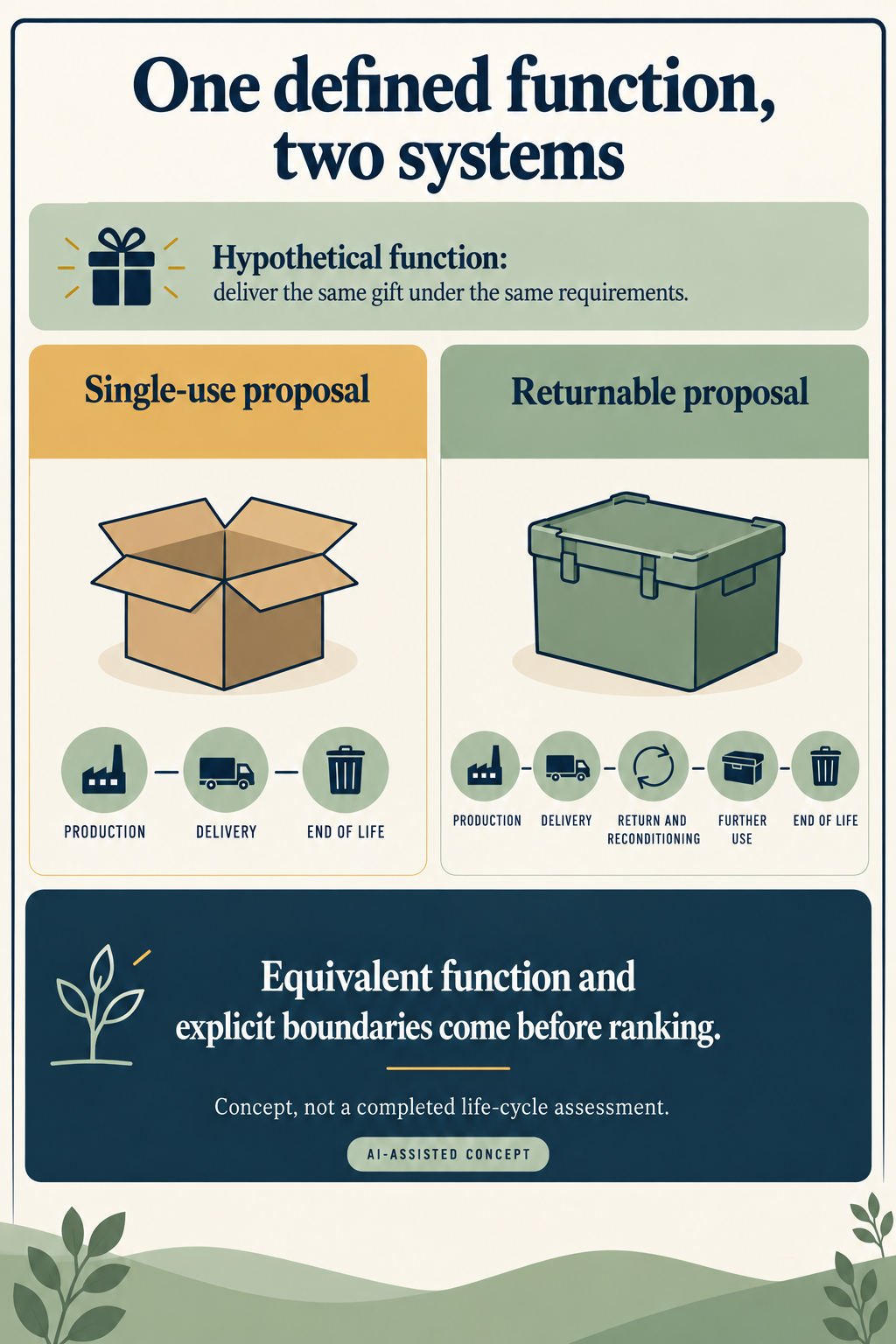
Keep the same gift and performance requirement in the comparison
Imagine two hypothetical proposals for delivering one identified gift in the required presentation and condition to the same destination. One uses single-use packaging; the other proposes a returnable container. Neither has demonstrated performance or an environmental result.
The comparison must account for whatever each system actually needs to provide that job. If one requires an additional outer carton or insert, leaving it out would compare incomplete systems. If the proposals provide different protection or presentation, first establish whether they fulfil the intended equivalent function.
Calling both items a gift box doesn't resolve that difference. Nor does a material-weight comparison establish that they deliver the same service.
The resulting definition should be concrete enough for an assessor to identify the included packaging and service. It shouldn't be an aspiration such as sustainable delivery with no specified gift or requirements.
System boundaries determine which activities are included
A boundary identifies the activities represented in an assessment. Material production, conversion, transport, use and end-of-life handling can belong to different parts of the system. A returnable proposal may also introduce return transport, inspection and reconditioning.
The UNEP/SETAC Life Cycle Initiative's packaging life-cycle report discusses comparison scope and packaging functions in food and beverage applications. Its case results aren't transferred to jewelry, candles or gift boxes here.
An assessment covering manufacture only shouldn't silently become a whole-life ranking. Equally, one proposal shouldn't include its return transport while the other's distribution stage is omitted. Differences in boundary need to be visible before interpreting the result.
These decisions are part of the study design. Naming stages in a diagram doesn't mean data have been collected for them or that an assessment is complete.
A proposed reuse count is an input to investigate
A durable box may be capable of another use, but capability doesn't establish how many times the system actually circulates it. An assumed number of uses changes how production and later activities are represented per unit of delivered function.
In the hypothetical comparison, the returnable proposal has no verified return rate or service-life record. Those inputs remain uncertain. They shouldn't be filled with an optimistic cycle count merely to make the heavier box look favourable.
An assessor can examine justified scenarios and the sensitivity of a result to uncertain inputs. The brand still needs to distinguish those scenarios from observed operation. No environmental break-even point or carbon-saving percentage is calculated here.
Make the comparison interpretable before making a claim
Packrivo's material-claim evidence guide addresses the evidence and subject behind proposed wording. The shipping-box range guide addresses a separate operational comparison; a freight or material saving isn't automatically a life-cycle result.
For the environmental comparison, keep the functional unit, system boundaries, included components and important assumptions together. Have the appropriate assessor determine what the available data can support, including any review required for the intended communication.
The next useful decision is whether the two proposals deliver an equivalent defined job within comparable boundaries. Until that is established, comparing empty-box weight or imagined reuse counts cannot supply a defensible life-cycle ranking.
A material allocation is not a life-cycle ranking
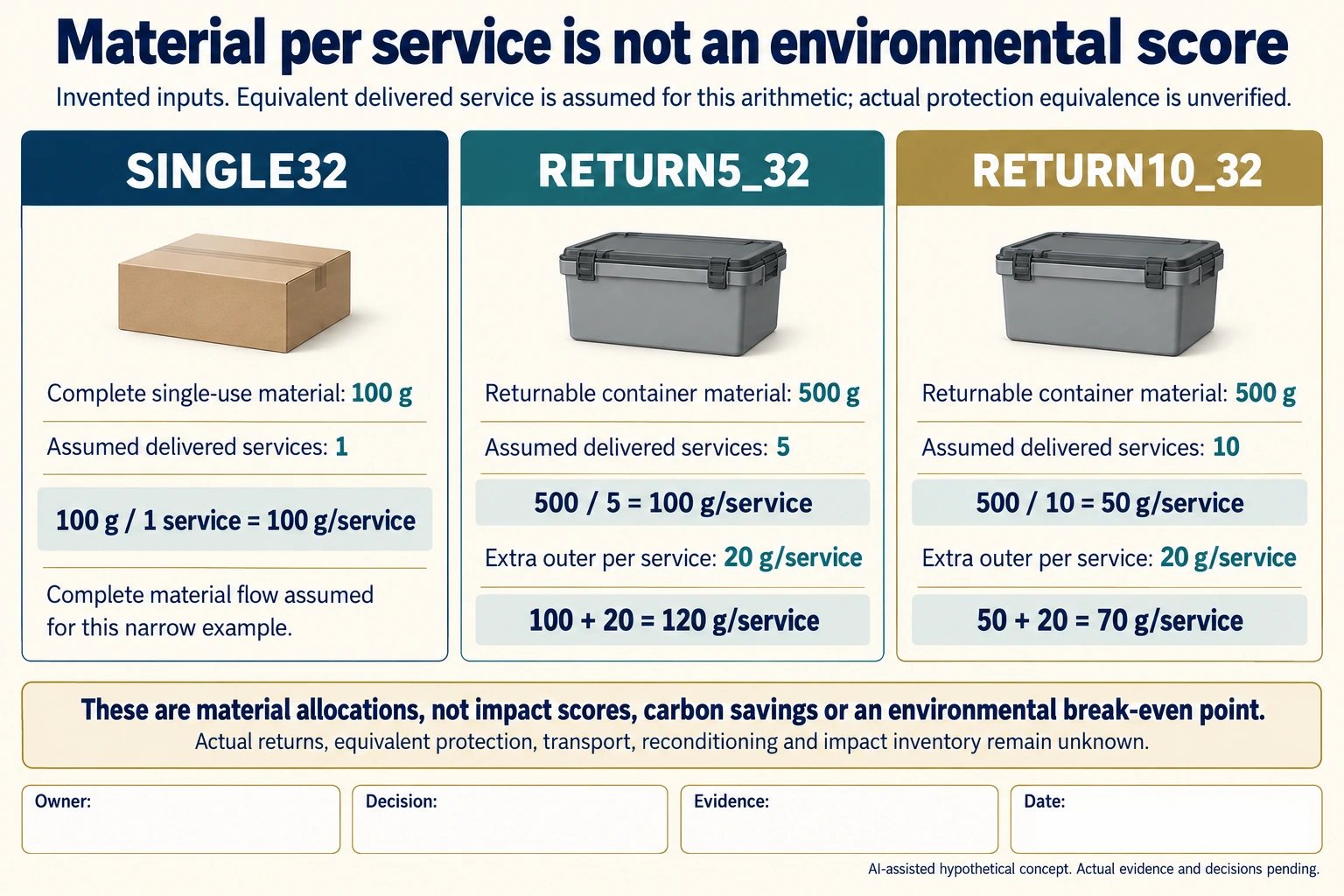
A small invented allocation can expose the reuse assumption without producing an environmental result. SINGLE32 assigns 100 g of packaging production material to one delivered service. RETURN32 assigns 500 g to one returnable container, with separate scenarios of five or ten assumed delivered services per container. These service counts are assumptions, not observed returns, proven service life or acceptable protection.
The manufacturing-material allocation is 100 g per service for SINGLE32, 500÷5=100 g for RETURN5_32 and 500÷10=50 g for RETURN10_32. If the returnable route additionally requires an assumed 20 g outer package for every service, those two material-accounting totals become 120 g and 70 g per service. The outer flow has not been made to disappear inside a reuse claim. SINGLE32 is assumed to include its complete material flow for this narrow arithmetic; that premise would need checking in a real comparison.
Neither 70 g nor 120 g is an impact score, carbon result or environmental break-even point. Return transport, inspection, cleaning or reconditioning, losses, actual usable circulations, protection equivalence and end-of-life inventory remain unquantified. The buyer can now see which flow and reuse premise an assessor must replace with evidence. Even the same functional unit does not resolve differing boundaries, data quality or performance.
| Hypothetical scope | Object and relationship | Input, formula or open question |
|---|---|---|
| SINGLE32_MASS | COMPLETE_SINGLE_USE_MATERIAL — ASSUMED_INPUT | 100 g |
| SINGLE32_SERVICES | DELIVERED_SERVICES_ASSUMED — ASSUMED_INPUT | 1 service |
| RETURN32_MASS | RETURNABLE_CONTAINER_MATERIAL — ASSUMED_INPUT | 500 g |
| RETURN5_32_SERVICES | DELIVERED_SERVICES_ASSUMED — ASSUMED_INPUT | 5 service |
| RETURN10_32_SERVICES | DELIVERED_SERVICES_ASSUMED — ASSUMED_INPUT | 10 service |
| RETURN32_OUTER | OUTER_PER_SERVICE — ASSUMED_INPUT | 20 g/service |
| SINGLE32_ALLOC | MANUFACTURING_MATERIAL_ALLOCATION — CALCULATED_FROM | SINGLE32_MASS/SINGLE32_SERVICES; 100 g/service |
| RETURN5_32_ALLOC | MANUFACTURING_MATERIAL_ALLOCATION — CALCULATED_FROM | RETURN32_MASS/RETURN5_32_SERVICES; 100.0 g/service |
| RETURN5_32_TOTAL | MATERIAL_ACCOUNTING_WITH_OUTER — CALCULATED_FROM | RETURN5_32_ALLOC+RETURN32_OUTER; 120.0 g/service |
| RETURN10_32_ALLOC | MANUFACTURING_MATERIAL_ALLOCATION — CALCULATED_FROM | RETURN32_MASS/RETURN10_32_SERVICES; 50.0 g/service |
| RETURN10_32_TOTAL | MATERIAL_ACCOUNTING_WITH_OUTER — CALCULATED_FROM | RETURN10_32_ALLOC+RETURN32_OUTER; 70.0 g/service |
| LCA32_EQUIVALENT_PROTECTION | EQUIVALENT_PROTECTION — REMAINS_UNKNOWN | No environmental ranking from material allocation |
| LCA32_ACTUAL_USABLE_RETURNS | ACTUAL_USABLE_RETURNS — REMAINS_UNKNOWN | No environmental ranking from material allocation |
| LCA32_RETURN_TRANSPORT | RETURN_TRANSPORT — REMAINS_UNKNOWN | No environmental ranking from material allocation |
| LCA32_RECONDITIONING | RECONDITIONING — REMAINS_UNKNOWN | No environmental ranking from material allocation |
| LCA32_IMPACT_INVENTORY | IMPACT_INVENTORY — REMAINS_UNKNOWN | No environmental ranking from material allocation |
Download the comparison and project record (.csv). It preserves the original passages, model branches and table fields alongside the added hypothetical scopes. Relationship rows are not business cases, tests or completed records. Every actual identity, quantity, material, process, specification, observation, owner, decision, evidence and date field is blank. ACTUAL_BLANK is an empty starting row; unknown fields require permitted project evidence.
For the separate question, read Recycled Content and Recyclability Describe Different Claims.
For the separate question, read Compostable Packaging Needs a Disposal-Condition Claim, Not Just a Material Name.
Source scope checked 17 October 2026: EPA 2006 and UNEP/SETAC 2013 explain their respective LCA contexts. ISO 14040:2006/Amd 1:2020 and ISO 14044:2006/Amd 1:2017/Amd 2:2020 are listed by public catalogues with 2022 confirmation; paid standard text was not obtained. This is material allocation arithmetic, not an LCA or environmental claim.
Public references for that scope: ISO 14040 public catalogue, ISO 14044 public catalogue.
Discuss this packaging specification with Packrivo. We coordinate independent suppliers. MOQ: 500 pieces per product/design; illustrative quantities are not production offers. Confirm materials, samples, price and timing for your project.