

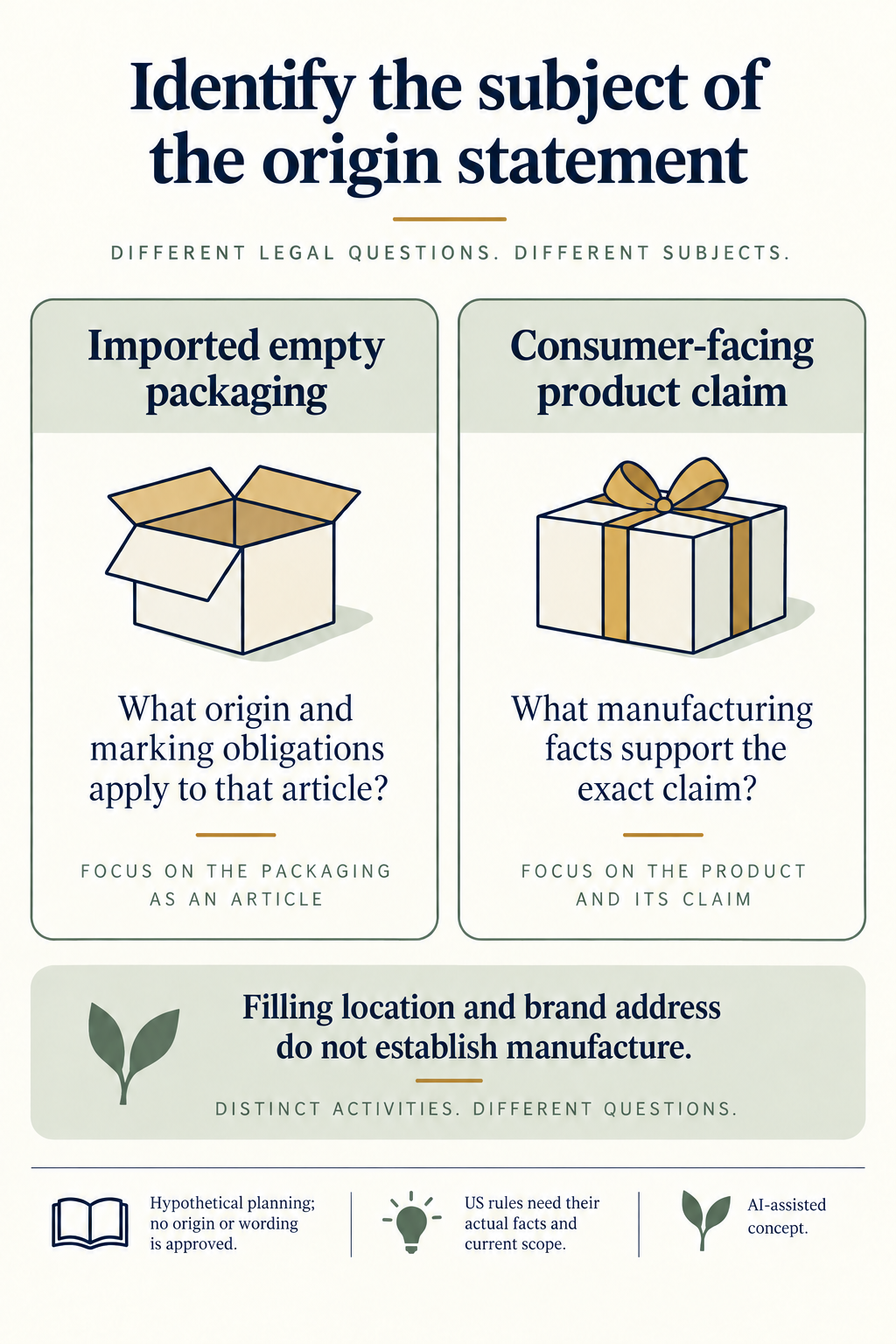
An origin-marking decision for imported empty packaging doesn't automatically decide which manufacturing claim a brand can make about the product later placed inside. The article being imported and the subject of the consumer-facing claim can be different.
For a US gift brand preparing artwork, identify what each origin statement describes before reviewing its evidence. A filling location, shipping address or brand office doesn't independently establish where the claimed product was manufactured.
Identify the subject before selecting the wording
An imported empty box is an article with its own facts. The gift placed inside it has another manufacturing history. A statement about the container should not silently become a statement about those contents or the entire finished presentation.
Likewise, a claim printed on a box can communicate something about the product inside. Its location alone doesn't prove that consumers will understand it as limited to the packaging. The wording, symbols and surrounding presentation belong in the review.
Packrivo's empty-packaging origin-marking guide discusses the import article, use and purchaser. That customs-related review leaves a separate question about US manufacturing claims made to consumers.
Unqualified US-origin claims need their own basis
The FTC Made in USA Rule page identifies 16 CFR Part 323 and the substantiation standard for unqualified claims. The current rule text addresses express and implied unqualified US-origin representations, including specified components.
Its conditions concern US final assembly or processing, significant processing and the sourcing of ingredients or components. Those requirements cannot be reduced to the fact that a gift was placed in a box in the United States.
The FTC's business guidance on the standard discusses assessing manufacturing facts and the overall claim. This article doesn't supply a percentage shortcut, approve wording or determine the origin of an actual product.
Follow a hypothetical imported-box presentation
Imagine a brand imports empty gift boxes, then fills them at a US packing site with products whose manufacturing facts have not been supplied. This is a hypothetical arrangement, not a Packrivo shipment or customer project.
The import-marking question concerns the boxes and the applicable transaction. The proposed consumer statement requires identifying whether it describes the box, the gift or a specific component. Each subject needs its relevant evidence.
The US packing operation supplies one fact about the arrangement. It doesn't resolve the missing manufacturing history of the contents. Nor does an imported box's origin alone determine whether a properly scoped claim about another component could be supported.
The brand therefore has two evidence tasks, rather than one origin label to copy between stages. Preserve the customs-related decision for its actual subject and obtain the manufacturing facts needed for the exact marketing statement.
Qualified wording isn't an automatic alternative
A narrower statement can communicate different facts from an unqualified claim, but it still needs an accurate subject and support. Adding a qualification doesn't automatically make any wording suitable.
For example, an assembly-related statement and a statement about manufacturing the complete product describe different jobs. The responsible reviewer needs the actual operation and components before deciding what can be communicated. No print-ready alternative is approved by this example.
The same applies to a US address or graphic in the surrounding artwork. Include the full presentation in the review rather than assuming that only the most prominent sentence creates the claim.
Keep the two decisions connected without merging them
Use the retail-copy responsibility guide to connect approved wording with the final artwork and named review owner. Keep the imported packaging's identity and the claimed product or component explicit.
Where either subject's facts remain unknown, hold that wording decision instead of filling the gap with the place of packing or the brand address. Transaction-specific customs and marketing conclusions belong with the appropriate responsible advisers.
Sources accessed 11 October 2026. The eCFR display reported Title 16 current through 7 October 2026; it is authoritative but unofficial. This US-focused explanation determines no actual origin, marking exception or claim compliance, and it doesn't extend the same rules to another market.
The same presentation can contain two different origin subjects
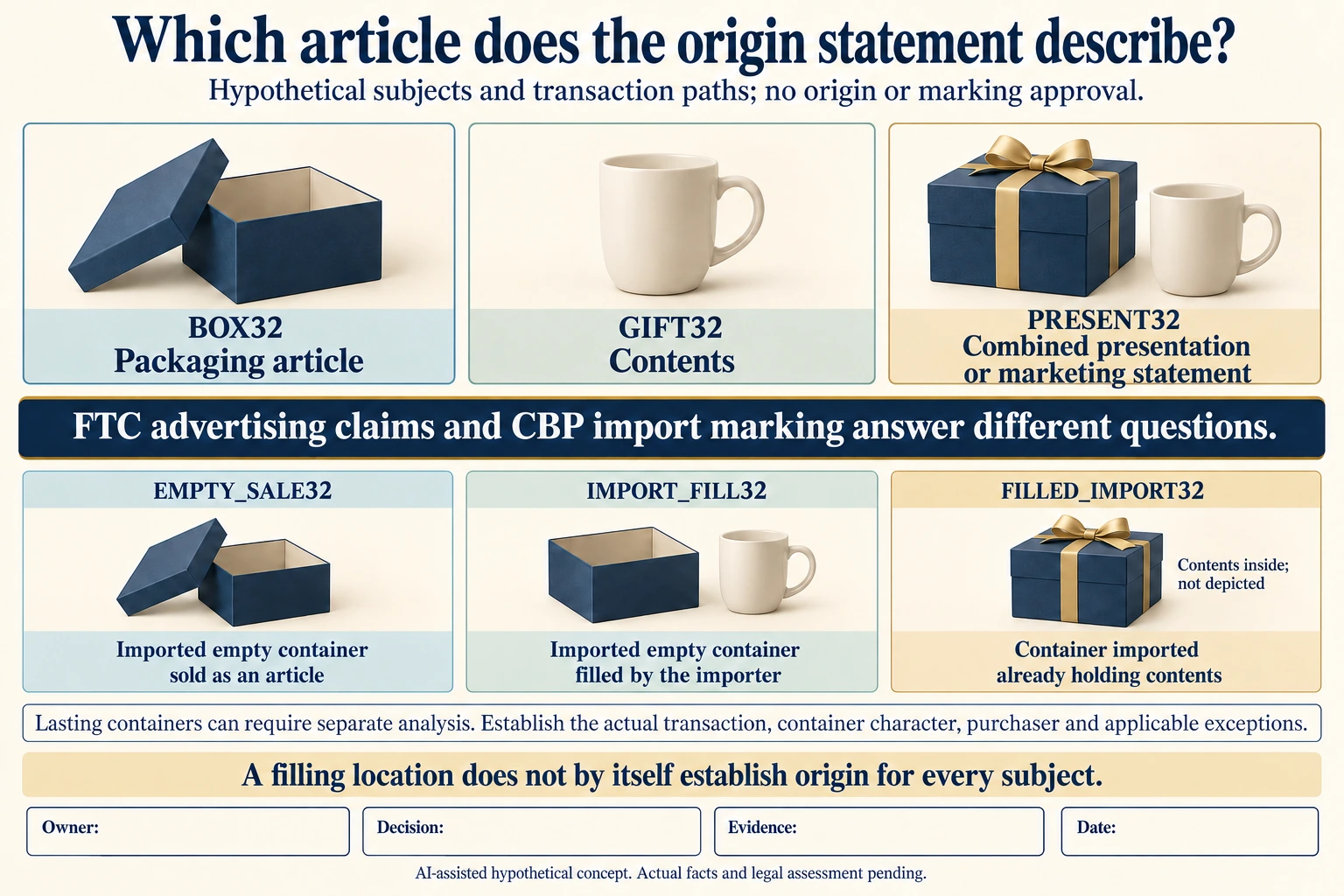
Build an invented subject map before choosing words. BOX32 is an imported empty disposable box, GIFT32 is the product later placed inside, and PRESENT32 is the complete consumer presentation. A US filling site identifies an operation in this example; it supplies no manufacturing history for BOX32 or GIFT32. All actual origins remain unknown.
Now separate the transactions. EMPTY_SALE32 considers empty boxes imported for distribution or sale. IMPORT_FILL32 considers an importer that fills and sells the packaged goods. FILLED_IMPORT32 instead crosses the border with merchandise already inside. These are different questions under the applicable container provisions, not three automatically approved marking routes. Independently lasting containers and relevant exceptions require their own facts.
A consumer manufacturing statement must identify whether its subject is BOX32, GIFT32 or the full presentation and retain the overall impression of surrounding text and graphics. A customs marking conclusion for an empty container cannot fill the marketing substantiation for the contents. Likewise, filling at a US site or adding a US address does not establish the conjunctive facts required for an unqualified US-origin claim. The output is a pair of clearly scoped questions for the responsible advisers, not print-ready alternative wording.
| Hypothetical scope | Object and relationship | Input, formula or open question |
|---|---|---|
| BOX32_SUBJECT | BOX32 — REQUIRES_SUBJECT_SPECIFIC_FACTS | Actual manufacturing origin and proposed wording unknown |
| GIFT32_SUBJECT | GIFT32 — REQUIRES_SUBJECT_SPECIFIC_FACTS | Actual manufacturing origin and proposed wording unknown |
| PRESENT32_SUBJECT | PRESENT32 — REQUIRES_SUBJECT_SPECIFIC_FACTS | Actual manufacturing origin and proposed wording unknown |
| EMPTY_SALE32_TRANSACTION | IMPORTED_ARTICLE — DISTINCT_CUSTOMS_SCOPE | EMPTY_SALE32; No marking exception or ultimate purchaser assigned |
| IMPORT_FILL32_TRANSACTION | IMPORTED_ARTICLE — DISTINCT_CUSTOMS_SCOPE | IMPORT_FILL32; No marking exception or ultimate purchaser assigned |
| FILLED_IMPORT32_TRANSACTION | IMPORTED_ARTICLE — DISTINCT_CUSTOMS_SCOPE | FILLED_IMPORT32; No marking exception or ultimate purchaser assigned |
| LASTING_CONTAINER32_TRANSACTION | IMPORTED_ARTICLE — DISTINCT_CUSTOMS_SCOPE | LASTING_CONTAINER32; No marking exception or ultimate purchaser assigned |
| FILL32_LOCATION | US_FILLING_OPERATION — DOES_NOT_ESTABLISH | GIFT32_MANUFACTURING_HISTORY |
| ORIGIN32_CROSSOVER | CONTAINER_CUSTOMS_DECISION — DOES_NOT_AUTHORIZE | CONSUMER_CONTENTS_US_ORIGIN_CLAIM |
Download the comparison and project record (.csv). It preserves the original passages, model branches and table fields alongside the added hypothetical scopes. Relationship rows are not business cases, tests or completed records. Every actual identity, quantity, material, process, specification, observation, owner, decision, evidence and date field is blank. ACTUAL_BLANK is an empty starting row; unknown fields require permitted project evidence.
For the separate question, read Empty Packaging Imports Need a Clear Origin-Marking Scope.
Source scope checked 17 October 2026: FTC Part 323 and customs 19 CFR 134 address different purposes and subjects. Sections 134.23/.24 retain imported-empty/for-sale/importer-filler/filled-container conditions and exceptions. Current eCFR title dates do not represent new publication dates for every clause. No actual origin, marking exception or marketing approval is determined.
Public references for that scope: FTC Made in USA Labeling Rule, CBP country-of-origin marking provisions.
Discuss this packaging specification with Packrivo. We coordinate independent suppliers. MOQ: 500 pieces per product/design; illustrative quantities are not production offers. Confirm materials, samples, price and timing for your project.