

A shared gift box pools only the components that are genuinely identical and approved across the products. Dedicated inserts remain separate stock lines. Compare complete packs by variant so a large common-box count doesn’t conceal a shortage in one product’s support.

Separate physical compatibility from stock pooling
First establish which box, insert and product arrangements are suitable. The multi-SKU fit matrix keeps that evidence row-specific. Once those relationships are approved, an inventory model can show the operating consequences.
Assign common components the same identity across rows. Keep distinct inserts separate even when their outside color is identical. The stock decision concerns interchangeable material, not a common brand appearance.
A common box doesn’t pool 200 missing inserts
Assume two approved products share 900 boxes. Variant A has 600 inserts and demand for 400 gifts. Variant B has 200 inserts and demand for 400 gifts. Each gift needs one box and its specific insert; other components are sufficient.
Scroll horizontally if columns extend beyond the view.
| Variant | Demand | Specific inserts | Complete gifts available |
|---|---|---|---|
| A | 400 | 600 | 400 |
| B | 400 | 200 | 200 |
Completing those 600 gifts leaves 300 common boxes and 200 A inserts. Variant B still has a 200-gift demand gap. A’s excess inserts cannot fill it without a separately approved alternative configuration.
The example uses assumed quantities and established fit as an input. It makes no claim that a common outer box suits the real products or that separate inserts can be purchased at these amounts.
Compare the alternate stock architecture
Dedicated outer boxes would create another variant-specific constraint. For example, an assumed 500 A boxes and 400 B boxes would remove common-box pooling while preserving the insert shortage. Show each proposed architecture against the same product demand.
Common boxes can offer flexibility when demand shifts, but only while their approved product relationships and artwork remain current. If a new B product needs a deeper box, it should leave the common-stock scenario until that change is reviewed.
Purchase minimums, delivered pack multiples and lead times belong beside each component line. They may differ between the outer box and the insert. Don’t transfer a box’s commercial basis automatically to every accessory.
Reorder the constrained component deliberately
Use the variant capacity table to identify which specific stock line needs attention. Then recalculate complete sets after the proposed receipt, including other components that may become limiting. The useful result is a shared-component plan with variant shortages visible, rather than a single reassuring total of boxes.
Sources and scope
Australian Government supports the stated general concepts within this scope: General inventory categories, reorder points and stocktake. Access checked 14 October 2026.
Shopify Help Center supports the stated general concepts within this scope: Shopify state definitions only. Access checked 14 October 2026.
The worked scenario is original editorial analysis with assumed inputs, not a supplier offer, customer record or measured Packrivo result. Commercial feasibility and physical suitability remain project-specific.
Reconcile the common pool after variant allocation
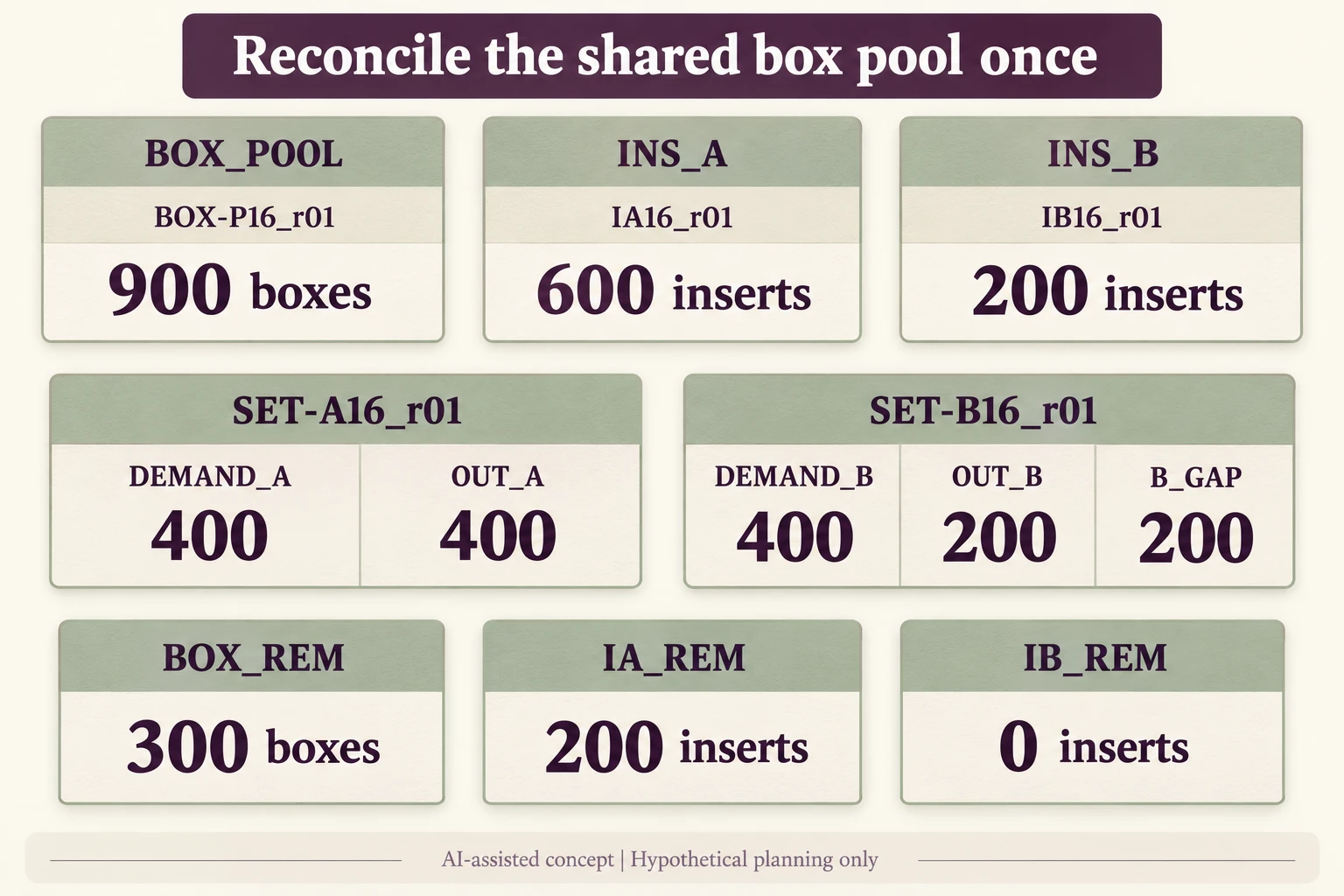
This new ledger gives the original 900-box, 600-A-insert, 200-B-insert example exact hypothetical component identities. Both variants require 400 gifts, and their physical fit is assumed suitable solely for the calculation.
Scroll horizontally if columns extend beyond the view.
| Scope ID | Exact entity | Stage / role | Hypothetical basis |
|---|---|---|---|
| BOX_POOL | BOX-P16_r01 | INPUT | Common pool; not allocated twice |
| INS_A | IA16_r01 | INPUT | A-only insert |
| INS_B | IB16_r01 | INPUT | B-only insert |
| DEMAND_A | SET-A16_r01 | INPUT | One common box and IA16_r01 per set |
| DEMAND_B | SET-B16_r01 | INPUT | One common box and IB16_r01 per set |
| OUT_A | SET-A16_r01 | MODELED_ALLOCATION | min(400 demand,600 A inserts,900 common boxes) |
| OUT_B | SET-B16_r01 | MODELED_ALLOCATION | min(400 demand,200 B inserts,500 boxes remaining after A) |
| BOX_REM | BOX-P16_r01 | RESIDUAL | 900 – 400 – 200 |
| IA_REM | IA16_r01 | RESIDUAL | 600 – 400 |
| IB_REM | IB16_r01 | RESIDUAL | 200 – 200 |
| B_GAP | SET-B16_r01 | UNRESOLVED_GAP | 400 demand – 200 modeled output |
OUT_A allocates 400 common boxes with 400 IA16_r01 inserts. OUT_B then uses 200 common boxes with 200 IB16_r01 inserts. The residual rows retain 300 common boxes, 200 A inserts and zero B inserts. B_GAP remains 200 complete sets; A inserts are not substituted for B inserts.
Inputs, complete outputs and residuals are separate scopes. These counts establish no actual inventory, procurement availability or approved substitution. Actual release and evidence cells are blank. The fixed allocation order is part of this fictional calculation, not an operating priority rule.
Download the shared gift box insert inventory record (.csv). HYPOTHETICAL rows are invented examples. Use ACTUAL_BLANK for permitted project inputs; replace that row label only when recording actual facts. Empty evidence, observation and date fields mean unknown or not performed, never acceptance. Keep checkpoints and revisions separate.
Use the named scope rows and unresolved evidence to prepare a project enquiry. Replace planning assumptions with actual authorised records before a commercial or use decision. Packrivo coordinates independent suppliers. These records establish no supplier offer, service availability or MOQ exception; its published baseline is 500 pieces per product/design.
What this changes in a packaging enquiry
A shared-box enquiry needs one common box specification and separate insert lines for each product variant. Send the accepted product-to-insert combinations and quantities, rather than a single total for the range. Common outer dimensions alone do not establish interchangeable inserts or a common production MOQ. A relevant configuration to compare is the Jewelry box with fitted insert; it is a concept reference, not confirmed suitability.