

A backup packaging route is useful only if its approved configuration and supply timing can cover the interruption being planned. Compare current usable-stock coverage with the alternative’s readiness interval. A second supplier name or an unreviewed substitute is not available material.
In this guide

Count coverage for the complete requirement
Identify which component could stop packing. Stock coverage should use the actual approved requirement and consumption basis. Extra boxes don’t cover missing variant-specific inserts.
The reorder version record retrieves the accepted configuration. An alternate material or structure requires its own relevant evidence before it can enter the coverage plan.
Keep alternative stages visible: proposal, representative review, commercial confirmation, production, transport and receipt release. An estimated duration can support a scenario without becoming a confirmed commitment.
An eight-week route can leave a two-week gap
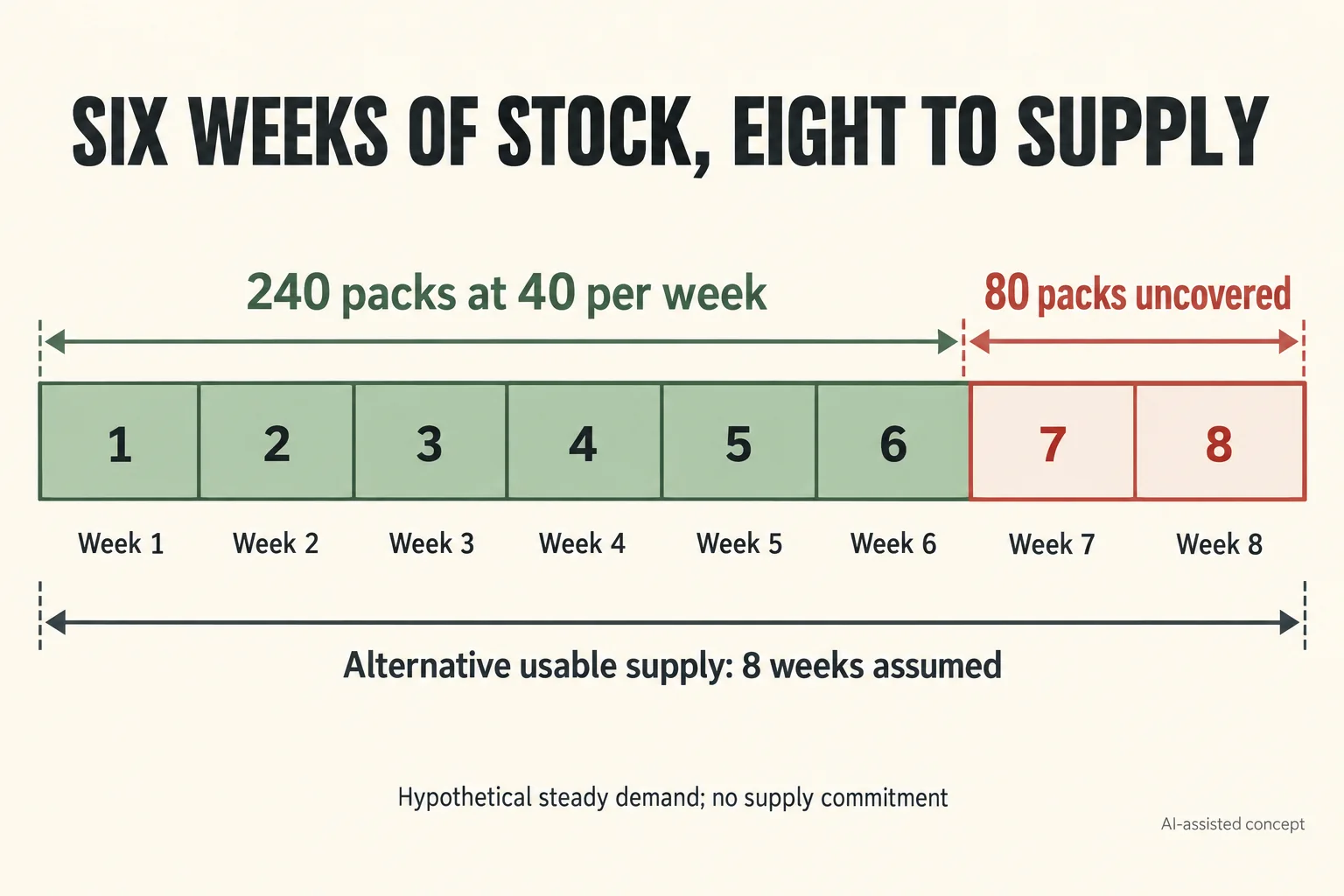
Assume usable stock is 240 packs and consumption is 40 each week. That supplies six weeks under a steady-demand assumption. Suppose an already qualified alternative requires an assumed eight weeks to become usable at the packing site.
Scroll horizontally if columns extend beyond the view.
| Planning field | Assumed result |
|---|---|
| Current stock coverage | 240 / 40 = 6 weeks |
| Alternative usable-arrival interval | 8 weeks |
| Uncovered interval | 2 weeks |
| Demand in that gap | 2 x 40 = 80 packs |
The gap is 80 packs. It remains open until a feasible response is established. Nothing in the arithmetic proves that an alternate stock format is suitable or that faster delivery is offered.
If qualification itself still needs three weeks, include it before supply timing unless the responsible parties confirm valid overlap. Omitting it can turn a contact list into a fictitious ready route.
Define the interruption response deliberately
An approved temporary presentation might cover some products but not others. State those limits and associated customer service terms. Don’t swap a protective component because its appearance is similar.
Demand also need not stay steady. Compare a known peak or a named high-demand case rather than assigning an unsupported stockout probability. A sudden gift campaign can consume the remaining coverage sooner.
Keeping two usable routes involves actual costs and maintenance of their references. The comparison should show preparation and stock exposure without assuming a supplier will reserve capacity indefinitely.
Retain the executable branch
The output should identify the trigger, approved alternate configuration, responsible contacts, confirmed scope and unresolved gap. A route whose required evidence or timing remains unknown stays a planning alternative. It should not support a customer dispatch promise.
Include qualification and a separate demand scenario
State exactly what the eight-week interval includes. A quoted production duration can exclude sample review, transport or receiving release. The coverage calculation needs the interval until approved material is usable at the actual packing location.
Scroll horizontally if columns extend beyond the view.
| Separate hypothetical scenario | Usable stock | Demand per week | Time to usable alternative | Uncovered demand |
|---|---|---|---|---|
| Original qualified-route model | 240 | 40 | 8 weeks | 80 packs |
| Three additional qualification weeks, sequential | 240 | 40 | 11 weeks | 200 packs |
| Higher demand, qualification already complete | 240 | 60 | 8 weeks | 240 packs |
For the second row, 11 × 40 − 240 = 200 packs. It assumes qualification and supply happen in sequence. For the third, 8 × 60 − 240 = 240 packs. It changes demand, not the source’s promised speed. These are separate invented cases, not forecasts or probabilities, and should not be combined silently.
Attach an owner to each proposed response. A faster route needs an actual offer and applicable approval; a temporary component needs its own complete permitted configuration; a changed customer commitment follows the brand’s actual service process. Leave the gap open when none of those conditions has been met.
The missing component decision guide handles an individual blocked order. This plan is earlier: it checks whether a named alternate route could cover a disruption before it is needed. Keep the qualification version, time basis and demand case together so a supplier contact cannot be mistaken for ready stock.
Download the backup packaging supplier plan record (.csv). It contains field definitions, clearly hypothetical examples and a blank actual-project row. Replace the invented entries; a blank field is unknown, not an approved result.
Send the specific open decision with the brief
Bring the current record, packaging configuration, actual evidence available and the unresolved question to Packrivo’s packaging inquiry. State who must answer and which next step remains on hold. Packrivo coordinates sourcing and project questions with independent suppliers; this record is not a manufacturing or fulfilment service commitment.
Sources and scope
Australian Government supports the stated general concepts within this scope: General inventory categories, reorder points and stocktake. Access checked 14 October 2026.
The worked scenario is original editorial analysis with assumed inputs, not a supplier offer, customer record or measured Packrivo result. Commercial feasibility and physical suitability remain project-specific.
What this changes in a packaging enquiry
A backup sourcing enquiry should identify the approved design, the uncovered demand interval and the date the alternative must become usable. Ask separately about the alternative supplier's sample, tooling and production steps. Neither existing stock coverage nor a hypothetical lead time establishes that a second supplier is qualified or ready.