
Packing equipment needs a payback model based on the work it can actually change. Identify eligible packs, supported marginal time or consumable differences, and all relevant purchase and running costs. Total store orders can overstate recovery if only a fraction use that operation.
Define the changed task
Name the proposed tool or device, component and operation. The assembly-resource map separates reusable equipment from recurring consumables, so a device purchase isn’t counted as another per-pack material.
Confirm technical suitability and the intended safe operation through the responsible maker and qualified users. A cost model does not approve equipment selection, guarding or modifications.
Twelve thousand eligible packs under assumed inputs
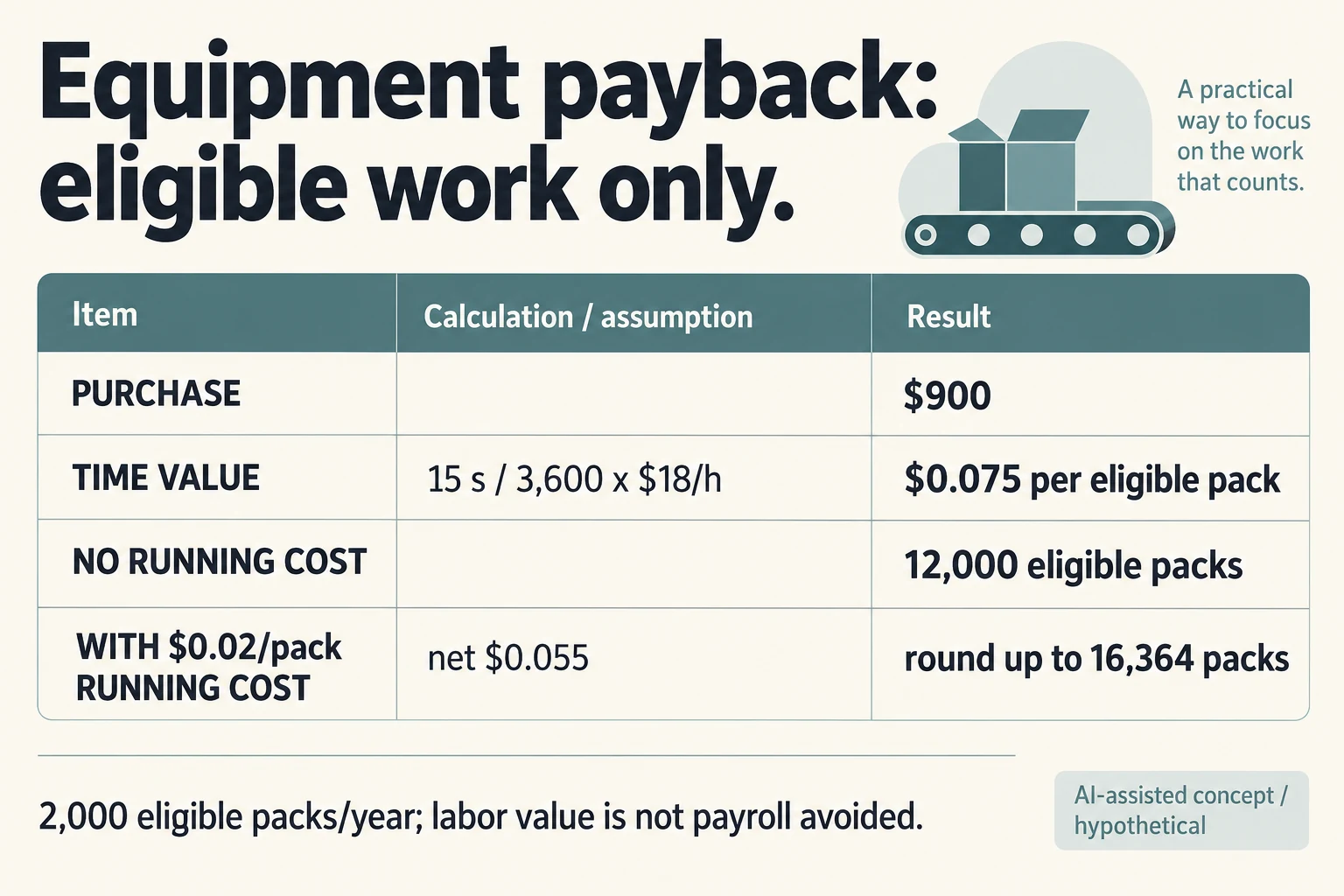
Suppose a fictional tool and setup cost $900. Assume a defined trial supports fifteen seconds less work per eligible pack, valued at an assumed $18 per hour. No actual timing or price is asserted.
Scroll horizontally if columns extend beyond the view.
| Calculation | Result |
|---|---|
| Assumed value per eligible pack | 15 / 3,600 x $18 = $0.075 |
| Uses to cover $900 before running costs | $900 / $0.075 = 12,000 |
| Eligible volume per year in scenario | 2,000 packs |
| Simple undiscounted use horizon | 12,000 / 2,000 = 6 years |
If a store ships 4,000 annual orders but only half use the task, the modeled horizon remains six years. Applying the saving to all 4,000 would halve the horizon without supporting work.
Distinguish labor value from cash avoided
Less time per pack may free capacity without reducing wages paid. State whether the model values released time or identifies an actual avoidable cash charge. The table uses an assumed time value; it does not promise that payroll falls by that amount.
Include maintenance, consumables, cleaning or setup differences when applicable. An assumed $0.02 running amount per pack reduces the modeled net difference to $0.055, moving the simple quantity crossing to about 16,364 eligible packs.
Repeat the scenario with a smaller supported time difference or shorter equipment-use horizon. This can show whether the purchase relies on continued volume or unchanged packaging that the business has not confirmed.
Retain feasibility beside the calculation
Request actual equipment scope and trial the complete operation with its transfers and replenishment. Keep the eligible workload definition in the calculation. The output is a bounded use-horizon comparison, not investment, accounting or financing advice and not a guaranteed labor saving.
Sources and scope
Australian Government supports the stated general concepts within this scope: Cash inflows/outflows and clear labeling of estimated figures. Access checked 14 October 2026.
The worked scenario is original editorial analysis with assumed inputs, not a supplier offer, customer record or measured Packrivo result. Commercial feasibility and physical suitability remain project-specific.
Test the payback against a smaller eligible-task difference
Keep the original $900 purchase, $18/hour time value and 2,000 eligible packs a year. A new hypothetical sensitivity reduces the modeled time difference from fifteen to ten seconds, while retaining the invented $0.02 running amount. No equipment or work trial supports these figures.
Scroll horizontally if columns extend beyond the view.
| Scenario scope | Exact object or route | Hypothetical input or output | Calculation or record boundary |
|---|---|---|---|
| Lower time assumption | TASK18_SENS | 10 seconds | New hypothetical sensitivity 10 seconds; same 900 and 18/hour |
| Time value | TASK18_SENS | 0.05 USD per eligible pack | 10/3600*18 |
| Running cost included | TASK18_SENS | 0.03 USD per eligible pack | .05-.02 |
| Whole pack crossing | TASK18_SENS | 30000 eligible packs | 900/.03 |
| Undiscounted | TASK18_SENS | 15 years | 30000/2000 |
At ten seconds, the modeled time value is $0.05 per eligible pack. Deducting $0.02 leaves $0.03, so $900 requires 30,000 eligible packs, or fifteen years at 2,000 a year. That arithmetic can reveal dependence on volume and configuration continuity; it cannot establish a fifteen-year equipment life.
The worksheet keeps maintenance, consumables, cleaning, changed setup, transfers and replenishment separate from the original lumped running assumption. Enter supported differences without adding the same cost twice. Until technical suitability and a credible use horizon are established, the financial result remains a scenario.
Download the packing equipment payback record (.csv). It covers the original scenarios and this added comparison. HYPOTHETICAL rows are invented planning examples. Actual quantity, value, configuration, method, owner, observation, condition, decision, evidence and dates are blank because no actual project record has been obtained. Copy a relevant row and replace its type with ACTUAL only when entering permitted project evidence; keep the example and actual record separate. ACTUAL_BLANK is an empty starting row. A blank is unknown, never approval.
The related Assembly Tools and Per-Pack Consumables Need Separate Planning Units guide concerns a separate requirement. Use this record for the specific comparison above rather than treating that guide as evidence of a completed result.
Upstream and downstream work need the same boundary in the shelf-ready work comparison. Keep the observation periods comparable using the packaging improvement baseline.
Source scope checked 16 October 2026: the original public references remain within their stated general guidance or manufacturer-example scope. The new numbers and task records are original hypothetical analysis, not observed supply, trials, inventory, prices or performance.
What this changes in a packaging enquiry
Before buying equipment, compare its eligible work with a supplier proposal that delivers the same packaging task completed. Confirm the actual materials, box construction and arrival state for both routes. The example payback does not establish equipment compatibility, staffing reduction or a supplier's ability to automate your design.
Discuss this packaging specification with Packrivo. We coordinate independent suppliers. MOQ: 500 pieces per product/design; illustrative quantities are not production offers. Confirm materials, samples, price and timing for your project.