

A price printed into the brand owner’s package graphics creates a different identification decision from a removable price ticket. Before embedding a price, consider how it will change, who controls it and what happens to stock bearing the earlier artwork. A sticker-removal test cannot answer those questions.
The GS1 GTIN Management Standard, release 1.1, defines “price on pack” in section 2.10. The definition covers brand-owner pre-pricing within package graphics and excludes a price on a removable ticket, sticker or hangtag.

Locate the price before deciding what changed
Record the actual carrier of the price. A price printed as part of a candle-carton design belongs in a different branch from a store-applied hangtag. A temporary ticket still needs suitable placement and removal conditions, but it is excluded from this particular GS1 definition.
Scroll horizontally if columns extend beyond the view.
| Price position | Main decision in this comparison |
|---|---|
| Brand-owner price within package graphics | Review section 2.10 and the affected trade-item hierarchy |
| Removable ticket, sticker or hangtag | Confirm store pricing and the actual attachment/removal arrangement |
| Price only on a shelf or store document | Confirm that channel’s actual information requirement |
These distinctions do not establish local price-display law. They also do not mean that every graphic change outside section 2.10 can retain its identifier. Consider all applicable GS1 change rules and stricter market requirements.
Trace a hypothetical price change through existing stock
Assume a brand has 400 unused cartons whose approved graphics include a selling price of $25. It proposes new graphics showing $28 for the same consumer gift. Those quantities and prices are invented.
Under section 2.10, adding, changing or removing a price marked directly on the product package requires a new GTIN. The standard describes a change at the consumer trade-item or base-unit level, with unique GTINs at each existing higher packaging level.
The identity decision and the 400-carton stock decision need separate answers. A new identifier does not remove the earlier printed price. Nor does a new sticker automatically make the earlier artwork commercially or legally acceptable.
Ask the responsible owners whether the old stock has any authorized remaining use, whether a correction is permitted and which records must distinguish the configurations. Keep unknown eligibility and any proposed rework visible until those decisions are made.
Compare permanent graphics with a variable-price route
A retailer-controlled removable ticket can leave a common branded carton unchanged while stores apply their agreed prices. That may suit a variable-price arrangement, provided the retailer accepts it and the ticket’s physical job has been reviewed.
The removable-label condition record covers time in place, hand removal, residue and surface appearance. It already includes a hypothetical gift-lid price sticker. Use that method for the attachment decision rather than treating this article as another adhesive test.
Compare the extra ticket, application work and information ownership with the direct-printed proposal. Neither route automatically costs less or avoids all identification reviews.
Resolve the promise and the identifier together
Give the artwork owner the approved pricing route and the barcode owner’s decision for the exact configuration. Show where the price sits, which party may change it and how old stock is distinguished during transition.
The official open standard was checked on 14 October 2026. Packrivo can organize the artwork and sourcing questions through a packaging project inquiry; it does not allocate identifiers, set retail prices or approve local pricing compliance through coordination.
Ask what remains underneath the removable price ticket
Compare four hypothetical artwork states. A blank base carrying a removable 28 ticket has no brand-printed price underneath. The same ticket over the original brand-printed 25 leaves that 25 in the underlying artwork. A new base printed 28 changes the brand’s direct pre-price; removing the direct pre-price is a different change even when no new number is printed.
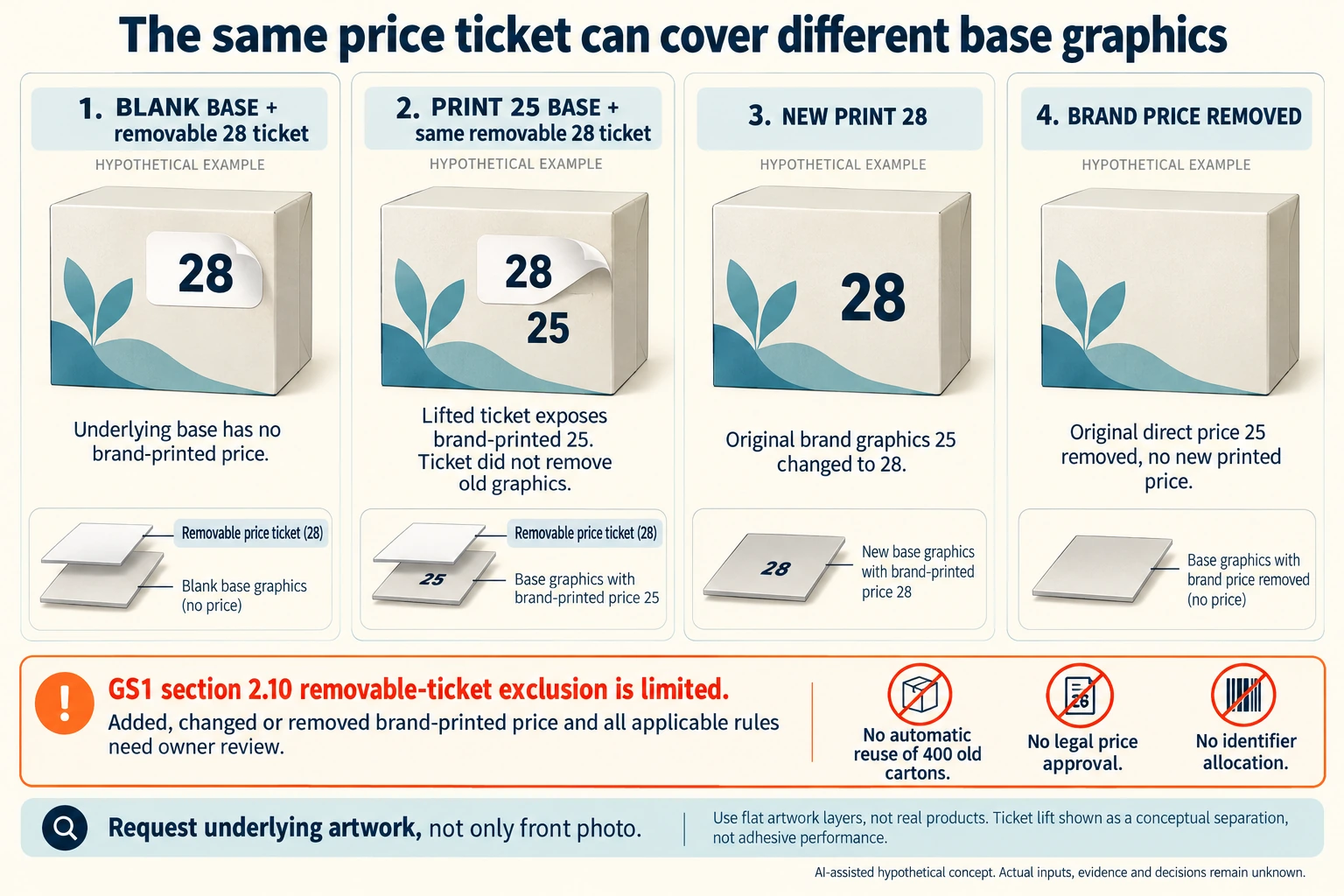
Scroll horizontally if columns extend beyond the view.
| Hypothetical scenario | Item or operation | Planning relationship | Assumed input or calculation |
|---|---|---|---|
| PRICE33 | UNDERLYING_OLD_PRICE | assumed input | 25 USD |
| PRICE33 | PROPOSED_PRICE | assumed input | 28 USD |
The same front photograph of a 28 ticket cannot distinguish the first two states. Request the underlying base artwork and the proposed complete configuration, not merely a photograph of the new ticket. Lifting a ticket in this concept is an explanation of layers, not evidence about adhesive removal, surface damage or an approved rework method.
GS1 section 2.10 distinguishes the stated removable-price-ticket exclusion from adding, changing or removing a brand-printed price; all other applicable rules still need review. The exclusion does not authorize using the original 400 cartons or establish a local price-display decision. Keep stock disposition, physical application, trade-item identity and approved commercial copy as separate open decisions.
Download the brand prepriced packaging removable ticket underlying artwork record (.csv). It includes the original table fields and scenarios alongside the added relationships. HYPOTHETICAL rows are editorial examples or required review scopes, not actual records. Actual quantity, configuration, component and file identities, materials, process, specification, copy, method, condition, observation, owner, decision, evidence and dates are blank. ACTUAL_BLANK is a separate empty starting row; enter permitted project evidence before using an actual record. A blank means unknown.
Use the Record Removal Conditions Before Asking for a Removable Label for its separate question. Use the Gift-Set Barcode Identity Follows the Sold Assortment for its separate question. Use the Retail Packaging Requirements for Existing Box Stock for its separate question.
Additional official reference: GS1 GTIN Management Standard, Release 1.1. Rule-specific public guidance supports an identity-owner review, not automatic artwork, stock or barcode approval.
Source scope checked 17 October 2026: GS1 GTIN Management Standard Release 1.1, ratified September 2023, section 2.10 addresses brand pre-pricing and its stated removable-ticket exclusion. All applicable rules and local requirements remain relevant. No GTIN allocation, stock-use approval or price-law conclusion was made. The added configurations and calculations are hypothetical, with actual evidence and decisions pending.
What this changes in a packaging enquiry
Before printing a price permanently on a package, compare that commitment with a separately applied price ticket under the actual trading partner's rules. Request the physical ticket size, application surface and artwork versions as separate specifications. Neither option automatically settles the GTIN or retailer-approval decision. A relevant configuration to compare is the Sheet labels; it is a concept reference, not confirmed suitability.
Discuss this packaging specification with Packrivo. We coordinate independent suppliers. MOQ: 500 pieces per product/design; illustrative quantities are not production offers. Confirm materials, samples, price and timing for your project.