

Plan retail demonstrators as a separate material-use route from unopened sale-ready gifts. Count the holders, boxes and other components required for initial setup, planned rotation and retirement. Otherwise, replacing handled display pieces can consume packaging the brand has already allocated to customer purchases.
In this guide
Start with the retailer’s permission. The store may allow one touch sample, an operated demonstrator or no exposed product at all. A packaging supplier cannot establish that policy by offering an open display.

Define the demonstrator’s lifecycle
A demonstration item may be unpacked at setup, moved for storage, replaced after a stated period and finally withdrawn. Its packaging demand depends on those actions. Some components may remain in the display; others may need a new identified version at each rotation.
State what is actually consumed and what remains for another approved use. Calling a box “reusable” does not establish its condition, hygiene or suitability after handling.
The customer-access packaging guide distinguishes demonstrators from saleable stock and separates seeing, touching and removing. This material plan starts after those permissions have been chosen.
Count one hypothetical eight-week program
Assume four shops each use two demonstrators. The brand plans one rotation after four weeks and, for this calculation, each new demonstrator uses a fresh presentation holder. Separately, it expects 400 sale-ready gifts across the shops. No actual store program or sales forecast supports these numbers.
Scroll horizontally if columns extend beyond the view.
| Material use | Calculation | Holder demand |
|---|---|---|
| Initial demonstrator setup | 4 shops × 2 pieces | 8 |
| One planned rotation | 4 shops × 2 replacement pieces | 8 |
| Demonstrator program total | Both setups | 16 |
| Sale-ready gifts | 400 gifts × 1 holder | 400 |
| Combined holder requirement | Separate use routes | 416 |
Sixteen demonstrator holders do not create sixteen additional customer sales. Equally, a purchase plan for 400 sale-ready holders cannot cover both routes unless the brand deliberately reduces another allocation or changes the material requirement.
If eight outer boxes are intended to remain through rotation, identify that retained use separately. The assumption needs a physical and operational review before those boxes are removed from the replacement demand.
Keep retirement from becoming an informal sale
Give handled demonstrators and their components a clear status when they leave the fixture. The store’s responsible owner decides whether they can be retained, reviewed for another purpose or excluded. Do not quietly place an old display piece into untouched sale stock because its box still closes.
Record any replacement stock held at the shop separately from demonstrators currently in use. A spare holder on hand has not yet been consumed, while a retired holder may still exist physically without being available for a new setup.
The official inventory-management guidance supports distinguishing stock by type and location and recording sales and returns. This lifecycle model is an original planning application, not a hygiene or resale assessment. Public guidance was checked on 14 October 2026.
Confirm the supply route before launch
Send the permitted demonstration format, shop count, setup quantity, proposed rotation and component-retention assumptions together. Ask which materials can be supplied and identified independently, rather than assuming every replacement requires a complete gift pack.
Packrivo can coordinate those material and supplier questions through a packaging project inquiry. Actual maintenance frequency, retailer permissions and replacement availability remain unconfirmed until the responsible parties establish them.
Assign holder consumption to a route, not to sales
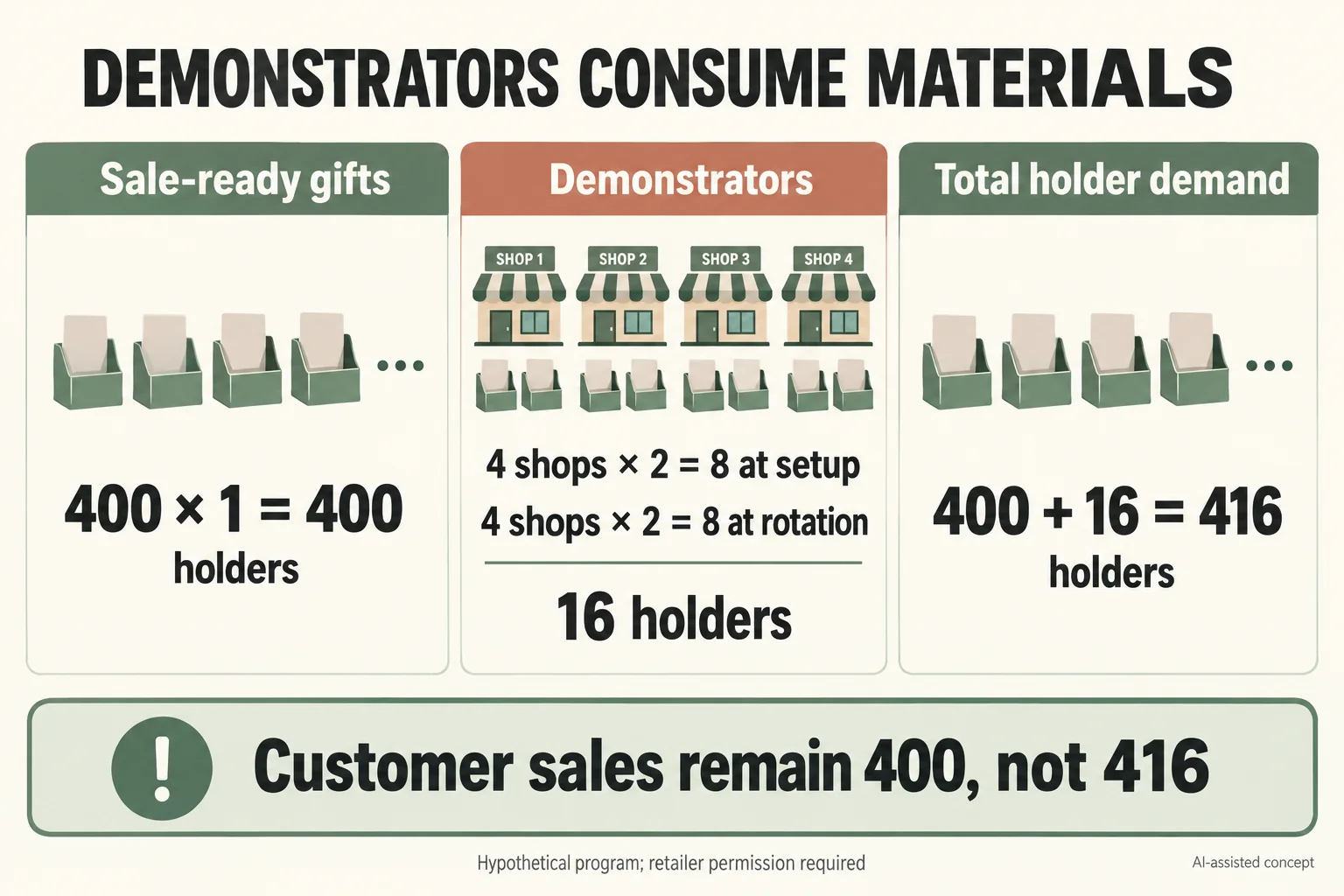
Keep the sale-ready demand and demonstration material in separate rows even when the same holder design is proposed. A demonstrator is a use of material under the store’s permission; it is not an additional customer transaction.
Scroll horizontally if columns extend beyond the view.
| Fictional material allocation | Holder pieces | Customer sales represented | Condition or permission |
|---|---|---|---|
| Sale-ready gifts | 400 | 400 | Untouched sale-ready configuration |
| First demonstration setup | 8 | 0 | Four shops × two permitted demonstrators |
| Planned demonstration rotation | 8 | 0 | Fresh holder per replacement assumed |
| Total | 416 | 400 | No other reserve allowance included |
If 400 holders were purchased and all 16 demonstration uses were taken from them, only 384 holder pieces would remain for the 400 intended sale-ready gifts in this simplified model. That is a sixteen-holder material gap, not a reduction in customer demand. Identify the response rather than silently changing the sales count.
The 416 requirement is consumption planning. It is not a confirmed purchasable custom quantity. Packrivo’s starting basis is 500 pieces per product/design, with the actual component grouping and terms confirmed for the project. If a hypothetical order were 500 identical holders and all 416 planned uses occurred, 84 would remain before other reservations or losses. Decide their allocation explicitly; do not call them additional sales.
The retail customer access guide handles whether people may touch or remove a display item. This plan starts after that permission and counts initial setup, rotation and retained pieces. The retailer requirements review helps identify new channel requirements; it does not authorise reusing handled demonstrators as untouched stock.
Download the retail demonstrator packaging record (.csv). It contains field definitions, clearly hypothetical examples and a blank actual-project row. Replace the invented entries; a blank field is unknown, not an approved result.
Send the specific open decision with the brief
Bring the current record, packaging configuration, actual evidence available and the unresolved question to Packrivo’s packaging inquiry. State who must answer and which next step remains on hold. Packrivo coordinates sourcing and project questions with independent suppliers; this record is not a manufacturing or fulfilment service commitment.
What this changes in a packaging enquiry
Add demonstrator materials as separate purchasing lines where they are genuinely needed: display holders, replacement cards or presentation boxes. Keep these quantities distinct from sale-ready gifts and obtain the intended retail handling arrangement. Demonstrator consumption is not customer demand or evidence of additional product sales. A relevant configuration to compare is the Counter Display Cartons: Plan Setup, Refilling and Access; it is a concept reference, not confirmed suitability.