

Check a packaging demand forecast against the periods it was meant to predict before using it to fix purchase quantities. Matching total demand over several weeks can hide large misses within each week. Keep the original forecast, actual quantity and comparison period together so the planning input can be evaluated honestly.
Start with the same demand unit throughout. Finished gifts, individual products and packaging components are different counts. Use the approved component requirements to translate the relevant gift demand; evaluate that conversion separately from the demand forecast.

Keep the forecast frozen for the comparison
Save the estimate that existed before the period, including its date and scope. Editing earlier forecasts to match later results would remove the evidence needed to assess the planning method.
NIST’s forecasting explanation defines period forecast error as actual quantity minus forecast quantity. Using that convention, a positive error means demand exceeded the estimate; a negative error means the estimate exceeded demand.
State the convention because other records may use the opposite sign. Keep exceptional events visible rather than silently removing them after seeing whether they make the forecast look better.
Equal totals can conceal four separate misses
The following four-week example is hypothetical. Each frozen forecast is 100 gift units, while actual demand alternates between eighty and 120. No real demand history or forecasting model supports the figures.
Scroll horizontally if columns extend beyond the view.
| Week | Frozen forecast | Assumed actual demand | Error: actual minus forecast | Squared error |
|---|---|---|---|---|
| 1 | 100 | 80 | -20 | 400 |
| 2 | 100 | 120 | +20 | 400 |
| 3 | 100 | 80 | -20 | 400 |
| 4 | 100 | 120 | +20 | 400 |
| Total | 400 | 400 | 0 | 1,600 |
The average signed error is zero because positive and negative values cancel. Yet every week differs by twenty units. A purchase or dispatch arrangement relying on each weekly estimate can encounter both excess stock and insufficient stock even though the four-week total agrees.
Mean squared error is 1,600 divided by four, or 400 units squared. NIST’s squared-error comparison explains this arithmetic summary. The value is not a spare-stock quantity, a probability or a statement that twenty extra boxes will solve future shortages.
Investigate the input the buying decision actually uses
If purchasing covers a longer period, compare the demand over that same relevant horizon as well as its timing within the horizon. Confirm the starting stock and actual receipt schedule before attributing a shortage solely to forecast error.
A launch, promotion, changed product mix or different service uptake can alter the demand question. Keep its context when deciding whether earlier periods are comparable. Four illustrative weeks cannot establish a stable future pattern.
The dispatch-size planning method uses order configurations and their frequencies as inputs. This forecast check examines the reliability of the quantity input before the brand commits to that packaging range or stock plan.
Return an input review rather than a guaranteed forecast
Record the frozen forecast, actual periods, signed errors and unresolved changes in demand context. The next decision might be to revise the planning assumptions or obtain a more appropriate forecasting review. No particular method or buffer follows automatically from the example.
Packrivo can coordinate component and quantity questions through a packaging project inquiry. NIST’s public pages were checked on 15 October 2026. No model has been fitted and no future demand or confidence level is claimed.
Equal error scores can hide different cumulative timing pressure
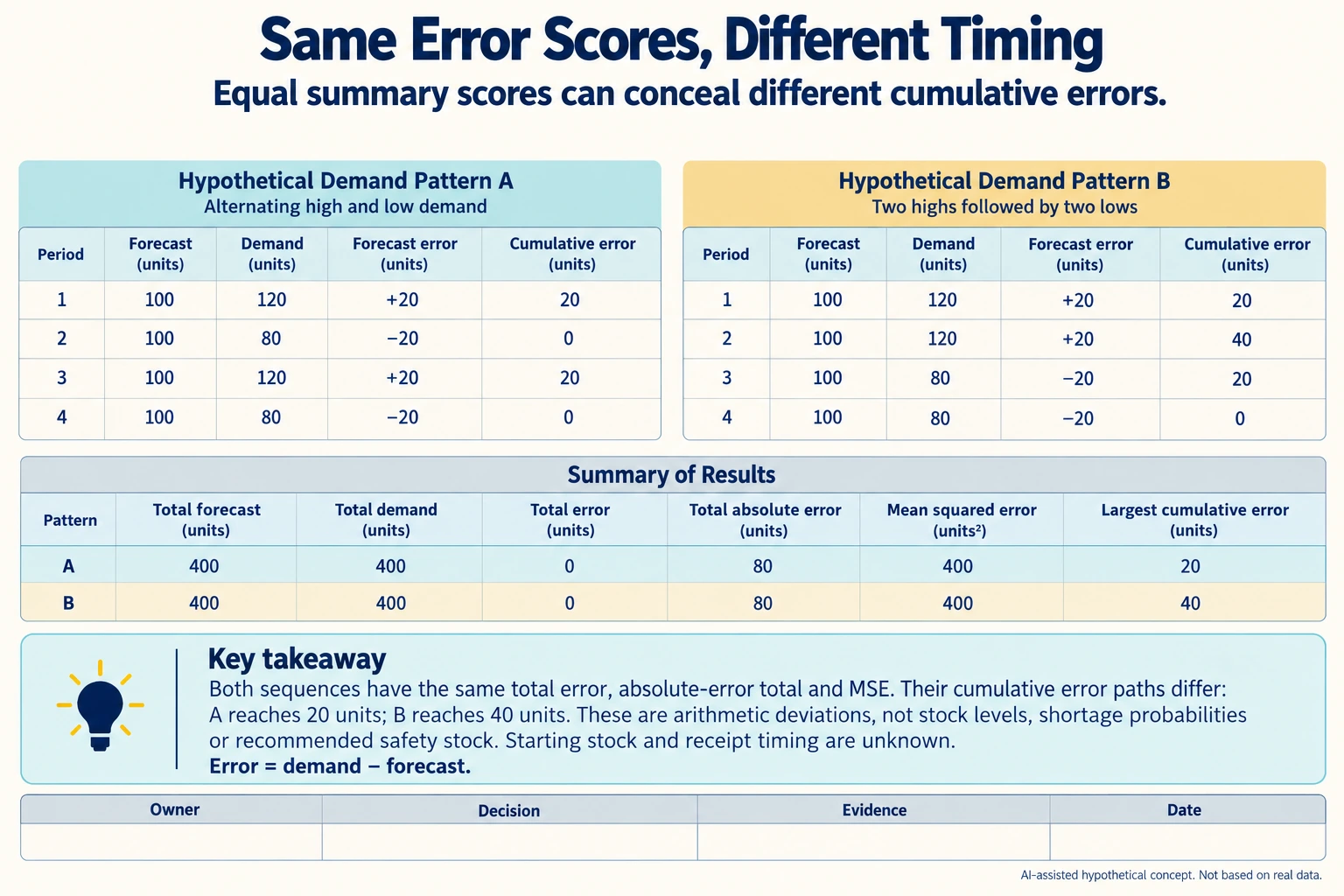
Keep four frozen forecasts of one hundred units each. New sequence A has hypothetical demand 120, 80, 120, 80; sequence B has 120, 120, 80, 80. Under actual-minus-forecast, A’s errors are +20, −20, +20, −20 and B’s are +20, +20, −20, −20.
Scroll horizontally if columns extend beyond the view.
| Hypothetical configuration | Named object | Relationship | Input or next scope |
|---|---|---|---|
| SEQ_A | CUMULATIVE_ERROR | calculated from | SEQ_A_P1_E; 20 gift units |
| SEQ_A | CUMULATIVE_ERROR | calculated from | SEQ_A_P1_CUM+SEQ_A_P2_E; 0 gift units |
| SEQ_A | CUMULATIVE_ERROR | calculated from | SEQ_A_P2_CUM+SEQ_A_P3_E; 20 gift units |
| SEQ_A | CUMULATIVE_ERROR | calculated from | SEQ_A_P3_CUM+SEQ_A_P4_E; 0 gift units |
| SEQ_B | CUMULATIVE_ERROR | calculated from | SEQ_B_P1_E; 20 gift units |
| SEQ_B | CUMULATIVE_ERROR | calculated from | SEQ_B_P1_CUM+SEQ_B_P2_E; 40 gift units |
| SEQ_B | CUMULATIVE_ERROR | calculated from | SEQ_B_P2_CUM+SEQ_B_P3_E; 20 gift units |
| SEQ_B | CUMULATIVE_ERROR | calculated from | SEQ_B_P3_CUM+SEQ_B_P4_E; 0 gift units |
| SEQ_A | MEAN_SQUARED_ERROR | calculated from | SEQ_A_SSE/SEQ_A_PERIODS; 400 gift units squared |
| SEQ_B | MEAN_SQUARED_ERROR | calculated from | SEQ_B_SSE/SEQ_B_PERIODS; 400 gift units squared |
| SEQ_A | LARGEST_CUMULATIVE_ERROR | calculated from | max(SEQ_A_P1_CUM,SEQ_A_P2_CUM,SEQ_A_P3_CUM,SEQ_A_P4_CUM); 20 gift units |
| SEQ_B | LARGEST_CUMULATIVE_ERROR | calculated from | max(SEQ_B_P1_CUM,SEQ_B_P2_CUM,SEQ_B_P3_CUM,SEQ_B_P4_CUM); 40 gift units |
Both have total error zero, absolute-error total eighty units and MSE four hundred units squared. But cumulative error after each period is 20, 0, 20, 0 for A and 20, 40, 20, 0 for B. The same summary scores conceal a different concentration of early demand above the forecasts.
These cumulative deviations are not simulated stock levels, lost sales or recommended reserves. Starting stock, receipt timing, allocation and service requirements have not been supplied. A maximum cumulative deviation of forty in this four-period exercise does not prescribe forty spare boxes.
The buyer can therefore request the period sequence and relevant purchasing horizon alongside the error score before fixing a quantity. NIST supports the error convention and squared-error arithmetic, not a universal inventory buffer. Neither four-week construction establishes a future distribution or a fitted forecast.
Download the packaging forecast cumulative error timing same mse record (.csv). It includes the original table fields and scenarios alongside the added relationships. HYPOTHETICAL rows are editorial examples or required review scopes, not actual records. Actual quantity, configuration, component and file identities, materials, process, specification, copy, method, condition, observation, owner, decision, evidence and dates are blank. ACTUAL_BLANK is a separate empty starting row; enter permitted project evidence before using an actual record. A blank means unknown.
Use the Shipping Box Sizes for Small Business: Plan the Range for its separate question. Use the Packaging Reorder Point During Replenishment for its separate question.
Source scope checked 17 October 2026: NIST Handbook sections 6.4.3.2 and 6.4.2 were actually read; no separate reliable page publication date was shown. Error is Actual−Forecast here. MSE has squared units; cumulative deviation and RMSE are not approved stock buffers. The added configurations and calculations are hypothetical, with actual evidence and decisions pending.
What this changes in a packaging enquiry
Use the forecast-error check to decide the purchasing scenario and the consequences of excess or missing packaging. Then ask for actual order multiples, sample steps and confirmed lead times. Historical fit to a forecast cannot establish future supplier replenishment or justify presenting an assumed reserve as a standard requirement.
Discuss this packaging specification with Packrivo. We coordinate independent suppliers. MOQ: 500 pieces per product/design; illustrative quantities are not production offers. Confirm materials, samples, price and timing for your project.