

Assign packaging storage locations by checking their physical eligibility first, then comparing the retrieval work they create. A nearby shelf is useful only if it suits the material, handling and access requirements. Keep retrieval quantities fixed while comparing locations so the result reflects slotting rather than a different refill method.
This is a bulk-storage decision. Working stock at the packing bench and the lot size used to refill it can be evaluated separately once the storage route is defined.

Exclude unsuitable locations before ranking distance
Identify the delivered bundle or carton, dimensions, mass, storage instructions and lot identity. Assess the actual storage arrangement and equipment with the responsible warehouse owner. A short walking route cannot compensate for an unsuitable shelf or obstructed passage.
OSHA’s warehouse handling guidance discusses clear routes, rack capacity and stable storage arrangements in its US context. It does not approve a particular location or provide universal limits for a gift brand’s materials.
Keep an eligibility record for each candidate location. A place can be suitable for care-card cartons while unsuitable for a different bundle of boxes. Do not treat all empty packaging as one interchangeable storage load.
Compare fixed retrieval frequencies
The following example assumes two locations are already eligible for the identified materials. Box A requires twenty retrieval trips per day, while Card B requires five. The near route is ten meters per round trip and the far route is thirty. All numbers are hypothetical.
Scroll horizontally if columns extend beyond the view.
| Location assignment | Box A route distance | Card B route distance | Combined daily route distance |
|---|---|---|---|
| A near, B far | 20 × 10 = 200 m | 5 × 30 = 150 m | 350 m |
| A far, B near | 20 × 30 = 600 m | 5 × 10 = 50 m | 650 m |
The first assignment reduces modeled route distance by 300 meters. It establishes no labor saving, safe carrying method or shorter elapsed time. Congestion, loading, equipment and other tasks remain outside this simple calculation.
Keep the retrieval batch sizes and frequencies unchanged between these rows. If one option also changes the refill lot, calculate that as another scenario so its effect remains visible.
Include access and identity in the slotting decision
A frequent line might share a route with other materials. Combined collection could change actual trips, while blocked access or a lengthy identification task could change the practical operation. Retain those facts instead of applying the distance table mechanically.
The incoming lot-reference method preserves material identity when items leave their original cartons or move for review. Carry the relevant identity into storage and retrieval so a convenient new location does not mix component versions.
Location labels should correspond to the material actually available there. Held or obsolete components can exist nearby without being permitted for the current packing instruction.
Return an eligible-location comparison
Give the warehouse owner each candidate’s eligibility, defined round-trip route, retrieval frequency and unresolved constraints. Use actual observations to replace the invented inputs before deciding the physical layout.
The shipping-box range comparison discusses the cost and stock work created by extra sizes. Location assignment adds a different decision after the material range is established.
Packrivo can coordinate delivered-state and material questions through a packaging project inquiry. Public guidance was checked on 14 October 2026. No site layout, handling approval or measured improvement is supplied here.
Count the existing route once before ranking storage positions
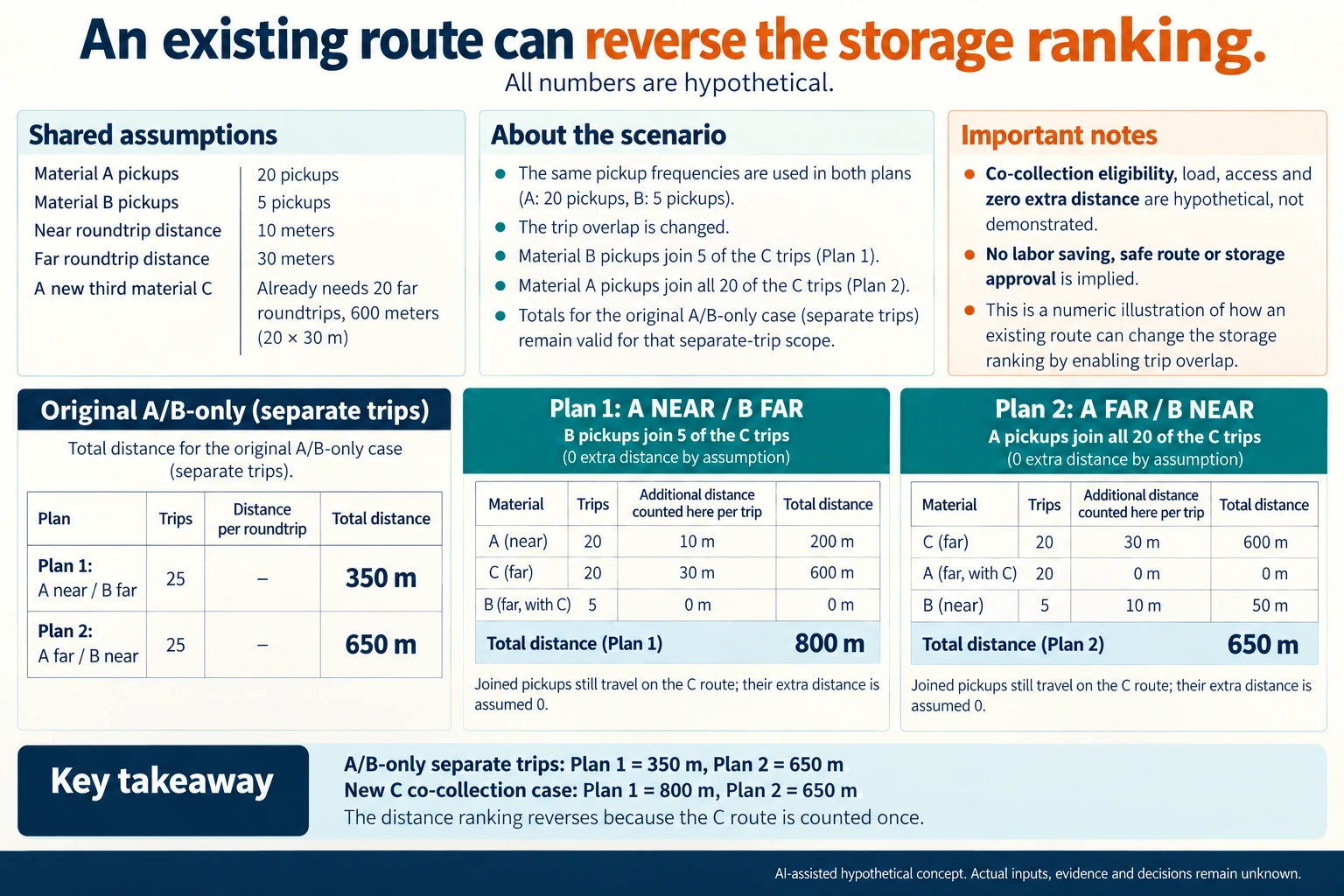
The original 350-versus-650-metre comparison counts separate retrievals for A and B. Add a different operating condition for this new example: material C already requires twenty far round trips of thirty metres, or 600 metres. Assume eligible co-collection adds no distance. A still needs twenty pickups and B five, with unchanged pickup quantities. These are hypothetical conditions, not a demonstrated handling route.
Scroll horizontally if columns extend beyond the view.
| Hypothetical scenario | Item or operation | Planning relationship | Assumed input or calculation |
|---|---|---|---|
| COCOLLECT35 | C_ROUTE_DISTANCE | calculated from | C_TRIPS*O_FAR; 600 m |
| A_NEAR_B_FAR35 | A_SEPARATE_ROUNDTRIPS | calculated from | A_PICKUPS*SEPARATE_RATIO; 20 roundtrips |
| A_FAR_B_NEAR35 | B_SEPARATE_ROUNDTRIPS | calculated from | B_PICKUPS*SEPARATE_RATIO; 5 roundtrips |
| A_NEAR_B_FAR35 | SEPARATE_A | calculated from | P1_A_TRIPS*O_NEAR; 200 m |
| A_NEAR_B_FAR35 | B_JOIN_ADDITIONAL | calculated from | B_PICKUPS*JOIN_EXTRA; 0 m |
| A_NEAR_B_FAR35 | TOTAL_DISTANCE | calculated from | C_DISTANCE+P1_A_DISTANCE+P1_B_EXTRA; 800 m |
| A_FAR_B_NEAR35 | A_JOIN_ADDITIONAL | calculated from | A_PICKUPS*JOIN_EXTRA; 0 m |
| A_FAR_B_NEAR35 | SEPARATE_B | calculated from | P2_B_TRIPS*O_NEAR; 50 m |
| A_FAR_B_NEAR35 | TOTAL_DISTANCE | calculated from | C_DISTANCE+P2_A_EXTRA+P2_B_DISTANCE; 650 m |
With A near and B far, A adds twenty ten-metre trips, or 200 metres. B joins five of C’s trips. Total route distance is 600 + 200 + 0 = 800 metres. With A far and B near, all twenty A pickups join C’s existing trips while B adds five near trips. The result is 600 + 0 + 50 = 650 metres. The distance ranking reverses because the operation now includes a shared route.
The CSV names all twenty C-trip references and maps joined A or B pickups to them. A joined pickup still travels; zero means no additional distance under this assumption, not a zero-length physical journey. Do not charge the same C route again for its co-collected material.
Before using a combined plan, confirm the actual material identities, access, load, equipment and route. A helper refill comparison asks who performs the work; this storage comparison asks which already required travel can be shared. Neither a shorter distance nor a nearby position establishes labour, elapsed-time or safety improvement.
Download the packaging storage shared retrieval trip comparison record (.csv). It includes the original table fields and scenarios alongside the added relationships. HYPOTHETICAL rows are editorial examples or required review scopes, not actual records. Actual quantity, configuration, component and file identities, materials, process, specification, copy, method, condition, observation, owner, decision, evidence and dates are blank. ACTUAL_BLANK is a separate empty starting row; enter permitted project evidence before using an actual record. A blank means unknown.
Use the Shipping Box Sizes for Small Business: Plan the Range for its separate question. Use the Keep Incoming Lot References With the Items Reviewed for its separate question. Use the Refilling a Packing Bench Trades Fewer Trips for More Working Stock for its separate question.
Source scope checked 17 October 2026: OSHA’s public warehouse guidance addresses US-context handling/access hazards, not this shared-route formula, storage approval or a labour saving. Co-collection and zero additional distance are explicit hypothetical conditions. The added configurations and calculations are hypothetical, with actual evidence and decisions pending.
What this changes in a packaging enquiry
Give the purchasing plan a confirmed delivery unit and storage-eligible component state before using pick frequency to allocate space. Ask suppliers for units per carton and supplied-state dimensions. Shorter retrieval routes cannot justify storing packaging in conditions unsuitable for its actual material or supplier instructions.
Discuss this packaging specification with Packrivo. We coordinate independent suppliers. MOQ: 500 pieces per product/design; illustrative quantities are not production offers. Confirm materials, samples, price and timing for your project.